Thank you for visiting SNEWPapers!
Sign up free
Gazette Of The United States
New York, New York County, New York
What is this article about?
In a 1780 letter from Amsterdam, John Adams refutes Dutch claims of widespread American hatred toward Britain and significant Tory support, emphasizing aspirations for liberty, free trade, and minimal Loyalist numbers based on British generals' accounts of failed recruitment efforts.
Merged-components note: This is a continuation of John Adams' letter written in Holland, published as correspondence; merging the two parts for coherence as a single logical unit.
Clippings
1 of 2
OCR Quality
Full Text
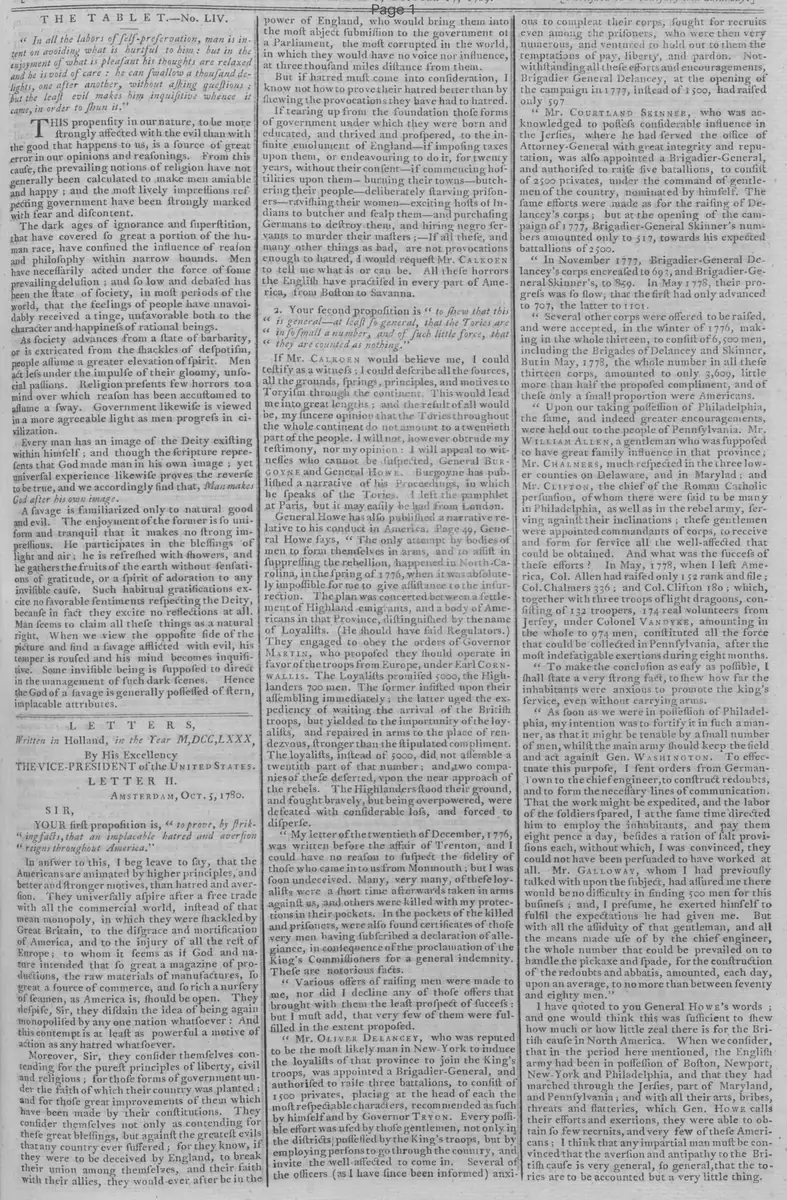
Written in Holland, in the Year MDCCLXXX
By His Excellency
THE VICE-PRESIDENT of the UNITED STATES.
LETTER II.
Amsterdam, Oct. 5, 1780.
SIR,
YOUR first proposition is, "to prove, by striking facts, that an implacable hatred and aversion reigns throughout America."
In answer to this, I beg leave to say, that the Americans are animated by higher principles, and better and stronger motives, than hatred and aversion. They universally aspire after a free trade with all the commercial world, instead of that mean monopoly, in which they were shackled by Great Britain, to the disgrace and mortification of America, and to the injury of all the rest of Europe; to whom it seems as if God and nature intended that so great a magazine of productions, the raw materials of manufactures, so great a source of commerce, and so rich a nursery of seamen, as America is, should be open. They despise, Sir, they disdain the idea of being again monopolised by any one nation whatsoever: And this contempt is at least as powerful a motive of action as any hatred whatsoever.
Moreover, Sir, they consider themselves contending for the purest principles of liberty, civil and religious; for those forms of government under the faith of which their country was planted; and for those great improvements of them which have been made by their constitutions. They consider themselves not only as contending for these great blessings, but against the greatest evils that any country ever suffered; for they know, if they were to be deceived by England, to break their union among themselves, and their faith with their allies, they would ever after be in the power of England, who would bring them into the most abject submission to the government of a Parliament, the most corrupted in the world, in which they would have no voice nor influence, at three thousand miles distance from them.
But if hatred must come into consideration, I know not how to prove their hatred better than by showing the provocations they have had to hatred. If tearing up from the foundation those forms of government under which they were born and educated, and thrived and prospered, to the infinite emolument of England—if imposing taxes upon them, or endeavouring to do it, for twenty years, without their consent—if commencing hostilities upon them—burning their towns—butchering their people—deliberately starving prisoners—ravishing their women—exciting hosts of Indians to butcher and scalp them—and purchasing Germans to destroy them, and hiring negro servants to murder their masters;—If all these, and many other things as bad, are not provocations enough to hatred, I would request Mr. Kalkoen to tell me what is or can be. All these horrors the English have practised in every part of America, from Boston to Savanna.
2. Your second proposition is "to show that this is general at least so general, that the Tories are in so small a number, and of such little force, that they are counted as nothing."
If Mr. Kalkoen would believe me, I could testify as a witness; I could describe all the sources, all the grounds, springs, principles, and motives to Toryism through the continent. This would lead me into great lengths; and the result of all would be, my sincere opinion that the Tories throughout the whole continent do not amount to a twentieth part of the people. I will not, however obtrude my testimony, nor my opinion: I will appeal to witnesses who cannot be suspected, General Burgoyne and General Howe. Burgoyne has published a narrative of his Proceedings, in which he speaks of the Tories. I left the pamphlet at Paris, but it may easily be had from London.
General Howe has also published a narrative relative to his conduct in America. Page 49, General Howe says, "The only attempt by bodies of men to form themselves in arms, and to assist in suppressing the rebellion, happened in North-Carolina, in the spring of 1776, when it was absolutely impossible for me to give assistance to the insurrection. The plan was concerted between a settlement of Highland emigrants, and a body of Americans in that Province, distinguished by the name of Loyalists. (He should have said Regulators.) They engaged to obey the orders of Governor Martin, who proposed they should operate in favor of the troops from Europe, under Earl Cornwallis. The Loyalists promised 5000, the Highlanders 700 men. The former insisted upon their assembling immediately; the latter urged the expediency of waiting the arrival of the British troops, but yielded to the importunity of the loyalists, and repaired in arms to the place of rendezvous, stronger than the stipulated compliment. The loyalists, instead of 5000, did not assemble a twentieth part of that number; and two companies of these deserted, upon the near approach of the rebels. The Highlanders stood their ground, and fought bravely, but being overpowered, were defeated with considerable loss, and forced to disperse."
"My letter of the twentieth of December, 1776, was written before the affair of Trenton, and I could have no reason to suspect the fidelity of those who came in to us from Monmouth; but I was soon undeceived. Many, very many, of these loyalists were a short time afterwards taken in arms against us, and others were killed with my protections in their pockets. In the pockets of the killed and prisoners, were also found certificates of those very men having subscribed a declaration of allegiance, in consequence of the proclamation of the King's Commissioners for a general indemnity. These are notorious facts."
"Various offers of raising men were made to me, nor did I decline any of those offers that brought with them the least prospect of success: but I must add, that very few of them were fulfilled in the extent proposed."
"Mr. Oliver Delancey, who was reputed to be the most likely man in New-York to induce the loyalists of that province to join the King's troops, was appointed a Brigadier-General, and authorised to raise three battalions, to consist of 1500 privates, placing at the head of each the most respectable characters, recommended as such by himself and by Governor Tryon. Every possible effort was used by those gentlemen, not only in the districts possessed by the King's troops, but by employing persons to go through the country, and invite the well-affected to come in. Several of the officers (as I have since been informed) anxious to complete their corps, sought for recruits even among the prisoners, who were then very numerous, and ventured to hold out to them the temptations of pay, liberty, and pardon. Notwithstanding all these efforts and encouragements, Brigadier General Delancey, at the opening of the campaign in 1777, instead of 1500, had raised only 597."
"Mr. Courtland Skinner, who was acknowledged to possess considerable influence in the Jerseys, where he had served the office of Attorney-General with great integrity and reputation, was also appointed a Brigadier-General, and authorised to raise five battalions, to consist of 2500 privates, under the command of gentlemen of the country, nominated by himself. The same efforts were made as for the raising of Delancey's corps; but at the opening of the campaign of 1777, Brigadier-General Skinner's numbers amounted only to 517, towards his expected battalions of 2500."
"In November 1777, Brigadier-General Delancey's corps increased to 693, and Brigadier-General Skinner's, to 859. In May 1778, their progress was so slow, that the first had only advanced to 707, the latter to 1101."
"Several other corps were offered to be raised, and were accepted, in the winter of 1776, making in the whole thirteen, to consist of 6500 men, including the Brigades of Delancey and Skinner. But in May, 1778, the whole number in all these thirteen corps, amounted to only 3609, little more than half the proposed compliment, and of these only a small proportion were Americans."
"Upon our taking possession of Philadelphia, the same, and indeed greater encouragements, were held out to the people of Pennsylvania. Mr. William Allen, a gentleman who was supposed to have great family influence in that province; Mr. Chalmers, much respected in the lower counties on Delaware, and in Maryland; and Mr. Clifton, the chief of the Roman Catholic persuasion, of whom there were said to be many in Philadelphia, as well as in the rebel army, serving against their inclinations; these gentlemen were appointed commandants of corps, to receive and form for service all the well-affected that could be obtained. And what was the success of these efforts? In May, 1778, when I left America, Col. Allen had raised only 152 rank and file; Col. Chalmers 336; and Col. Clifton 180; which, together with three troops of light dragoons, consisting of 132 troopers, 174 real volunteers from Jersey, under Colonel Vandyke, amounting in the whole to 974 men, constituted all the force that could be collected in Pennsylvania, after the most indefatigable exertions during eight months."
"To make the conclusion as easy as possible, I shall state a very strong fact, to show how far the inhabitants were anxious to promote the king's service, even without carrying arms."
"As soon as we were in possession of Philadelphia, my intention was to fortify it in such a manner, as that it might be tenable by small number of men, whilst the main army should keep the field and act against Gen. Washington. To effectuate this purpose, I sent orders from Germantown to the chief engineer, to construct redoubts, and to form the necessary lines of communication. That the work might be expedited, and the labor of the soldiers spared, I at the same time directed him to employ the inhabitants, and pay them eight pence a day, besides a ration of salt provisions each, without which, I was convinced, they could not have been persuaded to have worked at all. Mr. Galloway, whom I had previously talked with upon the subject, had assured me there would be no difficulty in finding 500 men for this business; and, I presume, he exerted himself to fulfil the expectations he had given me. But with all the assiduity of that gentleman, and all the means made use of by the chief engineer, the whole number that could be prevailed on to handle the pickaxe and spade, for the construction of the redoubts and abbatis, amounted, each day, upon an average, to no more than between seventy and eighty men."
I have quoted to you General Howe's words; and one would think this was sufficient to show how much or how little zeal there is for the British cause in North America. When we consider, that in the period here mentioned, the English army had been in possession of Boston, Newport, New-York and Philadelphia, and that they had marched through the Jerseys, part of Maryland, and Pennsylvania; and with all their arts, bribes, threats and flatteries, which Gen. Howe calls their efforts and exertions, they were able to obtain so few recruits, and very few of these Americans; I think that any impartial man must be convinced that the aversion and antipathy to the British cause is very general, so general, that the Tories are to be accounted but a very little thing.
The addresses which they have obtained to the
King and his Generals, when their army was in
Boston, Newport, New York, Philadelphia, Sa-
vannah and Charleston, show the same thing. It
is very well known, that every art of flattery
and of terror, was always used to obtain subscri-
bers to these addresses. Yet the miserable num-
bers that they have obtained, and the still more
despicable character of most of these small num-
bers, show that the British cause is held in very
low esteem. Even in Charleston, the capital of
a Province, which contains two hundred thou-
sand whites, they were able to obtain only two hun-
dred and ten subscribers, and among these there
is not one name that I ever remember to have
heard before.
I am sorry I have not Burgoyne's narrative;
which shows, in the same point of light, the re-
sources the English are likely to find in the tories,
to be nothing more than a sure means of getting
rid of a great number of their guineas.
I have the honor to be, Sir,
Your humble servant,
JOHN ADAMS.
To learn the present state of America, it is suf-
ficient to read the public papers. The present
state of Great Britain and its dependencies may
be learned the same way. The omnipotence of
the British Parliament, and the omnipotence of the
British navy, are like to go the same way.
MR. GALKOEN.
What sub-type of article is it?
What themes does it cover?
What keywords are associated?
What entities or persons were involved?
Letter to Editor Details
Author
John Adams
Recipient
Mr. Kalkoen
Main Argument
americans are motivated by principles of liberty and free trade rather than mere hatred, and tory support is negligible, as demonstrated by british generals' reports of failed loyalist recruitment efforts despite extensive inducements.
Notable Details