Thank you for visiting SNEWPapers!
Sign up free
Literary
November 7, 1886
The Indianapolis Journal
Indianapolis, Marion County, Indiana
What is this article about?
In chapters XVI-XVIII of 'Fortunes of Philippa Fairfax,' Philippa faces her lover Wilfred after he's warned she's an adventuress sent by her father to ensnare him for money. She admits partial truth but affirms her genuine love, yet he rejects her. Devastated, she leaves Brackencleugh for London and confronts her father about the scheme's failure.
Clipping
OCR Quality
95%
Excellent
Full Text
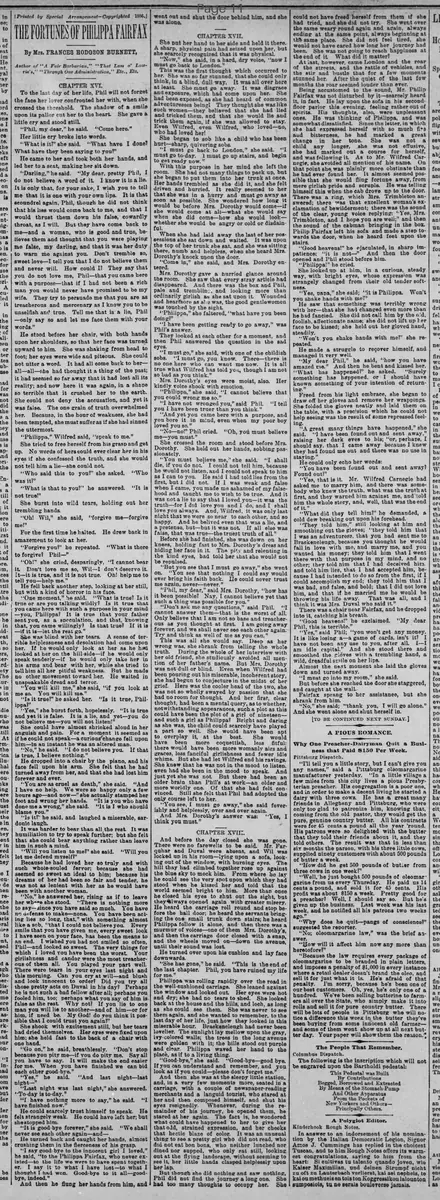
(Printed by Special Arrangement—Copyrighted, 1886.)
FORTUNES OF PHILIPPA FAIRFAX.
By Mrs. FRANCES HODGSON BURNETT,
Author of "A Fair Barbarian," "That Lass o' Lowrie's," "Through One Administration," Etc., Etc.
CHAPTER XVI.
To the last day of her life, Phil will not forget the face her lover confronted her with, when she crossed the threshold. The shadow of a smile upon its pallor cut her to the heart. She gave a little cry and stood still.
"Phil, my dear," he said. "Come here."
Her little cry broke into words.
"What is it?" she said. "What have I done? What have they been saying to you?"
He came to her and took both her hands, and led her to a seat, making her sit down.
"Darling," he said. "My dear, pretty Phil, I do not believe a word of it. I know it is a lie. It is only that, for your sake, I wish you to tell me that it is one with your own lips. It is that scoundrel again, Phil, though he did not think that his lies would come back to me, and that I would thrust them down his false, cowardly throat, as I will. But they have come back to me—and a woman, who is good and true, believes them and thought that you were playing me false, my darling, and that it was her duty to warn me against you. Don't tremble so, sweet love—I tell you that I do not believe them and never will. How could I? They say that you do not love me, Phil—that you came here with a purpose—that if I had not been a rich man you would never have promised to be my wife. They try to persuade me that you are as treacherous and mercenary as I know you to be unselfish and true. Tell me that it's a lie, Phil—only say so and let me face them with your words."
He stood before her chair, with both hands upon her shoulders, so that her face was turned upward to him. She was shaking from head to foot; her eyes were wide and piteous. She could not utter a word. It had all come back to her—all—all—she had thought it a thing of the past; it had seemed so far away that it had lost all its reality; and now here it was again, in a shape so terrible that it crushed her to the earth.
She could not deny the accusation, and yet it was false. The one grain of truth overwhelmed her. Because, in the hour of weakness, she had been tempted, she must suffer as if she had sinned the uttermost.
"Philippa," Wilfred said, "speak to me."
She tried to free herself from his grasp and get up. No words of hers could ever clear her in his eyes if she confessed the truth, and she would not tell him a lie—she could not.
"Who said this to you?" she asked. "Who was it?"
"What is that to you?" he answered. "It is not true!"
She burst into wild tears, holding out her trembling hands.
"Oh! Wil," she said, "forgive me—forgive me!"
For the first time he halted. He drew back in amazement to look at her.
"Forgive you?" he repeated. "What is there to forgive? Phil"
"Oh!" she cried, despairingly. "I cannot bear it. Don't love me so, Wil—I don't deserve it. It—it is true, and it is not true. Oh! help me to tell you—help me."
He fell back another step, looking at her still, but with a kind of horror in his face.
"One moment," he said. "What is true? Is it true or are you talking wildly? Is it true that you came here with such a purpose in your mind—you, Philippa? It is true that your father sent you, as a speculation, and that, knowing that, you came willingly? Is that true? If it is—if it is—let the rest go."
She was blind with her tears. A sense of terrible helplessness and desolation had come upon her. If he would only look at her as he had looked at her on the hill-side—if he would only speak tenderly—if he would only take her in his arms and bear with her, while she tried to tell him all her pitiful weakness. But he made no other movement toward her. He waited in unspeakable dread and terror.
"You will kill me," she said, "if you look at me so. You will kill me."
"Is it true?" he asked her. "Is it true, Phil-ippa?"
"Yes," she burst forth, hopelessly. "It is true and yet it is false. It is a lie, and yet—you do not believe me—you will not listen!"
She could have almost shrieked aloud in her anguish and pain. For a moment it seemed as if he could not speak—a curious change fell upon him—in an instant he was an altered man.
"No," he said. "I do not believe you. If that is true, I believe nothing."
He dropped into a chair by the piano, and his face fell upon his arm. She felt that he had turned away from her, and that she had lost him forever and ever.
"You are as cruel as death," she said. "And I have no help. We were so happy only a few hours ago—and now—" she actually stamped her foot and wrung her hands. "It is you who have done me a wrong,"
she said. "It is I who should blame you."
"Is it?" he said, and laughed a miserable, sardonic laugh.
It was harder to bear than all the rest. It was humiliation to try to speak further; but she felt that she could bear anything rather than leave him in such a mind.
"Will you listen to me?" she said. "Will you let me defend myself?"
Because he had loved her so truly and with such whole-souled fervor; because she had seemed so sweet an ideal to him; because his dreams of her had been so fair and tender, he was not as lenient with her as he would have been with another woman.
"No," he answered her, rising as if to leave her where she stood. "There is nothing more to say—since you have said so much. You have no defense to make—none. You have been acting lies so long, that," with something almost like a sob, "that I could not believe you. Every smile that you have given me, every sweet look I have seen on your face, has been the means to an end. I wish you had not smiled so often, Phil—and looked so sweet. The very things for which I loved you have been the worst. Your girlishness and candor were the most treacherous of them all. You played your part well. There were tears in your eyes last night and this morning. Can you cry at will—and blush and look innocent to order? Did you try all those pretty acts on Duval in his day? Perhaps he is not such a bad fellow after all; perhaps you fooled him, too; perhaps what you say of him is false as the rest. Why not? If you lie to one man you will lie to another—and of him—or for him, if need be. My God! do you think it possible that I could trust you again?"
She shook with excitement still, but her tears had dried themselves. Her eyes were fixed upon him; she held fast to the back of a chair with one hand.
"Go on," he said, breathlessly. "Don't stop because you pity me—if you do pity me. Say all you have to say. It will make the end easier for me. When you have finished we can bid each other good-bye."
"Yes," she said. "And last night—last night—"
"Last night was last night," she answered. "To-day is to-day."
"I have nothing more to say," he said. "I have finished now."
He could scarcely trust himself to speak. He felt strangely weak. He could have left her; but she stopped him.
"It is good-bye forever," she said. "We shall never see each other again—and—"
He turned back and caught her hands, almost crushing them in the fierceness of his grasp.
"I say good-bye to the innocent girl I loved," he said. "to the Philippa Fairfax, who never existed—to the life we were to have spent together. I say it to what I have lost—to what I thought I had won. Good-bye to it all—good-bye, indeed."
And then he flung her hands from him, and went out and shut the door behind him, and she was alone.
CHAPTER XVII.
She put her hand to her side and held it there. A sharp, physical pain had seized upon her, but she scarcely recognized that it was physical.
"Now," she said, in a hard, dry voice, "now I must go back to London."
This was the first thought which occurred to her. She was so far stunned, that she could only think, in a blind, dull way. It was all over here at least. She must go away. It was disgrace and exposure, which had come upon her. She had been exposed, as she had heard of common adventuresses being. They thought she was like such women—they believed that she had lied and tricked them, and that she would lie and trick them again, if she was allowed to stay. Even Wilfred, even Wilfred, who loved—no, who had loved her!
She began to sob like a child who has been hurt—sharp, quivering sobs.
"I must go back to London," she said. "I must go to-day. I must go up stairs, and begin to get ready now."
With this purpose in her mind she left the room. She had not many things to pack up, but she began to put them into her trunk at once. Her hands trembled as she did it, and she felt driven and hurried. It really seemed to her that she was in a hurry and must go away as soon as possible. She wondered how long it would be before Mrs. Dorothy would come—if she would come at all—what she would say when she did come—how she would look—whether she would be angry or cold or disdainful.
When she had laid away the last of her possessions she sat down and waited. It was upon the top of her trunk she sat, and she was sitting there, numb and helpless, when she heard Mrs. Dorothy's knock upon the door.
"Come in," she said, and Mrs. Dorothy entered.
Mrs. Dorothy gave a hurried glance around the room. She saw that every stray article had disappeared. And there was the box and Phil, pale and trembling, and looking more than ordinarily girlish as she sat upon it. Wounded and heartsore as she was, the good gentlewoman was touched by the sight.
"Philippa," she faltered, "what have you been doing?"
"I have been getting ready to go away," was Phil's answer.
They looked at each other for a moment, and then Phil answered the question in the sad eyes.
"I must go," she said, with one of the childish sobs. "I must go, you know. There—there is no one here who can want me now. It is all true what Wilfred has told you, though I am not so bad as you think."
Mrs. Dorothy's eyes were moist, also. Her kindly voice shook with emotion.
"Philippa," she said. "I cannot believe that you could wrong me so."
"I have not wronged you," said Phil. "I tell you I have been truer than you think."
"And yet you came here with a purpose, and you bore it in mind, even when my poor boy loved you so."
"No—no!" Phil cried. "Oh, you must believe me—you must."
She crossed the room and stood before Mrs. Dorothy. She held out her hands, sobbing passionately.
"You must believe me," she said. "I shall die, if you do not. I could not tell him, because he would not listen, and I could not speak to him as I can to you. He said I had told lies from the first, but I did not. If I was weak and false when I came, you made me ashamed of my falsehood and taught me to wish to be true. And it was not a lie to say that I loved you—it was the truth—for I did love you and I do, and I shall love you always. And, Wilfred, it was only last night that we were so near to each other, and so happy. And he believed even that was a lie, and a pretense, but—but it was not. If all else was false, that was true—the truest truth of all."
Before she had finished, she was down on her knees, holding fast to Mrs. Dorothy's dress and hiding her face in it. The pity and relenting in the kind eyes had told her that she would not be repulsed.
"But you see that I must go away," she went on. "You see that nothing I could say would ever bring his faith back. He could never trust me again, never—never."
"Phil, my dear," said Mrs. Dorothy. "how has it been possible? Nay, I cannot believe yet that such a thing was possible for you."
"Don't ask me any questions," said Phil. "I cannot answer them—that is the worst of all. Only believe that I am not so base and treacherous as you thought at first. I am going away forever, and we shall never see each other again. Try and think as well of me as you can."
This was all she would say. Deep as her wrong was, she shrank from telling the whole truth. During the whole of her interview with her old friend, she studiously avoided all mention of her father's name. But Mrs. Dorothy was not dull or blind. Even when Wilfred had been pouring out his miserable, incoherent story, she had begun to conjecture in the midst of her grief. Hers was the cooler head of the two, she was not so wholly swayed by passion that she had no room for thought. And her first, clear thought, had been a mental query, as to whether, notwithstanding appearances, such a plot as this could have been the plot of a girl of nineteen—and such a girl as Philippa? Bright and daring as she was, the child could scarcely have played a part so well. She would have been apt to overplay it, at the best. She would have been more coquettish, less fitful: there would have been more womanly airs and graces, less fanciful girlishness and fewer idle whims. But she had let Wilfred end his ravings. She knew that he was not in the mood to listen, even had she been in the mood to speak. And just yet she was not. But there had been an older brain than Phil's at work—an older and more worldly one. Of that she had felt convinced. Still she felt that Phil had adopted the only course left to her.
"You see, I must go away," she said feverishly and helplessly, over and over again.
And Mrs. Dorothy's answer was:
"Yes, I think you must."
CHAPTER XVIII.
And before the day closed she was gone. There were no farewells to be said. Mr. Farquhar and Duval were absent, and Wil was locked up in his room—lying upon a sofa, looking out of the window, with burning eyes. The hill they had climbed together rose up against the blue sky to mock him. From where he lay he could see the very spot upon which they had stood when he kissed her and told that the world seemed bright to him. More than once he closed his eyes to shut out the sight, but they always opened again with greater misery.
He heard the carriage roll round and stop before the hall door; he heard the servants bringing the one small trunk down stairs; he heard Philippa follow it alone, and then there was a murmur of voices—one of them Mrs. Dorothy's, and then the carriage door closed with a snap, and the wheels moved on—down the avenue, until their sound was lost.
He turned over upon his cushion and lay face downwards.
"She has gone," he said. "This is the end of the last chapter. Phil, you have ruined my life for me."
Philippa was rolling rapidly over the road in the well-cushioned carriage. She leaned against the window and looked out. Her eyes were hot and dry; she had no tears to shed. She looked back at the house and the hills, and loch, as long as she could see them. She was never to see them again, and she wanted to remember, to the last day of her life, just how they looked in this miserable hour. Brackencleugh had never been lovelier. The sunlight lay mellow upon the gray, ivy-colored walls; the trees in the long avenue were golden with it; the hills stood out purple and clear. Philippa waved her hand to the place, as if to a living thing.
"Good-bye," she said. "Good-bye—good-bye. If you can understand and remember, and you look as if you could—please don't forget me."
And then she was at the sleepy little station, and, in a very few moments more, seated in a carriage, with a couple of newspaper-reading merchants and a languid tourist, who stared at her and then composed himself, and shut his eyes resignedly. Whenever, during the remainder of his journey, he opened them, he stared at her again. The fact is, he wondered what could have happened to her to give her that old, strained expression, and her cheeks that hectic blaze of color. It was an unusual thing to see a pretty girl who did not read, who did not eat bon-bons, who neither lunched nor dined nor supped, who only sat still, looking out at the flying landscape, without seeming to see it, her little hands clasped helplessly upon her lap.
But though she did nothing and saw nothing, Phil did not find the journey a long one. She had too many thoughts to occupy her. She could not have freed herself from them if she had tried, and she did not try. She went over the same weary round again and again, always ending at the same point, always beginning at the same place. She did not feel tired, she would not have cared how long her journey had been. She was not going to reach happiness at the end of it. What did it matter?
At last, however, came London and the roar of the streets, and the rattle of vehicles, and the stir and bustle that for a few moments stunned her. After the quiet of the last few months the roar seemed louder than ever.
Being accustomed to the sound, Mr. Philip Fairfax was not disturbed by it—scarcely heard it, in fact. He lay upon the sofa in his second-floor parlor this evening, feeling rather out of spirits. His thoughts, also, were unpleasant ones. He was thinking of Philippa, and was somewhat dissatisfied. Since the letter, in which she had expressed herself with so much fire and bitterness, he had marked a great change in her tone. She was not a child any longer, she was not effusive; she had marked out a course for herself, and was following it. As to Mr. Wilfred Carnegie, she avoided all mention of his name. On that point she was plainly more obstinate than he had ever found her. It almost seemed possible that she would fling fortune away, from mere girlish pride and scruple. He was telling himself this when the cab drove up to the door. There was a ring, which Mrs. Trimbleton answered; there was that excellent woman's exclamation of bewilderment; there was the sound of the clear, young voice replying: "Yes, Mrs. Trimbleton, and I hope you are well;" and then the sound of the cabman bringing in the box.
Philip Fairfax left his sofa and made a step towards the door, when he heard feet upon the stairs.
"Good heavens!" he ejaculated, in sharp impatience: "it is not—" And then the door opened and Phil stood before him.
"Philippa!" he cried.
She looked up at him, in a curious, steady way, with bright eyes, whose expression was strangely changed from their old tender softness.
"Yes, papa," she said; "it is Philippa. Won't you shake hands with me?"
He saw that something was terribly wrong with her—that she had changed even more than he had fancied. She did not call him by the old, foolish, affectionate name; she did not lift up her face to be kissed; she held out her gloved hand, steadily.
"Won't you shake hands with me?" she repeated.
He made a struggle to recover himself, and managed it very well.
"My dear Phil," he said, "how you have amazed me." And then he bent and kissed her.
"What has happened?" he asked. "Surely something has happened, or I should have known something of your intention of returning."
Freed from his light embrace, she began to draw off her gloves and remove her wrappings. She folded the gloves neatly and laid them on the table, with a precision which he could not help seeing was the result of some repressed feeling.
"A great many things have happened," she said. "I have been found out and sent away," raising her dark eyes to his; "or, perhaps, I should say, that I came away because I knew they had found me out and there was no use in staying."
He could only echo her words:
"You have been found out and sent away? Found out?"
"Yes, that is it. Mr. Wilfred Carnegie had asked me to marry him, and there was somebody who knew the truth, what was the truth at first, and they warned him against me, and told him the whole story, and, well, that was the end of it."
"What did they tell him?" he demanded, a cold dew breaking out upon his forehead.
"They told him," still looking at him and smoothing out the gloves; "they told him that I was an adventuress, that you had sent me to Brackencleugh, because you thought he would fall in love with me, and marry me, and you wanted his money; they told him that I went there with that purpose in my mind, and no other; they told him that I had deceived him, and told him lies, that I had accepted him, because I had intended to do so from the first, if I could accomplish my end; they told him that I was bad, and false, and bold; that I did not love him, and that if he married me he would be throwing his life away. That was all, and I think it was Mrs. Duval who said it."
There was a chair near Fairfax, and he dropped into it, catching his breath.
"Good heavens!" he exclaimed. "My dear Phil, this is terrible."
"Yes," said Phil; "you won't get any money. It is like losing a—a game of cards, isn't it? I have not been any use to you, after all. I—I am idle capital." And she stood there and smoothed the gloves with a trembling hand, a wild, dreadful smile on her lips.
Almost the next moment she laid the gloves down and turned away.
"I must go into my room," she said.
But before she reached the door she staggered, and caught at the wall.
Fairfax sprang to her assistance, but she shrank from him.
"No," she said; "thank you, I will go alone."
And she went alone and shut herself in.
[TO BE CONTINUED NEXT SUNDAY.]
FORTUNES OF PHILIPPA FAIRFAX.
By Mrs. FRANCES HODGSON BURNETT,
Author of "A Fair Barbarian," "That Lass o' Lowrie's," "Through One Administration," Etc., Etc.
CHAPTER XVI.
To the last day of her life, Phil will not forget the face her lover confronted her with, when she crossed the threshold. The shadow of a smile upon its pallor cut her to the heart. She gave a little cry and stood still.
"Phil, my dear," he said. "Come here."
Her little cry broke into words.
"What is it?" she said. "What have I done? What have they been saying to you?"
He came to her and took both her hands, and led her to a seat, making her sit down.
"Darling," he said. "My dear, pretty Phil, I do not believe a word of it. I know it is a lie. It is only that, for your sake, I wish you to tell me that it is one with your own lips. It is that scoundrel again, Phil, though he did not think that his lies would come back to me, and that I would thrust them down his false, cowardly throat, as I will. But they have come back to me—and a woman, who is good and true, believes them and thought that you were playing me false, my darling, and that it was her duty to warn me against you. Don't tremble so, sweet love—I tell you that I do not believe them and never will. How could I? They say that you do not love me, Phil—that you came here with a purpose—that if I had not been a rich man you would never have promised to be my wife. They try to persuade me that you are as treacherous and mercenary as I know you to be unselfish and true. Tell me that it's a lie, Phil—only say so and let me face them with your words."
He stood before her chair, with both hands upon her shoulders, so that her face was turned upward to him. She was shaking from head to foot; her eyes were wide and piteous. She could not utter a word. It had all come back to her—all—all—she had thought it a thing of the past; it had seemed so far away that it had lost all its reality; and now here it was again, in a shape so terrible that it crushed her to the earth.
She could not deny the accusation, and yet it was false. The one grain of truth overwhelmed her. Because, in the hour of weakness, she had been tempted, she must suffer as if she had sinned the uttermost.
"Philippa," Wilfred said, "speak to me."
She tried to free herself from his grasp and get up. No words of hers could ever clear her in his eyes if she confessed the truth, and she would not tell him a lie—she could not.
"Who said this to you?" she asked. "Who was it?"
"What is that to you?" he answered. "It is not true!"
She burst into wild tears, holding out her trembling hands.
"Oh! Wil," she said, "forgive me—forgive me!"
For the first time he halted. He drew back in amazement to look at her.
"Forgive you?" he repeated. "What is there to forgive? Phil"
"Oh!" she cried, despairingly. "I cannot bear it. Don't love me so, Wil—I don't deserve it. It—it is true, and it is not true. Oh! help me to tell you—help me."
He fell back another step, looking at her still, but with a kind of horror in his face.
"One moment," he said. "What is true? Is it true or are you talking wildly? Is it true that you came here with such a purpose in your mind—you, Philippa? It is true that your father sent you, as a speculation, and that, knowing that, you came willingly? Is that true? If it is—if it is—let the rest go."
She was blind with her tears. A sense of terrible helplessness and desolation had come upon her. If he would only look at her as he had looked at her on the hill-side—if he would only speak tenderly—if he would only take her in his arms and bear with her, while she tried to tell him all her pitiful weakness. But he made no other movement toward her. He waited in unspeakable dread and terror.
"You will kill me," she said, "if you look at me so. You will kill me."
"Is it true?" he asked her. "Is it true, Phil-ippa?"
"Yes," she burst forth, hopelessly. "It is true and yet it is false. It is a lie, and yet—you do not believe me—you will not listen!"
She could have almost shrieked aloud in her anguish and pain. For a moment it seemed as if he could not speak—a curious change fell upon him—in an instant he was an altered man.
"No," he said. "I do not believe you. If that is true, I believe nothing."
He dropped into a chair by the piano, and his face fell upon his arm. She felt that he had turned away from her, and that she had lost him forever and ever.
"You are as cruel as death," she said. "And I have no help. We were so happy only a few hours ago—and now—" she actually stamped her foot and wrung her hands. "It is you who have done me a wrong,"
she said. "It is I who should blame you."
"Is it?" he said, and laughed a miserable, sardonic laugh.
It was harder to bear than all the rest. It was humiliation to try to speak further; but she felt that she could bear anything rather than leave him in such a mind.
"Will you listen to me?" she said. "Will you let me defend myself?"
Because he had loved her so truly and with such whole-souled fervor; because she had seemed so sweet an ideal to him; because his dreams of her had been so fair and tender, he was not as lenient with her as he would have been with another woman.
"No," he answered her, rising as if to leave her where she stood. "There is nothing more to say—since you have said so much. You have no defense to make—none. You have been acting lies so long, that," with something almost like a sob, "that I could not believe you. Every smile that you have given me, every sweet look I have seen on your face, has been the means to an end. I wish you had not smiled so often, Phil—and looked so sweet. The very things for which I loved you have been the worst. Your girlishness and candor were the most treacherous of them all. You played your part well. There were tears in your eyes last night and this morning. Can you cry at will—and blush and look innocent to order? Did you try all those pretty acts on Duval in his day? Perhaps he is not such a bad fellow after all; perhaps you fooled him, too; perhaps what you say of him is false as the rest. Why not? If you lie to one man you will lie to another—and of him—or for him, if need be. My God! do you think it possible that I could trust you again?"
She shook with excitement still, but her tears had dried themselves. Her eyes were fixed upon him; she held fast to the back of a chair with one hand.
"Go on," he said, breathlessly. "Don't stop because you pity me—if you do pity me. Say all you have to say. It will make the end easier for me. When you have finished we can bid each other good-bye."
"Yes," she said. "And last night—last night—"
"Last night was last night," she answered. "To-day is to-day."
"I have nothing more to say," he said. "I have finished now."
He could scarcely trust himself to speak. He felt strangely weak. He could have left her; but she stopped him.
"It is good-bye forever," she said. "We shall never see each other again—and—"
He turned back and caught her hands, almost crushing them in the fierceness of his grasp.
"I say good-bye to the innocent girl I loved," he said. "to the Philippa Fairfax, who never existed—to the life we were to have spent together. I say it to what I have lost—to what I thought I had won. Good-bye to it all—good-bye, indeed."
And then he flung her hands from him, and went out and shut the door behind him, and she was alone.
CHAPTER XVII.
She put her hand to her side and held it there. A sharp, physical pain had seized upon her, but she scarcely recognized that it was physical.
"Now," she said, in a hard, dry voice, "now I must go back to London."
This was the first thought which occurred to her. She was so far stunned, that she could only think, in a blind, dull way. It was all over here at least. She must go away. It was disgrace and exposure, which had come upon her. She had been exposed, as she had heard of common adventuresses being. They thought she was like such women—they believed that she had lied and tricked them, and that she would lie and trick them again, if she was allowed to stay. Even Wilfred, even Wilfred, who loved—no, who had loved her!
She began to sob like a child who has been hurt—sharp, quivering sobs.
"I must go back to London," she said. "I must go to-day. I must go up stairs, and begin to get ready now."
With this purpose in her mind she left the room. She had not many things to pack up, but she began to put them into her trunk at once. Her hands trembled as she did it, and she felt driven and hurried. It really seemed to her that she was in a hurry and must go away as soon as possible. She wondered how long it would be before Mrs. Dorothy would come—if she would come at all—what she would say when she did come—how she would look—whether she would be angry or cold or disdainful.
When she had laid away the last of her possessions she sat down and waited. It was upon the top of her trunk she sat, and she was sitting there, numb and helpless, when she heard Mrs. Dorothy's knock upon the door.
"Come in," she said, and Mrs. Dorothy entered.
Mrs. Dorothy gave a hurried glance around the room. She saw that every stray article had disappeared. And there was the box and Phil, pale and trembling, and looking more than ordinarily girlish as she sat upon it. Wounded and heartsore as she was, the good gentlewoman was touched by the sight.
"Philippa," she faltered, "what have you been doing?"
"I have been getting ready to go away," was Phil's answer.
They looked at each other for a moment, and then Phil answered the question in the sad eyes.
"I must go," she said, with one of the childish sobs. "I must go, you know. There—there is no one here who can want me now. It is all true what Wilfred has told you, though I am not so bad as you think."
Mrs. Dorothy's eyes were moist, also. Her kindly voice shook with emotion.
"Philippa," she said. "I cannot believe that you could wrong me so."
"I have not wronged you," said Phil. "I tell you I have been truer than you think."
"And yet you came here with a purpose, and you bore it in mind, even when my poor boy loved you so."
"No—no!" Phil cried. "Oh, you must believe me—you must."
She crossed the room and stood before Mrs. Dorothy. She held out her hands, sobbing passionately.
"You must believe me," she said. "I shall die, if you do not. I could not tell him, because he would not listen, and I could not speak to him as I can to you. He said I had told lies from the first, but I did not. If I was weak and false when I came, you made me ashamed of my falsehood and taught me to wish to be true. And it was not a lie to say that I loved you—it was the truth—for I did love you and I do, and I shall love you always. And, Wilfred, it was only last night that we were so near to each other, and so happy. And he believed even that was a lie, and a pretense, but—but it was not. If all else was false, that was true—the truest truth of all."
Before she had finished, she was down on her knees, holding fast to Mrs. Dorothy's dress and hiding her face in it. The pity and relenting in the kind eyes had told her that she would not be repulsed.
"But you see that I must go away," she went on. "You see that nothing I could say would ever bring his faith back. He could never trust me again, never—never."
"Phil, my dear," said Mrs. Dorothy. "how has it been possible? Nay, I cannot believe yet that such a thing was possible for you."
"Don't ask me any questions," said Phil. "I cannot answer them—that is the worst of all. Only believe that I am not so base and treacherous as you thought at first. I am going away forever, and we shall never see each other again. Try and think as well of me as you can."
This was all she would say. Deep as her wrong was, she shrank from telling the whole truth. During the whole of her interview with her old friend, she studiously avoided all mention of her father's name. But Mrs. Dorothy was not dull or blind. Even when Wilfred had been pouring out his miserable, incoherent story, she had begun to conjecture in the midst of her grief. Hers was the cooler head of the two, she was not so wholly swayed by passion that she had no room for thought. And her first, clear thought, had been a mental query, as to whether, notwithstanding appearances, such a plot as this could have been the plot of a girl of nineteen—and such a girl as Philippa? Bright and daring as she was, the child could scarcely have played a part so well. She would have been apt to overplay it, at the best. She would have been more coquettish, less fitful: there would have been more womanly airs and graces, less fanciful girlishness and fewer idle whims. But she had let Wilfred end his ravings. She knew that he was not in the mood to listen, even had she been in the mood to speak. And just yet she was not. But there had been an older brain than Phil's at work—an older and more worldly one. Of that she had felt convinced. Still she felt that Phil had adopted the only course left to her.
"You see, I must go away," she said feverishly and helplessly, over and over again.
And Mrs. Dorothy's answer was:
"Yes, I think you must."
CHAPTER XVIII.
And before the day closed she was gone. There were no farewells to be said. Mr. Farquhar and Duval were absent, and Wil was locked up in his room—lying upon a sofa, looking out of the window, with burning eyes. The hill they had climbed together rose up against the blue sky to mock him. From where he lay he could see the very spot upon which they had stood when he kissed her and told that the world seemed bright to him. More than once he closed his eyes to shut out the sight, but they always opened again with greater misery.
He heard the carriage roll round and stop before the hall door; he heard the servants bringing the one small trunk down stairs; he heard Philippa follow it alone, and then there was a murmur of voices—one of them Mrs. Dorothy's, and then the carriage door closed with a snap, and the wheels moved on—down the avenue, until their sound was lost.
He turned over upon his cushion and lay face downwards.
"She has gone," he said. "This is the end of the last chapter. Phil, you have ruined my life for me."
Philippa was rolling rapidly over the road in the well-cushioned carriage. She leaned against the window and looked out. Her eyes were hot and dry; she had no tears to shed. She looked back at the house and the hills, and loch, as long as she could see them. She was never to see them again, and she wanted to remember, to the last day of her life, just how they looked in this miserable hour. Brackencleugh had never been lovelier. The sunlight lay mellow upon the gray, ivy-colored walls; the trees in the long avenue were golden with it; the hills stood out purple and clear. Philippa waved her hand to the place, as if to a living thing.
"Good-bye," she said. "Good-bye—good-bye. If you can understand and remember, and you look as if you could—please don't forget me."
And then she was at the sleepy little station, and, in a very few moments more, seated in a carriage, with a couple of newspaper-reading merchants and a languid tourist, who stared at her and then composed himself, and shut his eyes resignedly. Whenever, during the remainder of his journey, he opened them, he stared at her again. The fact is, he wondered what could have happened to her to give her that old, strained expression, and her cheeks that hectic blaze of color. It was an unusual thing to see a pretty girl who did not read, who did not eat bon-bons, who neither lunched nor dined nor supped, who only sat still, looking out at the flying landscape, without seeming to see it, her little hands clasped helplessly upon her lap.
But though she did nothing and saw nothing, Phil did not find the journey a long one. She had too many thoughts to occupy her. She could not have freed herself from them if she had tried, and she did not try. She went over the same weary round again and again, always ending at the same point, always beginning at the same place. She did not feel tired, she would not have cared how long her journey had been. She was not going to reach happiness at the end of it. What did it matter?
At last, however, came London and the roar of the streets, and the rattle of vehicles, and the stir and bustle that for a few moments stunned her. After the quiet of the last few months the roar seemed louder than ever.
Being accustomed to the sound, Mr. Philip Fairfax was not disturbed by it—scarcely heard it, in fact. He lay upon the sofa in his second-floor parlor this evening, feeling rather out of spirits. His thoughts, also, were unpleasant ones. He was thinking of Philippa, and was somewhat dissatisfied. Since the letter, in which she had expressed herself with so much fire and bitterness, he had marked a great change in her tone. She was not a child any longer, she was not effusive; she had marked out a course for herself, and was following it. As to Mr. Wilfred Carnegie, she avoided all mention of his name. On that point she was plainly more obstinate than he had ever found her. It almost seemed possible that she would fling fortune away, from mere girlish pride and scruple. He was telling himself this when the cab drove up to the door. There was a ring, which Mrs. Trimbleton answered; there was that excellent woman's exclamation of bewilderment; there was the sound of the clear, young voice replying: "Yes, Mrs. Trimbleton, and I hope you are well;" and then the sound of the cabman bringing in the box.
Philip Fairfax left his sofa and made a step towards the door, when he heard feet upon the stairs.
"Good heavens!" he ejaculated, in sharp impatience: "it is not—" And then the door opened and Phil stood before him.
"Philippa!" he cried.
She looked up at him, in a curious, steady way, with bright eyes, whose expression was strangely changed from their old tender softness.
"Yes, papa," she said; "it is Philippa. Won't you shake hands with me?"
He saw that something was terribly wrong with her—that she had changed even more than he had fancied. She did not call him by the old, foolish, affectionate name; she did not lift up her face to be kissed; she held out her gloved hand, steadily.
"Won't you shake hands with me?" she repeated.
He made a struggle to recover himself, and managed it very well.
"My dear Phil," he said, "how you have amazed me." And then he bent and kissed her.
"What has happened?" he asked. "Surely something has happened, or I should have known something of your intention of returning."
Freed from his light embrace, she began to draw off her gloves and remove her wrappings. She folded the gloves neatly and laid them on the table, with a precision which he could not help seeing was the result of some repressed feeling.
"A great many things have happened," she said. "I have been found out and sent away," raising her dark eyes to his; "or, perhaps, I should say, that I came away because I knew they had found me out and there was no use in staying."
He could only echo her words:
"You have been found out and sent away? Found out?"
"Yes, that is it. Mr. Wilfred Carnegie had asked me to marry him, and there was somebody who knew the truth, what was the truth at first, and they warned him against me, and told him the whole story, and, well, that was the end of it."
"What did they tell him?" he demanded, a cold dew breaking out upon his forehead.
"They told him," still looking at him and smoothing out the gloves; "they told him that I was an adventuress, that you had sent me to Brackencleugh, because you thought he would fall in love with me, and marry me, and you wanted his money; they told him that I went there with that purpose in my mind, and no other; they told him that I had deceived him, and told him lies, that I had accepted him, because I had intended to do so from the first, if I could accomplish my end; they told him that I was bad, and false, and bold; that I did not love him, and that if he married me he would be throwing his life away. That was all, and I think it was Mrs. Duval who said it."
There was a chair near Fairfax, and he dropped into it, catching his breath.
"Good heavens!" he exclaimed. "My dear Phil, this is terrible."
"Yes," said Phil; "you won't get any money. It is like losing a—a game of cards, isn't it? I have not been any use to you, after all. I—I am idle capital." And she stood there and smoothed the gloves with a trembling hand, a wild, dreadful smile on her lips.
Almost the next moment she laid the gloves down and turned away.
"I must go into my room," she said.
But before she reached the door she staggered, and caught at the wall.
Fairfax sprang to her assistance, but she shrank from him.
"No," she said; "thank you, I will go alone."
And she went alone and shut herself in.
[TO BE CONTINUED NEXT SUNDAY.]
What sub-type of article is it?
Prose Fiction
What themes does it cover?
Love Romance
Social Manners
Moral Virtue
What keywords are associated?
Romance Betrayal
Adventuress
Family Deception
Love Confession
Social Exposure
What entities or persons were involved?
By Mrs. Frances Hodgson Burnett, Author Of "A Fair Barbarian," "That Lass O' Lowrie's," "Through One Administration," Etc., Etc.
Literary Details
Title
Fortunes Of Philippa Fairfax. Chapter Xvi. Chapter Xvii. Chapter Xviii.
Author
By Mrs. Frances Hodgson Burnett, Author Of "A Fair Barbarian," "That Lass O' Lowrie's," "Through One Administration," Etc., Etc.
Form / Style
Serialized Novel Chapters In Prose
Key Lines
"Phil, My Dear," He Said. "Come Here."
"Darling," He Said. "My Dear, Pretty Phil, I Do Not Believe A Word Of It. I Know It Is A Lie."
"Yes," She Burst Forth, Hopelessly. "It Is True And Yet It Is False. It Is A Lie, And Yet—You Do Not Believe Me—You Will Not Listen!"
"Good Bye," She Said. "Good Bye—Good Bye. If You Can Understand And Remember, And You Look As If You Could—Please Don't Forget Me."
"They Told Him That I Was An Adventuress, That You Had Sent Me To Brackencleugh, Because You Thought He Would Fall In Love With Me, And Marry Me, And You Wanted His Money;"