Thank you for visiting SNEWPapers!
Sign up free
Editorial
May 16, 1861
Southern Christian Advocate
Charleston, Charleston County, South Carolina
What is this article about?
The editorial advocates for lay co-operation in Methodist conferences, citing successful implementations in Louisiana, Virginia, and Southern U.S. conferences, and drawing on English Methodism's mixed committees under Bunting, which boosted finances and missions without legal barriers.
Clipping
OCR Quality
95%
Excellent
Full Text
SELECTIONS.
LAY CO-OPERATION.
The North Carolina Advocate says that the late Louisiana Conference adopted a plan which will test the practicability of lay-delegation on a more extensive scale than has heretofore been tried among us. That Conference urges each Quarterly Meeting Conference to select a gentleman, not a lady of course, to attend the Annual Conference, to give aid and share in the committee action of the Conference upon the cause of Missions, Education, Sabbath-schools, Church Publications, and Support of the Ministry: the Conference and the lay-delegates to co-operate in Committee of the Whole. A plan of a similar character, perhaps not so fully defined, was initiated at the late Virginia Conference.
This seems very like the plan which has already been tested in several Southern Conferences, and been found quite successful. In fine, all experiments of the kind have thus far proved safe, to say the least. Such approximations of lay representation are the true method of reaching the desired modification of our economy. They have been happily exemplified for us in English Methodism. It can hardly be doubted that complete lay representation would long ago have been adopted in Wesleyan Methodism, had it not been for an insurmountable obstruction in the old Deed of Declaration which organizes the Conference, and which has been recognized in the Court of Chancery, and therefore, as forming the fundamental law and guarantee of the denomination, is wisely left intact. This Deed provides that the Conference shall be constituted of preachers, but Bunting, seeing the expediency of "lay co-operation," for both the efficiency of the Church and its safety from discontent and schism, introduced the present plan of "mixed" committees of laymen and preachers, for the transaction of the economical business of the Connection. These committees meet at the place of the Conference, one week before its session, and virtually form a pre-session of the Conference. They do up all the Missionary, Educational, and other financial affairs of the body, and, though the old "deed" cannot allow them to be recognized as a part of the Conference itself, yet the latter practically so considers them, for it has grown into a rule with it to receive and pass their measures without dissent. It was the policy of Bunting (that is to say the Conference, for he was virtually its legislator almost as much as Wesley had been,) to advance this plan as fast as the exigencies of the Church justified it; especially was it the means of curbing dissension. The last stage of importance in its progress was at the great agitation under Dr. Warren. Bunting wrote out a review of the whole legal system of the Conference at time, and by the authority of the Conference, the lay co-operation was extended at once to committees which had hitherto been purely clerical.
And how mighty has been the energy of this plan? The fiscal system of Wesleyan Methodism is now the wonder of Christendom. As we lately showed, the Wesleyans, much poorer, as a general fact, than American Methodists, contribute annually much more to the voluntary liberality of English Christianity than the National Church itself. To undo this plan would undo the noblest enterprise of English Methodism. The Centenary financial achievements put the crown upon it. That whole celebration was conducted by "mixed" committees. The Conference of 1857 appointed laymen and preachers to devise its programme. Their great meeting at Manchester was the greatest "Conference" ever held by Methodism. It resulted in the magnificent contribution of one million and eighty thousand dollars to the various Charities of Wesleyan Methodism—an example of liberality never perhaps surpassed in Protestant Christendom. It gave the impulse which led other branches of Methodism to the marvels of beneficence that distinguished that year, and which, with the Wesleyan contribution, amounted to more than seventeen hundred thousand dollars, and this too without interfering with their stated collections. The fact that in less than sixty years (since 1803) Wesleyan Methodism has given nearly nineteen millions of dollars to Missions, is owing largely to the fact of lay co-operation in its great Conference Committees.
Let not be afraid then, of this "innovation." It is Methodistic. Our Church Constitution does not present the difficulty to it which inheres in the organic law of Wesleyan Methodism. We may therefore have its advantages more completely than our Wesleyan brethren. -The Methodist.
LAY CO-OPERATION.
The North Carolina Advocate says that the late Louisiana Conference adopted a plan which will test the practicability of lay-delegation on a more extensive scale than has heretofore been tried among us. That Conference urges each Quarterly Meeting Conference to select a gentleman, not a lady of course, to attend the Annual Conference, to give aid and share in the committee action of the Conference upon the cause of Missions, Education, Sabbath-schools, Church Publications, and Support of the Ministry: the Conference and the lay-delegates to co-operate in Committee of the Whole. A plan of a similar character, perhaps not so fully defined, was initiated at the late Virginia Conference.
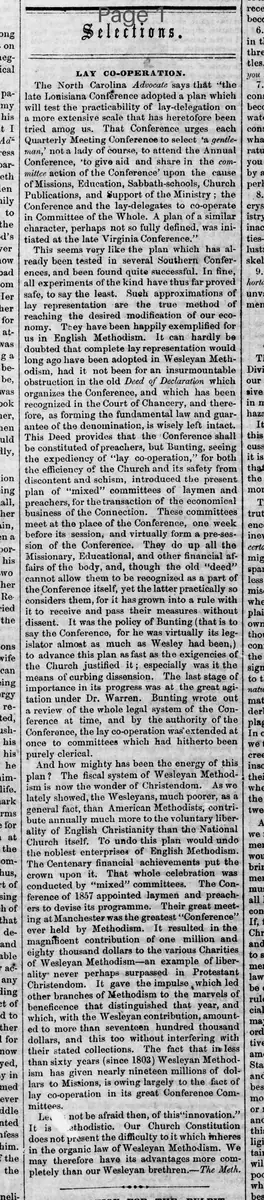
This seems very like the plan which has already been tested in several Southern Conferences, and been found quite successful. In fine, all experiments of the kind have thus far proved safe, to say the least. Such approximations of lay representation are the true method of reaching the desired modification of our economy. They have been happily exemplified for us in English Methodism. It can hardly be doubted that complete lay representation would long ago have been adopted in Wesleyan Methodism, had it not been for an insurmountable obstruction in the old Deed of Declaration which organizes the Conference, and which has been recognized in the Court of Chancery, and therefore, as forming the fundamental law and guarantee of the denomination, is wisely left intact. This Deed provides that the Conference shall be constituted of preachers, but Bunting, seeing the expediency of "lay co-operation," for both the efficiency of the Church and its safety from discontent and schism, introduced the present plan of "mixed" committees of laymen and preachers, for the transaction of the economical business of the Connection. These committees meet at the place of the Conference, one week before its session, and virtually form a pre-session of the Conference. They do up all the Missionary, Educational, and other financial affairs of the body, and, though the old "deed" cannot allow them to be recognized as a part of the Conference itself, yet the latter practically so considers them, for it has grown into a rule with it to receive and pass their measures without dissent. It was the policy of Bunting (that is to say the Conference, for he was virtually its legislator almost as much as Wesley had been,) to advance this plan as fast as the exigencies of the Church justified it; especially was it the means of curbing dissension. The last stage of importance in its progress was at the great agitation under Dr. Warren. Bunting wrote out a review of the whole legal system of the Conference at time, and by the authority of the Conference, the lay co-operation was extended at once to committees which had hitherto been purely clerical.
And how mighty has been the energy of this plan? The fiscal system of Wesleyan Methodism is now the wonder of Christendom. As we lately showed, the Wesleyans, much poorer, as a general fact, than American Methodists, contribute annually much more to the voluntary liberality of English Christianity than the National Church itself. To undo this plan would undo the noblest enterprise of English Methodism. The Centenary financial achievements put the crown upon it. That whole celebration was conducted by "mixed" committees. The Conference of 1857 appointed laymen and preachers to devise its programme. Their great meeting at Manchester was the greatest "Conference" ever held by Methodism. It resulted in the magnificent contribution of one million and eighty thousand dollars to the various Charities of Wesleyan Methodism—an example of liberality never perhaps surpassed in Protestant Christendom. It gave the impulse which led other branches of Methodism to the marvels of beneficence that distinguished that year, and which, with the Wesleyan contribution, amounted to more than seventeen hundred thousand dollars, and this too without interfering with their stated collections. The fact that in less than sixty years (since 1803) Wesleyan Methodism has given nearly nineteen millions of dollars to Missions, is owing largely to the fact of lay co-operation in its great Conference Committees.
Let not be afraid then, of this "innovation." It is Methodistic. Our Church Constitution does not present the difficulty to it which inheres in the organic law of Wesleyan Methodism. We may therefore have its advantages more completely than our Wesleyan brethren. -The Methodist.
What sub-type of article is it?
Moral Or Religious
What keywords are associated?
Lay Co Operation
Methodist Conferences
Wesleyan Methodism
Church Finances
Missions
Lay Representation
What entities or persons were involved?
Louisiana Conference
North Carolina Advocate
Virginia Conference
Bunting
Dr. Warren
Wesleyan Methodism
Editorial Details
Primary Topic
Lay Co Operation In Methodist Conferences
Stance / Tone
Supportive Of Lay Representation
Key Figures
Louisiana Conference
North Carolina Advocate
Virginia Conference
Bunting
Dr. Warren
Wesleyan Methodism
Key Arguments
Louisiana Conference Adopted Plan For Lay Delegates To Aid In Missions, Education, Sabbath Schools, Publications, And Ministry Support
Similar Plan Initiated In Virginia Conference
Lay Representation Experiments Successful In Southern Conferences
English Methodism Uses Mixed Committees For Financial Affairs Due To Legal Constraints
Bunting Advanced Lay Co Operation To Enhance Church Efficiency And Curb Dissension
Lay Co Operation Led To Impressive Financial Achievements In Wesleyan Methodism, Including Centenary Contributions
American Methodists Can Adopt Lay Co Operation More Completely Without English Legal Obstacles