Thank you for visiting SNEWPapers!
Sign up free
Norfolk Gazette And Publick Ledger
Norfolk, Virginia
What is this article about?
Diplomatic correspondence from Paris in 1807 between US Minister John Armstrong and French officials regarding interpretations of the November 1806 Berlin Decree, impacts on American commerce, privateer captures, shipwreck of the Horizon, and related decisions by the Council of Prizes.
Merged-components note: These components form a single continued set of documents on French affairs, including letters from General Armstrong and related decrees, spanning pages 2 and 3.
Clippings
1 of 2
OCR Quality
Full Text
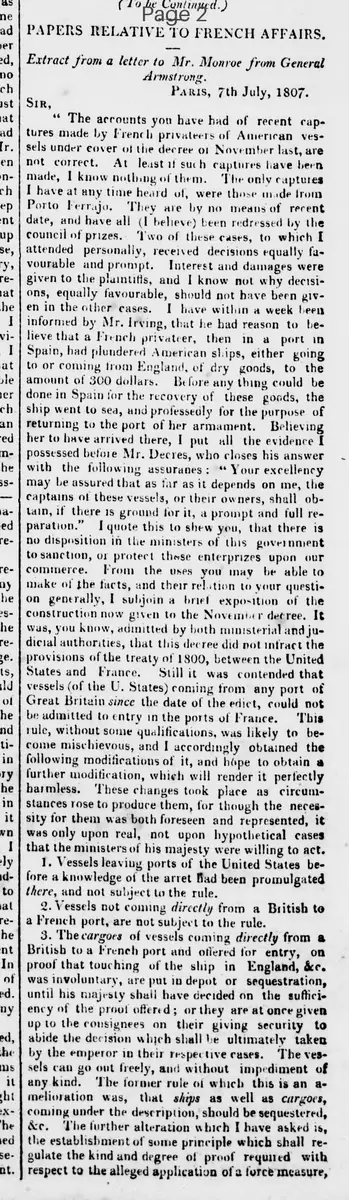
Extract from a letter to Mr. Monroe from General Armstrong.
Paris, 7th July, 1807.
SIR,
The accounts you have had of recent captures made by French privateers of American vessels under cover of the decree of November last, are not correct. At least if such captures have been made, I know nothing of them. The only captures I have at any time heard of, were those made from Porto Ferrajo. They are by no means of recent date, and have all (I believe) been redressed by the council of prizes. Two of these cases, to which I attended personally, received decisions equally favourable and prompt. Interest and damages were given to the plaintiffs, and I know not why decisions, equally favourable, should not have been given in the other cases. I have within a week been informed by Mr. Irving, that he had reason to believe that a French privateer, then in a port in Spain, had plundered American ships, either going to or coming from England, of dry goods, to the amount of 300 dollars. Before any thing could be done in Spain for the recovery of these goods, the ship went to sea, and professedly for the purpose of returning to the port of her armament. Believing her to have arrived there, I put all the evidence I possessed before Mr. Decres, who closes his answer with the following assurance: "Your excellency may be assured that as far as it depends on me, the captains of these vessels, or their owners, shall obtain, if there is ground for it, a prompt and full reparation." I quote this to show you, that there is no disposition in the ministers of this government to sanction, or protect those enterprises upon our commerce. From the uses you may be able to make of the facts, and their relation to your question generally, I subjoin a brief exposition of the construction now given to the November decree. It was, you know, admitted by both ministerial and judicial authorities, that this decree did not infract the provisions of the treaty of 1800, between the United States and France. Still it was contended that vessels (of the U. States) coming from any port of Great Britain since the date of the edict, could not be admitted to entry in the ports of France. This rule, without some qualifications, was likely to become mischievous, and I accordingly obtained the following modifications of it, and hope to obtain a further modification, which will render it perfectly harmless. These changes took place as circumstances rose to produce them, for though the necessity for them was both foreseen and represented, it was only upon real, not upon hypothetical cases that the ministers of his majesty were willing to act.
1. Vessels leaving ports of the United States before a knowledge of the arret had been promulgated there, and not subject to the rule.
2. Vessels not coming directly from a British to a French port, are not subject to the rule.
3. The cargoes of vessels coming directly from a British to a French port and offered for entry, on proof that touching of the ship in England, &c. was involuntary, are put in depot or sequestration, until his majesty shall have decided on the sufficiency of the proof offered; or they are at once given up to the consignees on their giving security to abide the decision which shall be ultimately taken by the emperor in their respective cases. The vessels can go out freely, and without impediment of any kind. The former rule of which this is an amelioration was, that ships as well as cargoes, coming under the description, should be sequestered, &c. The further alteration which I have asked is, the establishment of some principle which shall regulate the kind and degree of proof required with respect to the alleged application of a force majeure.
and my own opinion is, that this may best be found
in the greater or less correspondence which shall
exist between the cargo when shipped in America,
and when arrived here. If the correspondence be
complete, the evidence ought to be considered as
complete also, that they were not in Great Britain
for the purposes of commerce, and not being for these
purposes, the inference is fair, that their going there
at all was involuntary. This is a rule the minis-
ters will consent to, whether his majesty will do so
also, will be known in a few days: He is expected
here about the beginning of August."
Paris, September 18, 1807.
I have submitted, sir, to his majesty the emperour
and king, the doubts of his excellency the minister
of marine and colonies on the extent of some of the
provisions of the imperial decree of November 21st,
1806, which has declared the British islands in a
state of blockade; the following are the intentions
of his majesty on the point in question.
1. Can armed vessels, under the imperial decree
of the 21st of November last, seize in neutral ves-
sels, either English property, or merchandize pro-
ceeding from the manufactures of the English ter-
ritories?
His majesty notified me, that since he had not
thought proper to express any exception in his de-
cree, there is no ground to make any in the execu-
tion, with respect to any thing whatever.
2. His majesty has not decided the question whe-
ther French armed vessels may possess themselves
of neutral vessels going to or from England, altho
they have no English merchandize on board.
3. On the question, whether French armed ves-
sels are subject to the deduction ordered by the 6th
article of the decree of Nov. 21, his majesty has
declared that the provision of that article was not
susceptible of any restriction; that is to say, that
the deduction must take effect on the proceeds of all
confiscations of merchandize and property, which
have been, or may be, pronounced in execution of
the decree, without regard to the place of seizure
or character of the captors.
You will be so good, sir, as to notify these deci-
sions to the council of prizes, to have them entered
in the registers, and to acknowledge the receipt of
my letter.
Accept, &c. &c. the Grand Judge, Minister of
Justice.
(Signed)
REGNIER.
Procureur General Imperial of the Council of
Prizes.
Paris. 24 September. 1807.
Sir—I have this moment learned, that a new
and extended construction, highly injurious to the
commerce of the United States, was about to be
given to the imperial decree of the 21st Nov. last.
It is therefore incumbent upon me to ask from your
excellency an explanation of his majesty's views in
relation to this subject, and particularly whether it
be his majesty's intention, in any degree, to infract
the obligations of the treaty now subsisting between
the United States and the French empire?
I pray your excellency. &c. &c.
(Signed)
JOHN ARMSTRONG.
His excellency the minister of foreign relations.
Fontainebleau, Oct. 7.
Sir— You did me the honour on the 24th of Sep-
tember, to request me to send you some explanati-
ons as to the execution of the decree of blockade of
the British islands, as to vessels of the U. States
The provisions of all the regulations and treaties
relative to a state of blockade, have appeared appli-
cable to the existing circumstances, and it results
from the explanations which have been addressed to
me by the imperial procureur general of the council
of prizes, that his majesty has considered every neu-
tral vessel, going from English ports, with cargoes
of English merchandize or English origin, as law-
fully seizable by French armed vessels.
The decree of blockade has been now issued ele-
ven months, the principal powers of Europe, far
from protesting against its provisions, have adopted
them; they have perceived that its execution must
be complete, to render it more effectual, and it has
seemed easy to reconcile these measures with the
observance of treaties, especially at a time when the
infractions, by England, of the rights of all mari-
time powers render their interest common, and tend
to unite them in support of the same cause.
Accept, &c.
(Signed)
CHAMPAGNY.
H. E. General Armstrong,
Min. Plen. of the U. States.
Paris, Nov. 1807.
Sir—It was not till yesterday that I received
from Mr. Skipwith a copy of the decree of the coun-
cil of prizes, in the case of the Horizon. This is the
first unfriendly decision of that body under the de-
cree of the 21st of Nov. 1806. In this case and on
the petition of the defendant, the court has recom-
mended the restoration of the whole cargo. I did
not however think proper to join in asking as a fa-
vour, what I believed myself entitled to as a right.
I submit a copy of my note to the minister of fo-
reign affairs.
(Signed)
JOHN ARMSTRONG.
Mr. Madison, &c.
Paris, Nov. 12.
Sir—The documents to which these observations
are prefixed, will inform your excellency that an A-
merican ship trading under the protection of the
laws of nations and of particular treaties, and suffer-
ing shipwreck on the coast of France, has recently
been seized by his majesty's officers, and adjudged
by his council of prizes as follows, viz.
"Our council puts at liberty the American
vessel, the Horizon, shipwrecked the 30th of May
last, near Morlaix, and consequently orders, that
the amount of the sale legally made of the wreck of
said vessel, together with the merchandize of the
cargo, which according to an estimate made in pre-
sence of the overseers of the administrations of the
marine and custom house, shall be acknowledged
not to proceed either from English manufactures or
territory, shall be restored to captain Maclure with-
out deducting any other expenses but those relative
to the sale."
"And with regard to the other merchandize of
the cargo which from the result of the said estimate
shall be acknowledged to come from manufactures
or from English territory by virtue of the 5th arti-
cle of the decree of the 21st Nov. 1806, they shall
be confiscated for the use of the state, the whole to
be sold by the forms prescribed in the regulations;
and the application of the product to be made in
conformity to the arrangements of the said decree,
deduction being made for the expense of saving the
goods, and that of the support of the crew. until
the day that the captain shall receive the notificati-
on of the present decision."
The reasons upon which this decision is founded.
are at once so new and so alarming to the present
friendly relation of the two powers, that I cannot
but discuss them with a freedom in some degree
proportioned to my sense of their novelty and im-
portance.
"Considering" says the council—“That the neu-
trality of the ship and cargo were sufficiently esta-
blished, the whole ought to be restored, (agreeably
to the provisions of the convention of the 30th of
September, 1800) provided no merchandize of En-
glish origin had been found in her, and of course
that she had not been brought within the limits of
the imperial decree of the 21st of Nov. 1806."
Here is an open and unqualified admission that
the ship was found within the rules prescribed by
the convention of 1800, that according to these
rules, her cargo and herself ought to have been re-
stored, and that such would have been the fact but
for the operation of the decree of the 21st of No-
vember 1806.
In the letter your excellency did me the honour
to write to me on the 7th of October last, you
thought it "easy to reconcile the obligations of this
decree, with the preservation of those arising from
treaties." It was not for me to examine the means
by which this reconciliation was to be effected.—
They no doubt fully existed, and yet exist in his ma-
jesty's good pleasure, and taking for granted this
fact, I saw in the opinion nothing but proofs of a
friendly disposition, and pledges that this was not
to be either wantonly destroyed or diminished.—
How inauspicious however to its authority and the
faith of government, is the decision of the council
of prizes? An act which explicitly acknow-
ledges the opposite characters and conflicting in-
junctions of these two instruments, and which of
course draws after it considerations the most seri-
ous to the government of the U. States.
The 2d reason of the council is "that the decree
declaring British merchandize good prize, had prin-
cipally in view captures made on the high seas, but
that the question whether shipwrecked goods ought
to be restored or confiscated having always been
judged under the 14th article of the regulation of
the 26th July, 1778. And according to their cha-
racter (that might have rendered lawful, or have
even commanded their seizure at sea) there is no
room to introduce in this case any new distinction
which however philanthropick it may appear, has
not as yet been adopted as a rule by any maritime
nation.
The doctrine resisted in this passage, and
which inculcates the duty of extending protection
to the unfortunate is not new to his ma-
jesty's council of prizes. They have themselves
consecrated it by their decision of the 5th of
March, 1800. By that decision they restored an
enemy's ship on the single reason, that she had been
compelled to enter a French port by stress of weather.
"I should equally fail" says the attorney general,
"in respect to myself and the council, before whom
I have the honour to represent the government,
were I not to maintain a principle, consecrated by our
laws and by those of all nations. In all circumstances
let the loyalty of the French government serve
as the basis of your decisions. Prove yourselves at
once generous and just; your enemies will know
and respect your humanity." Such was the
principle adopted by the council in the year 1800,
and in the case of an enemy's ship, yet we are now
told, that this very principle, so honourable to the
court, to the nation and to human nature, is utterly
unknown to all maritime powers. And on what oc-
casion do we hear this? When an enemy's ship is
again thrown on the French coast? No—It has
been reserved for the wreck of a neutral and friend-
ly vessel!! for a ship of the United States! It is
not denied, that had this ship escaped the rocks and
made the port of Morlaix, the only inhospitality to
which she would have been exposed, (under the
most rigorous interpretation of the law in question,)
would have been that of being ordered again to sea.
Has then the misfortune of shipwreck so far alter-
ed her condition, as to expose her to the injury of
confiscation also? and is this among the principles
which the defender of maritime rights means to
consecrate by his power and his wisdom? It is im-
possible.
The third reason of the council is, "that the application
of the fifth article aforesaid, in as far as it concerns the A-
mericans and other nations, is the result both of the general
expressions of that very article, and of the communication
recently made his excellency the grand judge, concerning
the primitive intention of the sovereign, that the expedition
in question, having certainly been undertaken with full
knowledge of the said decree, no objection can be drawn with
any propriety from the general rules forbidding retrospective
action, nor in this particular case, from the posterior date of
the act in which the sovereign decides the question, since
that act sprung from his supreme wisdom, not as an inter-
pretation of a doubtful point, but as a declaration of an an-
terior and positive disposition."
A distinction is here attempted to be taken between the
interpretation of a doubtful point, and the declaration of an
anterior and positive rule. This distinction cannot be main-
tained; for if there had been positive, there would have
been no occasion for the declaration; neither the minister of
marine nor the council of prizes could have had any doubt on
the subject; the execution of the decree would have been
prompt and peremptory; nor would a second act on the part
of his majesty, after the lapse of twelve months, have been
necessary to give operation to the first. Need I appeal to
your excellency's memory for the facts on which these re-
marks turn? You know that doubts did exist—you know
that there was under them, even much hesitation in pro-
nouncing—you know that as late as the 9th of August, I
sought an explanation of the decree in question, and that
even then your excellency (who was surely a competent and
legitimate organ of his majesty,) did not think yourself pre-
pared to give it—the conclusion is inevitable—his majesty's
answer transmitted to the court of Paris,—on the 18th Sep-
tember following, through the medium of the grand judge,
was in the nature of an interpretation, and being so, could not
without possessing a retroactive quality apply to events many
months anterior in date to itself.
The fourth reason of the council, and the last which en-
enters into my present view on the subject, is, "that though
one of the principal agents of his majesty had given a contra-
ry opinion, of which the council had at no period partaken, this
opinion being that of an individual could not (whatever con-
sideration its author may merit,) balance the formal declara-
tion given in the name of his majesty himself—and that if
the communication of this opinion, had as is alleged, given
room to and served as a basis for many American shipments,
and particularly of the one in question; this circumstance,
which may call for the indulgence of his majesty, in a case in
which the confiscation is entirely to the advantage of the
state, does not prevent a council, rigid in its duty, to pro-
nounce in conformity to the decree of the 21st of November,
and of the declaration which followed it."
It would appear from the paragraph, that not finding it ea-
sy to untie the knot, the council had determined to cut it—
Pressed by the fact, that an interpretation of the decree had
been given by a minister of his majesty, especially charged with
its execution, they would now escape from this fact, and
from this conclusion to which it evidently leads, by alleging
1st That at no time has the council partaken of the opinion
given by the minister; and
2d. That the opinion being that of an individual, could not
possess either the force or the authority of one truly minis-
terial.
It appears to me, as I think it will to your excellency, that
the council have in these statements, been less correct than
is usual to them on similar occasions, if, as they now assert,
they have never partaken of the ministers opinion. If they
have never even hesitated on the question, whether the de-
cree of November did, or did not, derogate from the treaty of
1800: Why, I ask, suspend the American cases generally?
or why decide as they did in the case of the Hibernia? If I
mistake not, we find in this case, the negotiation of the very
principle laid down by the minister of marine. That officer
says "in my opinion the November decree does not work
any change in the rules at present observed with respect to
neutral commerce, and consequently none in the convention
of the 8th vendemire, year 9:" and what says the council?
"Admitting that this part of the cargo (the rum and sugar)
was of British origin, the dispositions of the November de-
cree, which contain nothing with regard to their own influ-
ence over the convention of the 8th vendemire, year 9, evi-
dently cannot be applied to a ship leaving America on the
6th of the same month of November, and of course cannot
have authorised the capture in the moment she was entering
the neutral port of her destination." We have here three
distinct grounds of exemption from the effects of the No-
vember decree.
1st. The entire silence of that decree with regard to its own
influence over the convention of 1800
2d The early period at which the ship left the United States, and
3d. The neutral character of the port to which she was des-
tined. If such, sir, were the principles admitted by the
council of the 25th of March last, with what correctness
can it be now said, "that at no period have they partaken
of the opinion of the minister?"
The 2d fact asserted by the council is, that the interpreta-
tion of the decree in question given on the 24th of December,
1806, was private, not publick, or in other words, that it was
the interpretation of the man, not of the minister—and as
such cannot outweigh the more recent declaration coming
immediately from his majesty himself.
On the comparative weight of these declarations I shall
say nothing, nor shall I do more to repel the first part of the
insinuation, (that the minister's declaration was that only of the
individual) than to submit to your excellency my letter of the
20th of December, 1806, claiming from the minister an offi-
cial interpretation of the decree in question, and his answer
of the 24th of the same month, giving to me the interpreta-
tion demanded.
To your excellency who as late as the 21st of August last,
considered the minister of marine as the natural organ of his
majesty's will, in whatever regarded the decree aforesaid, and
who actually applied to him for information relating to it
this allegation of the council of prizes, and the reasoning
founded upon it cannot but appear very extraordinary, and
will justify me in requesting that his majesty may be moved
to set aside the decision in question I beg, &c. &c.
His Excellency
The Minister of Foreign Relations.
Paris, August 9th, 1807.
SIR—Your excellency is not apprized that soon after the
promulgation of the imperial decree of the 21st November
last, one of similar character, and injunction was issued by
the Prince of Peace, in behalf of I. C. M. Under this order
sundry vessels belonging to the citizens of the United States
have been captured on the high seas, brought into the ports
of Spain, and are now before the court of admiralty for exa-
mination. To this brief statement I subjoin an extract of a
letter of the 27th ult. from the charge d'affaires of the Uni-
ted States at Madrid, which will shew your excellency that
the fate of these vessels will depend not on the construction
which might be given to the Spanish decree by the Spanish
tribunals; but on the practice which shall have been esta-
bished by France, under her decree of November last, and
that Prince Masserano has accordingly been directed to ask
from your excellency such exposition of that decree, and of
the practice under it, as shall regulate, on this head, the
conduct of Spanish courts and cruisers towards neutral com-
merce in general Assured as I feel myself, that this expo-
sition whenever given, will not be less friendly and liberal
than that already found in the decisions of his imperial ma-
jesty's council of prizes and correspondence of his minister of
marine, viz. that the provisions of the decree in question do
not infract any of the rights of commerce stipulated by treaty
between France and the United States, it is incumbent on
me to pray your excellency that it (the exposition required)
be given as expeditiously as possible, to the end that the le-
gitimate commerce of the United States be relieved from all
further annoyance, growing out of the doubtful meaning and
operation of the Spanish decree aforesaid
Your excellency will permit me to avail myself of this occa-
sion to recall to your attention the subject of my letter of the
20th June last. I learn from Antwerp that the cargoes men-
tioned in that letter are yet under sequestration, and that
considerable loss, as well by diminution of price in the arti-
cles, as by accumulation of interest and charges, has been al-
ready incurred.
Your excellency will do me the honour to accept the assur-
ances of my profound respect
(Signed)
JOHN ARMSTRONG.
His Excellency the Prince of Benevento.
Letter from the minister of foreign relations, of the 21st Aug. 1807
Sir—I have received the letter which you did me the ho-
nour of addressing me on the 9th of this month, relative to
American vessels carried into the ports of Spain, in conse-
quence of the measures taken by that power against the Eng-
lish commerce in imitation of France
As the execution of the maritime measures indicated by
the imperial decree of the 21st of November, 1806, rests na-
turally with his excellency the minister of marine, and that
moreover he has already had the honour of addressing you
some first observations on the application of that decree, I
transmitted without delay your letter, and asked from him the
new explanations which you might desire When they
shall have been forwarded to me, I will have the honour of
informing you of them
Accept the assurance of my high consideration.
(Signed)
CHAMPAGNY
His Excellency Gen. Armstrong.
(Here follows the Milan Decree
What sub-type of article is it?
What keywords are associated?
What entities or persons were involved?
Where did it happen?
Foreign News Details
Primary Location
Paris
Event Date
1807
Key Persons
Outcome
redress of earlier captures from porto ferrajo with interest and damages; assurance of reparation for plundered goods; modifications to november 1806 decree allowing entry for certain us vessels; emperor's decisions on seizures of english property in neutral vessels and deductions; partial confiscation of horizon's cargo of english origin after shipwreck; ongoing diplomatic protests and requests for explanations.
Event Details
Series of letters and official communications in 1807 discussing French privateer captures of American vessels, interpretations and modifications of the November 21, 1806 imperial decree blockading British islands, impacts on US neutral commerce under the 1800 treaty, shipwreck and adjudication of the American vessel Horizon near Morlaix, and related Spanish imitations affecting US ships.