Thank you for visiting SNEWPapers!
Sign up free
Alexandria Gazette & Advertiser
Alexandria, Virginia
What is this article about?
Overview of European political dynamics: Turkey as a tool in great power rivalries; pacification between Russia and Ottoman Empire; internal issues in Russia, Austria, Prussia, Sweden-Norway, Denmark, Britain, France, Spain, and Portugal; concerns over reforms, revolutions, and colonial policies.
Clipping
OCR Quality
Full Text
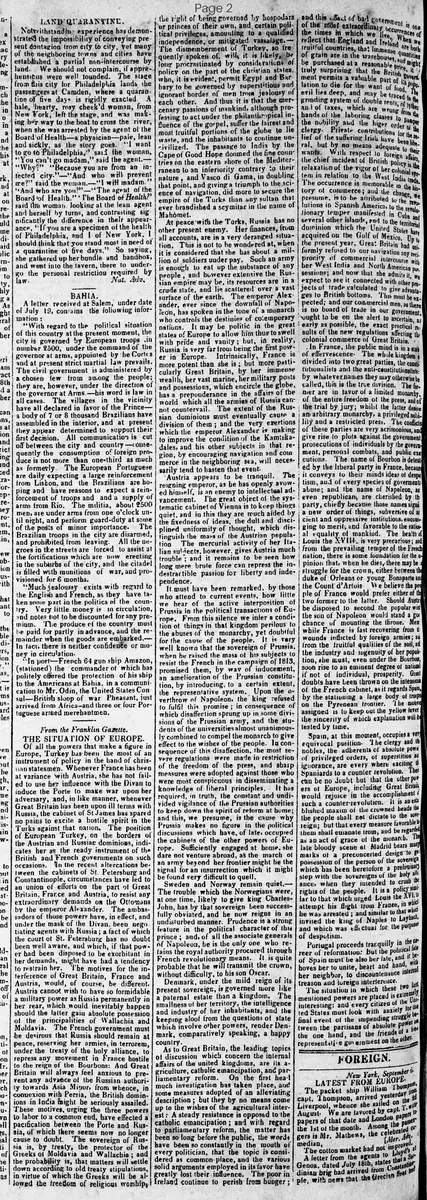
THE SITUATION OF EUROPE.
Of all the powers that make a figure in Europe, Turkey has been the most of an instrument of policy in the hand of christian statesmen. Whenever France has been at variance with Austria, she has not failed to use her influence with the Divan to induce the Porte to make war upon her adversary, and, in like manner, whenever Great Britain has been upon ill terms with Russia, the cabinet of St James has spared no pains to excite a hostile spirit in the Turks against that nation. The position of European Turkey, on the borders of the Austrian and Russian dominions, indicates her as the ready instrument of the British and French governments on such occasions. In the recent altercations between the cabinets of St. Petersburg and Constantinople, circumstances have led to an union of efforts on the part of Great Britain, France and Austria, to resist any extraordinary demands on the Ottomans by the emperor Alexander. The ambassadors of those powers have, in effect, and under the mask of the Divan, been negotiating agents with Russia; a fact of which the court of St. Petersburg has no doubt been well aware, and which, if that power had been disposed to be exorbitant in her demands, might have had a tendency to restrain her. The motives for the interference of Great Britain, France and Austria, would, of course, be different. Austria cannot wish to have so formidable a military power as Russia permanently in her rear, which would inevitably happen should the latter gain absolute possession of the principalities of Wallachia and Moldavia. The French government must be desirous that Russia should remain at peace, reserving her armies, in terrorem, under the treaty of the holy alliance, to repress any movement in France hostile to the reign of the Bourbons: And Great Britain will always feel anxious to prevent any advance of the Russian authority towards Asia Minor, from whence, in connexion with Persia, the British dominions in India might be seriously assailed. These motives, urging the three powers to labor to a common end, have effected a pacification between the Porte and Russia, of which there seems now no longer cause to doubt. The sovereign of Russia is, by treaty, the protector of the Greeks of Moldavia and Wallachia: and the probability is, that matters will settle down according to old treaty stipulations, in virtue of which the Greeks will be allowed the freedom of religious worship the right of being governed by hospodars or princes of their own, and certain political privileges, amounting to a qualified independence, or mitigated vassalage.- The dismemberment of Turkey, so frequently spoken of, will it is likely, be long procrastinated by considerations of policy on the part of the christian states, who, it is evident, permit Egypt and Barbary to be governed by superstitious and ignorant hordes of men from jealousy of each other. And thus it is that the mercenary passions of mankind, although professing to act under the philanthropical influence of the gospel, suffer the fairest and most fruitful portions of the globe to lie waste, and the inhabitants to continue uncivilized. The passage to India by the Cape of Good Hope doomed the fine countries on the eastern shore of the Mediterranean to an inferiority contrary to their nature, and Vasco di Gama, in doubling that point, and giving a triumph to the science of navigation, did more to secure the empire of the Turks than any sultan that ever brandished a scymitar in the name of Mahomet.
At peace with the Turks, Russia has no other present enemy. Her finances, from all accounts, are in a very deranged situation. This is not to be wondered at, when it is considered that she has about a million of soldiers under pay. Such an army is enough to eat up the substance of any people, and however extensive the Russian empire may be, its resources are in a crude state, and lie scattered over a vast surface of the earth. The emperor Alexander, ever since the downfall of Napoleon, has spoken in the tone of a monarch who controls the destinies of contemporary nations. It may be politic in the great states of Europe to allow him thus to swell with pride and vanity: but, in reality, Russia is very far from being the first power in Europe. Intrinsically, France is more potent than she is: but more particularly Great Britain, by her immense wealth, her vast marine, her military posts and possessions, which encircle the globe, has a preponderance in the affairs of the world which all the armies of Russia can not countervail. The extent of the Russian dominions must eventually cause a division of them; and the very exertions which the emperor Alexander is making to improve the condition of the Kamtschadales, and his other subjects in that region, by encouraging navigation and commerce in the neighboring sea, will necessarily tend to hasten that event.
reigning emperor, as he has openly avowed himself, is an enemy to intellectual advancement. The great object of the systematic cabinet of Vienna is to keep things quiet, and in this they are much aided by the fixedness of ideas, the dull and disciplined uniformity of thought, which distinguish the mass of the Austrian population. The mercurial activity of her Italian subjects, however, gives Austria much trouble; and it remains to be seen how long mere brute force can repress the indestructible passion for liberty and independence.
It must have been remarked, by those who attend to current events, how little we hear of the active interposition of Prussia in the political transactions of Europe. From this silence we infer a condition of things in that kingdom perilous to the abuses of the monarchy, yet doubtful for the cause of the people. It is very well known that the sovereign of Prussia, when he raised the mass of his subjects to resist the French in the campaign of 1813, promised them, by way of inducement, an amelioration of the Prussian constitution, by introducing, to a certain extent, the representative system. Upon the overthrow of Napoleon, the king refused to fulfill this promise; in consequence of which disaffection sprung up in some divisions of the Prussian army, and the students of the universities almost unanimously combined to compel the monarch to give effect to the wishes of the people. In consequence of this disaffection, the most severe regulations were made in restriction of the freedom of the press, and sharp measures were adopted against those who were most conspicuous in disseminating a knowledge of liberal principles. - It has required, in truth, the constant and undivided vigilance of the Prussian authorities to keep down the spirit of reform at home: and this, we presume, is the cause why Prussia makes no figure in the political discussions which have, of late, occupied the cabinets of the other powers of Europe. Sufficiently engaged at home, she dare not venture abroad, as the march of an army beyond her frontier might be the signal for an insurrection which it might be found very difficult to quell.
Sweden and Norway remain quiet,- The trouble which the Norwegians were at one time, likely to give king Charles-John, has by that sovereign been successfully obviated, and he now reigns in an undisturbed manner. Prudence is a strong feature in the political character of this prince; and, of all the associate generals of Napoleon, he is the only one who retains the royal authority procured through French revolutionary means. It is quite probable that he will transmit the crown, without difficulty, to his son Oscar.
Denmark, under the mild reign of its present sovereign, is governed more like a paternal estate than a kingdom. The smallness of her territory, the intelligence and industry of her inhabitants, and the keeping aloof from the questions of state which involve other powers, render Denmark, comparatively speaking, a happy country.
As to Great Britain, the leading topics of discussion which concern the internal affairs of the united kingdoms, are its agriculture, catholic emancipation, and parliamentary reform. On the first head much investigation has taken place, and some measures adopted of an alleviating description; but they by no means come up to the wishes of the agricultural interest: A steady resistance is opposed to the catholic emancipation; and with regard to parliamentary reform, the matter has been so long before the public, the words have been so constantly in the mouth of every politician, that the topic is considered as common-place, and the various solid arguments employed in its favor have greatly lost their influence. The poor in Ireland continue to perish from hunger; and this check of bad government is one respect of the times that most in England extraordinary which and Ireland are truly be ruinful grain purchased surprising countries in at the a that tha reasonable warehouses the inmense British price and quantities might ment permits a vatuable part evil lation lies to deep die or and may want be of traced lood to Th grinding an of taxes system which of double are wrung rents of from iythes te hands the nobilily of the and laboring the higer classes order to pamper of lief ral clergy of but the Private by susfering no means con lrish ributions adequale bave for been to the theis libe re wants With respect to foreign attirs relaxation the chie relation incident of the to vigor of the British of West her colonial policy lndia is trade sys- the occuirence is meinorable in the bis presume coronerce atiributed and the to change the revo we lutions in Spanish America to the rerolu lionary temper inaniesied in Cuba and other islands and to the lerritoril doininion which the United States bare acquired on the Gulf of Mexico. Up to the present year, Great Britain had uniformly refused to our navigation any reciprocity of commercial intercourse with her West India and North American possessions; and now that she admits it, we expect to see it connected with other projects of trade calculated to give advantages to British bottoms. This must be expected; and our commercial men, as there is no board of trade in our government, ought to be on the alert to ascertain, as early as possible, the exact practical results of the new regulations affecting the colonial commerce of Great Britain.
In France, the public mind is in a state of effervescence. "The whole kingdom divided into two great parties, the constitutionalists and the anti-constitutionalists: by whatever names they may otherwise be called, this is the true division. The former are in favor of a limited monarchy, of the entire freedom of the press, and of the trial by jury; whilst the latter desire an arbitrary monarchy, a privileged nobility and a restricted press. The conflicts of these parties are very acrimonious, and give rise to plots against the government prosecutions of individuals by the government, personal combats, and public executions. The name of Bourbon is detested by the liberal party in France, because it conveys to their minds ideas of despotism, and of every species of government abuse; and the name of Napoleon, or even republican, are cherished by the party, chiefly because those names signify a new order of things, subversive of ancient and oppressive institutions, encouraging to merit, and favorable to the rational equality of mankind. The health of Louis the XVIII. is very precarious; and from the prevailing temper of the French nation, there is some foundation for the opinion that, when he dies, there may be a struggle for the crown, either between the duke of Orleans or young Bonaparte and the Count d'Artois We believe the people of France would prefer either of the two former to the latter. Should Austria be disposed to second, the popular wish the son of Napoleon would stand a good chance of mounting the throne. Meanwhile France is fast recovering from the wounds inflicted by foreign armies; and from the fruitful qualities of the soil, and the industry and ingenuity of her population, she must, even under the Bourbons, soon rise to an eminent degree of national if not of individual, prosperity. Great doubts have been thrown on the intentions of the French cabinet, as it regards Spain, by the stationing a large body of troops on the Pyrenean frontier. The motive assigned is to keep out the yellow fever, the sincerity of which explanation will be tested by time.
Spain, at this moment, occupies a very equivocal position. The clergy and the nobles, the adherents of absolute power of privileged orders, of superstition and ignorance, are every where exciting the Spaniards to a counter revolution. There can be no doubt but that the other powers of Europe, including Great Britain would rejoice in the accomplishment such a counter-revolution. it is an established maxim of the crowned heads that the people shall not dictate to the sovereign; but that every measure favorable to them shall emanate from, and be regarded as an act of grace of the monarch. The late bloody scene at Madrid bears many marks of a preconcerted design to get possession of the person of the sovereign ance, when they intended to crush the step with the sovereigns of the holy alliance which has been heretofore a preliminary rigbis of the people. It is a policy similar to that which urged Louis the XVI.t attempt his flight from France, in which be was arrested; and similar to that which invited the king of Naples to Layback, and which was effectual for the purposes of despotism.
Portugal proceeds tranquilly in the career of reformation: But the political fate of Spain must be also her fate, and it behooves her to unite, heart and hand, with her neighbor, to discountenance internal treason and foreign interference.
The situation in which these two last mentioned powers are placed is extremely ted States must look with anxiety for the final event of the impending struggle between the one hand, and the friends of a led representalj e gov ernment on the other.
and every citizen
tween tbe the partisans absolute
What sub-type of article is it?
What keywords are associated?
What entities or persons were involved?
Where did it happen?
Foreign News Details
Primary Location
Europe
Key Persons
Outcome
pacification between porte and russia; ongoing internal political tensions and reforms in various states; potential struggles for power in france and spain.
Event Details
Detailed analysis of European powers' relations, with Turkey as a diplomatic tool; joint efforts by Britain, France, Austria against Russian demands; internal politics in Russia, Austria, Prussia, Sweden-Norway, Denmark, Britain, France, Spain, Portugal; concerns over reforms, revolutions, and colonial trade changes.