Thank you for visiting SNEWPapers!
Sign up free
Literary
November 10, 1855
Butte Record
Oroville, Bidwell, Butte County, California
What is this article about?
Conclusion of 'The Judge's Daughter': Kate Cameron reveals her father in court. Years later, her betrayer John Bromley plots to marry her daughter (his own, unknown to him) for wealth, but faces exposure of incest, past deceptions, and frauds, leading to his arrest, ruin, and death.
Clipping
OCR Quality
95%
Excellent
Full Text
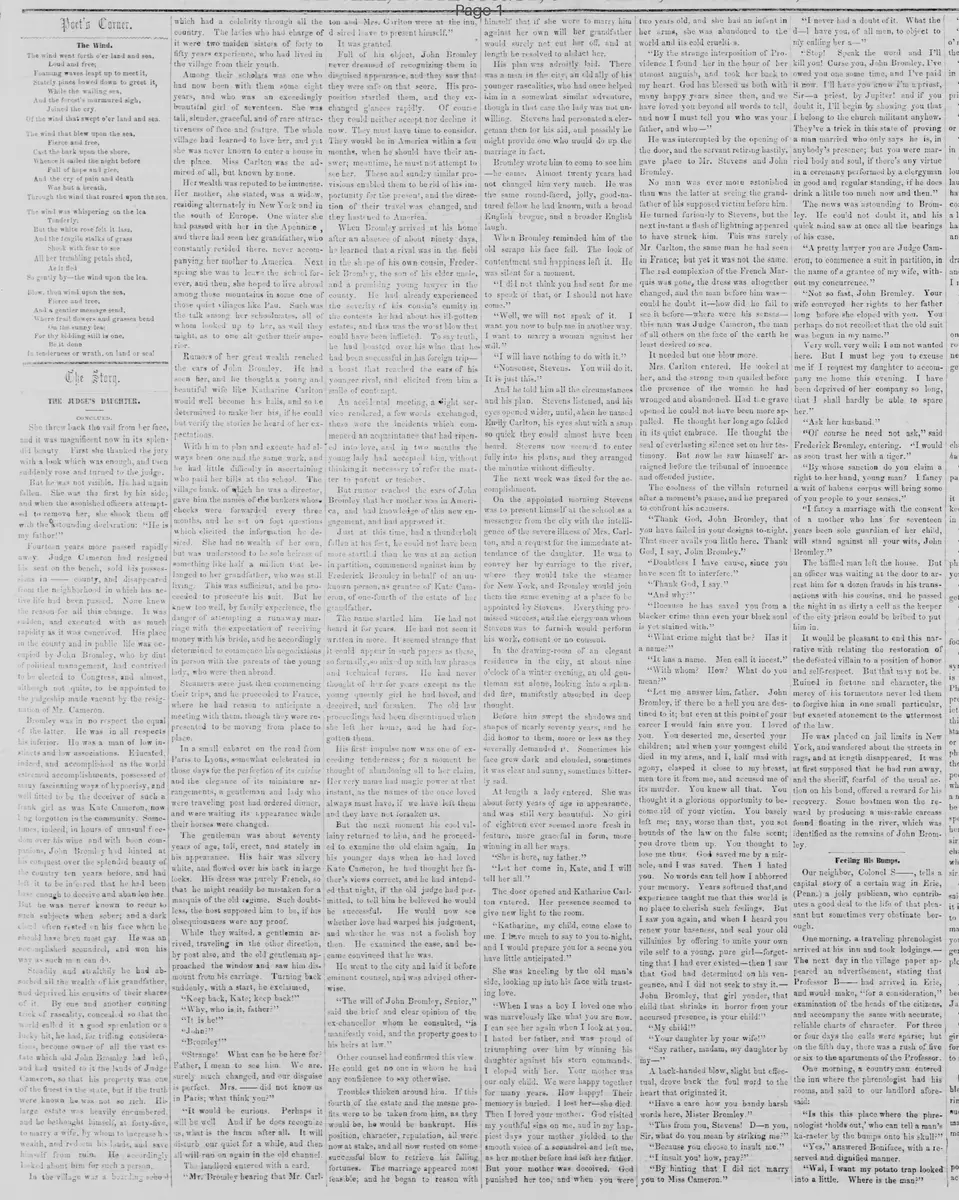
THE JUDGE'S DAUGHTER.
CONCLUDED.
She threw back the veil from her face, and it was magnificent now in its splendid beauty. First she thanked the jury with a look which was enough, and then suddenly rose and turned to the judge.
But he was not visible. He had again fallen. She was the first by his side; and when the astonished officers attempted to remove her, she shook them off with the astounding declaration: "He is my father!"
Fourteen years more passed rapidly away. Judge Cameron had resigned his seat on the bench, sold his possessions in -- county, and disappeared from the neighborhood in which his active life had been passed. None knew the reason for all this change. It was sudden, and executed with as much rapidity as it was conceived. His place in the county and in public life was occupied by John Bromley, who by dint of political management, had contrived to be elected to Congress, and almost, although not quite, to be appointed to the judgeship made vacant by the resignation of Mr. Cameron.
Bromley was in no respect the equal of the latter. He was in all respects his inferior. He was a man of low instincts and low associations. Educated, indeed, and accomplished as the world esteemed accomplishments, possessed of many fascinating ways of hypocrisy, and well fitted to be the deceiver of such a frank girl as was Kate Cameron, now long forgotten in the community. Sometimes, indeed, in hours of unusual freedom over his wine and with boon companions, John Bromley had hinted at his conquest over the splendid beauty of the country ten years before, and had left it to be inferred that he had been base enough to deceive and abandon her.
But he was never known to recur to such subjects when sober; and a dark cloud often rested on his face when he should have been most gay. He was an accomplished scoundrel, and won his way as such men can do.
Steadily and stealthily he had absorbed all the wealth of his grandfather, and deprived his cousins of their shares of it. By one and another cunning trick of rascality, concealed so that the world called it a good speculation or a lucky hit, he had, for trifling considerations, become owner of all the vast estate which old John Bromley had left, and had united to it the lands of Judge Cameron, so that his property was one of the finest in the state, but if the truth were known he was not so rich. His large estate was heavily encumbered and he bethought himself, at forty-five, to marry a wife, by whom to increase his wealth, and redeem his lands, and save himself from ruin. He accordingly looked about him for such a person.
In the village was a boarding school which had a celebrity through all the country. The ladies who had charge of it were two maiden sisters of forty to fifty years experience, who had lived in the village from their youth.
Among their scholars was one who had now been with them some eight years, and who was an exceedingly beautiful girl of seventeen. She was tall, slender, graceful, and of rare attractiveness of face and feature. The whole village had learned to love her, and yet she was never known to enter a house in the place. Miss Carlton was the admired of all, but known by none.
Her wealth was reputed to be immense. Her mother, she stated, was a widow, residing alternately in New York and in the south of Europe. One winter she had passed with her in the Apennines and there had seen her grandfather, who constantly resided there, never accompanying her mother to America. Next spring she was to leave the school forever, and then, she hoped to live abroad among those mountains in some one of those quiet villages like Pau. Such was the talk among her schoolmates, all of whom looked up to her, as well they might, as to one altogether their superior.
Rumors of her great wealth reached the ears of John Bromley. He had seen her, and he thought a young and beautiful wife like Katharine Carlton would well become his halls, and so he determined to make her his, if he could but verify the stories he heard of her expectations.
With him to plan and execute had always been one and the same work, and he had little difficulty in ascertaining who paid her bills at the school. The village bank, of which he was a director, gave him the names of the bankers whose checks were forwarded every three months, and he set on foot questions which elicited the information he desired. She had no wealth of her own but was understood to be sole heiress of something like half a million that belonged to her grandfather, who was still living. This was sufficient, and he proceeded to prosecute his suit. But he knew too well, by family experience, the danger of attempting a runaway marriage with the expectation of receiving money with his bride, and he accordingly determined to commence his negotiations in person with the parents of the young lady, who were then abroad.
Steamers were just then commencing their trips, and he proceeded to France, where he had reason to anticipate a meeting with them, though they were represented to be moving from place to place.
In a small cabaret on the road from Paris to Lyons, somewhat celebrated in those days for the perfection of its cuisine and the elegance of its miniature arrangements, a gentleman and lady who were traveling post had ordered dinner, and were waiting its appearance while their horses were changed.
The gentleman was about seventy years of age, tall, erect, and stately in his appearance. His hair was silvery white, and flowed over his back in large locks. His dress was purely French, so that he might readily be mistaken for a marquis of the old regime. Such doubtless, the host supposed him to be, if his obsequiousness were any proof.
While they waited, a gentleman arrived, traveling in the other direction by post also, and the old gentleman approached the window and saw him dismount from his carriage. Turning back suddenly, with a start, he exclaimed,
"Keep back, Kate; keep back!"
"Why, who is it, father?"
"It is he!"
"John:"
"Bromley!"
"Strange! What can he be here for: Father, I mean to see him. We are surely much changed, and our disguise is perfect. Mrs. --did not know us in Paris; what think you?"
It would be curious. Perhaps it will be well. And if he does recognize us, what is the harm after all. It will disturb our quiet for a while, and then all will run on again in the old channel.
The landlord entered with a card.
"Mr. Bromley hearing that Mr. Carlton"
It was granted.
Full of his object, John Bromley never dreamed of recognizing them in disguised appearance, and they saw that they were safe on that score. His proposition startled them, and they exchanged glances rapidly. Of course they could neither accept nor decline it now. They must have time to consider. They would be in America within a few months, when he should have their answer; meantime, he must not attempt to see her. These and sundry similar provisions enabled them to be rid of his importunity for the present, and the direction of their travel was changed, and they hastened to America.
When Bromley arrived at his home after an absence of about ninety days, he learned that a rival was in the field in the shape of his own cousin, Frederick Bromley, the son of his elder uncle, and a promising young lawyer in the county. He had already experienced the severity of his cousin's enmity in the contests he had about his ill-gotten estates, and this was the worst blow that could have been inflicted. To say truth, he had boasted over his wine that he had been successful in his foreign trip- a boast that reached the ears of his younger rival, and elicited from him a smile of contempt.
An accidental meeting, a slight service rendered, a few words exchanged, these were the incidents which commenced an acquaintance that had ripened into love, and in two months the young lady had accepted him, without thinking it necessary to refer the matter to parent or teacher.
But rumor reached the ears of John Bromley that her mother was in America, and had knowledge of this new engagement, and had approved it.
Just at this time, had a thunderbolt fallen at his feet, he could not have been more startled than he was at an action in partition, commenced against him by Frederick Bromley in behalf of an unknown person, as grantee of Kate Cameron, of one-fourth of the estate of her grandfather.
The name startled him. He had not heard it for years. He had not seen it written in more. It seemed strange that it could appear in such papers as these, so formally, so mixed up with law phrases and technical terms. He had never thought of her for years except as the young queenly girl he had loved, and deceived, and forsaken. The old law proceedings had been discontinued when she left her home, and he had forgotten them.
His first impulse now was one of exceeding tenderness; for a moment he thought of abandoning all to her claim. Her very name had magic power at that instant, as the names of the once loved always must have, if we have left them and they have not forsaken us.
But the next moment his cool villainy returned to him, and he proceeded to examine the old claim again. In his younger days when he had loved Kate Cameron, he had thought her father's views correct, and he had intended that night, if the old judge had permitted, to tell him he believed he would be successful. He would now see whether love had warped his judgment, and whether he was not a foolish boy then. He examined the case, and became convinced that he was.
He went to the city and laid it before eminent counsel, and was advised otherwise.
"The will of John Bromley, Senior," said the brief and clear opinion of the ex-chancellor whom he consulted, "is manifestly void, and the property goes to his heirs at law."
Other counsel had confirmed this view. He could get no one in whom he had any confidence to say otherwise.
Troubles thicken around him. If this fourth of the estate and the mesne profits were to be taken from him, as they would be, he would be bankrupt. His position, character, reputation, all were now at stake, and all now rested on some successful blow to retrieve his falling fortunes. The marriage appeared most feasible; and he began to reason with himself that if she were to marry him against her own will her grandfather would surely not cut her off, and at length he resolved to abduct her.
His plan was adroitly laid. There was a man in the city, an old ally of his younger rascallties, who had once helped him in a somewhat similar adventure, though in that case the lady was not unwilling. Stevens had personated a clergyman then for his aid, and possibly he might provide one who would do up the marriage in fact.
Bromley wrote him to come to see him --he came. Almost twenty years had not changed him very much. He was the same round-faced, jolly, good-natured fellow he had known, with a broad English brogue, and a broader English laugh.
When Bromley reminded him of the old scrape his face fell. The look of contentment and happiness left it. He was silent for a moment.
"I did not think you had sent for me to speak of that, or I should not have come."
"Well, we will not speak of it. I want you now to help me in another way. I want to marry a woman against her will."
"I will have nothing to do with it."
"Nonsense, Stevens. You will do it. It is just this."
And he told him all the circumstances and his plan. Stevens listened, and his eyes opened wider, until, when he named Emily Carlton, his eyes shut with a snap so quick they could almost have been heard. Stevens now seemed to enter fully into his plans, and they arranged the minutiae without difficulty.
The next week was fixed for the accomplishment.
On the appointed morning Stevens was to present himself at the school as a messenger from the city with the intelligence of the severe illness of Mrs. Carlton, and a request for the immediate attendance of the daughter. He was to convey her by carriage to the river, where they would take the steamer for New York, and Bromley would join them the same evening at a place to be appointed by Stevens. Everything promised success, and the clergyman whom Stevens was to furnish would perform his work, consent or no consent.
In the drawing-room of an elegant residence in the city, at about nine o'clock of a winter evening, an old gentleman sat alone, looking into a splendid fire, manifestly absorbed in deep thought.
Before him swept the shadows and shapes of nearly seventy years, and he did honor to them, more or less as they severally demanded it. Sometimes his face grew dark and clouded, sometimes it was clear and sunny, sometimes bitterly sad.
At length a lady entered. She was about forty years of age in appearance, and was still very beautiful. No girl of eighteen ever seemed more fresh in feature, more graceful in form, more winning in all her ways.
"She is here, my father."
"Let her come in, Kate, and I will tell her all"
The door opened and Katharine Carlton entered. Her presence seemed to give new light to the room.
"Katharine, my child, come close to me. I have much to say to you to-night, and I would prepare you for a scene you have little anticipated."
She was kneeling by the old man's side, looking up into his face with trusting love.
"When I was a boy I loved one who was marvelously like what you are now. I can see her again when I look at you. I hated her father, and was proud of triumphing over him by winning his daughter against his stern commands. I eloped with her. Your mother was our only child. We were happy together for many years. How happy! Their memory is buried. I lost her-she died. Then I loved your mother. God visited my youthful sins on me, and in my happiest days your mother yielded to the smooth voice of a scoundrel and left me, as her mother before had left her father.
But your mother was deceived. God punished her too, and when you were two years old, and she had an infant in her arms, she was abandoned to the world and its cold cruelties.
"By the strange interposition of Providence I found her in the hour of her utmost anguish, and took her back to my heart. God has blessed us both with many happy years since then, and we have loved you beyond all words to tell, and now I must tell you who was your father, and who-"
He was interrupted by the opening of the door, and the servant retiring hastily, gave place to Mr. Stevens and John Bromley.
No man was ever more astonished than was the latter at seeing the grandfather of his supposed victim before him. He turned furiously to Stevens, but the next instant a flash of lightning appeared to have struck him. This was surely Mr. Carlton, the same man he had seen in France; but yet it was not the same. The red complexion of the French Marquis was gone, the dress was altogether changed, and the man before him was- could he doubt it-how did he fail to see it before-where were his senses- this man was Judge Cameron, the man of all others on the face of the earth he least desired to see.
It needed but one blow more.
Mrs. Carlton entered. He looked at her, and the strong man quailed before the presence of the woman he had wronged and abandoned. Had the grave opened he could not have been more appalled. He thought her long ago folded in its quiet embrace. He thought the seal of everlasting silence set on her testimony. But now he saw himself arraigned before the tribunal of innocence and offended justice.
The coolness of the villain returned after a moment's pause, and he prepared to confront his accusers.
"Thank God, John Bromley, that you have failed in your designs to-night. That sneer avails you little here. Thank God, I say, John Bromley."
"Doubtless I have cause, since you have seen fit to interfere."
"Thank God, I say."
"And why?"
"Because he has saved you from a blacker crime than even your black soul is yet stained with."
"What crime might that be? Has it a name?"
"It has a name. Men call it incest."
"With whom? How? What do you mean?"
"Let me answer him, father. John Bromley, if there be a hell you are destined to it; but even at this point of your career I would fain save you. I loved you. You deserted me, deserted your children; and when your youngest child died in my arms, and I, half mad with agony, clasped it close to my breast, men tore it from me, and accused me of its murder. You knew all that. You thought it a glorious opportunity to become rid of your victim. You basely left me; nay, worse than that, you set hounds of the law on the false scent; you drove them up. You thought to lose me thus. God saved me by a miracle, and I was saved. Then I hated you. No words can tell how I abhorred your memory. Years softened that, and experience taught me that this world is no place to cherish such feelings. But I saw you again, and when I heard you renew your baseness, and seal your old villainies by offering to unite your own vile self to a young, pure girl--forgetting that I had ever existed-then I saw that God had determined on his vengeance, and I did not seek to stay it.
John Bromley, that girl yonder, that child that shrinks in horror from your accursed presence, is your child!"
"My child!"
"Your daughter by your wife!"
"Say rather, madam, my daughter by my-"
A back-handed blow, slight but effectual, drove back the foul word to the heart that originated it.
"Have a care how you bandy harsh words here, Mister Bromley."
"This from you, Stevens! D-n you. Sir, what do you mean by striking me?"
"Because you choose to insult me."
"I insult you! how, pray?"
"By hinting that I did not marry you to Miss Cameron."
"I never had a doubt of it. What the d--l have you, of all men, to object to my calling her a--"
"Stop! Speak the word and I'll kill you! Curse you, John Bromley, I've owed you one some time, and I've paid it now. I'll have you know I'm a priest, Sir-a priest, by Jupiter! and if you doubt it, I'll begin by showing you that I belong to the church militant anyhow.
They've a trick in this state of proving a man married who only says he is, in anybody's presence; but you were married body and soul, if there's any virtue in a ceremony performed by a clergyman in good and regular standing, if he does drink a little too much now and then."
The news was astounding to Bromley. He could not doubt it, and his quick mind saw at once all the bearings of his case.
"A pretty lawyer you are Judge Cameron, to commence a suit in partition, in the name of a grantee of my wife, without my concurrence."
"Not so fast, John Bromley. Your wife conveyed her rights to her father long before she eloped with you. You perhaps do not recollect that the old suit was begun in my name."
Very well, very well; I am not wanted here. But I must beg you to excuse me if I request my daughter to accompany me home this evening. I have been deprived of her company so long, that I shall hardly be able to spare her."
"Ask her husband."
"Of course he need not ask," said Frederick Bromley, entering. "I would as soon trust her with a tiger."
"By whose sanction do you claim a right to her hand, young man? I fancy a writ of habeas corpus will bring some of you people to your senses."
"I fancy a marriage with the consent of a mother who has for seventeen years been sole guardian of her child, will stand against all your wits, John Bromley."
The baffled man left the house. But an officer was waiting at the door to arrest him for a dozen frauds in his transactions with his cousins, and he passed the night in as dirty a cell as the keeper of the city prison could be bribed to put him in.
It would be pleasant to end this narrative with relating the restoration of the defeated villain to a position of honor and self-respect. But that may not be. Ruined in fortune and character, the mercy of his tormentors never led them to forgive him in one small particular, but exacted atonement to the uttermost of the law.
He was placed on jail limits in New York, and wandered about the streets in rags, and at length disappeared. It was at first supposed that he had run away, and the sheriff, fearful of the usual action on his bond, offered a reward for his recovery. Some boatmen won the reward by producing a miserable carcass found floating in the river, which was identified as the remains of John Bromley.
CONCLUDED.
She threw back the veil from her face, and it was magnificent now in its splendid beauty. First she thanked the jury with a look which was enough, and then suddenly rose and turned to the judge.
But he was not visible. He had again fallen. She was the first by his side; and when the astonished officers attempted to remove her, she shook them off with the astounding declaration: "He is my father!"
Fourteen years more passed rapidly away. Judge Cameron had resigned his seat on the bench, sold his possessions in -- county, and disappeared from the neighborhood in which his active life had been passed. None knew the reason for all this change. It was sudden, and executed with as much rapidity as it was conceived. His place in the county and in public life was occupied by John Bromley, who by dint of political management, had contrived to be elected to Congress, and almost, although not quite, to be appointed to the judgeship made vacant by the resignation of Mr. Cameron.
Bromley was in no respect the equal of the latter. He was in all respects his inferior. He was a man of low instincts and low associations. Educated, indeed, and accomplished as the world esteemed accomplishments, possessed of many fascinating ways of hypocrisy, and well fitted to be the deceiver of such a frank girl as was Kate Cameron, now long forgotten in the community. Sometimes, indeed, in hours of unusual freedom over his wine and with boon companions, John Bromley had hinted at his conquest over the splendid beauty of the country ten years before, and had left it to be inferred that he had been base enough to deceive and abandon her.
But he was never known to recur to such subjects when sober; and a dark cloud often rested on his face when he should have been most gay. He was an accomplished scoundrel, and won his way as such men can do.
Steadily and stealthily he had absorbed all the wealth of his grandfather, and deprived his cousins of their shares of it. By one and another cunning trick of rascality, concealed so that the world called it a good speculation or a lucky hit, he had, for trifling considerations, become owner of all the vast estate which old John Bromley had left, and had united to it the lands of Judge Cameron, so that his property was one of the finest in the state, but if the truth were known he was not so rich. His large estate was heavily encumbered and he bethought himself, at forty-five, to marry a wife, by whom to increase his wealth, and redeem his lands, and save himself from ruin. He accordingly looked about him for such a person.
In the village was a boarding school which had a celebrity through all the country. The ladies who had charge of it were two maiden sisters of forty to fifty years experience, who had lived in the village from their youth.
Among their scholars was one who had now been with them some eight years, and who was an exceedingly beautiful girl of seventeen. She was tall, slender, graceful, and of rare attractiveness of face and feature. The whole village had learned to love her, and yet she was never known to enter a house in the place. Miss Carlton was the admired of all, but known by none.
Her wealth was reputed to be immense. Her mother, she stated, was a widow, residing alternately in New York and in the south of Europe. One winter she had passed with her in the Apennines and there had seen her grandfather, who constantly resided there, never accompanying her mother to America. Next spring she was to leave the school forever, and then, she hoped to live abroad among those mountains in some one of those quiet villages like Pau. Such was the talk among her schoolmates, all of whom looked up to her, as well they might, as to one altogether their superior.
Rumors of her great wealth reached the ears of John Bromley. He had seen her, and he thought a young and beautiful wife like Katharine Carlton would well become his halls, and so he determined to make her his, if he could but verify the stories he heard of her expectations.
With him to plan and execute had always been one and the same work, and he had little difficulty in ascertaining who paid her bills at the school. The village bank, of which he was a director, gave him the names of the bankers whose checks were forwarded every three months, and he set on foot questions which elicited the information he desired. She had no wealth of her own but was understood to be sole heiress of something like half a million that belonged to her grandfather, who was still living. This was sufficient, and he proceeded to prosecute his suit. But he knew too well, by family experience, the danger of attempting a runaway marriage with the expectation of receiving money with his bride, and he accordingly determined to commence his negotiations in person with the parents of the young lady, who were then abroad.
Steamers were just then commencing their trips, and he proceeded to France, where he had reason to anticipate a meeting with them, though they were represented to be moving from place to place.
In a small cabaret on the road from Paris to Lyons, somewhat celebrated in those days for the perfection of its cuisine and the elegance of its miniature arrangements, a gentleman and lady who were traveling post had ordered dinner, and were waiting its appearance while their horses were changed.
The gentleman was about seventy years of age, tall, erect, and stately in his appearance. His hair was silvery white, and flowed over his back in large locks. His dress was purely French, so that he might readily be mistaken for a marquis of the old regime. Such doubtless, the host supposed him to be, if his obsequiousness were any proof.
While they waited, a gentleman arrived, traveling in the other direction by post also, and the old gentleman approached the window and saw him dismount from his carriage. Turning back suddenly, with a start, he exclaimed,
"Keep back, Kate; keep back!"
"Why, who is it, father?"
"It is he!"
"John:"
"Bromley!"
"Strange! What can he be here for: Father, I mean to see him. We are surely much changed, and our disguise is perfect. Mrs. --did not know us in Paris; what think you?"
It would be curious. Perhaps it will be well. And if he does recognize us, what is the harm after all. It will disturb our quiet for a while, and then all will run on again in the old channel.
The landlord entered with a card.
"Mr. Bromley hearing that Mr. Carlton"
It was granted.
Full of his object, John Bromley never dreamed of recognizing them in disguised appearance, and they saw that they were safe on that score. His proposition startled them, and they exchanged glances rapidly. Of course they could neither accept nor decline it now. They must have time to consider. They would be in America within a few months, when he should have their answer; meantime, he must not attempt to see her. These and sundry similar provisions enabled them to be rid of his importunity for the present, and the direction of their travel was changed, and they hastened to America.
When Bromley arrived at his home after an absence of about ninety days, he learned that a rival was in the field in the shape of his own cousin, Frederick Bromley, the son of his elder uncle, and a promising young lawyer in the county. He had already experienced the severity of his cousin's enmity in the contests he had about his ill-gotten estates, and this was the worst blow that could have been inflicted. To say truth, he had boasted over his wine that he had been successful in his foreign trip- a boast that reached the ears of his younger rival, and elicited from him a smile of contempt.
An accidental meeting, a slight service rendered, a few words exchanged, these were the incidents which commenced an acquaintance that had ripened into love, and in two months the young lady had accepted him, without thinking it necessary to refer the matter to parent or teacher.
But rumor reached the ears of John Bromley that her mother was in America, and had knowledge of this new engagement, and had approved it.
Just at this time, had a thunderbolt fallen at his feet, he could not have been more startled than he was at an action in partition, commenced against him by Frederick Bromley in behalf of an unknown person, as grantee of Kate Cameron, of one-fourth of the estate of her grandfather.
The name startled him. He had not heard it for years. He had not seen it written in more. It seemed strange that it could appear in such papers as these, so formally, so mixed up with law phrases and technical terms. He had never thought of her for years except as the young queenly girl he had loved, and deceived, and forsaken. The old law proceedings had been discontinued when she left her home, and he had forgotten them.
His first impulse now was one of exceeding tenderness; for a moment he thought of abandoning all to her claim. Her very name had magic power at that instant, as the names of the once loved always must have, if we have left them and they have not forsaken us.
But the next moment his cool villainy returned to him, and he proceeded to examine the old claim again. In his younger days when he had loved Kate Cameron, he had thought her father's views correct, and he had intended that night, if the old judge had permitted, to tell him he believed he would be successful. He would now see whether love had warped his judgment, and whether he was not a foolish boy then. He examined the case, and became convinced that he was.
He went to the city and laid it before eminent counsel, and was advised otherwise.
"The will of John Bromley, Senior," said the brief and clear opinion of the ex-chancellor whom he consulted, "is manifestly void, and the property goes to his heirs at law."
Other counsel had confirmed this view. He could get no one in whom he had any confidence to say otherwise.
Troubles thicken around him. If this fourth of the estate and the mesne profits were to be taken from him, as they would be, he would be bankrupt. His position, character, reputation, all were now at stake, and all now rested on some successful blow to retrieve his falling fortunes. The marriage appeared most feasible; and he began to reason with himself that if she were to marry him against her own will her grandfather would surely not cut her off, and at length he resolved to abduct her.
His plan was adroitly laid. There was a man in the city, an old ally of his younger rascallties, who had once helped him in a somewhat similar adventure, though in that case the lady was not unwilling. Stevens had personated a clergyman then for his aid, and possibly he might provide one who would do up the marriage in fact.
Bromley wrote him to come to see him --he came. Almost twenty years had not changed him very much. He was the same round-faced, jolly, good-natured fellow he had known, with a broad English brogue, and a broader English laugh.
When Bromley reminded him of the old scrape his face fell. The look of contentment and happiness left it. He was silent for a moment.
"I did not think you had sent for me to speak of that, or I should not have come."
"Well, we will not speak of it. I want you now to help me in another way. I want to marry a woman against her will."
"I will have nothing to do with it."
"Nonsense, Stevens. You will do it. It is just this."
And he told him all the circumstances and his plan. Stevens listened, and his eyes opened wider, until, when he named Emily Carlton, his eyes shut with a snap so quick they could almost have been heard. Stevens now seemed to enter fully into his plans, and they arranged the minutiae without difficulty.
The next week was fixed for the accomplishment.
On the appointed morning Stevens was to present himself at the school as a messenger from the city with the intelligence of the severe illness of Mrs. Carlton, and a request for the immediate attendance of the daughter. He was to convey her by carriage to the river, where they would take the steamer for New York, and Bromley would join them the same evening at a place to be appointed by Stevens. Everything promised success, and the clergyman whom Stevens was to furnish would perform his work, consent or no consent.
In the drawing-room of an elegant residence in the city, at about nine o'clock of a winter evening, an old gentleman sat alone, looking into a splendid fire, manifestly absorbed in deep thought.
Before him swept the shadows and shapes of nearly seventy years, and he did honor to them, more or less as they severally demanded it. Sometimes his face grew dark and clouded, sometimes it was clear and sunny, sometimes bitterly sad.
At length a lady entered. She was about forty years of age in appearance, and was still very beautiful. No girl of eighteen ever seemed more fresh in feature, more graceful in form, more winning in all her ways.
"She is here, my father."
"Let her come in, Kate, and I will tell her all"
The door opened and Katharine Carlton entered. Her presence seemed to give new light to the room.
"Katharine, my child, come close to me. I have much to say to you to-night, and I would prepare you for a scene you have little anticipated."
She was kneeling by the old man's side, looking up into his face with trusting love.
"When I was a boy I loved one who was marvelously like what you are now. I can see her again when I look at you. I hated her father, and was proud of triumphing over him by winning his daughter against his stern commands. I eloped with her. Your mother was our only child. We were happy together for many years. How happy! Their memory is buried. I lost her-she died. Then I loved your mother. God visited my youthful sins on me, and in my happiest days your mother yielded to the smooth voice of a scoundrel and left me, as her mother before had left her father.
But your mother was deceived. God punished her too, and when you were two years old, and she had an infant in her arms, she was abandoned to the world and its cold cruelties.
"By the strange interposition of Providence I found her in the hour of her utmost anguish, and took her back to my heart. God has blessed us both with many happy years since then, and we have loved you beyond all words to tell, and now I must tell you who was your father, and who-"
He was interrupted by the opening of the door, and the servant retiring hastily, gave place to Mr. Stevens and John Bromley.
No man was ever more astonished than was the latter at seeing the grandfather of his supposed victim before him. He turned furiously to Stevens, but the next instant a flash of lightning appeared to have struck him. This was surely Mr. Carlton, the same man he had seen in France; but yet it was not the same. The red complexion of the French Marquis was gone, the dress was altogether changed, and the man before him was- could he doubt it-how did he fail to see it before-where were his senses- this man was Judge Cameron, the man of all others on the face of the earth he least desired to see.
It needed but one blow more.
Mrs. Carlton entered. He looked at her, and the strong man quailed before the presence of the woman he had wronged and abandoned. Had the grave opened he could not have been more appalled. He thought her long ago folded in its quiet embrace. He thought the seal of everlasting silence set on her testimony. But now he saw himself arraigned before the tribunal of innocence and offended justice.
The coolness of the villain returned after a moment's pause, and he prepared to confront his accusers.
"Thank God, John Bromley, that you have failed in your designs to-night. That sneer avails you little here. Thank God, I say, John Bromley."
"Doubtless I have cause, since you have seen fit to interfere."
"Thank God, I say."
"And why?"
"Because he has saved you from a blacker crime than even your black soul is yet stained with."
"What crime might that be? Has it a name?"
"It has a name. Men call it incest."
"With whom? How? What do you mean?"
"Let me answer him, father. John Bromley, if there be a hell you are destined to it; but even at this point of your career I would fain save you. I loved you. You deserted me, deserted your children; and when your youngest child died in my arms, and I, half mad with agony, clasped it close to my breast, men tore it from me, and accused me of its murder. You knew all that. You thought it a glorious opportunity to become rid of your victim. You basely left me; nay, worse than that, you set hounds of the law on the false scent; you drove them up. You thought to lose me thus. God saved me by a miracle, and I was saved. Then I hated you. No words can tell how I abhorred your memory. Years softened that, and experience taught me that this world is no place to cherish such feelings. But I saw you again, and when I heard you renew your baseness, and seal your old villainies by offering to unite your own vile self to a young, pure girl--forgetting that I had ever existed-then I saw that God had determined on his vengeance, and I did not seek to stay it.
John Bromley, that girl yonder, that child that shrinks in horror from your accursed presence, is your child!"
"My child!"
"Your daughter by your wife!"
"Say rather, madam, my daughter by my-"
A back-handed blow, slight but effectual, drove back the foul word to the heart that originated it.
"Have a care how you bandy harsh words here, Mister Bromley."
"This from you, Stevens! D-n you. Sir, what do you mean by striking me?"
"Because you choose to insult me."
"I insult you! how, pray?"
"By hinting that I did not marry you to Miss Cameron."
"I never had a doubt of it. What the d--l have you, of all men, to object to my calling her a--"
"Stop! Speak the word and I'll kill you! Curse you, John Bromley, I've owed you one some time, and I've paid it now. I'll have you know I'm a priest, Sir-a priest, by Jupiter! and if you doubt it, I'll begin by showing you that I belong to the church militant anyhow.
They've a trick in this state of proving a man married who only says he is, in anybody's presence; but you were married body and soul, if there's any virtue in a ceremony performed by a clergyman in good and regular standing, if he does drink a little too much now and then."
The news was astounding to Bromley. He could not doubt it, and his quick mind saw at once all the bearings of his case.
"A pretty lawyer you are Judge Cameron, to commence a suit in partition, in the name of a grantee of my wife, without my concurrence."
"Not so fast, John Bromley. Your wife conveyed her rights to her father long before she eloped with you. You perhaps do not recollect that the old suit was begun in my name."
Very well, very well; I am not wanted here. But I must beg you to excuse me if I request my daughter to accompany me home this evening. I have been deprived of her company so long, that I shall hardly be able to spare her."
"Ask her husband."
"Of course he need not ask," said Frederick Bromley, entering. "I would as soon trust her with a tiger."
"By whose sanction do you claim a right to her hand, young man? I fancy a writ of habeas corpus will bring some of you people to your senses."
"I fancy a marriage with the consent of a mother who has for seventeen years been sole guardian of her child, will stand against all your wits, John Bromley."
The baffled man left the house. But an officer was waiting at the door to arrest him for a dozen frauds in his transactions with his cousins, and he passed the night in as dirty a cell as the keeper of the city prison could be bribed to put him in.
It would be pleasant to end this narrative with relating the restoration of the defeated villain to a position of honor and self-respect. But that may not be. Ruined in fortune and character, the mercy of his tormentors never led them to forgive him in one small particular, but exacted atonement to the uttermost of the law.
He was placed on jail limits in New York, and wandered about the streets in rags, and at length disappeared. It was at first supposed that he had run away, and the sheriff, fearful of the usual action on his bond, offered a reward for his recovery. Some boatmen won the reward by producing a miserable carcass found floating in the river, which was identified as the remains of John Bromley.
What sub-type of article is it?
Prose Fiction
What themes does it cover?
Moral Virtue
What keywords are associated?
Judges Daughter
Betrayal
Incest Revelation
Justice
Villain Ruin
Literary Details
Title
The Judge's Daughter.
Key Lines
"He Is My Father!"
"It Has A Name. Men Call It Incest."
"John Bromley, That Girl Yonder, That Child That Shrinks In Horror From Your Accursed Presence, Is Your Child!"
"I'm A Priest, Sir A Priest, By Jupiter!"
Ruined In Fortune And Character, The Mercy Of His Tormentors Never Led Them To Forgive Him In One Small Particular, But Exacted Atonement To The Uttermost Of The Law.