Thank you for visiting SNEWPapers!
Sign up free
Story
November 4, 1915
The Ward County Independent
Minot, Ward County, North Dakota
What is this article about?
Homer White, a young man from Iowa, died after being run over by a train while riding the rods near Churchs Ferry. His leg was severed, leading to amputation and death from blood loss.
Clipping
OCR Quality
98%
Excellent
Full Text
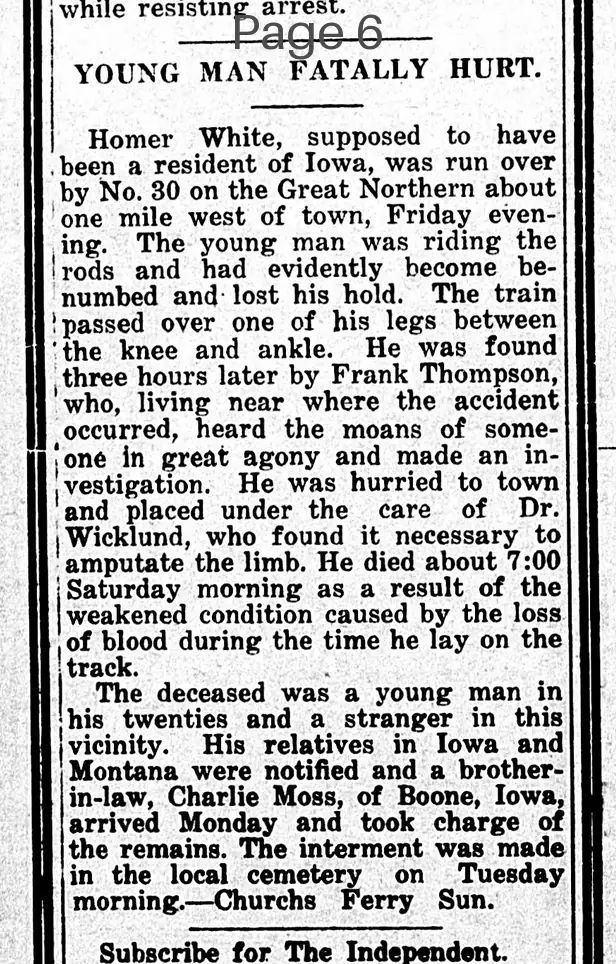
YOUNG MAN FATALLY HURT.
Homer White, supposed to have been a resident of Iowa, was run over by No. 30 on the Great Northern about one mile west of town, Friday evening. The young man was riding the rods and had evidently become benumbed and lost his hold. The train passed over one of his legs between the knee and ankle.
He was found three hours later by Frank Thompson, who, living near where the accident occurred, heard the moans of someone in great agony and made an investigation. He was hurried to town and placed under the care of Dr. Wicklund, who found it necessary to amputate the limb. He died about 7:00 Saturday morning as a result of the weakened condition caused by the loss of blood during the time he lay on the track.
The deceased was a young man in his twenties and a stranger in this vicinity. His relatives in Iowa and Montana were notified and a brother-in-law, Charlie Moss, of Boone, Iowa, arrived Monday and took charge of the remains. The interment was made in the local cemetery on Tuesday morning.-Churchs Ferry Sun.
Homer White, supposed to have been a resident of Iowa, was run over by No. 30 on the Great Northern about one mile west of town, Friday evening. The young man was riding the rods and had evidently become benumbed and lost his hold. The train passed over one of his legs between the knee and ankle.
He was found three hours later by Frank Thompson, who, living near where the accident occurred, heard the moans of someone in great agony and made an investigation. He was hurried to town and placed under the care of Dr. Wicklund, who found it necessary to amputate the limb. He died about 7:00 Saturday morning as a result of the weakened condition caused by the loss of blood during the time he lay on the track.
The deceased was a young man in his twenties and a stranger in this vicinity. His relatives in Iowa and Montana were notified and a brother-in-law, Charlie Moss, of Boone, Iowa, arrived Monday and took charge of the remains. The interment was made in the local cemetery on Tuesday morning.-Churchs Ferry Sun.
What sub-type of article is it?
Disaster
Tragedy
What themes does it cover?
Tragedy
Misfortune
What keywords are associated?
Train Accident
Fatal Injury
Riding Rods
Amputation
Blood Loss
What entities or persons were involved?
Homer White
Frank Thompson
Dr. Wicklund
Charlie Moss
Where did it happen?
One Mile West Of Town Near Churchs Ferry
Story Details
Key Persons
Homer White
Frank Thompson
Dr. Wicklund
Charlie Moss
Location
One Mile West Of Town Near Churchs Ferry
Event Date
Friday Evening
Story Details
Homer White was run over by a train while riding the rods, losing part of his leg; found hours later, amputated, and died from blood loss the next morning.