Thank you for visiting SNEWPapers!
Sign up free
Southern Christian Advocate
Charleston, Charleston County, South Carolina
What is this article about?
Rev. Thomas Smyth's article argues for the unity of human races originating from a single Asian center, supported by history, tradition, and science. It cites migrations from Iran post-global flood, ancient civilizations, and shared linguistic and cultural evidence across continents.
Clipping
OCR Quality
Full Text
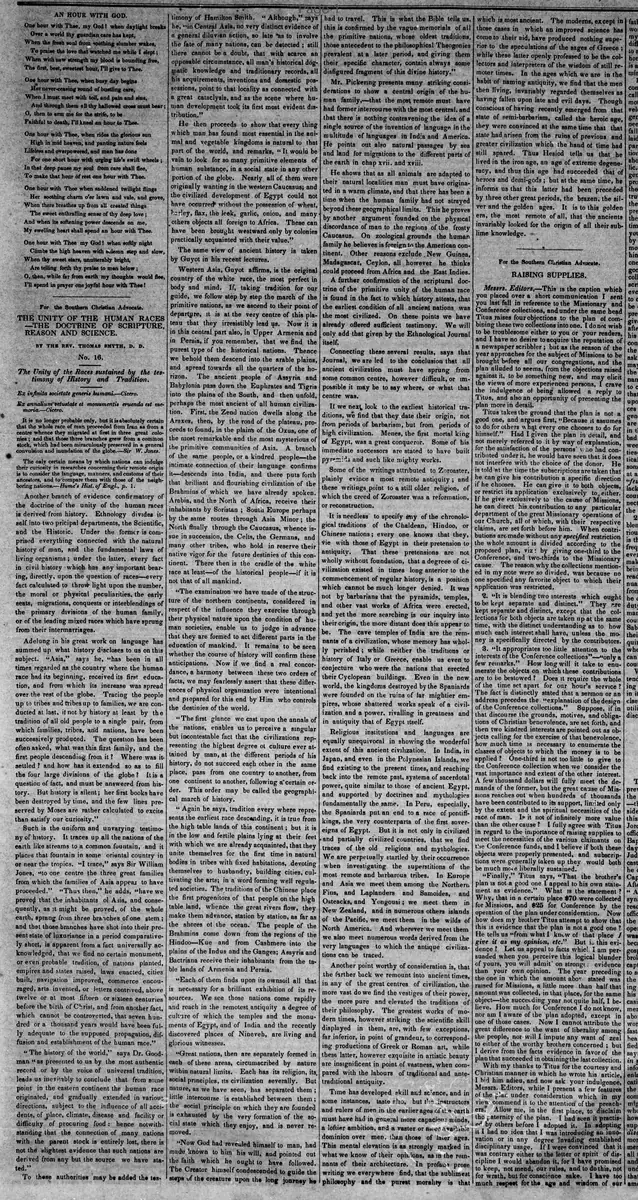
THE UNITY OF THE HUMAN RACES
THE DOCTRINE OF SCRIPTURE,
REASON AND SCIENCE.
BY THE REV. THOMAS SMYTH, D. D.
No. 16.
The Unity of the Races sustained by the testimony of History and Tradition.
Ex infinita societate generis humani.—Cicero.
Ex annalium vetustate et monumentis eruenda est memoria.—Cicero.
It is no longer probable only, but it is absolutely certain that the whole race of man proceeded from Iran as from a centre whence they migrated at first in three great colonies; and that those three branches grew from a common stock, which had been miraculously preserved in a general convulsion and inundation of the globe. Sir W. Jones.
The only certain means by which nations can indulge their curiosity in researches concerning their remote origin is to consider the language, manners, and customs of their ancestors, and to compare them with those of the neighboring nations.—Hume's Hist. of Engl., p. 1.
Another branch of evidence confirmatory of the doctrine of the unity of the human races is derived from history. Ethnology divides itself into two principal departments, the Scientific, and the Historic. Under the former is comprised everything connected with the natural history of man, and the fundamental laws of living organisms; under the latter, every fact in civil history which has any important bearing, directly, upon the question of races—every fact calculated to throw light upon the number, the moral or physical peculiarities, the early seats, migrations, conquests or interblendings of the primary divisions of the human family, or of the leading mixed races which have sprung from their intermarriages.
Adelung in his great work on language has summed up what history discloses to us on this subject. "Asia," says he, "has been in all times regarded as the country where the human race had its beginning, received its first education, and from which its increase was spread over the rest of the globe. Tracing the people up to tribes and tribes up to families, we are conducted at last, if not by history at least by the tradition of all old people to a single pair, from which families, tribes, and nations, have been successively produced. The question has been often asked, what was this first family, and the first people descending from it? Where was it settled? and how has it extended so as to fill the four large divisions of the globe? It is a question of fact, and must be answered from history. But history is silent; her first books have been destroyed by time, and the few lines preserved by Moses are rather calculated to excite than satisfy our curiosity."
Such is the uniform and unvarying testimony of history. It traces up all the nations of the earth like streams to a common fountain, and it places that fountain in some oriental country in or near the tropics. "I trace," says Sir William Jones, "to one centre the three great families from which the families of Asia appear to have proceeded." "Thus then," he adds, "have we proved that the inhabitants of Asia, and consequently, as it might be proved, of the whole earth, sprang from three branches of one stem; and that those branches have shot into their present state of luxuriance in a period comparatively short, is apparent from a fact universally acknowledged, that we find no certain monument, or even probable tradition, of nations planted, empires and states raised, laws enacted, cities built, navigation improved, commerce encouraged, arts invented, or letters contrived, above twelve or at most fifteen or sixteen centuries before the birth of Christ, and from another fact, which cannot be controverted, that seven hundred or a thousand years would have been fully adequate to the supposed propagation, diffusion and establishment of the human race."
"The history of the world," says Dr. Goodman "as presented to us by the most authentic record or by the voice of universal tradition, leads us inevitably to conclude that from some point in the eastern continent the human race originated, and gradually extended in various directions, subject to the influence of all accidents, of place, climate, disease and facility or difficulty of procuring food: hence notwithstanding that the connection of many nations with the parent stock is entirely lost, there is not the slightest evidence that such nations are derived from any but the source we have stated."
To these authorities may be added the testimony of Hamilton Smith. "Although," says he, in Central Asia, no very distinct evidence of a general diluvian action, so late as to involve the fate of many nations, can be detected; still there cannot be a doubt, that with scarce an opposable circumstance, all man's historical dogmatic knowledge and traditionary records, all his acquirements, inventions and domestic possessions, point to that locality as connected with a great cataclysism, and as the scene where human development took its first most evident distribution."
He then proceeds to show that every thing which man has found most essential in the animal and vegetable kingdoms is natural to that part of the world, and remarks, "It would be vain to look for so many primitive elements of human substance, in a social state in any other portion of the globe. Nearly all of them were originally wanting in the western Caucasus; and the civilized development of Egypt could not have occurred without the possession of wheat, barley, flax, the leek, garlic, onion, and many others objects all foreign to Africa. These can have been brought westward only by colonies practically acquainted with their value."
The same view of ancient history is taken by Guyot in his recent lectures. Western Asia, Guyot affirms, is the original country of the white race, the most perfect in body and mind. If, taking tradition for our guide, we follow step by step the march of the primitive nations, as we ascend to their point of departure, it is at the very centre of this plateau that they irresistibly lead us. Now it is in this central part also, in Upper Armenia and in Persia, if you remember, that we find the purest type of the historical nations. Thence we behold them descend into the arable plains, and spread towards all the quarters of the horizon. The ancient people of Assyria and Babylonia pass down the Euphrates and Tigris into the plains of the South, and then unfold, perhaps the most ancient of all human civilization. First, the Zend nation dwells along the Araxes, then, by the road of the plateau, proceeds to found, in the plains of the Oxus, one of the most remarkable and the most mysterious of the primitive communities of Asia. A branch of the same people, or a kindred people—the intimate connection of their language confirms it—descends into India, and there puts forth that brilliant and flourishing civilization of the Brahmins of which we have already spoken. Arabia, and the North of Africa, receive their inhabitants by Soristan; South Europe perhaps by the same routes through Asia Minor; the North finally through the Caucasus, whence issue in succession, the Celts, the Germans, and many other tribes, who hold in reserve their native vigor for the future destinies of this continent. There then is the cradle of the white race at least—of the historical people—if it is not that of all mankind.
"The examination we have made of the structure of the northern continents, considered in respect of the influence they exercise through their physical nature upon the condition of human societies, enable us to judge in advance that they are formed to act different parts in the education of mankind. It remains to be seen whether the course of history will confirm these anticipations. Now if we find a real concordance, a harmony between these two orders of facts, we may fearlessly assert that these differences of physical organization were intentional and prepared for this end by Him who controls the destinies of the world.
"The first glance we cast upon the annals of the nations, enables us to perceive a singular but incontestable fact that the civilizations representing the highest degree of culture ever attained by man, at the different periods of his history, do not succeed each other in the same place, pass from one country to another, from one continent to another, following a certain order. This order may be called the geographical march of history.
"Again he says, tradition every where represents the earliest race descending, it is true from the high table lands of this continent; but it is in the low and fertile plains lying at their feet with which we are already acquainted, that they unite themselves for the first time in natural bodies in tribes with fixed habitations, devoting themselves to husbandry, building cities, cultivating the arts; in a word forming well regulated societies. The traditions of the Chinese place the first progenitors of that people on the high table land, whence the great rivers flow, they make them advance, station by station, as far as the shores of the ocean. The people of the Brahmins come down from the regions of the Hindoo-Koosh and from Cashmere into the plains of the Indus and the Ganges; Assyria and Bactriana receive their inhabitants from the table lands of Armenia and Persia.
"Each of them finds upon its own soil all that is necessary for a brilliant exhibition of its resources. We see those nations come rapidly and reach in the remotest antiquity a degree of culture of which the temples and the monuments of Egypt, and of India and the recently discovered places of Nineveh, are living and glorious witnesses.
"Great nations, then are separately formed in each of these areas, circumscribed by nature within natural limits. Each has its religion, its social principles, its civilization severally. But nature, as we have seen, has separated them; little intercourse is established between them; the social principle on which they are founded is exhausted by the very formation of the social state which they enjoy, and is never removed.
Now God had revealed himself to man, had made known to him his will, and pointed out the faith which he ought to have followed. The Creator himself condescended to guide the steps of the creature upon the long journey he had to travel. This is what the Bible tells us, this is confirmed by the vague memorials of all the primitive nations, whose oldest traditions those antecedent to the philosophical Theogonies prevalent at a later period, and giving them their specific character, contain always some disfigured fragment of this divine history."
Mr. Pickering presents many striking considerations to show a central origin of the human family, that the most remote must have had former intercourse with the most central, and that there is nothing contravening the idea of a single source of the invention of language in the multitude of languages in India and America. He points out also natural passages by sea and land for migrations to the different parts of the earth in chap xvii. and xviii.
He shows that as all animals are adapted to their natural localities man must have originated in a warm climate, and that there has been a time when the human family had not strayed beyond these geographical limits. This he proves by another argument founded on the physical discordance of man to the regions of the frosty Caucasus. On zoological grounds the human family he believes is foreign to the American continent. Other reasons exclude New Guinea, Madagascar, Ceylon, all however he thinks could proceed from Africa and the East Indies.
A further confirmation of the scriptural doctrine of the primitive unity of the human race is found in the fact to which history attests, that the earliest condition of all ancient nations was the most civilized. On these points we have already offered sufficient testimony. We will only add that given by the Ethnological Journal itself.
Connecting these several results, says that Journal, we are led to the conclusion that all ancient civilization must have sprung from some common centre, however difficult, or impossible it may be to say where, or what that centre was.
If we next look to the earliest historical traditions, we find that they date their origin, not from periods of barbarism, but from periods of high civilization. Menes, the first mortal king of Egypt, was a great conqueror. Some of his immediate successors are stated to have built pyramids and such like mighty works.
Some of the writings attributed to Zoroaster, plainly evince a most remote antiquity; and these writings point to a still older religion, of which the creed of Zoroaster was a reformation, or reconstruction.
It is needless to specify any of the chronological traditions of the Chaldean, Hindoo, or Chinese nations; every one knows that they, vie with those of Egypt in their pretension to antiquity. That these pretensions are not wholly without foundation, that a degree of civilization existed in times long anterior to the commencement of regular history, is a position which cannot be much longer denied. It was not by barbarians that the pyramids, temples, and other vast works of Africa were erected, and yet the more searching is our inquiry into their origin, the more distant does this appear to be. The cave temples of India are the remnants of a civilization, whose memory has wholly perished; while neither the traditions or history of Italy or Greece, enable us even to conjecture who were the nations that erected their Cyclopean buildings. Even in the new world, the kingdoms destroyed by the Spaniards were founded on the ruins of far mightier empires, whose shattered works speak of a civilization and a power, rivalling in greatness and in antiquity that of Egypt itself.
Religious institutions and languages are equally unequivocal in showing the wonderful extent of this ancient civilization. In India, in Japan, and even in the Polynesian Islands, we find existing to the present times, and reaching back into the remote past, systems of sacerdotal power, quite similar to those of ancient Egypt, and supported by doctrines and mythologies fundamentally the same. In Peru, especially, the Spaniards put an end to a race of pontiff-kings, the very counterparts of the first sovereigns of Egypt. But it is not only in civilized and partially civilized countries, that we find traces of the old religions and mythologies. We are perpetually startled by their occurrence when investigating the superstitions of the most remote and barbarous tribes. In Europe and Asia we meet them among the Northern Fins, and Laplanders and Samoides, and Osteacks, and Yongousi; we meet them in New Zealand, and in numerous others islands of the Pacific, we meet them in the wilds of North America. And wherever we meet them we also meet numerous words derived from the very languages to which the antique civilizations can be traced.
Another point worthy of consideration is, that the farther back we remount into ancient times, in any of the great centres of civilization, the more vast do we find the vestiges of their power, the more pure and elevated the traditions of their philosophy. The greatest works of modern times, however striking the scientific skill displayed in them, are, with few exceptions, far inferior, in point of grandeur, to corresponding productions of Greek or Roman art, while these latter, however exquisite in artistic beauty are insignificant in point of vastness, when compared with the labours of traditional and ante-traditional antiquity.
Time has developed skill and science, and in some instances, taste also, but the instructors and rulers of men in the earlier ages of the earth must have had in general more capacious minds, a loftier ambition, and a vaster or more available dominion over men, than those of later ages.
This mental elevation is as strongly marked in what we know of their opinions, as in the remnants of their architecture. In plain prose writing we everywhere find, that the sublimest philosophy and the purest morality is that which is most ancient. The moderns, except in those cases in which an improved science has come to their aid, have produced nothing superior to the speculations of the sages of Greece; while these latter openly professed to be the collectors and interpreters of the wisdom of still remoter times. In the ages which we are in the habit of naming antiquity, we find that the men then living, invariably regarded themselves as having fallen upon late and evil days. Though conscious of having recently emerged from that state of semi-barbarism, called the heroic age, they were convinced at the same time that that state had arisen from the ruins of previous and greater civilization which the hand of time had still spared. Thus Hesiod tells us that he lived in the iron age, an age of extreme degeneracy, and thus this age had succeeded that of heroes and demi-gods; but at the same time, he informs us that this latter had been preceded by three other great periods, the brazen, the silver and the golden ages. It is to this golden era, the most remote of all, that the ancients invariably looked for the origin of all their sublime knowledge.
What sub-type of article is it?
What themes does it cover?
What keywords are associated?
What entities or persons were involved?
Where did it happen?
Story Details
Key Persons
Location
Asia, Iran, Central Asia, Upper Armenia, Persia
Event Date
Ancient Times, Before 12 16 Centuries Bc
Story Details
The article presents historical and traditional evidence for the unity of human races originating from a single pair in Asia, migrating in three branches after a global flood, leading to ancient civilizations worldwide, confirmed by shared languages, myths, and monuments.