Thank you for visiting SNEWPapers!
Sign up free
Deseret Evening News
Salt Lake City, Salt Lake County, Utah
What is this article about?
Detailed report of a Latter-day Saints Sunday service in the Salt Lake City Tabernacle on April 24, 1892, presided over by President Angus M. Cannon. Features sermons by Elder Jos. H. Dean on faith, Joseph Smith's prophethood, and divine evidences, and by Apostle Abraham H. Cannon on missionary service, division of labor, and temple work for the dead.
Clipping
OCR Quality
Full Text
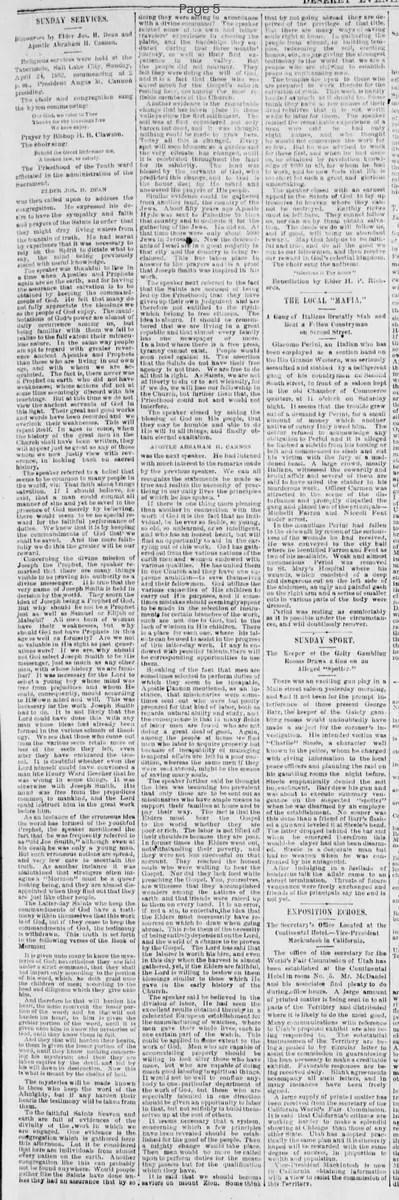
Discourses by Elder Jos. H. Dean and Apostle Abraham H. Cannon.
Tabernacle, Salt Lake City, Sunday, April 24, 1892, commencing at 2 p.m., President Angus M. Cannon presiding.
The choir and congregation sang the hymn commencing:
O God, we raise to Thee
Thanks for thy blessings free
We here enjoy.
Prayer by Bishop H. B. Clawson.
The choir sang:
Behold the Great Redeemer die,
A broken law, to satisfy.
The Priesthood of the Tenth ward officiated in the administration of the Sacrament.
ELDER JOS. H. DEAN
was then called upon to address the congregation. He expressed his desire to have the sympathy and faith of the congregation. He expressed his deep desire and prayers of the Saints in order that they might draw living waters from the fountain of truth. He had learned by experience that it was necessary to rely on the Spirit to dictate what to say, the mind being previously stored with useful knowledge.
The speaker was thankful to live in a time when Apostles and Prophets again are on the earth, and for having the assurance that salvation is to be obtained by keeping the commandments of God. He felt that many do not fully appreciate the blessings we as the people of God enjoy. The manifestations of God's power are almost of daily occurrence among us, but being familiar with them we fail to realize to the full extent their miraculous nature. In the same way people are apt to regard with greater reverence ancient Apostles and Prophets than those who are living in our own age, and with whom we are acquainted. The fact is, there never was a Prophet on earth who did not have some seeming discord with his teachings. But at this time we do not view the ancient servants of God in this light. Their great and good works and words have been recorded and we overlook their weaknesses. This will repeat itself. In ages to come, when the history of the great men in the Church shall have been written, they will appear just as great as any of those whom we now justly view with reverence, in looking back on sacred history.
The speaker referred to a belief that seems to be common to many people in the world, viz: That faith alone brings salvation. If I should believe, he said, that a man could commit all manner of sins and yet be saved in the presence of God merely by believing, there would seem to be no special reward for the faithful performance of duties. We know that it is by keeping the commandments of God that we shall be saved. And the more faithfully we do this the greater will be our reward.
Concerning the divine mission of Joseph the Prophet, the speaker remarked that there are many things visible to us proving his authority as a divine messenger. It is true that the very name of Joseph Smith is held in derision by the world. They scorn the idea of Joseph being a Prophet of God. But why should he not be a Prophet just as well as Samuel or Elijah or Malachi? All men born of woman have their weaknesses, but why should God not have Prophets in this age as well as formerly? Are we not as valuable in His sight as past generations were? If we are, why should not God select Joseph Smith to be His messenger, just as much as any other man, with whose history we are familiar? It was necessary for the Lord to select a young boy whose mind was free from prejudices and whom He could, consequently, mould according to His own mind and will. This was necessary for the work Joseph Smith had to do. It is not likely that the Lord could have done this with any man whose ideas had already been formed in the various schools of theology. We see that those who come out from the various sects retain more or less of the sects they left, even after they have embraced the Gospel. It is doubtful whether even the Lord himself could have convinced a man like Henry Ward Beecher that he was wrong in some things. It was otherwise with Joseph Smith. His mind was free from the prejudices common to mankind, and the Lord could instruct him in the great work before him.
As an instance of the erroneous idea the world has formed of the youthful Prophet, the speaker mentioned the fact that he was frequently referred to as "old Joe Smith," although even at his death he was only a young man. But such erroneous notions are spread, and very few care to ascertain the truth. As another instance it was maintained that strangers often imagine a "Mormon" must be a queer looking being, and they are almost disappointed when they find out that they are just like other people.
The Latter-day Saints who keep the commandments of God have a testimony within themselves that this work is of God, but if they cease to keep the commandments of God, the testimony is withdrawn. This truth is set forth in the following verses of the Book of Mormon:
It is given unto many to know the mysteries of God; nevertheless they are laid under a strict command, that they shall not impart only according to the portion of his word, which he doth grant unto the children of men; according to the heed and diligence which they give unto him.
And therefore, he that will harden his heart, the same receiveth the lesser portion of the word; and he that will not harden his heart, to him is given the greater portion of the word, until it is given unto him to know the mysteries of God, until they know them in full.
And they that will harden their hearts, to them is given the lesser portion of the word, until they know nothing concerning his mysteries; and then they are taken captive by the devil, and led by his will down to destruction. Now this is what is meant by the chains of hell.
The mysteries will be made known to those who keep the word of the Almighty, but if any harden their hearts the testimony will be taken from them.
To the faithful Saints heaven and earth are full of evidences of the divinity of the work in which we are engaged. One evidence is the congregation which is gathered here this afternoon. Let it be considered that here are individuals from almost every nation on the earth. Another congregation like this can probably not be found anywhere. Would people gather like the Saints have done unless they had an assurance that by so doing they were acting in accordance with a divine command? The speaker related some of his own and fellow travelers' experience in crossing the plains, and the hardships they endured during that three months' journey, as well as their first experience in this valley. But the people did not murmur. They felt they were doing the will of God, and it is a fact that those who endured much for the Gospel's sake in coming here, are among the most reliable members of the Church.
Another evidence is the remarkable change that has taken place in these valleys since the first settlement. The soil was at first considered not only barren but dead, and it was thought nothing could be made to grow here. Today all this is changed. Every spot will soon blossom as a garden and the very climate has changed, until it is celebrated throughout the land for its salubrity. The land was blessed by the servants of God, who predicted this change, and to God is the honor due; for He heard and answered the prayers of His people.
Similar evidence could be gathered from another land, the country of the Jews. About fifty years ago Apostle Hyde was sent to Palestine to bless that country and to dedicate it for the gathering of the Jews. He did so. At that time there were only about 5,000 Jews in Jerusalem. Now the descendants of Israel are in a great majority in that city and the country is being reclaimed. This has taken place in answer to the prayers and is a proof that Joseph Smith was inspired in his work.
The speaker next referred to the fact that the Saints are accused of being led by the Priesthood; that they have given up their own judgment and are therefore not entitled to the right which belong to free citizens. The idea is absurd. It should be remembered that we are living in a great republic and that almost every family has one newspaper or more. In a land where there is a free press, tyranny cannot exist. People would soon rebel against it. The assertion that the Saints do not have their free agency is not true. We are free to do all that is right. As Saints, we are not at liberty to sin or to act wickedly, for if we do, we will lose our fellowship in the Church, but further than that, the Priesthood could not and would not interfere.
The speaker closed by asking the blessing of God on His people, that they may be humble and able to do His will in all things, and finally obtain eternal exaltation.
APOSTLE ABRAHAM H. CANNON
was the next speaker. He had listened with much interest to the remarks made by the previous speaker. We can all recognize the statements he made as true and realize the necessity of practicing in our daily lives the principles of which he has spoken.
If there is one thing more pleasing than another in connection with the work of God it is the fact that no individual, be he ever so feeble, so young, so old, so unlearned, or so intelligent, and who has an honest heart, but will find an opportunity to aid in the carrying out of this work. God has gathered out from the various nations of the earth men and women endowed with various qualities. He has united them in one Church and they have one supreme ambition—to save themselves and their fellowmen. God utilizes the various capacities of His children to carry out His purposes, and if sometimes mistakes should seemingly appear to be made in the selection of instruments for certain branches of the work, such are not due to God, but to the lack of wisdom in His children. There is a place for each one, where his talents can be used to assist in the progress of this latter-day work. If any is endowed with peculiar talents, there will be corresponding opportunities to use them.
Speaking of the fact that men are sometimes selected to perform duties of which they seem to be incapable, Apostle Cannon mentioned, as an instance, that missionaries were sometimes sent out who were but poorly prepared for that kind of labor, both as regards natural ability and study, and the consequence is that in many fields of labor men are found who are not doing a great deal of good. Again, among the people at home we find men who labor to acquire property but because of incapability of managing temporal affairs are left in a poor condition, whereas the same men if they were sent abroad, might be the means of saving many souls.
The speaker further said he thought the idea was becoming too prevalent that only those are to be sent out as missionaries who have ample means to support their families at home and to pay their way. The fact is that the Elders must bear the Gospel to the world whether they are poor or rich. The labor is not lifted off their shoulders because they are poor. In former times the Elders went out, notwithstanding their poverty, and they were not less successful on that account. They reached the honest souls who were waiting to hear the Gospel. Nor did they lack food while preaching the Gospel. You, yourselves, are witnesses that they accomplished wonders among the nations of the earth and that friends were raised up to them on every hand. It is an error, if not a sin, to entertain the idea that the Elders must necessarily have resources on which to draw when going abroad. This robs them of the necessity of being entirely dependent on the Lord, and the world of a chance to be proven by the Gospel. The Lord has said that the laborer is worth his hire, and even in this day when the harvest is almost gathered, yet, if the Elders are faithful, the Lord is willing to bestow on them blessings similar to those which He gave in the early history of the Church.
The speaker said he believed in the division of labor. He had seen the excellent results obtained thereby in a celebrated European establishment for the manufacturing of watches, where men gave their whole lives, each to one certain part of the watch. This could be applied to some extent to the work of God. Men who are capable of accumulating property should be willing to look after those who have none, but who are capable of doing much good laboring in spiritual things. It would not be well to confine anybody to one particular department of the work of God, but those who are especially talented in one direction should be given an opportunity to labor in that, but not selfishly to build themselves up at the cost of others.
It seems necessary that a system, concerning which a few principles have been revealed should be established for the good of the people. Then a mighty change would take place. Then men would no more be called upon to perform duties for the means they possess but for the qualification which they have.
It is said that we should become saviors on mount Zion. Some think that by not going abroad they are deprived of the privilege of that title. But there are many ways of saving souls right at home. In gathering the people from abroad, in building temples, redeeming the soil, erecting homes, etc., we are giving the strongest testimony to the world that we are people who are striving to establish peace on earth among men.
The temples are open to those who are prepared to work therein for the salvation of the dead. This work is hardly heeded as much as it should be. Some think they have a few names of their dead relatives that it is not worth while to labor for them. The speaker related the remarkable experience of a man who said he had only eight names, and who thought he would not commence the work for so few. But he was advised to work for these first, and when he had done so, he obtained by revelation knowledge of 5,000 in all, for whom he had to work, and he now feels that life is too short for such a great and glorious undertaking.
The speaker closed with an earnest appeal to the Saints of God to lay up treasures in heaven where they cannot be destroyed. Earthly riches must be left here. They cannot follow us, nor can we by them obtain salvation. The deeds we do will follow us, and if good, will bring us abundant reward. May God help us to be faithful and true, and do all the good we can to our fellowmen, and then receive our reward in God's celestial kingdom.
The choir sang the anthem:
"Glorious is Thy name"
Benediction by Elder H. B. Richards.
What sub-type of article is it?
What themes does it cover?
What keywords are associated?
What entities or persons were involved?
Where did it happen?
Story Details
Key Persons
Location
Tabernacle, Salt Lake City
Event Date
April 24, 1892
Story Details
Elder Jos. H. Dean's sermon emphasizes faith through keeping commandments, defends Joseph Smith's prophethood, cites divine evidences like gathering of Saints and transformation of Utah valley, and refutes accusations of priesthood tyranny. Apostle Abraham H. Cannon's address highlights opportunities for all to contribute to God's work, critiques selection of missionaries based on wealth, advocates division of labor, and urges temple work for the dead and laying up heavenly treasures.