Thank you for visiting SNEWPapers!
Sign up free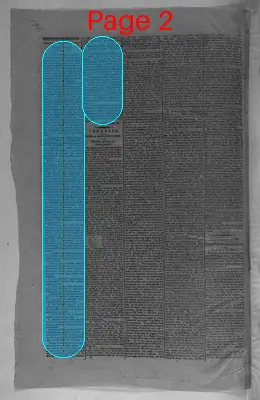
Gazette Of The United States And Daily Evening Advertiser
Philadelphia, Philadelphia County, Pennsylvania
What is this article about?
In Letter VII, Germanicus argues to U.S. citizens that voluntary societies of individuals do not gain superior political rights, using the French National Convention's October 16 decrees restricting popular societies' affiliations and influence as a warning against such groups becoming threats to government.
Clipping
OCR Quality
Full Text
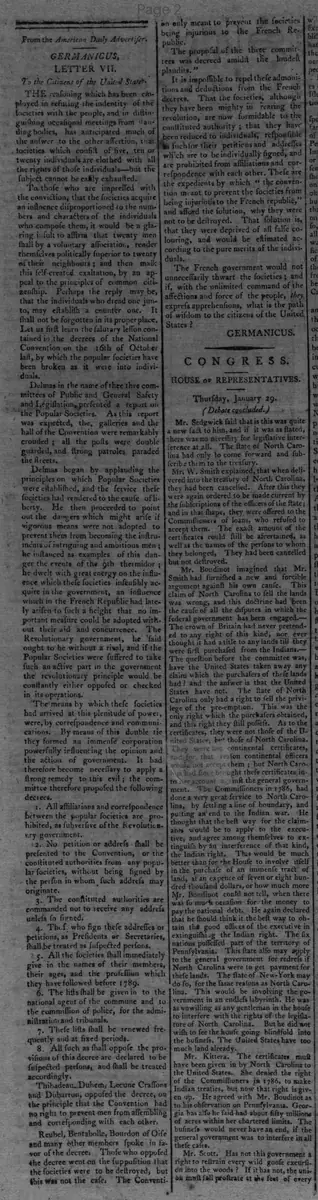
GERMANICUS,
LETTER VII.
To the Citizens of the United States.
The reasoning which has been employed in refuting the identity of the societies with the people, and in distinguishing occasional meetings from standing bodies, has anticipated much of the answer to the other assertion, that societies which consist of five, ten or twenty individuals are clothed with all the rights of those individuals—but the subject cannot be easily exhausted.
To those who are impressed with the conviction, that the societies acquire an influence disproportioned to the numbers and characters of the individuals who compose them, it would be a glaring insult to affirm that twenty men shall by a voluntary association, render themselves politically superior to twenty of their neighbours: and then mask this self-created exaltation, by an appeal to the principles of common citizenship. Perhaps the reply may be, that the individuals who dread one junta, may establish a counter one. It shall not be forgotten in its proper place.
Let us first learn the salutary lesson contained in the decrees of the National Convention on the 16th of October last, by which the popular societies have been broken as it were into individuals.
Delmas in the name of these three committees of Public and General Safety and Legislation, presented a report on the Popular Societies. As this report was expected, the galleries and the hall of the Convention were remarkably crowded; all the posts were double guarded, and strong patroles paraded the streets.
Delmas began by applauding the principles on which Popular Societies were established, and the service these societies had rendered to the cause of liberty. He then proceeded to point out the dangers which might arise if vigorous means were not adopted to prevent them from becoming the instruments of intriguing and ambitious men; he instanced as examples of this danger the events of the 9th Thermidor; he dwelt with great energy on the influence which these societies insensibly acquire in the government, an influence which in the French Republic had lately arisen to such a height that no important measure could be adopted without their aid and concurrence. The Revolutionary government, he said, ought to be without a rival, and if the Popular Societies were suffered to take such an active part in the government the revolutionary principle would be constantly either opposed or checked in its operations.
The means by which these societies had arrived at this plenitude of power, were, by correspondence and communications. By means of this double tie they formed an immense corporation powerfully influencing the opinion and the action of government. It had therefore become necessary to apply a strong remedy to this evil; the committee therefore proposed the following decrees.
1. All affiliations and correspondence between the popular societies are prohibited, as subversive of the Revolutionary government.
2. No petition or address shall be presented to the Convention, or the constituted authorities from any popular societies, without being signed by the person in whom such address may originate.
3. The constituted authorities are commanded not to receive any address unless so signed.
4. He who signs these addresses or petitions, as Presidents or Secretaries, shall be treated as suspected persons.
5. All the societies shall immediately give in the names of their members, their ages, and the profession which they have followed before 1789.
6. These lists shall be given in to the national agent of the commune and to the commission of police, for the administration and tribunals.
7. These lists shall be renewed frequently and at fixed periods.
8. All such as shall oppose the provisions of this decree are declared to be suspected persons, and shall be treated accordingly.
Thibaudeau Duhem, Lecointre, Grieux and Dubarron, opposed the decree, on the principle that the Convention had no right to prevent men from assembling and corresponding with each other.
Reubel, Bentabole, Bourdon of Oise and many other members spoke in favor of the decree. Those who opposed the decree went on the supposition that the societies were to be destroyed, but this was not the case. The Convention only meant to prevent the societies from being injurious to the French Republic.
The proposal of the three committees was decreed amidst the loudest plaudits.
It is impossible to repel these admonitions and deductions from the French decrees. That the societies, although they have been mighty in rearing the revolution, are now formidable to the constituted authority; that they have been reduced to individuals, responsible as such for their petitions and addresses which are to be individually signed, and are prohibited from affiliations and correspondence with each other. These are the expedients by which "the convention meant to prevent the societies from being injurious to the French republic," and afford the solution, why they were not to be destroyed. That solution is, that they were deprived of all false colouring, and would be estimated according to the pure merits of the individuals.
The French government would not unnecessarily thwart the societies: and if, with the unlimited command of the affections and force of the people, they express apprehensions, what is the path of wisdom to the citizens of the United States?
GERMANICUS.
What sub-type of article is it?
What themes does it cover?
What keywords are associated?
What entities or persons were involved?
Letter to Editor Details
Author
Germanicus
Recipient
To The Citizens Of The United States
Main Argument
voluntary societies of individuals do not acquire disproportionate political influence or superior rights; the french national convention's decrees restricting popular societies serve as a cautionary lesson for u.s. citizens to prevent such groups from undermining government authority.
Notable Details