Thank you for visiting SNEWPapers!
Sign up free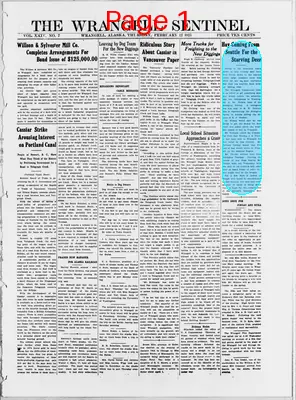
Story
February 12, 1925
The Wrangell Sentinel
Wrangell, Alaska
What is this article about?
Heavy snows near Wrangell force deer to beaches, causing starvation and deaths. Wrangell Commercial Club seeks aid from Biological Survey. Warden Pitcher arrives to provide relief, including 5 tons of hay from Seattle and cutting trees for browse.
Clipping
OCR Quality
95%
Excellent
Full Text
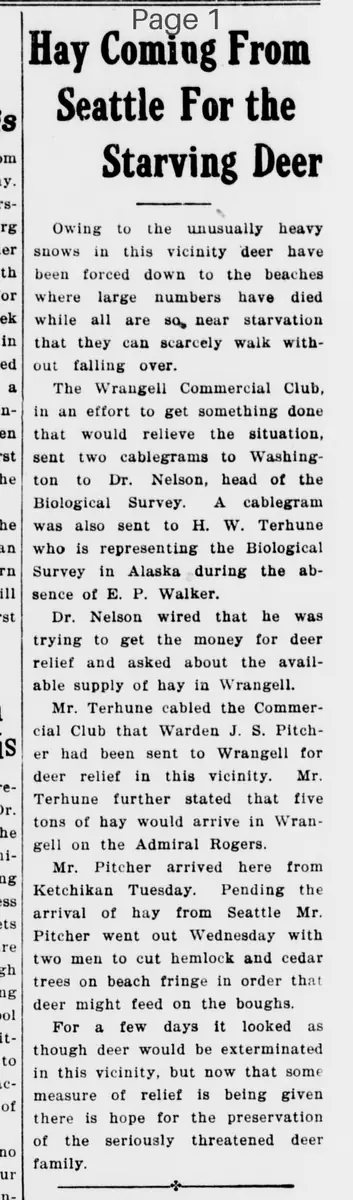
Hay Coming From
Seattle For the
Starving Deer
Owing to the unusually heavy snows in this vicinity deer have been forced down to the beaches where large numbers have died while all are so near starvation that they can scarcely walk without falling over.
The Wrangell Commercial Club in an effort to get something done that would relieve the situation sent two cablegrams to Washington to Dr. Nelson, head of the Biological Survey.
A cablegram was also sent to H. W. Terhune who is representing the Biological Survey in Alaska during the absence of E. P. Walker.
Dr. Nelson wired that he was trying to get the money for deer relief and asked about the available supply of hay in Wrangell.
Mr. Terhune cabled the Commercial Club that Warden J. S. Pitcher had been sent to Wrangell for deer relief in this vicinity.
Mr. Terhune further stated that five tons of hay would arrive in Wrangell on the Admiral Rogers.
Mr. Pitcher arrived here from Ketchikan Tuesday.
Pending the arrival of hay from Seattle Mr. Pitcher went out Wednesday with two men to cut hemlock and cedar trees on beach fringe in order that deer might feed on the boughs.
For a few days it looked as though deer would be exterminated in this vicinity, but now that some measure of relief is being given there is hope for the preservation of the seriously threatened deer family.
Seattle For the
Starving Deer
Owing to the unusually heavy snows in this vicinity deer have been forced down to the beaches where large numbers have died while all are so near starvation that they can scarcely walk without falling over.
The Wrangell Commercial Club in an effort to get something done that would relieve the situation sent two cablegrams to Washington to Dr. Nelson, head of the Biological Survey.
A cablegram was also sent to H. W. Terhune who is representing the Biological Survey in Alaska during the absence of E. P. Walker.
Dr. Nelson wired that he was trying to get the money for deer relief and asked about the available supply of hay in Wrangell.
Mr. Terhune cabled the Commercial Club that Warden J. S. Pitcher had been sent to Wrangell for deer relief in this vicinity.
Mr. Terhune further stated that five tons of hay would arrive in Wrangell on the Admiral Rogers.
Mr. Pitcher arrived here from Ketchikan Tuesday.
Pending the arrival of hay from Seattle Mr. Pitcher went out Wednesday with two men to cut hemlock and cedar trees on beach fringe in order that deer might feed on the boughs.
For a few days it looked as though deer would be exterminated in this vicinity, but now that some measure of relief is being given there is hope for the preservation of the seriously threatened deer family.
What sub-type of article is it?
Disaster
Animal Story
Heroic Act
What themes does it cover?
Catastrophe
Survival
Triumph
What keywords are associated?
Deer Starvation
Heavy Snows
Deer Relief
Wrangell
Biological Survey
Hay Shipment
What entities or persons were involved?
Dr. Nelson
H. W. Terhune
Warden J. S. Pitcher
E. P. Walker
Wrangell Commercial Club
Where did it happen?
Wrangell Vicinity, Alaska
Story Details
Key Persons
Dr. Nelson
H. W. Terhune
Warden J. S. Pitcher
E. P. Walker
Wrangell Commercial Club
Location
Wrangell Vicinity, Alaska
Story Details
Heavy snows drive deer to beaches causing starvation; Wrangell Commercial Club cables Biological Survey for aid; Warden Pitcher arrives, cuts trees for browse, and 5 tons of hay en route from Seattle to save the deer.