Thank you for visiting SNEWPapers!
Sign up free
Poem
January 12, 1828
New Hampshire Statesman And Concord Register
Concord, Merrimack County, New Hampshire
What is this article about?
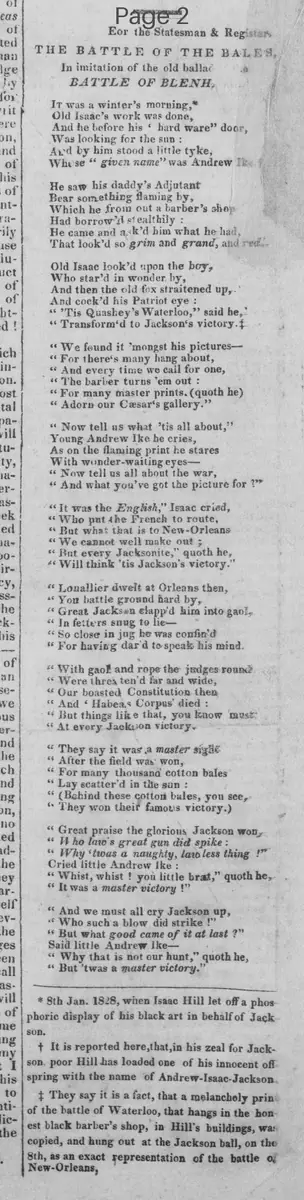
Satirical ballad imitating 'Battle of Blenheim,' mocking Andrew Jackson's victory at New Orleans as 'Battle of the Bales,' portraying it through a father's explanation to his son, critiquing martial law and political zeal. References 1828 Jackson support event.
Clipping
OCR Quality
95%
Excellent
Full Text
For the Statesman & Register
THE BATTLE OF THE BALES
In imitation of the old ballad
BATTLE OF BLENHEIM.
It was a winter's morning,
Old Isaac's work was done,
And he before his "hardware" door,
Was looking for the sun:
And by him stood a little tyke.
Whose "given name" was Andrew Ike
He saw his daddy's Adjutant
Bear something flaming by,
Which he from out a barber's shop
Had borrow'd stealthily:
He came and ask'd him what he had.
That look'd so grim and grand, and red..
Old Isaac look'd upon the boy,
Who star'd in wonder by,
And then the old fox straitened up,
And cock'd his Patriot eye:
" 'Tis Quashey's Waterloo," said he.
" Transform'd to Jackson's victory.
" We found it 'mongst his pictures—
" For there's many hang about,
" And every time we call for one,
" The barber turns 'em out:
" For many master prints. (quoth he)
" Adorn our Cæsar's gallery.'
"Now tell us what 'tis all about,"
Young Andrew Ike be cries,
As on the flaming print he stares
With wonder-waiting eyes—
" Now tell us all about the war,
" And what you've got the picture for?"
" It was the English," Isaac cried,
" Who put the French to route,
" But what that is to New-Orleans
"We cannot well make out;
" But every Jacksonite," quoth he,
Will think 'tis Jackson's victory.
" Louallier dwelt at Orleans then.
" Yon battle ground hard by,
" Great Jackson clapp'd him into gaol,
" In fetters snug to lie—
" So close in jug he was confin'd
" For having dar'd to speak his mind.
" With gaol and rope the judges round
" Were threatened far and wide,
Our boasted Constitution then
" And 'Habeas Corpus' died:
" But things like that, you know must
" At every Jackson victory.
" They say it was a master sight
" After the field was won,
" For many thousand cotton bales
"Lay scatter'd in the sun:
" (Behind these cotton bales, you see,
"They won their famous victory.)
" Great praise the glorious Jackson won,
" He law's great gun did spike:
"Why 'twas a naughty, lawless thing!"
Cried little Andrew Ike:
" Whist, whist! you little brat," quoth he,
" It was a master victory!"
" And we must all cry Jackson up,
" Who such a blow did strike!"
" But what good came of it at last?"
Said little Andrew Ike—
" Why that is not our hunt," quoth he,
" But 'twas a master victory.
* 8th Jan. 1828, when Isaac Hill let off a phosphoric display of his black art in behalf of Jackson.
It is reported here, that, in his zeal for Jackson, poor Hill has loaded one of his innocent offspring with the name of Andrew-Isaac-Jackson.
They say it is a fact, that a melancholy print of the battle of Waterloo, that hangs in the honest black barber's shop, in Hill's buildings, was copied, and hung out at the Jackson ball, on the 8th, as an exact representation of the battle of New-Orleans,
THE BATTLE OF THE BALES
In imitation of the old ballad
BATTLE OF BLENHEIM.
It was a winter's morning,
Old Isaac's work was done,
And he before his "hardware" door,
Was looking for the sun:
And by him stood a little tyke.
Whose "given name" was Andrew Ike
He saw his daddy's Adjutant
Bear something flaming by,
Which he from out a barber's shop
Had borrow'd stealthily:
He came and ask'd him what he had.
That look'd so grim and grand, and red..
Old Isaac look'd upon the boy,
Who star'd in wonder by,
And then the old fox straitened up,
And cock'd his Patriot eye:
" 'Tis Quashey's Waterloo," said he.
" Transform'd to Jackson's victory.
" We found it 'mongst his pictures—
" For there's many hang about,
" And every time we call for one,
" The barber turns 'em out:
" For many master prints. (quoth he)
" Adorn our Cæsar's gallery.'
"Now tell us what 'tis all about,"
Young Andrew Ike be cries,
As on the flaming print he stares
With wonder-waiting eyes—
" Now tell us all about the war,
" And what you've got the picture for?"
" It was the English," Isaac cried,
" Who put the French to route,
" But what that is to New-Orleans
"We cannot well make out;
" But every Jacksonite," quoth he,
Will think 'tis Jackson's victory.
" Louallier dwelt at Orleans then.
" Yon battle ground hard by,
" Great Jackson clapp'd him into gaol,
" In fetters snug to lie—
" So close in jug he was confin'd
" For having dar'd to speak his mind.
" With gaol and rope the judges round
" Were threatened far and wide,
Our boasted Constitution then
" And 'Habeas Corpus' died:
" But things like that, you know must
" At every Jackson victory.
" They say it was a master sight
" After the field was won,
" For many thousand cotton bales
"Lay scatter'd in the sun:
" (Behind these cotton bales, you see,
"They won their famous victory.)
" Great praise the glorious Jackson won,
" He law's great gun did spike:
"Why 'twas a naughty, lawless thing!"
Cried little Andrew Ike:
" Whist, whist! you little brat," quoth he,
" It was a master victory!"
" And we must all cry Jackson up,
" Who such a blow did strike!"
" But what good came of it at last?"
Said little Andrew Ike—
" Why that is not our hunt," quoth he,
" But 'twas a master victory.
* 8th Jan. 1828, when Isaac Hill let off a phosphoric display of his black art in behalf of Jackson.
It is reported here, that, in his zeal for Jackson, poor Hill has loaded one of his innocent offspring with the name of Andrew-Isaac-Jackson.
They say it is a fact, that a melancholy print of the battle of Waterloo, that hangs in the honest black barber's shop, in Hill's buildings, was copied, and hung out at the Jackson ball, on the 8th, as an exact representation of the battle of New-Orleans,
What sub-type of article is it?
Ballad
Satire
What themes does it cover?
Political
War Military
Satire Society
What keywords are associated?
Battle Of The Bales
Jackson Victory
New Orleans
Cotton Bales
Waterloo Imitation
Martial Law
Isaac Hill
Andrew Jackson
What entities or persons were involved?
For The Statesman & Register
Poem Details
Title
The Battle Of The Bales
Author
For The Statesman & Register
Subject
In Imitation Of The Old Ballad Battle Of Blenheim
Form / Style
Rhymed Couplets
Key Lines
" 'Tis Quashey's Waterloo," Said He.
" Transform'd To Jackson's Victory.
" Behind These Cotton Bales, You See,
"They Won Their Famous Victory.)
" It Was A Master Victory!"