Thank you for visiting SNEWPapers!
Sign up free
Constitutional Whig
Richmond, Virginia
What is this article about?
A letter from Stockholm dated Sept. 28, 1821, praises Sweden's political tranquility under its 1809 constitution, adopted after dethroning Gustavus IV. It details the Diet's four estates, ministerial accountability, judicial independence, and notes King Charles XIII's admiration for the U.S. and Prince Oscar's role in Norway.
Clipping
OCR Quality
Full Text
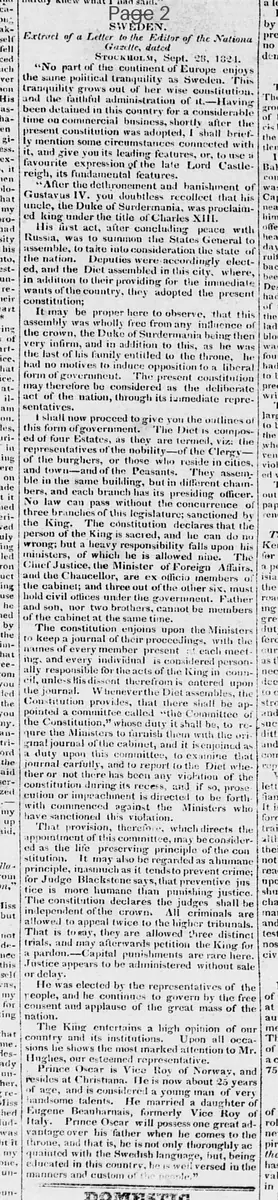
Extract of a Letter to the Editor of the National Gazette, dated STOCKHOLM, Sept. 28, 1821.
"No part of the continent of Europe enjoys the same political tranquility as Sweden. This tranquility grows out of her wise constitution, and the faithful administration of it.—Having been detained in this country for a considerable time on commercial business, shortly after the present constitution was adopted, I shall briefly mention some circumstances connected with it, and give you its leading features, or, to use a favourite expression of the late Lord Castlereagh, its fundamental features.
"After the dethronement and banishment of Gustavus IV. you doubtless recollect that his uncle, the Duke of Sudermania, was proclaimed king under the title of Charles XIII. His first act, after concluding peace with Russia, was to summon the States General to assemble, to take into consideration the state of the nation. Deputies were accordingly elected, and the Diet assembled in this city, where, in addition to their providing for the immediate wants of the country, they adopted the present constitution;
It may be proper here to observe, that this assembly was wholly free from any influence of the crown, the Duke of Sudermania being then very infirm, and in addition to this, as he was the last of his family entitled to the throne, he had no motives to induce opposition to a liberal form of government. The present constitution may therefore be considered as the deliberate act of the nation, through its immediate representatives.
I shall now proceed to give you the outlines of this form of government. The Diet is composed of four Estates, as they are termed, viz: the representatives of the nobility—of the Clergy—of the burghers, or those who reside in cities, and towns—and of the Peasants. They assemble in the same building, but in different chambers, and each branch has its presiding officer. No law can pass without the concurrence of three branches of this legislature; sanctioned by the King. The constitution declares that the person of the King is sacred, and he can do no wrong; but a heavy responsibility falls upon his ministers, of which he is allowed nine. The Chief Justice, the Minister of Foreign Affairs, and the Chancellor, are ex officio members of the cabinet; and three out of the other six, must hold civil offices under the government. Father and son, nor two brothers, cannot be members of the cabinet at the same time.
The constitution enjoins upon the Ministers to keep a journal of their proceedings, with the names of every member present: each meeting, and every individual is considered personally responsible for the acts of the King in council, unless his dissent therefrom is entered upon the journal. Whenever the Diet assembles, the Constitution provides, that there shall be appointed a committee called "the Committee of the Constitution," whose duty it shall be, to require the Ministers to furnish them with the original journal of the cabinet, and it is enjoined as a duty upon this committee, to examine that journal carefully, and to report to the Diet whether or not there has been any violation of the constitution during its recess, and if so, prosecution or impeachment is directed to be forthwith commenced against the Ministers who have sanctioned this violation.
That provision, therefore, which directs the appointment of this committee, may be considered as the life preserving principle of the constitution. It may also be regarded as a humane principle, inasmuch as it tends to prevent crime; for Judge Blackstone says, that preventive justice is more humane than punishing justice.
The constitution declares the judges shall be independent of the crown. All criminals are allowed to appeal twice to the higher tribunals. That is to say, they are allowed three distinct trials, and may afterwards petition the King for a pardon.—Capital punishments are rare here. Justice appears to be administered without sale or delay.
He was elected by the representatives of the people, and he continues to govern by the free consent and applause of the great mass of the nation.
The King entertains a high opinion of our country and its institutions. Upon all occasions he shows the most marked attention to Mr. Hughes, our esteemed representative. Prince Oscar is Viceroy of Norway, and resides at Christiania. He is now about 25 years of age, and is considered a young man of very handsome talents. He married a daughter of Eugene Beauharnais, formerly Viceroy of Italy. Prince Oscar will possess one great advantage over his father when he comes to the throne, and that is, he is not only thoroughly acquainted with the Swedish language, but, being educated in this country, he is well versed in the manners and customs of the people."
What sub-type of article is it?
What keywords are associated?
What entities or persons were involved?
Where did it happen?
Foreign News Details
Primary Location
Sweden
Event Date
Sept. 28, 1821
Key Persons
Outcome
adoption of the 1809 constitution establishing a liberal form of government with four estates in the diet, ministerial accountability via a committee of the constitution, judicial independence, and rare capital punishments.
Event Details
The letter describes Sweden's political tranquility under its constitution adopted in 1809 after the dethronement of Gustavus IV and ascension of Charles XIII. The Diet consists of four estates: nobility, clergy, burghers, and peasants. Laws require concurrence of three estates and royal sanction. The king is sacred, but ministers are responsible and limited to nine, with journaling of proceedings. A Committee of the Constitution examines for violations. Judges are independent, appeals allowed, justice prompt. The king admires the U.S., attends to its representative; Prince Oscar is Viceroy of Norway.