Thank you for visiting SNEWPapers!
Sign up free
Gazette Of The United States, & Philadelphia Daily Advertiser
Philadelphia, Philadelphia County, Pennsylvania
What is this article about?
Debates in the U.S. House of Representatives in May and June 1797 on the address responding to President Adams' speech about French depredations, including Mr. Dayton's amendment for conciliatory stance toward France, and discussions on a bill to man frigates and protect trade without using them as foreign convoys, amid fears of war.
Merged-components note: These components form a single continuous story reporting on congressional debates in the House of Representatives, spanning multiple sections with sequential reading order and narrative flow.
Clippings
1 of 2
OCR Quality
Full Text
May
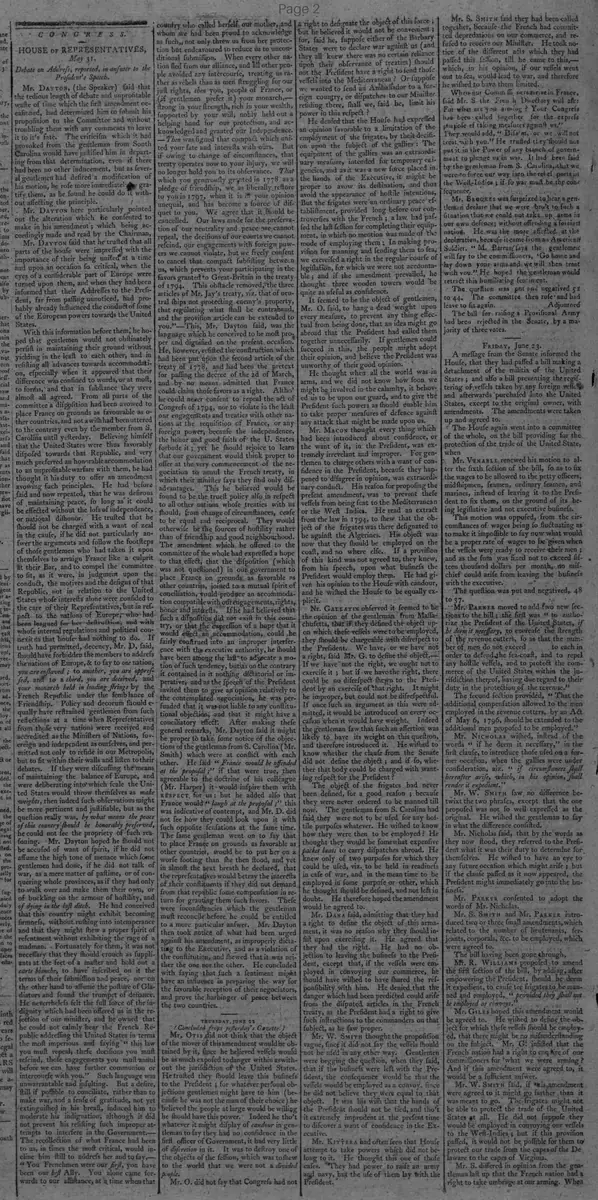
Debate on Address, reported, in answer to the President's Speech.
Mr. Dayton, (the Speaker) said that the tedious length of debate and unprofitable waste of time which the first amendment occasioned, had determined him to submit his proposition to the Committee and without troubling them with any comments to leave it to its fate. The criticism which it had provoked from the gentleman from South Carolina would have justified him in departing from that determination, even if there had been no other inducement, but as several gentlemen had desired a modification of his motion, he rose more immediately to gratify them, as he found he could do it without affecting the principle.
Mr. Dayton here particularly pointed out the alteration which he consented to make in his amendment; which being accordingly made and read by the Chairman, Mr. Dayton said that he trusted that all parts of the house were impressed with the importance of their being united at a time and upon an occasion so critical, when the eyes of a considerable part of Europe were turned upon them, and when they had been informed that their Address to the President, far from passing unnoticed, had probably already influenced the conduct of some of the European powers towards the United States.
With this information before them, he hoped that gentlemen would not obstinately persist in maintaining their ground without yielding in the least to each other, and in resisting all advances towards accommodation, especially when it appeared that their difference was confined to words, or at most, to forms, and that in substance they were almost all agreed. From all parts of the committee a disposition had been avowed to place France on grounds as favourable as other countries, and not a wish had been uttered to the contrary even by the member from S. Carolina until yesterday. Believing himself that the United States were thus favorably disposed towards that Republic, and very much preferred an honorable accommodation to an unprofitable warfare with them, he had thought it his duty to offer an amendment avowing such principles. He had before said and now repeated, that he was desirous of maintaining peace, so long as it could be effected without the loss of independence, or national dishonor. He trusted that he should not be charged with a want of zeal in the cause, if he did not particularly answer the arguments and follow the footsteps of those gentlemen who had taken it upon themselves to arraign France like a culprit at their Bar, and to compel the committee to sit, as it were, in judgment upon the conduct, the motives and the designs of that Republic, not in relation to the United States whose interests alone were confided to the care of their Representatives, but in respect to the nations of Europe, who had been leagued for her destruction, and whose internal regulations and political connexions this house had nothing to do. If truth had permitted, decency, Mr. D. said, should have forbidden the members to address the nations of Europe, & to say to one nation, you are enslaved; to another, you are oppressed, and to a third, you are deceived, and your monarch held in leading strings by the French Republic under the semblance of Friendship. Policy and decorum should equally have restrained gentlemen from such reflections at a time when Representatives from those very nations were received and accredited as the Ministers of Nations, sovereign and independent as ourselves, and permitted not only to reside in our Metropolis, but to sit within their walls and listen to their debates. If they were discussing the means of maintaining the balance of Europe, and were deliberating into which scale the United States would throw themselves as make weights, then indeed such observations might be more pertinent and justifiable, but as the question really was, by what means the peace of this country should be honorably preserved, he could not see the propriety of such reasoning. Mr. Dayton hoped he should not be accused of want of spirit, if he did not assume the high tone of menace which some gentlemen had done, if he did not talk of war, as a mere matter of pastime, or of conquering whole provinces, as if they had only to walk over and make them their own, or of buckling on the armour of hostility, and of dying in the last ditch. He had conceived that this country might exhibit becoming firmness, without rushing into intemperance and that they might shew a proper spirit of resentment without exhibiting the rage of a madman. Fortunately for them, it was not necessary that they should crouch as suppliants at the feet of a master and hold out a carte blanche, to have inscribed on it the terms of their submission and peace, nor on the other hand to assume the posture of Gladiators and sound the trumpet of defiance. He nevertheless felt the full force of the indignity which had been offered us in the rejection of our minister, and he owned that he could not calmly hear the French Republic addressing the United States in terms the most imperious and saying "this law you must repeal, these decisions you must rescind, those engagements you must annul before we can have further communion or intercourse with you." Such language was unwarrantable and insulting. But a desire, still if possible to conciliate, rather than to make war, and a sense of gratitude, not yet extinguished in his breast, induced him to moderate his indignation, although it did not prevent his resisting such improper attempts to interfere in the Government.
The recollection of what France had been to us, in times the most critical, would incline him still to address her and to say, "You Frenchmen were our first, you have been our best Ally. You alone came forwards to our assistance, at a time when that country who called herself our mother, and whom we had been proud to acknowledge as such, not only threw us from her protection but endeavoured to reduce us to unconditional submission. When every other nation fled from our alliance, and all other people avoided any intercourse, treating us rather as rebels than as men struggling for our just rights, then you, people of France, or (if gentlemen prefer it) your monarch,-- strong in your strength, rich in your wealth, supported by your will, nobly held out a helping hand for our protection, and acknowledged and granted our Independence. Then was signed that compact which united your fate and interests with ours. But if owing to change of circumstances, that treaty operates now to your injury, we will no longer hold you to its observance. That which you generously granted in 1778 as a pledge of friendship, we as liberally restore to you in 1797, when it is in your opinion unequal, and has become a source of disquiet to you. We agree that it should be cancelled. Our laws made for the preservation of our neutrality and peace we cannot repeal, the decisions of our courts we cannot rescind, our engagements with foreign powers we cannot violate, but we freely consent to cancel that compact uniting between us, which prevents your participating in the favors granted to Great-Britain in the treaty of 1794. This obstacle removed, the three articles of Mr. Jay's treaty, viz. that of neutral ships not protecting enemy's property, that regulating what shall be contraband, and the provision article can be extended to you." This, Mr. Dayton said, was the language which he conceived to be most proper and dignified on the present occasion. He, however, resisted the construction which had been put upon the second article of the treaty of 1778, and had been the pretext for passing the decree of the 2d of March, and by no means admitted that France could claim those favors as a right. Altho' he could never consent to repeal the act of Congress of 1794, nor to violate in the least our engagements and treaties with other nations at the requisition of France, or any foreign power, because the independence, the honor and good faith of the U. States forbade it; yet he should rejoice to learn that our government would think proper to offer at the very commencement of the negotiation to annul the French treaty, in which their minister says they find only disadvantages. This he believed would be found to be the truest policy also in respect to all other nations whose treaties with us should, from change of circumstances, cease to be equal and reciprocal. They would otherwise be the sources of hostility rather than of friendship and good neighbourhood. The amendment which he offered to the committee of the whole had expressed a hope to that effect, that the disposition (which was not questioned) in our government to place France on grounds as favorable as other countries, joined to a mutual spirit of conciliation, would produce an accommodation compatible with our engagements, rights, honor and interests." If he had believed that such a disposition did not exist in this country, or that the expression of a hope that it would effect an accommodation, could be fairly construed into an improper interference with the executive authority, he should have been among the last to advocate a motion of such tendency, but as on the contrary it contained in it nothing dictatorial or imperative, and as the speech of the President invited them to give an opinion relatively to the contemplated negotiation, he was persuaded that it was not liable to any constitutional objection, and that it might have a conciliatory effect. After making these general remarks, Mr. Dayton said it might be proper to take some notice of the objections of the gentleman from S. Carolina (Mr. Smith) which were at conflict with each other. He said "France would be offended at the proposal;" if that were true, then agreeable to the doctrine of his colleague (Mr. Harper) it would inspire them with respect for us: but he added also that France would "laugh at the proposal;" this was indicative of contempt, and Mr. D. did not see how they could look upon it with such opposite sensations at the same time. The same gentleman went on to say that to place France on grounds as favorable as other countries, would be to put her on a worse footing than she then stood, and yet in almost the next breath he declared, that the representatives would betray the interests of their constituents if they did not demand from that republic some compensation in return for granting them such favors. These were inconsistencies which the gentleman must reconcile before he could be entitled to a more particular answer. Mr. Dayton then took notice of what had been urged against his amendment, as improperly dictating to the Executive, and as a violation of the constitution, and shewed that it was neither the one nor the other. He concluded with saying that such a sentiment might have an influence in preparing the way for the favorable reception of their negociators, and prove the harbinger of peace between the two countries.
Mr. S. Smith said they had been called together, because the French had committed depredations on our commerce, and refused to receive our Minister. He took notice of the different acts which they had passed this session, till he came to this, which, in his opinion, if our vessels went out to sea, would lead to war, and therefore he wished to have them limited.
When our Commissioners arrive in France, said Mr. S. the French Directory will ask: For what else you arming? Your Congress has been called together for the express purpose of taking measures against us." They would add, "Disarm, or we will not treat with you." He trusted they should not put it in the Power of any branch of government to plunge us in war. It had been said by the gentleman from S. Carolina, that we were to force our way into the rebel ports in the West-Indies; if so war must be the consequence.
Mr. Brooks was surprised to hear a gentleman declare that we were brought to such a situation that we could not take up arms in our own defence; without offending a foreign nation. He was the more affected at the declaration, because it came from an American Soldier. "M. Barras, says the gentleman will say to the commissioners, 'Go home and lay down your arms, and we will then treat with you.' He hoped the gentleman would retract this humiliating sentiment.
- The question was put and negatived 52 to 44. The committee then rose and had leave to sit again.
Adjourned
The bill for raising a Provisional Army had been rejected in the Senate, by a majority of three votes.
FRIDAY, June 23.
A message from the Senate informed the House, that they had passed a bill making a detachment of the militia of the United States; and also a bill preventing the registering of vessels taken by any foreign vessel, and afterwards purchased into the United States, except to the original owner, with amendments. The amendments were taken up and agreed to.
The House again went into a committee of the whole, on the bill providing for the protection of the trade of the United States, when
Mr. Venable renewed his motion to alter the sixth section of the bill, so as to fix the wages to be allowed to the petty officers, midshipmen, seamen, ordinary seamen, and marines, instead of leaving it to the President to fix them, on the ground of its being legislative and not executive business.
This motion was opposed, from the circumstances of wages being so fluctuating as to make it impossible to say now what would be a proper rate of wages to be given when the vessels were ready to receive their men; and as the sum was fixed not to exceed eighteen thousand dollars per month, no mischief could arise from leaving the business with the executive.
The question was put and negatived, 48 to 37
Mr. Parker moved to add two new sections to the bill; the first was to authorize the President of the United States, if he deem it necessary, to increase the strength of the revenue cutters, so as that the number of men do not exceed to each in order to defend the sea-coast, and to repel any hostile vessels, and to protect the commerce of the United States within the jurisdiction thereof, having due regard to their duty in the protection of the revenue."
The second section provided, "That the additional compensation allowed to the men employed in the revenue cutters, by an Act of May 6, 1796, should be extended to the additional men proposed to be employed."
Mr. Nicholas wished, instead of the words "if he deem it necessary," in the first clause, to introduce those used on a former occasion, when the gallies were under consideration, viz. "if circumstances shall hereafter arise, which, in his opinion, shall render it expedient."
Mr. W. Smith saw no difference between the two phrases, except that the one proposed was not so well expressed as the original. He wished the gentleman to say in what the difference consisted.
Mr. Nicholas said, that by the words as they now stood, they referred to the President what it was their duty to determine for themselves. He wished to have an eye to any future occasion which might arise; but if the clause passed as it now appeared, the President might immediately go into the business.
Mr. Parker consented to adopt the words of Mr. Nicholas.
Mr. S. Smith and Mr. Parker introduced two or three small amendments, which related to the number of lieutenants, sergeants, corporals, &c. to be employed, which were agreed to.
The bill having been gone through,
Mr. R. Williams proposed to amend the first section of the bill, by adding, after empowering the President, should he deem it expedient, to cause the frigates to be manned and employed, "provided they shall not be employed as convoys."
Mr. Giles hoped this amendment would be agreed to. He wished to define the object for which these vessels should be employed, that there might be no misunderstanding on the subject. Mr. G. insisted that the French nation had a right to enquire of our commissioners for what we were arming? And if this amendment were agreed to, it would be a sufficient answer.
Mr. W. Smith said, if his amendment were agreed to it might go farther than it was meant to go. The frigates might not be able to protect the trade of the United States at all. He did not suppose they would be employed in convoying our vessels to the West-Indies; but if this provision passed, it would not be possible for them to protect our trade from the capes of the Delaware to the capes of Virginia.
Mr. S. differed in opinion from the gentleman last up that the French nation had a right to take umbrage at our arming. When
THURSDAY, JUNE 22
(Concluded from yesterday's Gazette.)
Mr. Otis did not think that the object of the mover of this amendment would be obtained by it, since he believed vessels would be as much exposed to danger within as without the jurisdiction of the United States. He trusted they should leave this business to the President; for whatever personal objections gentlemen might have to him (because he was not the man of their choice), he believed the people at large would be willing he should have this power. Indeed he tho't whatever it might display of candour in gentlemen to say they had no confidence in the first officer of Government, it had very little of discretion in it. It was to destroy one of the objects of the session, which was to shew to the world that we were not a divided people.
Mr. O. did not say that Congress had not a right to designate the object of this force; but he believed it would not be convenient; for, said he, suppose either of the Barbary States were to declare war against us (and they all knew there was no certain reliance upon their observance of treaties) should not the President have a right to send those vessels into the Mediterranean? Or suppose we wanted to send an Ambassador to a foreign country, or dispatches to our Minister residing there, shall we, said he, limit his power in this respect?
He denied that the House had expressed an opinion favorable to a limitation of the employment of the frigates, by their decision upon the subject of the gallies: The equipment of the gallies was an extraordinary measure, intended for temporary exigencies, and as it was a new force placed in the hands of the Executive, it might be proper to avow its destination, and thus avoid the appearance of hostile intentions, But the frigates were an ordinary peace establishment, provided long before our controversies with the French; a law had passed the last session for completing their equipment, in which no mention was made of the mode of employing them: In making provision for manning and sending them to sea, we exercised a right in the regular course of legislation, for which we were not accountable; and if the amendment prevailed, he thought three wooden towers would be quite as useful as confidence.
It seemed to be the object of gentlemen, Mr. O. said, to hang a dead weight upon every measure, to prevent any thing effectual from being done, that an idea might go abroad that the President had called them together unnecessarily. If gentlemen could succeed in this, the people might adopt their opinion, and believe the President was unworthy of their good opinion.
He thought when all the world was in arms, and we did not know how soon we might be involved in the calamity, it behooved us to be upon our guard, and to give the President such powers as should enable him to take proper measures of defence against any attack that might be made upon us.
Mr. Macon thought every thing which had been introduced about confidence, or the want of it, in the President, was extremely irrelevant and improper. For gentlemen to charge others with a want of confidence in the President, because they happened to disagree in opinion, was extraordinary conduct. His reason for proposing the present amendment, was to prevent these vessels from being sent to the Mediterranean or the West Indies. He read an extract from the law in 1794, to shew that the object of the frigates was there designated to be against the Algerines. His object was now that they should be employed on the coast, and no where else. If a provision of this kind was not agreed to, they knew, from his speech, upon what business the President would employ them. He had given his opinion to the House with candour, and he wished the House to be equally explicit.
Mr. Gallatin observed it seemed to be the opinion of the gentleman from Massachusetts, that if they defined the object upon which these vessels were to be employed, they should be chargeable with disrespect to the President. We have, or we have not a right, said Mr. G. to define the object. If we have not the right, we ought not to exercise it; but if we have the right, there could be no disrespect shewn to the President by an exercise of that right. It might be improper, but could not be disrespectful. If once such an argument as this were admitted, it would be introduced on every occasion when it would have weight. Indeed the gentleman saw that such an assertion was likely to have its weight on this question, and therefore introduced it. He wished to know whether the clause from the Senate did not define the object; and if so, whether that body could be charged with wanting respect for the President?
The object of the frigates had never been designed, for a good reason; because they were never ordered to be manned till now. The gentleman from S. Carolina had said they were not to be used for any hostile purposes whatever. He wished to know how they were then to be employed? He thought they would be somewhat expensive packet boats to carry dispatches abroad. He knew only of two purposes for which they could be used, viz. to be held in readiness in case of war, and in the mean time to be employed in some purpose or other, which he thought should be defined, and not left in doubt. He therefore hoped the amendment would be agreed to.
Mr. Dana said, admitting that they had a right to define the object of this armament, it was no reason why they should insist upon exercising it. He agreed that they had the right. He had no objection to leaving the business to the President, except that, if the vessels were employed in convoying our commerce, he should have wished to have shared the responsibility with him. He denied that the danger which had been predicted could arise from the disputed articles in the French treaty, as the President had a right to give such instructions to the commanders on that subject, as he saw proper.
Mr. W. Smith thought the proposition vague, since it did not say the vessels should not be used in any other way. Gentlemen were begging the question, when they said, that if the business were left with the President, the consequence would be that the vessels would be employed as a convoy, since he did not believe they were equal to that object. It was his wish that the hands of the President should not be tied, and tho't it extremely imprudent at the present time to discover a want of confidence in the Executive.
Mr. Kittera had often seen that House attempt to take powers which did not belong to it. -He thought this one of those cases. They had power to raise an army and navy, but the use of them lay with the President.
When two nations were at peace, and one of them began to arm, it was customary to enquire what was the object of it; but when two nations had disputes to settle, and one of the nations had committed aggressions against the other, it was common for the injured nation to arm in her defence; and, if the French nation refused to treat with our commissioners, until they answered enquiries respecting our arming, he believed they were determined upon war.
Mr. S. Smith said, if he understood the amendment to go to the length which the gentleman from S. Carolina represented it to go, he should certainly be opposed to it; but he believed it only went to prevent the frigates from being employed as convoys to foreign ports. Merchants, he said, who carried on a fair course of trade, would not ask for convoys; they would wish to run the risk and go alone; for if they went under convoy the probability would be, that from a number of vessels sailing together, they would glut any market to which they might go, and consequently lower the price of their cargoes; but merchants who wished to go into rebel ports would wish to be convoyed, and the first convoy that went on such a business, he was confident, would produce war.
Mr. S. justified the expression he made use of yesterday, with respect to the French making enquiry into the cause of our armament. Not that they could take any notice of our fortifications, or our militia regulations; but when we are about to fit out a naval armament, it was a different thing, and the maritime powers of the world had a right to enquire the cause of our arming. Our commissioners, when they were asked, would say they knew not. The French would answer, "Then enquire, if it be against us, we shall know what to do; if not, let us know." To avoid this enquiry, he wished to designate the object.
Mr. Venable said, from what fell from the gentleman from S. Carolina, he supposed he would be satisfied with a small amendment. That gentleman supposed that the present amendment would prevent the frigates from convoying our merchant vessels from one part of the union to another. This might be remedied, by adding, "to any foreign port or place."
Mr. R. Williams consented to make this a part of his amendment.
Mr. Brookes wished to know whether the frigates were to be prevented from taking any vessels bound to a foreign port under convoy at all, though she might be going out at the same time with vessels bound to different parts of the union.
Mr. Porter hoped this amendment would obtain, as he did not believe these vessels would be equal to the convoying of our commerce. He hoped, before the session closed, they should pass an act for arming our merchantmen, which, he believed, would be the best protection that could be given to our commerce.
The question was put and carried 47 to 45.
Mr. Coit moved an additional section, "to confine the duration of this act for one year, and from thence to the end of the next session of Congress, and no longer."
Mr. Sitgreaves thought that the period for which the seamen and marines were engaged, being only for one year, there needed no other limitation.
Mr. Coit was of a different opinion. It was true the men could not be engaged for a longer period than a year, but those engagements might be renewed from time to time. For his part he did not wish to see a permanent naval establishment in this country; he would rather see the frigates at the wharves than see them go to sea. He trusted a majority of the House would one day be of his opinion, and, if such a change of sentiment should take place, he wished to put it in their power to annul the establishment.
The question on this section was put, and there appeared to be 46 votes for it, and 45 votes against; when the chairman (Mr. Dent) according to the power given him by the rules of the House, declared the question not carried.
The committee rose, and the house proceeded to consider the amendments; the first which came under consideration, was that for confining the frigates from being used as convoys.
Mr. Sitgreaves hoped this amendment would not prevail. He was at a loss to account for the change of sentiment in the House since yesterday; he thought it was then the opinion that they ought to provide the force, and when provided, leave it to the disposal of the Executive, and that if he thought proper to employ the frigates in the protection of our commerce beyond the jurisdiction line, he should be authorized to do so. He yet entertained this opinion.
It was a little extraordinary, he said, that those gentlemen who had, on a former occasion, quoted the articles of the armed neutrality, should forget one of the most important, he meant that which sanctioned the right of convoying their trade in time of peace, to protect their neutrality against the aggressions of belligerent powers, which doctrine had, by a solemn act of her government been acquiesced in by France.
This being the case, and seeing that the President of the United States, in his speech at the opening of the session, had declared his opinion, that vessels ought to be provided as a convoy to our commerce, and knowing no principle in the law of nations to the contrary, he was surprised the right should be called in question. He hoped no act of that House would justify such a sentiment.
Another glaring inconsistency. Gentlemen admitted that the frigates were to be employed for the protection and defence of our commerce; but he asked how this could be effected, if they were not to be employed in the way of convoys? He did not mean for a number of ships together, but for single vessels. But it was said that citizens who carried on an honest trade—
would not ask a convoy. How did this appear? Had no attack been made upon the fair commerce of this country? If there had been none such, he would allow that there was no necessity for a convoy or naval force; but, if there had been aggressions, they must have been upon the fair trade of this country, and persons employed in this trade, were entitled to protection.
Why, he asked, were they always told of our commerce being forced into the rebel ports in the West Indies, and that war would be the consequence? Were it to be supposed that the President would wantonly go into this business? He hoped they should do what the circumstances of the country required, and not profusely lavish money which could answer no good purpose, since the injuries committed within our jurisdiction compared to those sustained upon the high seas, were not worthy of being named. If any protection was given therefore, it should be extended beyond the jurisdiction line.
But it was said three frigates were incompetent to the protection of the trade of the United States; but they might be competent to protect a part of it; and if three frigates were not effectual, it was the duty of that House to provide such as would be effectual. But if this force would not be able to meet the naval power of any European country, it would be able to keep off privateers and picaroons, and therefore be of some service.
Mr. M'Dowell said, that if the gentleman last up had been present when the subject had before been under discussion, he would have spared his observations, as the principle of a convoy had been decided against by a large majority. Mr. M'D. went over the arguments which had been several times repeated against the employing of convoys, and concluded with hoping the motion would pass.
Mr. Sitgreaves acknowledged he was absent when the subject of the gallies was under discussion: but he had been told that principle had not been decided; but, suppose it had, his opinion was not to be influenced by a majority of that House, if he were convinced it was well founded.
Mr. Giles said, heretofore gentlemen had given up the idea of employing these vessels as a convoy, from their incompetency to that object; but now, the gentleman last up came forward, and said if they were not used for that purpose, they would be of no service at all. He allowed with the gentleman that we had a right thus to employ them, but he denied that it was expedient to do so. The President had committed himself on this head, and he thought they ought to give him an opportunity of retracting his opinion, by fixing the object to which the vessels should be employed.
Mr. Swanwick said, he felt himself called upon to give his reasons for voting against employing these frigates as a convoy to our trade. He looked upon the force as wholly inadequate. But it was said it might be brought to operate in part. He was, however, afraid, that in attempting an object to which they were not equal, they might, in the West-India seas, endanger the loss of the vessels themselves: for, when the privateers and cruisers in those seas, learnt that we had frigates out, they would become more acrimonious than ever.
Mr. S. said, it could not be supposed that the present war in Europe would be of long duration, nor could it be expected that we should be competent, whilst it lasted, to give complete protection to our commerce; he thought, therefore, it would be much better to trust entirely to insurance, than to risk these vessels as a convoy. And if the trade was not worth carrying on, after having paid the insurance, he would give it up.
He wished to avoid any measure which might lead to war; for if that were to take place, we should suffer infinitely more than we now suffered from any depredations committed on our commerce. Our trade in the West Indies, he said, was in some degree protected by the rival interests of the contending powers in those seas. They had heard (and he owned that it was with no pleasant sensation he heard it) that our vessels had sailed under British convoys in that quarter, so that the trade, in some degree, protected itself, by the interest which it holds out to the parties. If the frigates were to be employed as convoys, he did not believe the rates of insurance would at all be lowered; for he did not find that even the British, with all the force they had in the West-Indies, could effectually protect their merchant vessels against the French privateers. Besides, he should look upon the loss of one of the frigates as a very unfortunate occurrence; it would cast a damp upon the germ of our navy, and would be a discouragement to the voting of any more money for that object. This he should most sensibly regret. The frigates might be of some use in the protection of our coasts and jurisdiction, without running any of the risks which he thought would be run in sending them out as convoys.
Coming from a large commercial city, as he did, he should never be backward in his support of an effectual naval establishment; but for the present, he thought it best to keep the frigates about our coast.
Mr. W. Smith agreed with the gentleman from Rhode Island, that the arming of our merchant vessels would be a good defence for our commerce; but he thought there would be little chance of such a measure passing: he suggested to that gentleman, therefore, whether it would not be better to cleave to this. As to the amendment, he was doubtful of its meaning. Did it mean the frigates might be employed to convoy vessels bound to a foreign port, but not within a certain distance of those ports; or did it mean that they should not go further than three miles from the sea coast. He thought it very doubtful, and calculated to embarrass the executive in his proceedings.
(To be continued.)
What sub-type of article is it?
What themes does it cover?
What keywords are associated?
What entities or persons were involved?
Where did it happen?
Story Details
Key Persons
Location
House Of Representatives
Event Date
May 1797; June 22, 1797; June 23, 1797
Story Details
Mr. Dayton defends his amendment to the address expressing hope for honorable accommodation with France while maintaining U.S. independence and honor, recalling French aid in 1778 and proposing to annul the 1778 treaty if desired. Debates continue on a bill to protect U.S. trade by manning frigates and revenue cutters, with amendments to limit use to within U.S. jurisdiction and not as foreign convoys, amid concerns over provoking war with France.