Thank you for visiting SNEWPapers!
Sign up free
Story
April 20, 1953
Trainman News
Indianapolis, Marion County, Indiana
What is this article about?
Article from BRT's Negotiating Manual explaining the Railway Labor Act of 1926, its scope, purposes, definitions of 'carrier' and 'employee', amendments, and duties to settle disputes peacefully. Prepared by C. W. Stanley.
Clipping
OCR Quality
98%
Excellent
Full Text
Negotiating Manual
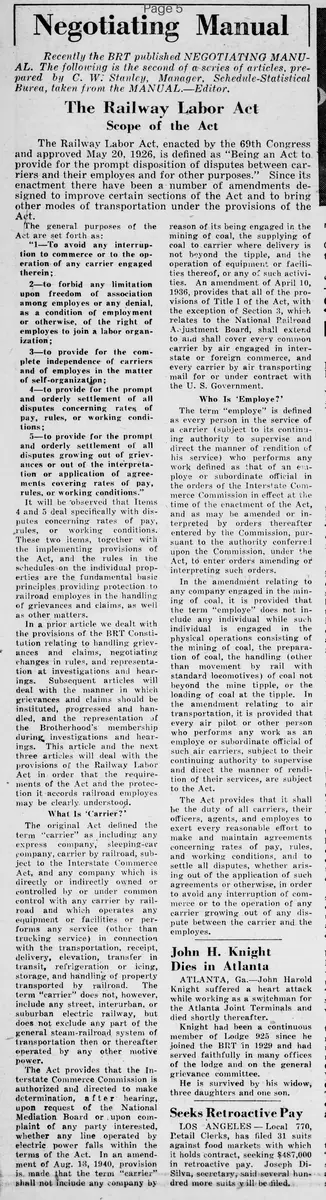
Recently the BRT published NEGOTIATING MANUAL. The following is the second of a series of articles, prepared by C. W. Stanley, Manager, Schedule-Statistical Bureau, taken from the MANUAL.--Editor.
The Railway Labor Act
Scope of the Act
The Railway Labor Act, enacted by the 69th Congress and approved May 20, 1926, is defined as "Being an Act to provide for the prompt disposition of disputes between carriers and their employees and for other purposes."
Since its enactment there have been a number of amendments designed to improve certain sections of the Act and to bring other modes of transportation under the provisions of the Act.
The general purposes of the Act are set forth as:
"1--To avoid any interruption to commerce or to the operation of any carrier engaged therein;
2--to forbid any limitation upon freedom of association among employees or any denial, as a condition of employment or otherwise, of the right of employees to join a labor organization;
3--to provide for the complete independence of carriers and of employees in the matter of self-organization;
4--to provide for the prompt and orderly settlement of all disputes concerning rates of pay, rules, or working conditions;
5--to provide for the prompt and orderly settlement of all disputes growing out of grievances or out of the interpretation or application of agreements covering rates of pay, rules, or working conditions."
It will be observed that Items 4 and 5 deal specifically with disputes concerning rates of pay, rules, or working conditions.
These two items, together with the implementing provisions of the Act, and the rules in the schedules on the individual properties are the fundamental basic principles providing protection to railroad employees in the handling of grievances and claims, as well as other matters.
In a prior article we dealt with the provisions of the BRT Constitution relating to handling grievances and claims, negotiating changes in rules, and representation at investigations and hearings. Subsequent articles will deal with the manner in which grievances and claims should be instituted, progressed and handled, and the representation of the Brotherhood's membership during investigations and hearings. This article and the next three articles will deal with the provisions of the Railway Labor Act in order that the requirements of the Act and the protection it accords railroad employees may be clearly understood.
What Is Carrier?
The original Act defined the term "carrier" as including any express company, sleeping-car company, carrier by railroad, subject to the Interstate Commerce Act, and any company which is directly or indirectly owned or controlled by or under common control with any carrier by railroad and which operates any equipment or facilities or performs any service (other than trucking service) in connection with the transportation, receipt, delivery, elevation, transfer in transit, refrigeration or icing, storage, and handling of property transported by railroad. The term "carrier" does not, however, include any street, interurban, or suburban electric railway, but does not exclude any part of the general steam-railroad system of transportation then or thereafter operated by any other motive power.
The Act provides that the Interstate Commerce Commission is authorized and directed to make determination, after hearing, upon request of the National Mediation Board or upon complaint of any party interested, whether any line operated by electric power falls within the terms of the Act. In an amendment of Aug. 13, 1940, provision is made that the term "carrier" shall not include any company by reason of its being engaged in the mining of coal, the supplying of coal to carrier where delivery is not beyond the tipple, and the operation of equipment or facilities thereof, or any of such activities. An amendment of April 10, 1936, provides that all of the provisions of Title I of the Act, with the exception of Section 3, which relates to the National Railroad Adjustment Board, shall extend to and shall cover every common carrier by air engaged in interstate or foreign commerce, and every carrier by air transporting mail for or under contract with the U. S. Government.
Who Is 'Employe?'
The term "employe" is defined as every person in the service of a carrier (subject to its continuing authority to supervise and direct the manner of rendition of his service) who performs any work defined as that of an employee or subordinate official in the orders of the Interstate Commerce Commission in effect at the time of the enactment of the Act, and as may be amended or interpreted by orders thereafter entered by the Commission, pursuant to the authority conferred upon the Commission, under the Act, to enter orders amending or interpreting such orders.
In the amendment relating to any company engaged in the mining of coal, it is provided that the term "employe" does not include any individual while such individual is engaged in the physical operations consisting of the mining of coal, the preparation of coal, the handling (other than movement by rail with standard locomotives) of coal not beyond the mine tipple, or the loading of coal at the tipple. In the amendment relating to air transportation, it is provided that every air pilot or other person who performs any work as an employe or subordinate official of such air carriers, subject to their continuing authority to supervise and direct the manner of rendition of their services, are subject to the Act.
The Act provides that it shall be the duty of all carriers, their officers, agents, and employees to exert every reasonable effort to make and maintain agreements concerning rates of pay, rules, and working conditions, and to settle all disputes, whether arising out of the application of such agreements or otherwise, in order to avoid any interruption of commerce or to the operation of any carrier growing out of any dispute between the carrier and the employees.
Recently the BRT published NEGOTIATING MANUAL. The following is the second of a series of articles, prepared by C. W. Stanley, Manager, Schedule-Statistical Bureau, taken from the MANUAL.--Editor.
The Railway Labor Act
Scope of the Act
The Railway Labor Act, enacted by the 69th Congress and approved May 20, 1926, is defined as "Being an Act to provide for the prompt disposition of disputes between carriers and their employees and for other purposes."
Since its enactment there have been a number of amendments designed to improve certain sections of the Act and to bring other modes of transportation under the provisions of the Act.
The general purposes of the Act are set forth as:
"1--To avoid any interruption to commerce or to the operation of any carrier engaged therein;
2--to forbid any limitation upon freedom of association among employees or any denial, as a condition of employment or otherwise, of the right of employees to join a labor organization;
3--to provide for the complete independence of carriers and of employees in the matter of self-organization;
4--to provide for the prompt and orderly settlement of all disputes concerning rates of pay, rules, or working conditions;
5--to provide for the prompt and orderly settlement of all disputes growing out of grievances or out of the interpretation or application of agreements covering rates of pay, rules, or working conditions."
It will be observed that Items 4 and 5 deal specifically with disputes concerning rates of pay, rules, or working conditions.
These two items, together with the implementing provisions of the Act, and the rules in the schedules on the individual properties are the fundamental basic principles providing protection to railroad employees in the handling of grievances and claims, as well as other matters.
In a prior article we dealt with the provisions of the BRT Constitution relating to handling grievances and claims, negotiating changes in rules, and representation at investigations and hearings. Subsequent articles will deal with the manner in which grievances and claims should be instituted, progressed and handled, and the representation of the Brotherhood's membership during investigations and hearings. This article and the next three articles will deal with the provisions of the Railway Labor Act in order that the requirements of the Act and the protection it accords railroad employees may be clearly understood.
What Is Carrier?
The original Act defined the term "carrier" as including any express company, sleeping-car company, carrier by railroad, subject to the Interstate Commerce Act, and any company which is directly or indirectly owned or controlled by or under common control with any carrier by railroad and which operates any equipment or facilities or performs any service (other than trucking service) in connection with the transportation, receipt, delivery, elevation, transfer in transit, refrigeration or icing, storage, and handling of property transported by railroad. The term "carrier" does not, however, include any street, interurban, or suburban electric railway, but does not exclude any part of the general steam-railroad system of transportation then or thereafter operated by any other motive power.
The Act provides that the Interstate Commerce Commission is authorized and directed to make determination, after hearing, upon request of the National Mediation Board or upon complaint of any party interested, whether any line operated by electric power falls within the terms of the Act. In an amendment of Aug. 13, 1940, provision is made that the term "carrier" shall not include any company by reason of its being engaged in the mining of coal, the supplying of coal to carrier where delivery is not beyond the tipple, and the operation of equipment or facilities thereof, or any of such activities. An amendment of April 10, 1936, provides that all of the provisions of Title I of the Act, with the exception of Section 3, which relates to the National Railroad Adjustment Board, shall extend to and shall cover every common carrier by air engaged in interstate or foreign commerce, and every carrier by air transporting mail for or under contract with the U. S. Government.
Who Is 'Employe?'
The term "employe" is defined as every person in the service of a carrier (subject to its continuing authority to supervise and direct the manner of rendition of his service) who performs any work defined as that of an employee or subordinate official in the orders of the Interstate Commerce Commission in effect at the time of the enactment of the Act, and as may be amended or interpreted by orders thereafter entered by the Commission, pursuant to the authority conferred upon the Commission, under the Act, to enter orders amending or interpreting such orders.
In the amendment relating to any company engaged in the mining of coal, it is provided that the term "employe" does not include any individual while such individual is engaged in the physical operations consisting of the mining of coal, the preparation of coal, the handling (other than movement by rail with standard locomotives) of coal not beyond the mine tipple, or the loading of coal at the tipple. In the amendment relating to air transportation, it is provided that every air pilot or other person who performs any work as an employe or subordinate official of such air carriers, subject to their continuing authority to supervise and direct the manner of rendition of their services, are subject to the Act.
The Act provides that it shall be the duty of all carriers, their officers, agents, and employees to exert every reasonable effort to make and maintain agreements concerning rates of pay, rules, and working conditions, and to settle all disputes, whether arising out of the application of such agreements or otherwise, in order to avoid any interruption of commerce or to the operation of any carrier growing out of any dispute between the carrier and the employees.
What sub-type of article is it?
Explanatory Article
Legal Analysis
What keywords are associated?
Railway Labor Act
Carrier Definition
Employee Rights
Dispute Settlement
Amendments
Interstate Commerce
What entities or persons were involved?
C. W. Stanley
Story Details
Key Persons
C. W. Stanley
Event Date
1926 05 20
Story Details
Explanation of the Railway Labor Act's enactment, purposes, definitions of carrier and employee, amendments extending to air and excluding coal mining, and duties to settle disputes on pay, rules, and conditions.