Thank you for visiting SNEWPapers!
Sign up free
Story
April 8, 1845
The Rhode Islander
Newport, Newport County, Rhode Island
What is this article about?
Report on the fifth farmers' meeting at the Massachusetts State House, where attendees discussed cultivation of fruits and fruit trees. Speakers including Major B. Wheeler and Hon. B. V. French shared experiences on growing apples, pears, peaches, plums, cherries, and grafting techniques, emphasizing local varieties and soil management.
Clipping
OCR Quality
98%
Excellent
Full Text
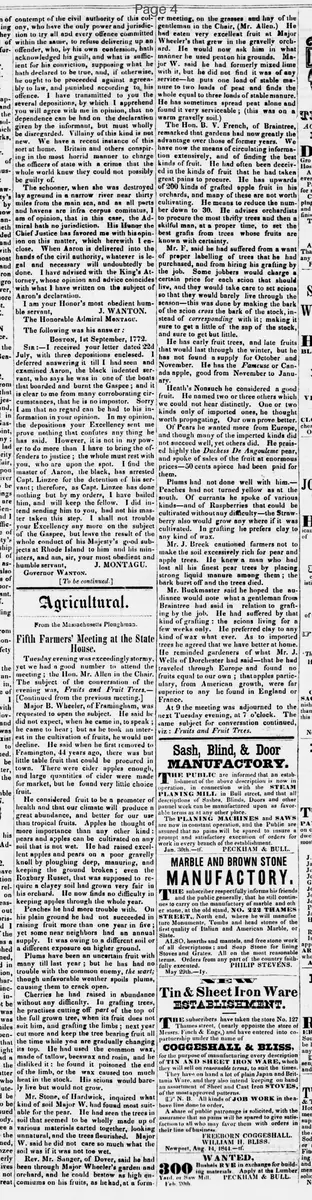
AGRICULTURAL.
From the Massachusetts Ploughman.
FIFTH FARMERS' MEETING AT THE STATE HOUSE.
Tuesday evening was exceedingly stormy, yet we had a good number to attend the meeting; the Hon. Mr. Allen in the Chair.
The subject of the conversation of the evening was, Fruits and Fruit Trees.
[Continued from the previous meeting.]
Major B. Wheeler, of Framingham, was requested to open the subject. He said he did not expect, when he came in, to speak; he came to hear; but as he took an interest in the cultivation of fruits, he would not decline. He said when he first removed to Framingham, 44 years ago, there was but little table fruit that could be procured in town. There were cider apples enough, and large quantities of cider were made for market, but he found very little choice fruit.
He considered fruit to be a promoter of health and that our climate will produce a great abundance, and better for our use than tropical fruits. Apples he thought of more importance than any other kind: pears and apples can be cultivated on any soil that is not wet. He had raised excellent apples and pears on a poor gravelly knoll by ploughing deep, manuring, and keeping the ground broken; even the Roxbury Russet, that was supposed to require a clayey soil had grown very fair in his orchard. He now finds no difficulty in keeping apples through the whole year.
Peaches he had more trouble with. On his plain ground he had not succeeded in raising fruit more than one year in five; yet some near neighbors had an annual supply. It was owing to a different soil or a different exposure on higher ground.
Plums have been an uncertain fruit with many till last year; but he has had no trouble with the common enemy, the wart; though unfavorable weather spoils plums, causing them to crack open.
Cherries he had raised in abundance without any difficulty. In grafting trees, he practises cutting off part of the top of the full grown tree, when its fruit does not suit him, and grafting the limbs; next year cut more and keep the tree bearing fruit all the time while you are gradually changing its top. He had used the common wax, made of tallow, beeswax and rosin, and he disliked it: he found it poisoned the end of the limb, or the wax caused too much heat in the stock. His scions would barely live but would not grow.
Mr. Stone, of Hardwick, inquired what kind of soil Major W. had found most suitable for the pear. He had seen the trees in soil that seemed to be wholly made up of various materials carted together, looking unnatural, and the trees flourished. Major W. said he did not care so much what the soil was if it was not too wet.
Rev. Mr. Sanger, of Dover, said he had been through Major Wheeler's garden and orchard, and he could bestow as high encomiums on his fruits, as he had, at a former meeting, on the grasses and lay of the gentleman in the Chair, (Mr. Allen.) He had eaten very excellent fruit at Major Wheeler's that grew in the gravelly orchard. He would now ask him in what manner he used peat on his grounds. Major W. said he had formerly mixed lime with it, but he did not find it was of any service--he puts one load of stable manure to two loads of peat and finds the whole equal to three loads of stable manure. He has sometimes spread peat alone and found it very serviceable; (this was on a warm gravelly soil.)
The Hon. B. V. French, of Braintree, remarked that gardens had now greatly the advantage over those of former years. We have now the means of circulating information extensively, and of finding the best kinds of fruit. He had often been deceived in the kinds of fruit that he had taken great pains to procure. He has upwards of 200 kinds of grafted apple fruit in his orchards, and many of these are not worth cultivating. He means to reduce the number down to 30. He advises orchardists to procure the most thrifty trees and then a skilful man, at a proper time, to set the best grafts from trees whose fruits are known with certainty.
Mr. F. said he had suffered from a want of proper labelling of trees that he had purchased, and from hiring his grafting by the job. Some jobbers would charge a certain price for each scion that should live, and they would take care to set scions so that they would barely live through the season--this was done by making the bark of the scion cross the bark of the stock, instead of corresponding with it; making it sure to get a little of the sap of the stock, and sure to get but little.
He has early fruit trees, and late fruits that would last through the winter, but he has not found a supply for October and November. He has the Fameuse or Canada apple, good from November to January.
Heath's Nonsuch he considered a good fruit. He named two or three others which we could not hear distinctly. One or two kinds only of imported ones, he thought worth propagating. Our own prove better.
Of Pears he wanted more from Europe, and though many of the imported kinds did not succeed well, yet others did. He praised highly the Duchess De Angouleme pear, and spoke of sales of the fruit at enormous prices--50 cents apiece had been paid for them.
Plums had not done well with him.
Peaches had not turned yellow as at the south. Of currants he spoke of various kinds--and of Raspberries that could be cultivated without any difficulty--the Strawberry also would grow any where if it was cultivated. In grafting he prefers clay to any kind of wax.
Mr. J. Breck cautioned farmers not to make the soil excessively rich for pear and apple trees. He knew a man who had lost all his finest pear trees by placing strong liquid manure among them; the bark burst off and the trees died.
Mr. Buckmaster said he hoped the audience would note what a gentleman from Braintree had said in relation to grafting by the job. He had suffered by that kind of grafting: the scions living for a few weeks only. He preferred clay to any kind of wax whatever. As to imported trees he agreed that we have better at home. He reminded gardeners of what Mr. J. Wells of Dorchester had said--that he had traveled through Europe and found no fruits equal to our own; that apples particularly, from American growth, were far superior to any he found in England or France.
At 9 the meeting was adjourned to the next Tuesday evening, at 7 o'clock. The same subject for conversation continued, viz: Fruits and Fruit Trees.
From the Massachusetts Ploughman.
FIFTH FARMERS' MEETING AT THE STATE HOUSE.
Tuesday evening was exceedingly stormy, yet we had a good number to attend the meeting; the Hon. Mr. Allen in the Chair.
The subject of the conversation of the evening was, Fruits and Fruit Trees.
[Continued from the previous meeting.]
Major B. Wheeler, of Framingham, was requested to open the subject. He said he did not expect, when he came in, to speak; he came to hear; but as he took an interest in the cultivation of fruits, he would not decline. He said when he first removed to Framingham, 44 years ago, there was but little table fruit that could be procured in town. There were cider apples enough, and large quantities of cider were made for market, but he found very little choice fruit.
He considered fruit to be a promoter of health and that our climate will produce a great abundance, and better for our use than tropical fruits. Apples he thought of more importance than any other kind: pears and apples can be cultivated on any soil that is not wet. He had raised excellent apples and pears on a poor gravelly knoll by ploughing deep, manuring, and keeping the ground broken; even the Roxbury Russet, that was supposed to require a clayey soil had grown very fair in his orchard. He now finds no difficulty in keeping apples through the whole year.
Peaches he had more trouble with. On his plain ground he had not succeeded in raising fruit more than one year in five; yet some near neighbors had an annual supply. It was owing to a different soil or a different exposure on higher ground.
Plums have been an uncertain fruit with many till last year; but he has had no trouble with the common enemy, the wart; though unfavorable weather spoils plums, causing them to crack open.
Cherries he had raised in abundance without any difficulty. In grafting trees, he practises cutting off part of the top of the full grown tree, when its fruit does not suit him, and grafting the limbs; next year cut more and keep the tree bearing fruit all the time while you are gradually changing its top. He had used the common wax, made of tallow, beeswax and rosin, and he disliked it: he found it poisoned the end of the limb, or the wax caused too much heat in the stock. His scions would barely live but would not grow.
Mr. Stone, of Hardwick, inquired what kind of soil Major W. had found most suitable for the pear. He had seen the trees in soil that seemed to be wholly made up of various materials carted together, looking unnatural, and the trees flourished. Major W. said he did not care so much what the soil was if it was not too wet.
Rev. Mr. Sanger, of Dover, said he had been through Major Wheeler's garden and orchard, and he could bestow as high encomiums on his fruits, as he had, at a former meeting, on the grasses and lay of the gentleman in the Chair, (Mr. Allen.) He had eaten very excellent fruit at Major Wheeler's that grew in the gravelly orchard. He would now ask him in what manner he used peat on his grounds. Major W. said he had formerly mixed lime with it, but he did not find it was of any service--he puts one load of stable manure to two loads of peat and finds the whole equal to three loads of stable manure. He has sometimes spread peat alone and found it very serviceable; (this was on a warm gravelly soil.)
The Hon. B. V. French, of Braintree, remarked that gardens had now greatly the advantage over those of former years. We have now the means of circulating information extensively, and of finding the best kinds of fruit. He had often been deceived in the kinds of fruit that he had taken great pains to procure. He has upwards of 200 kinds of grafted apple fruit in his orchards, and many of these are not worth cultivating. He means to reduce the number down to 30. He advises orchardists to procure the most thrifty trees and then a skilful man, at a proper time, to set the best grafts from trees whose fruits are known with certainty.
Mr. F. said he had suffered from a want of proper labelling of trees that he had purchased, and from hiring his grafting by the job. Some jobbers would charge a certain price for each scion that should live, and they would take care to set scions so that they would barely live through the season--this was done by making the bark of the scion cross the bark of the stock, instead of corresponding with it; making it sure to get a little of the sap of the stock, and sure to get but little.
He has early fruit trees, and late fruits that would last through the winter, but he has not found a supply for October and November. He has the Fameuse or Canada apple, good from November to January.
Heath's Nonsuch he considered a good fruit. He named two or three others which we could not hear distinctly. One or two kinds only of imported ones, he thought worth propagating. Our own prove better.
Of Pears he wanted more from Europe, and though many of the imported kinds did not succeed well, yet others did. He praised highly the Duchess De Angouleme pear, and spoke of sales of the fruit at enormous prices--50 cents apiece had been paid for them.
Plums had not done well with him.
Peaches had not turned yellow as at the south. Of currants he spoke of various kinds--and of Raspberries that could be cultivated without any difficulty--the Strawberry also would grow any where if it was cultivated. In grafting he prefers clay to any kind of wax.
Mr. J. Breck cautioned farmers not to make the soil excessively rich for pear and apple trees. He knew a man who had lost all his finest pear trees by placing strong liquid manure among them; the bark burst off and the trees died.
Mr. Buckmaster said he hoped the audience would note what a gentleman from Braintree had said in relation to grafting by the job. He had suffered by that kind of grafting: the scions living for a few weeks only. He preferred clay to any kind of wax whatever. As to imported trees he agreed that we have better at home. He reminded gardeners of what Mr. J. Wells of Dorchester had said--that he had traveled through Europe and found no fruits equal to our own; that apples particularly, from American growth, were far superior to any he found in England or France.
At 9 the meeting was adjourned to the next Tuesday evening, at 7 o'clock. The same subject for conversation continued, viz: Fruits and Fruit Trees.
What sub-type of article is it?
Historical Event
What themes does it cover?
Moral Virtue
What keywords are associated?
Farmers Meeting
Fruit Cultivation
Apple Trees
Pear Trees
Grafting Techniques
Soil Management
What entities or persons were involved?
Hon. Mr. Allen
Major B. Wheeler
Mr. Stone
Rev. Mr. Sanger
Hon. B. V. French
Mr. J. Breck
Mr. Buckmaster
Mr. J. Wells
Where did it happen?
State House, Massachusetts
Story Details
Key Persons
Hon. Mr. Allen
Major B. Wheeler
Mr. Stone
Rev. Mr. Sanger
Hon. B. V. French
Mr. J. Breck
Mr. Buckmaster
Mr. J. Wells
Location
State House, Massachusetts
Event Date
Tuesday Evening
Story Details
Attendees at the fifth farmers' meeting discussed fruits and fruit trees, sharing cultivation experiences, soil preferences, grafting methods, and preferences for local over imported varieties.