Thank you for visiting SNEWPapers!
Sign up free
Alexandria Daily Advertiser
Alexandria, Virginia
What is this article about?
In the U.S. House of Representatives on April 7, Mr. G. W. Campbell speaks in debate on inserting the President's December 6 message into the journal, defending secrecy in Spanish negotiations, denying bribery allegations regarding Florida purchase, opposing army increase, and advocating fair purchase over force.
Clipping
OCR Quality
Full Text
OF THE
UNITED STATES.
HOUSE OF REPRESENTATIVES
MONDAY, APRIL 7.
SPANISH AFFAIRS.
DEBATE
On the motion of Mr. F. Randolph to amend the secret journal, by inserting in it the message of the President of the 6th December,
CONTINUED.
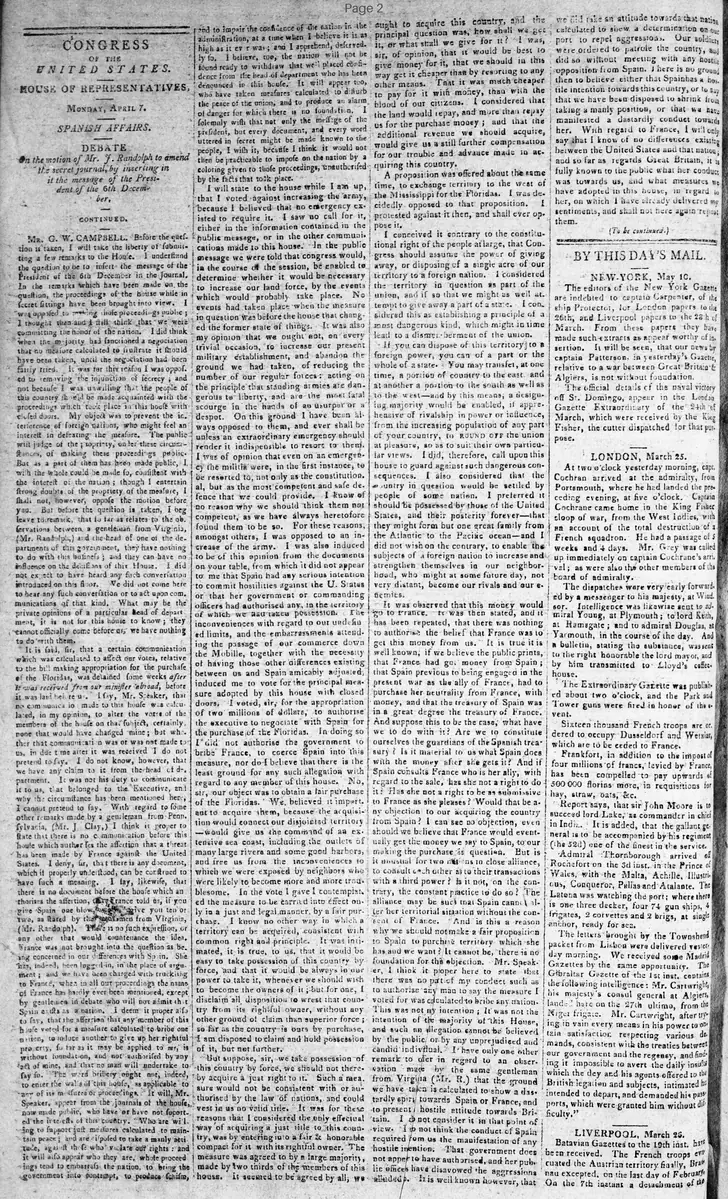
Mr. G. W. CAMPBELL. Before the question is taken, I will take the liberty of submitting a few remarks to the House. I understand the question to be to insert the message of the President of the 6th December in the Journal. In the remarks which have been made on the question, the proceedings of the house while in secret sittings have been brought into view. I was opposed to making those proceedings public; I thought then and I still think that we were committing the honor of the nation. I did think when the majority had sanctioned a negociation that no measure calculated to frustrate it should have been taken, until the negociation had been fairly tried. It was for this reason I was opposed to removing the injunction of secrecy; and not because I was unwilling that the people of this country should be made acquainted with the proceedings which took place in this house with closed doors. My object was to prevent the interference of foreign nations, who might feel an interest in defeating the measure. The public will judge of the propriety, under these circumstances, of making these proceedings public. But as a part of them has been made public, I wish the whole could be made so, consistent with the interest of the nation; though I entertain strong doubts of the propriety of the measure, I shall not, however, oppose the motion before you. But before the question is taken, I beg leave to remark, that so far as relates to the observations between a gentleman from Virginia, (Mr. Randolph,) and the head of one of the departments of this government, they have nothing to do with this business; and they can have no influence on the decisions of this House. I did not expect to have heard any such conversation introduced on this floor. We did not come here to hear any such conversation or to act upon communications of that kind. What may be the private opinions of a particular head of department, it is not for this house to know; they cannot officially come before us, we have nothing to do with them.
It is said, sir, that a certain communication which was calculated to affect our votes, relative to the bill making appropriation for the purchase of the Floridas, was detained some weeks after it was received from our minister abroad, before it was laid before us. I say, Mr. Speaker, that no communication made to this house was calculated, in my opinion, to alter the vote of the members of the house on that subject, certainly, none that would have changed mine; but whether that communication was or was not made to us, in due time after it was received I do not pretend to say. I do not know, however, that we have any claim to it from the head of department. It was not his duty to communicate it to us, that belonged to the Executive, and why the circumstance has been mentioned here; I cannot pretend to say. With regard to some other remarks made by a gentleman from Pennsylvania, (Mr. Clay,) I think it proper to state that there is no communication before this house which authorizes the assertion that a threat has been made by France against the United States. I deny, sir, that there is any document, which if properly understood, can be construed to have such a meaning. I say, likewise, that there is no document before the house which authorizes the assertion, that France told us, if you give Spain one blow money s agive you ten or. Two, as stated by the gentleman from Virginia, (Mr. Randolph). There is no such expression, or any other that would countenance the idea. France was not brought into the question as being concerned in our differences with Spain. She has, indeed, been lugged-in, in the place of argument; and we have been charged with truckling to France, when in all our proceedings the name of France has hardly ever been mentioned, except by gentlemen in debate who will not admit that Spain exists as a nation. I deem it proper also to say, that the assertion that any member of this house voted for a measure calculated to bribe one nation, to induce another to give up her rightful property, so far as it may be applied to me, is without foundation, and not authorized by any act of mine, and that no man will undertake to say so. The word bribery ought not, indeed, to enter the walls of this house, as applicable to any of its measures or proceedings. It will, Mr. Speaker, appear from the journals of the house, now made public, who have or have not supported the interests of this country. We are willing to support just measures calculated to maintain peace; and are disposed to take a manly attitude, against those who violate our rights: and it will also appear who they are, whose proceedings tend to embarrass the nation, to bring the government into contempt, to produce chilm,
and to impair the confidence in the administration, at a time when I believe it is as high as it ever was; and I apprehend, deservedly so. I believe, too, the nation will not be found ready to withdraw that well placed confidence from the head of department who has been denounced in this house. It will appear too, who have taken measures calculated to disturb the peace of the union; and to produce an alarm of danger for which there is no foundation. I solemnly wish that not only the message of the president, but every document, and every word uttered in secret might be made known to the people, I wish it, because I think it would not then be practicable to impose on the nation by a coloring given to those proceedings, unauthorized by the facts that took place.
I will state to the house while I am up, that I voted against increasing the army, because I believed that no emergency existed to require it. I saw no call for it, either in the information contained in the public message, or in the other communications made to this house. In the public message we were told that congress would, in the course of the session, be enabled to determine whether it would be necessary to increase our land force, by the events which would probably take place. No events had taken place when the measure in question was before the house that changed the former state of things. It was also my opinion that we ought not, on every trivial occasion, to increase our present military establishment, and abandon the ground we had taken, of reducing the number of our regular forces: acting on the principle that standing armies are dangerous to liberty, and are the most fatal scourge in the hands of an usurper or a despot. On this ground I have always opposed to them, and ever shall be unless an extraordinary emergency should render it indispensable to resort to them. I was of opinion that even on an emergency the militia were, in the first instance, to be resorted to, not only as the constitutional, but as the most competent and safe defence that we could provide. I know of no reason why we should think them not competent, as we have always heretofore found them to be so. For these reasons, amongst others, I was opposed to an increase of the army. I was also induced to be of this opinion from the documents on your table, from which it did not appear to me that Spain had any serious intention to commit hostilities against the U. States or that her government or commanding officers had authorised any. in the territory of which we now take possession. The inconveniences with regard to our undefined limits. and the embarrassments attending the passage of our commerce down the Mobile, together with the necessity of having those other differences existing between us and Spain amicably adjusted, induced me to vote for the principal measure adopted by this house with closed doors, I voted, sir, for the appropriation of two millions of dollars, to authorize the executive to negotiate with Spain for the purchase of the Floridas. In doing so I'did not authorize the government to bribe France, to coerce Spain into this measure, nor do I believe that there is the least ground for any such allegation with regard to any member of this house. No, sir, our object was to obtain a fair purchase of the Floridas. We believed it important to acquire them, because the acquisition would connect our disjoined territory would give us the command of an extensive sea coast, including the outlets of many large rivers and some good harbors, and free us from the inconveniences to which we were exposed by neighbors who were likely to become more and more troublesome. In the vote I gave I contemplated the measure to be carried into effect only in a just and legal manner, by a fair purchase. I know no other way in which a territory can be acquired, consistent with common right and principle. It was intimated, it is true, to us. that it would be easy to take possession of this country by force, and that it would be always in our power to take it, whenever we should wish to become the owners of it ; but for one, I disclaim all disposition to wrest that country from its rightful owner, without any other ground of claim than superior force; so far as the country is bought by purchase, I am disposed to claim and hold possession of it, but not further.
But suppose, sir, we take possession of this country by force, we should not thereby acquire a just right to it. Such a measure would not be consistent with or authorized by the law of nations, and could vest in us no valid title. It was for these reasons that I considered the only effectual way of acquiring a just title to this country, was by entering into a fair & honorable compact for it with its rightful owner. The measure was agreed to by a large majority, made by two thirds of the members of this house. It seemed to be agreed by all; we sought to acquire this country, and the principal question was, how shall we get it, or what shall we give for it? I was, sir, of opinion, that it would be best to way get it cheaper than by resorting to any other means. That it was much cheaper to pay for it with money, than with the blood of our citizens. I considered that the land would repay, and more than repay us for the purchase money ; and that the additional revenue we should acquire, would give us a still further compensation for our trouble and advance made in acquiring this country.
A proposition was offered about the same time, to exchange territory to the west of the Mississippi for the Floridas. I was decidedly opposed to that proposition. I protested against it then, and shall ever oppose it. I conceived it contrary to the constitutional right of the people at large, that Congress should assume the power of giving away, or disposing of a single acre of our territory to a foreign nation. I considered the territory in question as part of the union, and if so that we might as well attempt to give away a part of a state. I considered this as establishing a principle of a most dangerous kind, which might in time lead to a dismemberment of the union. If you can dispose of this territory to a foreign power, you can of a part or the whole of a state. You may transfer, at one time, a portion of country to the east, and at another a portion to the south as well as to the west--and by this means; a designing majority would be enabled, if apprehensive of rivalship in power or influence, from the increasing population of any part of your country, to round off the union at pleasure, so as to suit their own particular views. I did, therefore, call upon this house to guard against such dangerous consequences. I also considered that the country in question would be settled by people of some nation. I preferred it should be possessed by those of the United States, and their posterity forever--that they might form but one great family from the Atlantic to the Pacific ocean-and I did not wish on the contrary, to enable the subjects of a foreign nation to increase and strengthen themselves in our neighborhood, who might at some future day, not very distant, become our rivals and our enemies.
It was observed that this money would go to france. It was then stated, and it has been repeated, that there was nothing to authorize the belief that France was to get this money from us. It is true it is well known, if we believe the public prints, that France had got money from Spain; that Spain previous to being engaged in the present war as the ally of France, had to purchase her neutrality from France. with money, and that the treasury of Spain was in a great degree the treasury of France. And suppose this to be the case: what have we to do with it? Are we to constitute ourselves the guardians of the Spanish treasury ? Is it material to us what Spain does with the money after she gets it? And if Spain consults France who is her ally, with regard to the sale, has she not a right to do it ? Has she not a right to be as submissive to France as she pleases? Would that be any objection to our acquiring the country from Spain ? I can see no objection, even should we believe that France would eventually get the money we pay to Spain, to our making the purchase in question. But is it unusual for two nations in close alliance, to consult each other as to their transactions with a third power ? is it not, on the contrary, the constant practice to do so ? The alliance may be such that Spain cannot alter her territorial situation without the consent of France. And is this a reason why we should not make a fair proposition to Spain to purchase territory- which she has and we want ? It cannot be, there is no foundation for this objection. Mr. Speaker, I think it proper here to state that there was no part of my conduct such as to authorize any man to say the measure I voted for was calculated to bribe any nation- This was not my intention ; It was not the intention of the majority of this House, and such an allegation cannot be believed by the public or by any unprejudiced and candid individual. I have only one other remark to offer in regard to an observation made by the same gentleman from, Virginia (Mr. R.) that the ground we have taken is calculated to show a dastardly spirit towards Spain or France; and to present a hostile attitude towards Britain. I do not consider it in that point of view. I do not think the conduct of Spain required from us the manifestation of any hostile intention: That government does not appear to have authorised, and her public officers have disavowed the aggressions alluded to. In is well known however, that we did take an attitude towards that nation calculated to shew. a determination on our part to repel aggressions. Our soldiers were ordered to patrol the country, and did so without meeting with any hostile opposition from Spain. There is no ground then to believe either that Spain has a hostile intention towards this country, or to say that we have been disposed to shrink from taking a manly position, or that we have manilested a dastardly conduct towards her. With regard to France, I will only say that I know of no differences existing between the United States and that nation; and so far as regards Great Britain, it is fully known to the public what her conduct was towards us, and what measures we have adopted in this house, in regard to her, on which I have already delivered my sentiments, and shall not here again repeat them.
(To be continued.)
What sub-type of article is it?
What themes does it cover?
What keywords are associated?
What entities or persons were involved?
Where did it happen?
Story Details
Key Persons
Location
House Of Representatives, United States
Event Date
Monday, April 7
Story Details
Mr. Campbell defends his vote for a $2 million appropriation to negotiate the purchase of Florida from Spain, opposes army increase without emergency, denies bribery allegations involving France, advocates fair purchase over force, and opposes exchanging U.S. territory west of the Mississippi.