Thank you for visiting SNEWPapers!
Sign up free
Daily National Intelligencer
Washington, District Of Columbia
What is this article about?
Report on British impressment and imprisonment of American seamen during the War of 1812, including a letter from a prisoner on the Prison Ship Glory detailing poor treatment and desire for revenge.
Merged-components note: The main article on impressed seamen and the concluding editor's note belong to the same narrative.
Clipping
OCR Quality
Full Text
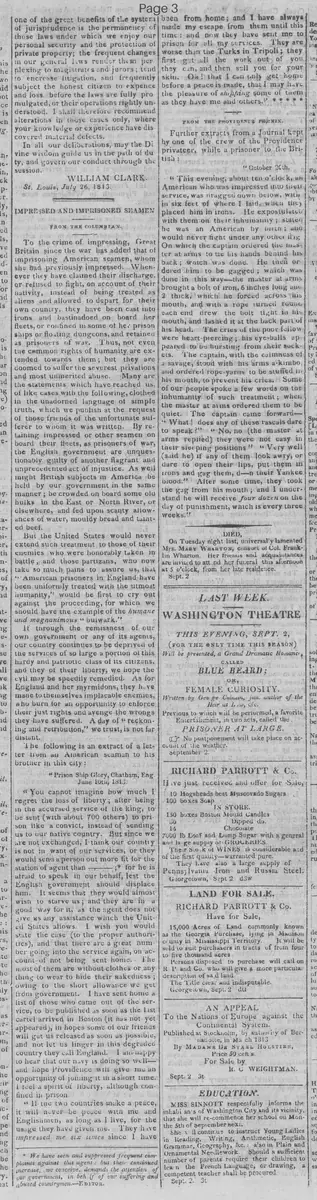
FROM THE COLUMBIAN.
To the crime of impressing, Great Britain since the war has added that of Imprisoning American seamen, whom she had previously impressed. Whenever they have claimed their discharge, or refused to fight, on account of their nativity, instead of being treated as aliens and allowed to depart for their own country, they have been cast into irons and bastinadoed on board her fleets, or confined in some of her prison ships or floating dungeons, and retained as prisoners of war. Thus, not even the common rights of humanity are extended towards them; but they are doomed to suffer the severest privations and most unmerited abuse. Many are the statements which have reached us, of like cases with the following, clothed in the unadorned language of simple truth, which we publish at the request of those friends of the unfortunate sufferer to whom it was written. By retaining impressed or other seamen on board their fleets, as prisoners of war, the English government are unquestionably guilty of another flagrant and unprecedented act of injustice. As well might British subjects in America be held by our government in the same manner; be crowded on board some old hulks in the East or North River, or elsewhere, and fed upon scanty allowances of water, mouldy bread and tainted beef.
But the United States would never extend such treatment to those of their enemies who were honorably taken in battle, and those partizans, who now take so much pains to assure us, that American prisoners in England have been uniformly treated with the utmost humanity," would be first to cry out against the proceeding, for which we should have the example of the humane and magnanimous "bulwark."
If through the remissness of our own government or any of its agents, our country continues to be deprived of the services of so large a portion of this hardy and patriotic class of its citizens, and they of their liberty, we hope the evil may be speedily remedied. As for England and her myrmidons, they have made to themselves implacable enemies, who burn for an opportunity to enforce their just rights and avenge the wrongs they have suffered. A day of "reckoning and retribution," we trust, is not far distant.
The following is an extract of a letter from an American Seaman to his brother in this city:
"Prison Ship Glory, Chatham, Eng. June 10th, 1813.
"You cannot imagine how much I regret the loss of liberty; after being in the accursed service of the king, to be sent (with about 700 others) to prison like a convict, instead of sending us to our native country. But since we are not exchanged, I think our country is not in want of our services, or they would send a person out more fit for the station of agent than -r-;* for he is afraid to speak in our behalf, lest the English government should displace him. It seems that they would almost wish to starve us; and they are in a good way for it, as the agent does not give us any assistance which the United States allows. I wish you would state the case (to the proper authorities), and that there are a great number going into the service again, on account of not being sent home. The most of them are without clothes or any thing to wear to hide their nakedness; owing to the short allowance we get from government. I have sent home a list of those who came out of the service, to be published as soon as the last Cartel arrived in Boston (it has not yet appeared), in hopes some of our friends will get us released as soon us possible, and not let us linger in this degraded country they call England. I am happy to hear that our navy is doing so well-- and hope Providence will give me an opportunity of joining it in a short time. I feel a spirit of liberty, although confined in prison.
"If the two countries make a peace, it will never be peace with me and Englishmen, as long as I live, for the usage they have given me. They have impressed me six times since I have
been from home; and I have always made my escape from them until this time: and now they have sent me to prison for all my services. They are worse than the Turks in Tripoli; they first get all the work out of you they can, and then sell you for your skin. Oh! that I can only get home before a peace is made, that I may have the pleasure of shipping some of them as they have me and others.' * * * *
* We have seen and suppressed frequent complaints against this agent: but their continued increase, we conceive, demands the attention of our government, in behalf of our suffering and abused countrymen.—Editor.
What sub-type of article is it?
What themes does it cover?
What keywords are associated?
What entities or persons were involved?
Where did it happen?
Story Details
Key Persons
Location
Prison Ship Glory, Chatham, Eng.
Event Date
June 10th, 1813
Story Details
British forces impress American seamen into service, then imprison them as prisoners of war when they refuse to fight; a letter from an imprisoned seaman describes harsh conditions, neglect by the American agent, and his resentment.