Thank you for visiting SNEWPapers!
Sign up free
Story
April 29, 1873
The Charlotte Democrat
Charlotte, Mecklenburg County, North Carolina
What is this article about?
In 1872, South Carolina cotton matured unusually quickly due to climatic changes and fertilizers, yielding a heavy crop by mid-August despite a late start, with observations on plant rust and the role of vegetable matter in soil.
Clipping
OCR Quality
98%
Excellent
Full Text
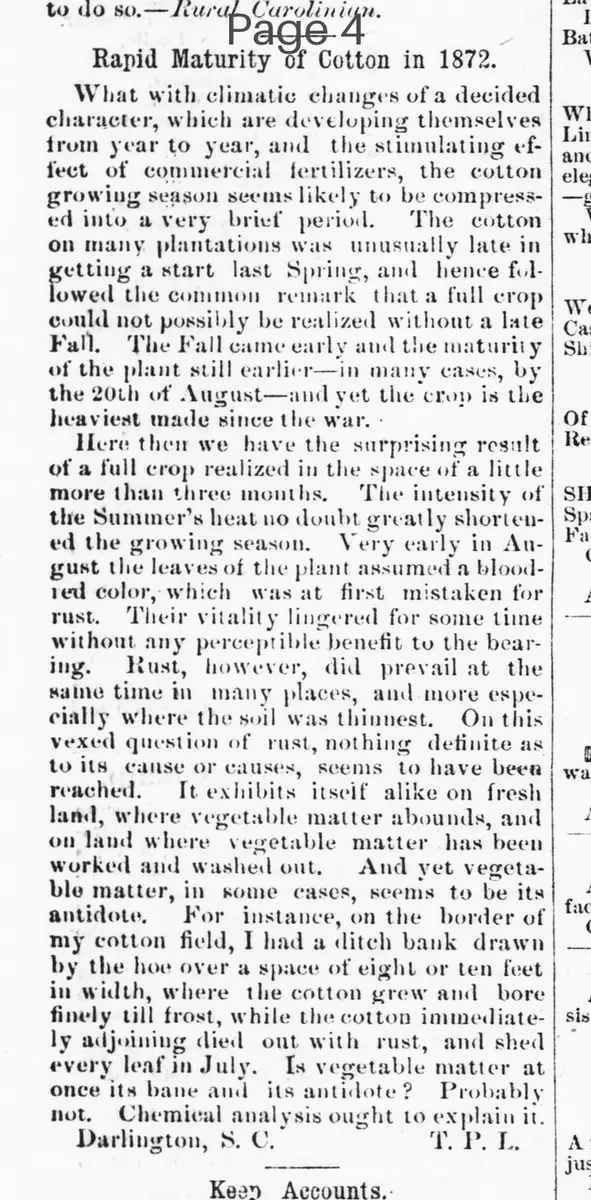
Rapid Maturity of Cotton in 1872.
What with climatic changes of a decided character, which are developing themselves from year to year, and the stimulating effect of commercial fertilizers, the cotton growing season seems likely to be compressed into a very brief period. The cotton on many plantations was unusually late in getting a start last Spring, and hence followed the common remark that a full crop could not possibly be realized without a late Fall. The Fall came early and the maturity of the plant still earlier—in many cases, by the 20th of August—and yet the crop is the heaviest made since the war.
Here then we have the surprising result of a full crop realized in the space of a little more than three months. The intensity of the Summer's heat no doubt greatly shortened the growing season. Very early in August the leaves of the plant assumed a blood-red color, which was at first mistaken for rust. Their vitality lingered for some time without any perceptible benefit to the bearing. Rust, however, did prevail at the same time in many places, and more especially where the soil was thinnest. On this vexed question of rust, nothing definite as to its cause or causes, seems to have been reached. It exhibits itself alike on fresh land, where vegetable matter abounds, and on land where vegetable matter has been worked and washed out. And yet vegetable matter, in some cases, seems to be its antidote. For instance, on the border of my cotton field, I had a ditch bank drawn by the hoe over a space of eight or ten feet in width, where the cotton grew and bore finely till frost, while the cotton immediately adjoining died out with rust, and shed every leaf in July. Is vegetable matter at once its bane and its antidote? Probably not. Chemical analysis ought to explain it.
Darlington, S. C.
T. P. L.
What with climatic changes of a decided character, which are developing themselves from year to year, and the stimulating effect of commercial fertilizers, the cotton growing season seems likely to be compressed into a very brief period. The cotton on many plantations was unusually late in getting a start last Spring, and hence followed the common remark that a full crop could not possibly be realized without a late Fall. The Fall came early and the maturity of the plant still earlier—in many cases, by the 20th of August—and yet the crop is the heaviest made since the war.
Here then we have the surprising result of a full crop realized in the space of a little more than three months. The intensity of the Summer's heat no doubt greatly shortened the growing season. Very early in August the leaves of the plant assumed a blood-red color, which was at first mistaken for rust. Their vitality lingered for some time without any perceptible benefit to the bearing. Rust, however, did prevail at the same time in many places, and more especially where the soil was thinnest. On this vexed question of rust, nothing definite as to its cause or causes, seems to have been reached. It exhibits itself alike on fresh land, where vegetable matter abounds, and on land where vegetable matter has been worked and washed out. And yet vegetable matter, in some cases, seems to be its antidote. For instance, on the border of my cotton field, I had a ditch bank drawn by the hoe over a space of eight or ten feet in width, where the cotton grew and bore finely till frost, while the cotton immediately adjoining died out with rust, and shed every leaf in July. Is vegetable matter at once its bane and its antidote? Probably not. Chemical analysis ought to explain it.
Darlington, S. C.
T. P. L.
What sub-type of article is it?
Curiosity
Historical Event
What themes does it cover?
Nature
What keywords are associated?
Cotton Maturity
1872 Harvest
Plant Rust
Commercial Fertilizers
Climatic Changes
Vegetable Matter
What entities or persons were involved?
T. P. L.
Where did it happen?
Darlington, S. C.
Story Details
Key Persons
T. P. L.
Location
Darlington, S. C.
Event Date
1872
Story Details
Cotton in 1872 started late but matured by August 20th due to heat and fertilizers, producing the heaviest crop since the war; observations note rust prevalence and vegetable matter's varying effects on plant health.