Thank you for visiting SNEWPapers!
Sign up free
Gazette Of The United States & Evening Advertiser
Philadelphia, Philadelphia County, Pennsylvania
What is this article about?
Diplomatic correspondence from French Minister J. Fauchet to US Secretary Edmund Randolph, dated 7th Germinal Year II (March 1794), responding to US complaints about French privateers, warships, admiralty courts, embargoes, and payments affecting American commerce. Fauchet assures justice, cites a decree on prizes, and promises indemnities. Randolph acknowledges the explanations on April 3, 1794.
Merged-components note: Merged as continuation of diplomatic correspondence between Fauchet and Randolph on international commerce and neutrality; relabeled from domestic_news to foreign_news as content pertains to foreign relations.
Clippings
1 of 2
OCR Quality
Full Text
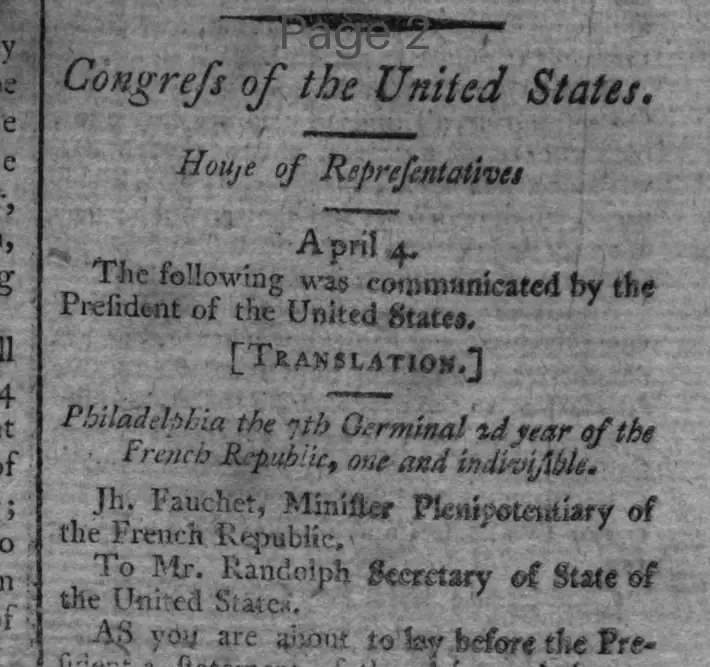
House of Representatives
April 4.
The following was communicated by the President of the United States.
[TRANSLATION.]
Philadelphia the 7th Germinal 2d year of the French Republic, one and indivisible.
J. Fauchet, Minister Plenipotentiary of the French Republic.
To Mr. Randolph Secretary of State of the United States.
The United States.
The vexations and depredations which your commerce has experienced, you will doubtless receive with pleasure some éclaircissements on the complaints well or ill founded, which have been brought against the privateers & ships of war of the French Republic. You will not observe with less pleasure in my reply, that the National Convention has already done justice to one of the demands of the merchants of the United States, and are now occupied in satisfying some others.
In the list of complaints against the republic of France the complainants urge that the French privateers do not less harass your commerce than those of the English.
To this assertion I answer by two observations which I submit to your impartiality.
I. It is now some time since any more privateers have sailed out of the ports of France, and the number of those which have been armed in our Islands is not to be compared with those pirates which the island of Bermuda alone sends forth.
2. If any of your merchants have suffered any injury by the conduct of our privateers, (a thing which would be contrary to the intention and express orders of the Republic) they may with confidence, address themselves to the French government, which will never refuse justice to those whose claims shall be legal.
I feel a pleasure in thinking, and saying to you, that it is not the fault of the French, if commercial property, even of enemy-nations, has not been respected amidst the horrors of war.
This proposition of natural right was made by one of our legislative assemblies to the British, who rejected it.
2dly. It is imputed to two of our ships of war that they have committed enormities on your vessels.
Should the fact be proved, the Captains of those two vessels are as culpable towards France as they are towards the United States, for having acted in a manner contrary to the instructions they have received: The government, upon information of the crime, will most certainly punish the authors of it. It would be unjust to accuse a nation generally for the act of some individuals, when that nation disavows their conduct, and repairs the wrongs which they have committed.
3dly. Certain acts of oppression in the courts of admiralty are complained of.
The oppressive acts of the admiralty courts need no longer to be complained of, since on the claims of merchants of the United States the Convention on the 8th November last, passed a decree giving to the executive council the power of judging of the validity or invalidity of prizes.
It is as follows:
The National Convention after having heard the report of the committee of public safety, decrees that all disputes arisen, or which may arise, on the validity or invalidity of prizes made by privateers, shall be decided, by way of administration, by the provisional executive council. The decree of the 14th, Feb. (O. S.) attributing the judgment of these matters to the commercial tribunals is repealed.
Copy agreeable to the original,
J. Fauchet.
The 4th allegation, would require a long discussion which I shall not undertake here. --I shall only indulge myself in this single reflection, that the horrible system of violating the law of nations in order to starve a people who cannot be conquered by force of arms, has not been invented by France, and that it would be as unjust as barbarous to require that she should allow provisions to pass to her enemies, while those destined for her are taken by them.
As to the embargo on American vessels. Imperious circumstances, the salvation of the country, have imposed that measure; but the interests of no one will be injured; and to convince you of this, I recite an extract of a letter which I have just received from citizen Talien Representative of the people at Bordeaux.
It is possible, he writes me, "That some malevolent persons may make use of this pretext (the embargo) to disturb the harmony existing between the Americans and us, or might represent this measure as a violation, of treaties between the two nations; the interest of individuals may for a moment cause the general interest to disappear. It is then to you brave Republican and the true friend of your country, that we must consign the care of defending it to Congress (should the measure happen to be there calumniated) as to our brethren that it is the intention of the committee of public safety, the actual center of the French government to indemnify all the owners or captains who by the operation of the embargo have been obliged to remain a length of time in France, and that the propositions which soon will be made to them in the name of the committee will be advantageous to both nations. In short, my friend, use every means of a frank republican negotiator to convince our brethren the Americans, that when occupied concerning the aggregate interests of the nation, we do not forget theirs, and they may be assured, that they will always find in us faithful observers of the treaties made with nations worthy of liberty."
The fifth and last allegation is that a contract the payment of which having been stipulated in cash, has been made in assignats; I am unacquainted with the fact, but I am assured, that it is the intention of the National Convention not to permit any injustice. and to repair such as shall have been committed.
I conclude my reflections; not doubting. Sir, but that they will be received with the same interests as would be excited in France by the observations of our allies, to whom I always with new pleasure renew the assurance of the most perfect fraternity and eternal friendship on the part of the people of France.
J. FAUCHET.
Faithfully translated from the original, 29th March, 1794, by
G. TAYLOR, jun.
Philadelphia, April 3d, 1794
SIR,
YOU do me no more than justice; in believing, that I receive with pleasure the explanations, which your letter of the 29th ult. contains. They inspire me with full confidence, that my representations on each complaint will be treated with candor; and assure me of redress, as far as truth will support my demands.
On my part, permit me here to repeat what I have expressed in my letter on the vexations of our commerce, that my inquiry into the facts did not go beyond the allegations of the parties interested. My view was to present a summary only of the subjects, of the remonstrances, lodged in my office, reserving the proofs for our interviews on the adjustment of the claims of retribution; delivering no opinion, how far the charges were supported by evidence, and above all, not imputing to the French Republic the unauthorized misconduct of its ships of war.
I have the honor, Sir, to be with great respect and esteem,
Your most obedient servant,
EDM. RANDOLPH.
The Minister Plenipotentiary of the French Republic.
True Copy,
GEORGE TAYLOR, jun.
What sub-type of article is it?
What keywords are associated?
What entities or persons were involved?
Where did it happen?
Foreign News Details
Primary Location
France
Event Date
7th Germinal 2d Year (29th March 1794)
Key Persons
Outcome
assurances of justice for complaints; national convention decree on 8th november transferring prize judgments to executive council; promises of indemnity for embargo delays; commitment to repair injustices in payments.
Event Details
French Minister J. Fauchet responds to US complaints about French privateers harassing commerce, warships committing enormities, oppressive admiralty courts, embargoes on American vessels, and payments in assignats instead of cash. He defends French actions, notes fewer privateers than British, promises redress, cites a decree empowering the executive council on prizes, quotes a letter assuring indemnities for embargoed ships, and reaffirms treaty observance. US Secretary Randolph acknowledges the explanations and expresses confidence in fair treatment.