Thank you for visiting SNEWPapers!
Sign up free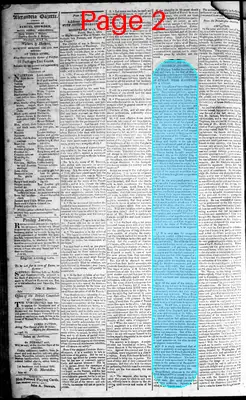
Alexandria Gazette, Commercial And Political
Alexandria, Virginia
What is this article about?
European affairs escalate toward crisis: Murat's forces retreat in Italy after May 3 battle, opening Naples to Austrians; French border preparations intensify without bloodshed; internal French insurrections reported; Europe unites against Bonaparte with British aid of 5 million and 50,000 troops.
Clipping

OCR Quality
Full Text
FOREIGN AFFAIRS.
We have London dates to the 1st June, and Paris to the last of May.-- Their contents daily accumulated import.
ALL THE GREAT CONCERNS OF EUROPE WERE HASTENING TO A CRISIS.
The affairs of the ex-king Murat in Italy, had approached a decisive moment. "Geographical positions, agreed to on both sides, showed, that after having foolishly advanced to the Po, Murat had been, after much desperate fighting, driven back many scores of miles-that his army was retreating in disorder; and while he is said (which we doubt) to have sought an asylum in the strong citadel of Ancona, he had left his whole kingdom open to the incursion of all the Austrian corps not immediately occupied with the investment of his place of retreat. After the decisive battle of the 3d May, the main body of Murat's army (whether he was with it, or had stopped at Ancona, was not certain) was retreating on the shores of the Adriatic, by Fermo and Pescara. Austrian corps being at Rome and Aquila, at the last date, proved the advanced point of the allied operations at that time. Six days march would fix them in Naples. The congress of Vienna having formally recognized Ferdinand 4th, as the rightful king of the two Sicilies, have virtually decreed, (as Bonaparte did to the same Ferdinand) that Joachim had ceased to reign ;' and there can be but little doubt of the decree having been fully executed ere this-especially if the reported expedition from Sicily had been brought into co-operation near Naples.
In the anticipated arena of the new war--the French northern border-- there had not been any bloodshedding at the last date :--the hostile preparations, however, continued on an immense scale. The latest Paris papers intimated, that the whole French force was cantoned between the Sombre and the Meuse, and that it would probably attack one of the flanks of the allies--that this point was watched by the Duke of Wellington and Prince Blucher, who had a large body of fine cavalry, and a train of 700 pieces of field artillery--that apprehensions of the attack were entertained by the citizens, who had removed; and that, to guard against it, the Duke of Wellington had ordered the inundations to be augmented.
It is very easy for paragraph-mongers to predict military movements. and to lead gaping credulity to anticipate important events. But while the French corps on the frontier remained scattered in cantonments and garrisons, without a prominent chief to direct them, and Bonaparte and his marshals continued in Paris, there was but little danger of any French hostilities. On the other hand the great allied commanders were not ready for decisive operations; and until they were fully ready, they could not move an inch forward. Well acquainted with popular impatience, they have learned to disregard the croakings and clamors of closet martinets and chimney-corner tacticians.
Of the state of the interior of France, it was not easy to form a decided opinion. Insurrections and divisions most certainly existed ; but their origin or extent was unknown. When Bonaparte arrived in Paris, the Duke of Bourbon fled to La Vendee, and there endeavored to raise a loyal force to oppose the Usurper. To aid him, a secret expedition, with arms and a few French royalists, sailed from England, and landed the arms and royalists at St. Gilles, on the coast of Poitou. The French papers say, these royalists had all been routed. and the arms taken, stated in various accounts at from 3000 to 10,000. But other accounts assert that the duke continued in Brittany ; and that the state of the insurrection was auspicious. One of the first objects of Bonaparte's attention was the double fortification of Paris-on one side. to repel assaults--on the other to over-
It is amply confirmed that all Europe is zealously united against Bonaparte; and that the French stories about Austria, Saxony, Sweden, Denmark, &c. were all sheer fabrications. The best evidence of their earnestness is their accession to the outlawry of Bonaparte-and the spirited exertions they are making to carry on the war against him.
Great Britain advances to the allies FIVE MILLIONS of money to carry on the war. She will also have in the field 50,000 men. Her naval preparations were very extensive. Squadrons had sailed to the French coast.
What sub-type of article is it?
What keywords are associated?
What entities or persons were involved?
Where did it happen?
Foreign News Details
Primary Location
Europe
Event Date
London Dates To The 1st June, Paris To The Last Of May
Key Persons
Outcome
murat's army retreating in disorder after battle of 3d may; kingdom open to austrian incursion; no bloodshed on french border; insurrections in france; europe united against bonaparte with british aid of five millions and 50,000 men
Event Details
Ex-king Murat's forces in Italy advanced to the Po but were driven back after desperate fighting and the decisive battle of 3d May, retreating toward Adriatic shores; Austrian corps advance to Rome and Aquila, poised to reach Naples; Vienna recognizes Ferdinand IV as king of Two Sicilies. On French northern border, massive preparations with French forces between Somme and Meuse, watched by Wellington and Blucher with cavalry and 700 artillery pieces; inundations augmented. Interior France sees insurrections, Duke of Bourbon raising forces in La Vendee and Brittany aided by English expedition landing arms at St. Gilles; conflicting reports on royalist success. Europe united against Bonaparte, acceding to his outlawry; Britain provides five million pounds and 50,000 troops, with naval squadrons sailing to French coast.