Thank you for visiting SNEWPapers!
Sign up free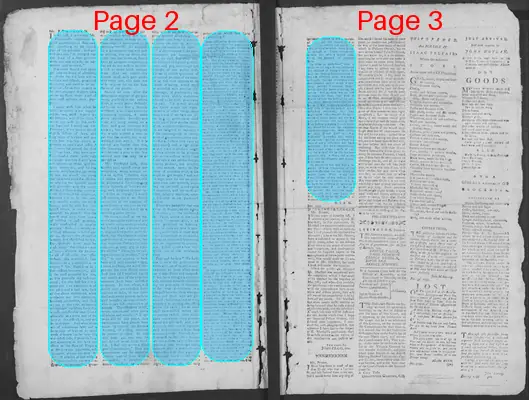
The Kentucky Gazette
Lexington, Fayette County, Kentucky
What is this article about?
A letter responding to Mr. Firebrand critiques complex laws influenced by lawyers, advocates for simpler government funded by produce, supports committees for representation, and quotes Thomas Paine on social compact to argue for Kentucky's new constitution free from Virginia's constraints.
Merged-components note: Merged as continuation of the same letter to the editor across pages, evidenced by sequential reading order, shared thematic focus on political committees, government formation, and references to Paine's pamphlet
Clippings
1 of 2
OCR Quality
Full Text
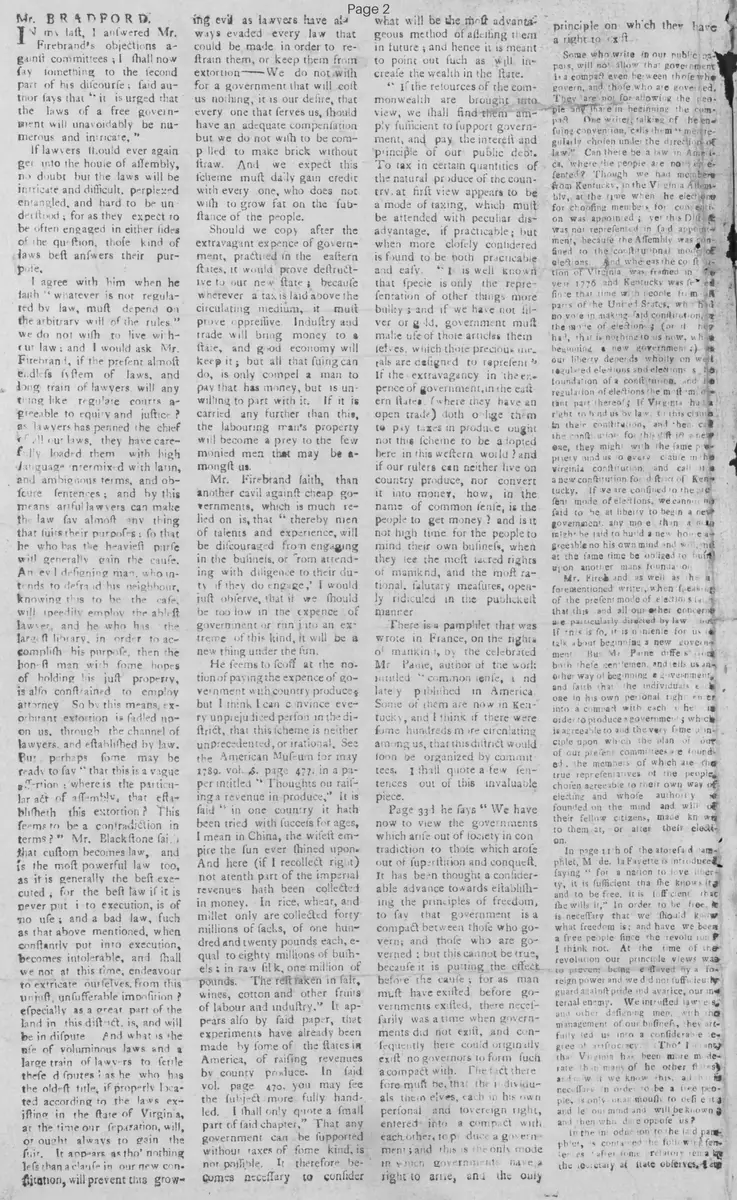
In my last, I answered Mr. Firebrand's objections against committees; I shall now say something to the second part of his discourse: said author says that "it is urged that the laws of a free government will unavoidably be numerous and intricate, if lawyers should ever again get into the house of assembly, no doubt but the laws will be intricate and difficult, perplexed entangled, and hard to be understood: for as they expect to be often engaged in either sides of the question, those kind of laws best answers their purpose."
I agree with him when he says "whatever is not regulated by law, must depend on the arbitrary will of the rulers." We do not wish to live without law: and I would ask Mr. Firebrand, if the present almost endless system of laws, and long train of lawyers will any thing like regulate courts agreeable to equity and justice? As lawyers has penned the chief of our laws, they have carefully loaded them with high language intermixed with slang, and ambiguous terms, and obscure sentences; and by this means artful lawyers can make the law say almost any thing that suits their purposes: so that he who has the heaviest purse will generally gain the cause.
An evil designing man, who intends to defraud his neighbour, knowing this to be the case, will speedily employ the ablest lawyer and he who has the largest library, in order to accomplish his purpose, then the honest man with some hopes of holding his just property, is also constrained to employ attorney. So by this means, exorbitant extortion is saddled upon us, through the channel of lawyers, and established by law.
But perhaps some may be ready to say "that this is a vague assertion: where is the particular act of assembly that establishes this extortion? This seems to be a contradiction in terms?" Mr. Blackstone says, that custom becomes law, and is the most powerful law too, as it is generally the best executed, for the best law if it is never put to execution, is of no use: and a bad law, such as that above mentioned, when constantly put into execution, becomes intolerable, and shall we not at this time, endeavour to extricate ourselves, from this unjust, unsufferable imposition? especially as a great part of the land in this district, is, and will be in dispute. And what is the use of voluminous laws and a large train of lawyers to settle these disputes? as he who has the oldest title, if properly stated according to the laws existing in the state of Virginia, at the time of our separation, will, or ought always to gain the suit. It appears as tho' nothing less than a clause in our new constitution, will prevent this growing evil as lawyers have always evaded every law that could be made in order to restrain them, or keep them from extortion.
We do not wish for a government that will cost us nothing, it is our desire, that every one that serves us, should have an adequate compensation but we do not wish to be compelled to make brick without straw. And we expect this scheme must daily gain credit with every one, who does not wish to grow fat on the substance of the people.
Should we copy after the extravagant expense of government, practiced in the eastern states, it would prove destructive to our new state; because wherever a tax is laid above the circulating medium, it must prove oppressive. Industry and trade will bring money to a state, and good economy will keep it: but all that suing can do, is only compel a man to pay that has money, but is unwilling to part with it. If it is carried any further than this, the labouring man's property will become a prey to the few monied men that may be amongst us.
Mr. Firebrand makes another cavil against cheap governments, which is much relied on is, that "thereby men of talents and experience, will be discouraged from engaging in the business, or from attending with diligence to their duty if they do engage." I would just observe, that if we should be too low in the expense of government or run into an extreme of this kind, it will be a new thing under the sun.
He seems to scoff at the notion of paying the expense of government with country produce but I think I can convince every unprejudiced person in the district, that this scheme is neither unprecedented, or irrational. See the American Museum for May 1780, vol. 5, page 427, in a paper entitled "Thoughts on raising a revenue in produce," It is said "in one country it hath been tried with success for ages, I mean in China, the wisest empire the sun ever shined upon. And here (if I recollect right) not a tenth part of the imperial revenues hath been collected in money. In rice, wheat, and millet only are collected forty millions of sacks, of one hundred and twenty pounds each, equal to eighty millions of bushels: in raw silk, one million of pounds. The rest taken in salt, wines, cotton and other fruits of labour and industry." It appears also by said paper, that experiments have already been made by some of the states in America, of raising revenues by county produce. In said vol. page 470, you may see the subject more fully handled. I shall only quote a small part of said chapter, "That any government can be supported without taxes of some kind, is not possible. It therefore becomes necessary to consider what will be the most advantageous method of assessing them in future; and hence it is meant to point out such as will increase the wealth in the state.
"If the resources of the commonwealth are brought into view, we shall find them amply sufficient to support government, and pay the interest and principle of our public debt. To tax in certain quantities of the natural produce of the country, at first view appears to be a mode of taxing, which must be attended with peculiar disadvantage, if practicable: but when more closely considered is found to be both practicable and easy." It is well known that specie is only the representation of other things more bulky; and if we have not silver or gold, government must make use of those articles themselves, which those precious metals are designed to represent.
If the extravagancy in the expense of government, in the east ern states, (where they have an open trade) doth oblige them to pay taxes in produce ought not this scheme to be adopted herein this western world? and if our rulers can neither live on country produce, nor convert it into money, how, in the name of common sense, is the people to get money! and is it not high time for the people to mind their own business, when they see the most sacred rights of mankind, and the most rational, salutary measures, openly ridiculed in the publickest manner.
There is a pamphlet that was wrote in France, on the rights of mankind, by the celebrated Mr. Paine, author of the work entitled "Common Sense," and late published in America. Some of them are now in Kentucky, and I think if there were some hundreds more circulating amongst us, that this district would soon be organized by committees. I shall quote a few sentences out of this invaluable piece.
Page 33d he says "We have now to view the governments which arise out of society in contradiction to those which arose out of superstition and conquest. It has been thought a considerable advance towards establishing the principles of freedom, to say that government is a compact between those who govern, and those who are governed; but this cannot be true, because it is putting the effect before the cause; for as man must have existed before governments existed, there necessarily was a time when governments did not exist, and consequently there could originally exist no governors to form such a compact with. The fact therefore must be, that the individuals themselves, each in his own personal and sovereign right, entered into a compact with each other, to produce a government; and this is the only mode in which governments have a right to arise, and the only principle on which they have a right to exists."
Some who write in our public papers, will not allow that government is a compact even between those who govern, and those who are governed. They are not for allowing the people any share in beginning the compact. One writer, talking of the ensuing convention, calls them "men regularly chosen under the direction of law." Can there be a law in America, where the people are not represented? Though we had members from Kentucky, in the Virginia Assembly, at the time when the elections for choosing members for convention was appointed; yet this District was not represented in said appointment, because the Assembly was confined to the constitutional mode of elections and whereas the constitution of Virginia was framed in the year 1776 and Kentucky was settled since that time with people from parts of the United States, who had no vote in making said constitution, the mode of election; (or it has nothing to us now, in beginning new government;) our liberty depends wholly on well regulated elections and elections foundation of a constitution, and regulation of elections the most important part thereof; If Virginia has a right to bind us by law, to this clause in their constitution, and then, in the constitution for this district anew one, they might with the same propriety bind us to every clause in the Virginia constitution and call "a new constitution for district of Kentucky." If we are confined to the present mode of elections, we cannot be said to be at liberty to begin a new government, any more than a man might be said to build a new house agreeable to his own mind and will, and at the same time be obliged to build upon another man's foundation.
Mr. Firebrand as well as the aformentioned writer, when speaking of the present mode of election says that this and all our other concerns are particularly directed by law. If this is so, it is nonsense for us to talk about beginning a new government. But Mr. Paine differs from both these gentlemen, and tells us another way of beginning government and says that the individuals one in his own personal right enter into a compact with each other in order to produce government; which is agreeable to and the very same principle upon which the plan of our present committees are founded and, the members of which are the true representatives of the people chosen agreeable to their own way of electing and whose authority founded on the mind and will of their fellow citizens, have known to them at, or alter their election.
In page 11th of the aforesaid pamphlet, M de. la Fayette is introduced saying "for a nation to love liberty, it is sufficient that they knows it and to be free, it is sufficient that they wills it." In order to be free, is necessary that we should know what freedom is; and have we been a free people since the revolution I think not. At the time of the revolution our principal views was to prevent being enslaved by a foreign power and we did not sufficiently guard against pride and avarice, our internal enemy. We intrusted lawyers and other designing men, with the management of our business, they artfully led us into a considerable degree of aristocracy. Tho I grant that Virginia has been more moderate than many of the other states and we too know this, as has necessary in order to be a free people, something must be done and let our mind and will be known and then what dare oppose us?
In the introduction to the said pamphlet, is contained the following sentences after some retrospection on the secretary of state observes etc.
Extremely pleased to find it reprinted here; and that something is at length to be publicly said against the political Heresies which have sprung up amongst us. I have no doubt our citizens will rally a second time, round the standard of common sense.
In order to understand what is meant by rallying a second time round the standard of Common sense, we need not enquire into the nature of the first collection under said standard. At the time of the revolution the aforesaid author wrote a pamphlet entitled "Common Sense," which was the means of uniting the people. And as there was no law existing at that time, they were at liberty to take the sense of the people, in any way that best suited them: But as it was absolutely necessary at that time to take the sense of every individual immediately, that they might know who was for the declaration of independence, and who was not; and finding that holding elections in only one place in each county, would not answer the purpose; therefore common recs. were chosen in all Districts, Elections,
VIZ.
Company Township and county committees. And by this means the sense of every individual was taken immediately. But since the revolution, the apparent attempts made of taking the sense of the people, has been generally only a sham; and at this back door extravagancy and oppression came in.
In the above you may find a secretary of state complaining of the political Heresies that has sprung up among them. What would not some in some of the eastern states give, to be in our situation, that is, to have the privilege of beginning a new government? and shall not we improve this favorable opportunity, and with one heart and soul, unite under the standard of common sense.
What sub-type of article is it?
What themes does it cover?
What keywords are associated?
What entities or persons were involved?
Letter to Editor Details
Recipient
Mr. Firebrand
Main Argument
the letter argues against complex, lawyer-influenced laws that favor the wealthy, advocates for a simple, affordable government funded by produce, supports committees for direct representation, and invokes paine's social compact to justify kentucky's independent constitutional formation free from virginia's electoral constraints.
Notable Details