Thank you for visiting SNEWPapers!
Sign up free
Gazette Of The United States & Evening Advertiser
Philadelphia, Philadelphia County, Pennsylvania
What is this article about?
Detailed account of Philippe Égalité's (Duke of Orleans) transfer from Marseilles to Paris, trial before the Revolutionary Tribunal, and execution by guillotine on November 6, 1793, amid the French Revolution. Includes his background, interactions, and public reaction.
Merged-components note: Continuation of the story about Philippe Egalite across pages, sequential reading order.
Clippings
1 of 2
OCR Quality
Full Text
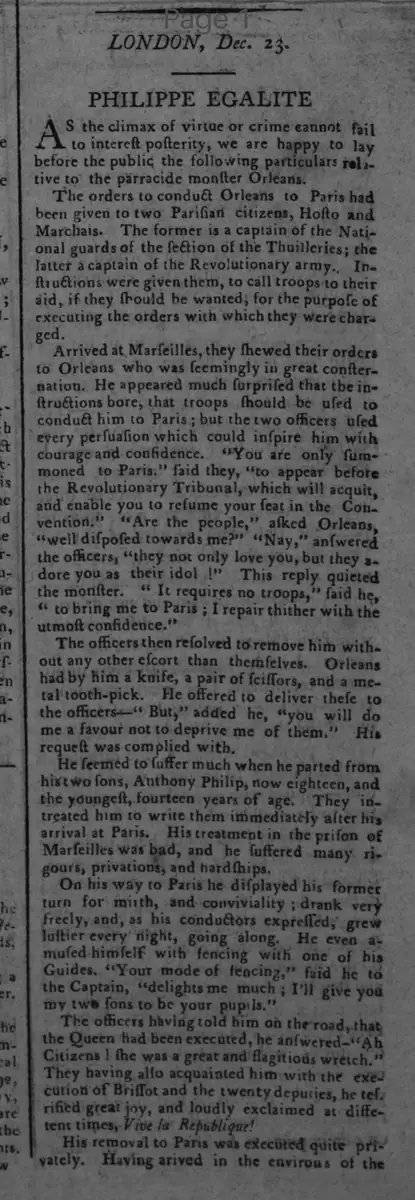
PHILIPPE EGALITE
As the climax of virtue or crime cannot fail to interest posterity, we are happy to lay before the public the following particulars relative to the parricide monster Orleans.
The orders to conduct Orleans to Paris had been given to two Parisian citizens, Hoto and Marchais. The former is a captain of the National guards of the section of the Tuilleries; the latter a captain of the Revolutionary army. Instructions were given them, to call troops to their aid, if they should be wanted; for the purpose of executing the orders with which they were charged.
Arrived at Marseilles, they shewed their orders to Orleans who was seemingly in great consternation. He appeared much surprised that the instructions bore, that troops should be used to conduct him to Paris; but the two officers used every persuasion which could inspire him with courage and confidence. "You are only summoned to Paris." said they, "to appear before the Revolutionary Tribunal, which will acquit, and enable you to resume your seat in the Convention." "Are the people," asked Orleans, "well disposed towards me?" "Nay," answered the officers, "they not only love you, but they adore you as their idol!" This reply quieted the monster. "It requires no troops," said he, "to bring me to Paris; I repair thither with the utmost confidence."
The officers then resolved to remove him without any other escort than themselves. Orleans had by him a knife, a pair of scissors, and a metal tooth-pick. He offered to deliver these to the officers—"But," added he, "you will do me a favour not to deprive me of them." His request was complied with.
He seemed to suffer much when he parted from his two sons, Anthony Philip, now eighteen, and the youngest, fourteen years of age. They entreated him to write them immediately after his arrival at Paris. His treatment in the prison of Marseilles was bad, and he suffered many rigours, privations, and hardships.
On his way to Paris he displayed his former turn for mirth, and conviviality; drank very freely, and, as his conductors expressed, grew livelier every night, going along. He even amused himself with fencing with one of his Guides. "Your mode of fencing," said he to the Captain, "delights me much; I'll give you my two sons to be your pupils."
The officers having told him on the road, that the Queen had been executed, he answered—"Ah Citizens! she was a great and flagitious wretch." They having also acquainted him with the execution of Brissot and the twenty deputies, he testified great joy, and loudly exclaimed at different times, Vive la Republique!
His removal to Paris was executed quite privately. Having arrived in the environs of the metropolis, he had his beard shaved; his hair dressed, and put on a fine suit of linen and clothes. "Now," said he, "I'll make a decent entry into Paris."
Having, however, passed through the barriers, how great was his surprise and dismay, when he was straight conducted to the Conciergerie. He concealed his disappointment by a forced and hypocritical smile.
With what fortitude he heard his sentence has already been stated. The President of the Tribunal having asked him if he had any thing to say why the sentence of the Law should not take place he answered "No I have no more defenders."
His execution was ordered for Thursday Nov. 7th. but by his own request, he was beheaded on the same day on which he received his doom.
He refused the ministration of a Priest, and spent the few hours he had to live in dressing himself. At two o'clock in the afternoon, on the 6th, he received sentence, and at half past three the same day, the Executioner arrived with his cart before the Conciergerie. The streets were more filled with people, than at the execution of Louis XVI. and that part of the mob among whom he had formerly distributed his money, insulted him most, especially the Ex-Marquis de St. Hurges formerly his hireling.
When he came to his palace the cart stopped for three minutes, either designedly or on account of the great crowds of people. He longingly cast his eyes upon that superb mansion, while the mob called out, "Look, look, 'tis for the last time."
On the scaffold he attempted to harangue the people, but their shouts drowned his voice.
At half past five his head was struck off; the executioner showed it twice or thrice on the corner of the scaffold, while the mob incessantly vociferated, "Bravo! bravo! Vive la Republique!"
Thus perished the most ruthless monster that ever polluted the Earth, Louis Philip Joseph Egalité, late Duke of Orleans, first Prince of the Blood; Lieutenant General of the French forces by Land and Sea, was born at St. Cloud, April 13, 1747. He was the pupil of Mirabeau, the confidant of Dumouriez and the client of Pétion.
Previous to the Revolution, he was the richest private man in Europe. In his youth he was a boon friend of the Dauphin afterwards Louis the XVI. whose blood he so much thirsted after. When the King was inoculated in 1775, Orleans, then Duke of Chartres, would not quit the King's apartment. The Duke of Orleans his father, who lived in his retirement at St. Af-ile, never troubled himself about his monstrous son, who, after his father's death wallowed in all kinds of excesses and debaucheries; and even when he succeeded to his title, he was the most nefarious man of his age.
At court he was despised, for which reason he exposed all its plans, being the first peer of France.
In 1787, Louis XVI. held a bed of Justice in the Parliament of Paris, when Égalité addressed him with so much boldness and daring effrontery, that his Majesty exiled him from the Capital by a Lettre-de-Cachet.
On the 6th. of October, 1789, Égalité and Mirabeau went both in disguise to Versailles, with the Fish-Women, whom the former had hired, in order to murder the Queen.
What sub-type of article is it?
What keywords are associated?
What entities or persons were involved?
Where did it happen?
Foreign News Details
Primary Location
Paris
Event Date
November 6
Key Persons
Outcome
executed by guillotine on november 6; head shown to the crowd amid cheers of 'vive la republique!'
Event Details
Philippe Egalité was arrested in Marseilles, escorted to Paris by captains Hoto and Marchais without additional troops after reassurances. En route, he was jovial, commented on executions of the Queen and Brissot with approval. Upon arrival, surprised to be taken to Conciergerie prison. Sentenced to death on November 6, refused priest, dressed carefully, executed that afternoon. Crowd insulted him; attempted speech drowned out. Background: Born 1747, key revolutionary figure, exiled 1787, involved in 1789 march to Versailles.