Thank you for visiting SNEWPapers!
Sign up free
Rhode Island American And Gazette
Providence, Providence County, Rhode Island
What is this article about?
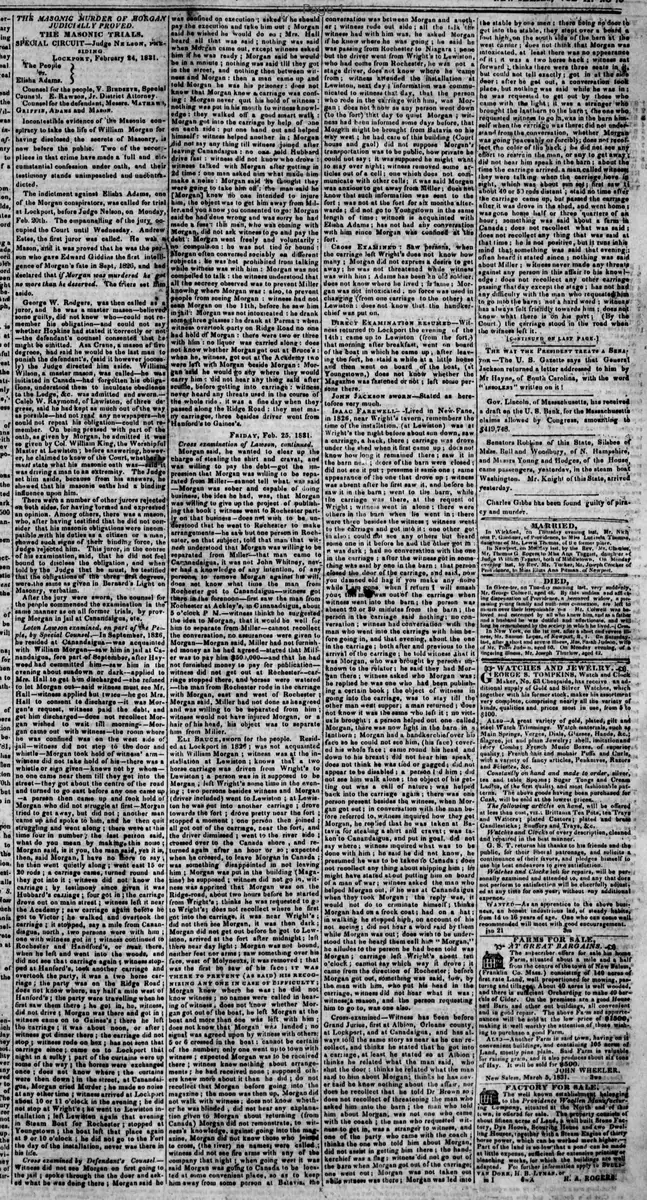
In February 1831, at Lockport, NY, Elisha Adams was tried for conspiracy in the Masonic abduction of William Morgan, who revealed Freemason secrets. Accomplice testimonies detailed Morgan's 1826 kidnapping from jail, transport to Fort Niagara, and confinement. Jury deadlocked, mistrial declared. Related trials mentioned.
Merged-components note: Merged multiple components spanning pages 1, 2, and 4 that form the complete report on the Masonic trials in the Morgan case, indicated by explicit continuation notes in the text.
Clippings
1 of 3
OCR Quality
Full Text
JUDICIALLY PROVED,
THE MASONIC TRIALS.
SPECIAL CIRCUIT-Judge NELSON, PRESIDING
Lockport, February 24, 1831.
The People
vs.
Elisha Adams.
Counsel for the people, W. Birdseye, Special
Counsel. E. Rawson, Jr. District Attorney.
Counsel for the defendant, Messrs. MATTHEW,
GRIFFIN, Adams and MASON.
Incontestible evidence of the Masonic con-
spiracy to take the life of William Morgan for
having disclosed, the secrets of Masonry, is
now before the public. Two of the accor-
plices in that crime have made a full and cir-
circumstantial confession under oath, and their
testimony stands unimpeached and uncontradic-
ted.
The indictment against Elisha Adams, one
of the Morgan conspirators, was called for trial
at Lockport, before Judge Nelson, on Monday,
Feb. 21st. The impanneling of the jury. oc-
curred the Court until Wednesday. Andrew
Estes, the first juror was called. He was a
Mason, and it was proved that he was the per-
son who gave Edward Giddins the first intelli-
gence of Morgan's fate in Sept, 1826, and had
declared that if Morgan was murdered he got
no more than he deserved. The friers set him
aside.
George W. Rodgers, was then called as
juror, and he was a master mason-believed
some guilty, did not know who-could not re-
member his obligation-and could not say
whether Hopkins had stated it correctly or not
-the defendant's counsel consented that he
might be omitted. Asa Crane, a mason of five
degrees, had said he would be the last man to
punish the defendant's, (said it however jocosely)
the Judge directed him aside. William
Wilson, a master mason, was called--he was
initiated in Canada-had forgotten his obliga-
tions, understood them to inculcate obedience
to the Lodge, &c. was admitted and sworn.
Caleb W. Raymond, of Lewiston, of three de-
grees, said he had kept as much out of the way
as possible-had not read any newspapers-he
could not repeat his obligation-could not re-
member. On being pressed with part of the
oath, as given by Morgan, he admitted it was
so given by Col. William King, the Worshipful
Master at Lewiston; before answering, howev-
er, he claimed to know of the Court, whether he
must state what his masonic oath was-said it
was driving a man to an extremity. The Judge
set him aside, because from his answers, he
showed that his masonic oaths had a binding
influence upon him.
There were a number of other jurors rejected
on both sides, for having formed and expressed
an opinion. Among others, there was a mason,
who, after having testified that he did not con-
sider that his masonic obligations were incom-
patible with his duties as a citizen or a man,
showed such signs of their binding force, the
Judge rejected him. This juror, in the course
of his examination, said, that he did not feel
bound to disclose the obligation, and when
told by the Judge that he must, he testified
that the obligations of the three first degrees,
were the same as given in Bernard's Light on
Masonry, verbatim.
After the jury were sworn, the counsel for
the people commenced the examination in the
same manner as on all former trials, by prov-
ing Morgan in jail at Canandaigua, &c.
Loton Lawson examined, on part of the Peo-
ple, by Special Counsel.-In September, 1826,
he resided at Canandaigua-was acquainted
with William Morgan--saw him in jail at Ca-
nandaigua, fore part of September, after Hay-
wood had committed him-saw him in the
evening about sundown or dark--applied to
Mrs. Hall to get him discharged-she refused
to let Morgan out-said witness must see Mr.
Hall-witness applied but twice-he got Mrs.
Hall to consent to discharge--it was Mor-
gan's request, witness paid the debt, and
got him discharged-does not recollect Mor-
gan wished to wait till morning--Mor-
gan came out with witness-the room where
he was confined was on the west side of
jail-witness did not step to the door and
whistle-Morgan took hold of witness' arm-
witness did not take hold of his--there was a
whistle or sign given-knows not by whom--
no one came near them till they got into the
street-they got about the centre of the road
and turned to go east before any one came up
-a person then came up and took hold of
Morgan who did not struggle at first-Morgan
tried to get away, but did not; another man
came up and spoke to him, and he then quit
struggling and went along; there were at this
time four in number; the last person said,
what do you mean by making this noise?
Morgan said, is it you, the man said, yes it is,
then, said Morgan, I have no more to say;
he then went quietly along; went east 15 or
20 rods; a carriage came, turned round and
they got into it; witness did not know the
carriage; by testimony since given it was
Hubbard's carriage; four got in the carriage
drove out on main street; witness left it near
the Academy; saw carriage again before he
got to Victor; he walked and overtook the
carriage; it stopped, say a mile from Canan-
digua, north, two persons were with him;
one with witness got in; witness continued to
Rochester and Hanford's, or near, there,
when he left and went into the woods, and
did not see that carriage again; witness stop-
ped at Hanford's, took another carriage and
overtook the party, it was a two horse car-
riage; the party was on the Ridge Road;
does not know where, say half a mile west of
Hanford's; the party were travelling when he
first saw them there; he got in, he, witness,
did not drive; Morgan was there and got in;
witness came on to Gaines's; there he left
the carriage; it was about noon, or after;
witness got dinner there; the carriage did not
stop; witness rode on box; has not seen that
carriage since; came on to Lockport that
night in a sulky; part of the curtains were up
some of the way; the horses were exchanged
once; does not know where; the curtains
were then down; in the street, at Canandai-
gua, Morgan cried Murder; he made no noise
at any other time; witness arrived at Lockport
about 10 or 11 o'clock in the evening; he did
not stop at Wright's; he went to Lewiston in-
stallation; left Lewiston again that evening
in Steam Boat or Rochester; stopped at
Youngstown; the boat left that place again
at 9 or 10 o'clock; he did not go to the Fort
the day of the installation, never was there in
his life.
Cross examined by Defendant's Counsel.-
Witness did not see Morgan on first going to
the jail; spoke through the door and asked
what he was doing there; Morgan said he
was confined on execution; asked if he should
pay the execution and take him out; Morgan
said he wished he would do so; Mrs. Hall
heard all that was said; nothing was said
when Morgan came out, except witness asked
him if he was ready; Morgan said he would
be in a minute; nothing was said till they got
in the street, and nothing then between wit-
ness and Morgan: then a man came up and
told Morgan he was his prisoner: does not
know that Morgan knew a carriage was com-
ing: Morgan never quit his hold of witness:
nothing was put in his mouth to witness knowl-
edge: they walked off a good smart walk:
Morgan got into the carriage by help of one
on each side: put one
hand out and helped
himself: witness helped another in; Morgan
did not say any thing till witness joined after
leaving Canandaigua: no one told Hubbard
drive fast: witness did not know who drove:
witness talked with Morgan after getting in
2d time: one man asked him what made him
make a noise: Morgan said he thought they
were going to take him off: the man said he
[Morgan] knew no
one
intended to injure
him, the object was to get him away from Mil-
ler, and you know you consented to go: Morgan
said he had done wrong and was sorry he had
made a fuss: this man, who was coming with
Morgan, did not ask witness to go and pay the
debt: Morgan went
freely and voluntarily
no compulsion: he was not tied or bound:
Morgan often conversed sociably on different
subjects: he was not prohibited from talking
while witness was with him: Morgan was not
compelled to talk: the witness understood that
all the secrecy observed was to prevent Miller
knowing where Morgan was: also, to prevent
people from seeing Morgan: witness had not
seen Morgan on the 11th, before he saw him
in jail: Morgan was not intoxicated: he drank
some three glasses: he drank at Parma: when
witness overtook party on Ridge Road no one
had hold of Morgan: there were two or three
with him: no liquor was carried along: does
not know whether Morgan got out at Bruce's:
when he, witness, got out at the Academy two
were left with Morgan beside Morgan: Mor-
gan said he would go anywhere they would
carry him: did not hear anything said after
scuffle, before getting into carriage: witness
never heard any threats used in the course of
the whole ride. it was a fine day when they
passed along the Ridge Road: they met ma-
ny carriages, three besides driver went from
Hanford's to Gaines's.
FRIDAY; Feb. 25, 1831.
Cross examination of Lawson, continued.
Morgan said, he wanted to clear up the
charge of stealing the shirt and cravat, and
was willing to pay the debt-got the im-
pression that Morgan was willing to be sepa-
rated from Miller-cannot tell what was said
-Morgan was sober and capable of doing
business, the idea he had, was, that Morgan
was willing to give up the project of publish-
ing the book; witness went to Rochester part-
ly on that business-does not wish to be un-
derstood that he went to Rochester to make
arrangements-he saw but one person in Roch-
ester, on that subject, told that man that wit-
ness understood that Morgan was willing to be
separated from Miller--that man came to
Canandaigua, it was not John Whitney, nev-
er had a knowledge of any intention, of any
person, to remove Morgan against his will,
does not know what time the man from
Rochester got to Canandaigua--witness got
there in the forenoon-first saw the man from
Rochester at Ackley's, in Canandaigua, about
5 o'clock P M.-witness thinks he suggested
the idea to Morgan, that it would be well for
him to separate from Miller-cannot recollect
the conversation, no assurances were given to
Morgan-Morgan said, Miller had not furnish-
ed money as he had agreed-Stated that Mill-
er was to pay him $500--and that he had
not furnished money to pay for publication-
witness did not get out at Rochester--car-
riage stopped there, and horses were watered
--the man from Rochester rode in the carriage
with Morgan, east and west of Rochester;
Morgan said, Miller had not done as he agreed
and was willing to be separated from him;
witness would not have injured Morgan, or a
hair of his head, his object was to separate
him from Miller.
Eli Bruce, sworn for the people. Resid-
ed at Lockport in 1826; was not acquainted
with William Morgan; witness was at the in-
stallation at Lewiston; knows that a two
horse carriage was driven from Wright's to
Lewiston; a person was in it supposed to be
Morgan; left Wright's some time in the even-
ing; two persons besides witness and Morgan
(driver included) went to Lewiston; at Lewis-
ton he was put into another carriage; drove
towards the fort; drove pretty near the fort;
stopped a moment; one person then joined;
all got out of the carriage, near the fort, and
the driver dismissed; went to the river side;
crossed over to the Canada shore, and re-
turned again after an hour or so; expected
when he crossed, to leave Morgan in Canada;
was somewhat disappointed in not leaving
him; Morgan was put in the building (Mag-
azine he supposed; witness did not go in, wit-
ness was apprized that Morgan was on the
Ridge-road, about two hours before he started
from Wright's; thinks he was requested to go
to Wright's; does not recollect where he first
got into the carriage, it was near Wright's:
did not then see Morgan, it was then dark;
Morgan did not get out before he got to Lew-
iston, arrived at the fort after midnight; left
there near day light; Morgan was not bound,
neither feet nor arms; saw something over his
face, west of Molyneuxs, it was removed; that
was the first he saw of his face; it was
THERE TO PREVENT (AS SAID) HIS RECOG-
NIZING ANY ONE IN CASE OF DIFFICULTY;
Morgan knew where he was; he did not
know witness; no names were called in hear-
ing of witness. does not know whether Mor-
gan got out of the boat, he left Morgan at the
boat and more than one was left, with him;
does not know that Morgan was landed; no
signal was agreed upon by witness with others;
5 or 6 crossed in the boat: cannot be certain
of the number; only one went up to town with
witness; expected Morgan was to be received
there; witness know nothing about arrange-
ments; he had received none; supposed oth-
ers knew more about it than he did; do not
recollect that Morgan before going into the
magazine; the moon was then up. Morgan did
not walk with witness; does not know wheth-
er he was blinded; did not hear any explana-
tion given to Morgan about returning (from
Canada) Morgan did not remonstrate, to wit-
ness's knowledge, against going into the mag-
azine, Morgan did not know those who joined
to cross, (the river) no names were called.;
witness did not see fire arms with any of the
company that night; when going west it was
said Morgan was going to Canada to be loca-
ted at some convenient place, so as to keep
him away from some person at Batavia, the
conversation was between Morgan and anoth-
er; witness rode outside; all the talk the
witness had with him was, he asked Morgan
if he knew where he was going; he said he
was passing from Rochester to Niagara: none
but the driver went from Wright's to Lewiston,
who had come from Rochester, he was not a
stage driver, does not know where he came
from; witness attended the installation at
Lewiston, next day; information was commu-
nicated to witness that day, that the person
who rode in the carriage with him, was
Mor-
gan; does not know as any person went down
(to the fort) that day to quiet Morgan; wit-
ness had been informed some days before, that
Morgan might be brought from Batavia on his
way west; he had care of this building (Court
house and gaol) did not suppose
Morgan's
transportation was to be public, how private he
could not say; it was supposed he might wish
to stay over night; witness removed some ar-
ticles out of a cell; one which does not com-
municate with other cells; it was said Morgan
was anxious to get away from Miller; does not
know that such information was sent to the
fort; was not at the fort for six months after-
wards; did not go to Youngstown in the same
length of time; witness is acquainted with
Elisha Adams; has not had any conversation
with him since Morgan was confined at the
fort.
Cross Examined: Saw persons, when
the carriage left Wright's does not know how
many; Morgan did not express a desire to get
away; he was not threatened while witness
was with him; Adams has been an old soldier;
does not know where he lived; same; Mor-
gan was not intoxicated; no force was used in
changing (from one carriage to the other at
Lewiston: does'not know that the handker-
chief was put on.
DIRECT EXAMINATION RESUMED-Wit-
ness returned to Lockport the evening of the
14th: came up to Lewiston (from the fort,)
that morning after breakfast, went on board
of the boat in which he came up; after leav-
ing the fort, he staid a while at a little house
and then went on board of the boat, (at
Youngstown.) does not know whether the
Magazine was fastened or not; left some per-
sons there.
John Jackson sworn-Stated as here-
tofore very much.
Isaac Farewell--Lived in New-Fane,
in 1826, near Wright's tavern, remembers the
time of the installation, (at Lewiston) was (at
Wright's the night before about sun down, saw
a carriage, a hack, there; carriage was drove
under the shed when it first came up: does not
know how long it remained there; saw it in
the barn near; doors of the barn were closed;
did not see it put; presume it same one; same
appearance of the one that drove up; witness
was absent after he first saw it, and before he
saw it in the barn; went to the barn, while
the carriage was there, at the request of
Wright: witness went in alone; there were
others in the barn when he went in; there
were three besides the witness; witness went
to the carriage and got into it; one other got
in also; could not see any others but heard
some one in it before he and the other got in:
it was dark; had no conversation with the one
in the carriage; after the witness got in some
thing was said by one in the barn; that person
closed the door of the carriage, and said, now
you damned old hag if you make any noise
while I am gone, when I return I will smash
you; this man was out of the carriage when
witness went into the barn; the person was
absent 20 or 30 minutes from the barn; the
person in the carriage said nothing; no con-
versation; witness had conversation with the
man who went into the carriage with him be-
fore going in, and that evening, about the one
in the carriage; both after and previous to the
arrival of the carriage; he told witness that it
was Morgan, who was brought by persons un-
known to the relator; he said they had Mor-
ran there; witness asked who Morgan was;
he replied he was one who had been publish-
ing a certain book; the object of witness in
going into the carriage, was to stay till the
other man went supper; a man returned; does
not know it was the same who left it; no vic-
tuals brought; a person helped out one called
Morgan, there was now light in the barn in a
lanthorn; Morgan had a handkerchief over his
face so he could not see him, (his face) covered
his whole face; come round his head and
down to his breast; did not hear him speak.
does not think he was tied or gagged; did not
appear to be disabled; a person led him; did
not see him walk alone; the object of his get-
ting out was a call of nature; was helped
back into the carriage again; there was one
person present besides the witness, when Mor-
gan got out; in conversation with the man be-
fore referred to, witness inquired how they got
Morgan, he replied that he was taken at Ba-
tavia for stealing a shirt and cravat; was ta-
ken to Canandaigua, and put in jail. did not
say where; witness inquired what was to be
done with him: he said he did not know, he
presumed he was to be taken to Canada; does
not recollect any thing about shipping him; he
might have stated about putting him on board
of a man of war; witness asked the man who
helped Morgan out, if he was at Canandaigua
when they took Morgan; the reply was, it
would not do to criminate himself; thinks
Morgan had on a frock coat; had on a hat;
in walking he stepped high, on account of his
not seeing; did not hear a word said by them
while Morgan was out; does wish to be under-
stood that he heard them call him "Morgan,"
he alludes to the person he had been told was
Morgan; carriage left Wright's about ten
o'clock; cannot say which way it drove; it
came from the direction of Rochester; before
Morgan got out, something was said, low, by
the man with him, who put his head in the
carriage, witness did not hear what it was;
witness a mason, and the person requesting
him to go to, was one also,
Cross-examined-Witness has been before
Grand Juries, first at Albion, Orleans county,
at Lockport, and at Canandaigua, and has al-
ways told the same story as near as he can re-
collect, and thinks he stated that he got into
a carriage, at least he stated so at Albion;
thinks he related what the man said, who
shut the door: thinks he related what the man
said to him about Morgan; thinks he has nev-
er said he knew nothing about the affair, nor
does he recollect that he told Dr Brown so;
does not recollect of threatening the man who
asked him into the barn; the man who told
him about Morgan, was not one who came
with the coach; the man who requested wit-
ness to get in, was a stranger to witness, and
one of the party who came with the coach;
thinks the one who told him about Morgan,
did not assist in getting him there; the hand-
kerchief was a flag; witness did not go out of
the barn when Morgan got out of the carriage;
one went out; Morgan was not taken out
while witness was there; Morgan was led into
the stable by one man; there being no door to
get into the stable, they slept over a board
four high, on the south side of the barn in the
west corner; does not think that Morgan was
intoxicated. at least there was no appearance
of it; it was a two horse hack; witness sat
forward; thinks there were three seats in
but could not tell exactly: got in at the side
door; after he got out, a conversation took
place, but nothing was said
while he was
in:
he was requested
to
get out
by
those who
came with the light; it was
a
d stranger
who
brought the lantern to the
barn
one
who
requested witness to go in, was in the barn him-
self when the carriage was there; did not under-
stand from the conversation, whether Morgan
was going peaceably or forcibly; does not recol-
lect the color of this hack; he did not see any
effort to restrain the man, or any to get away
did not hear him speak in the barn; about the
time the carriage arrived, a man called witness
they were talking when the carriage hove in
sight, which was about sun set; first saw it
about 40 or 50 rods distant; staid no time after
the carriage came up, but passed the carriage
after it was drove in the shed, and went home;
was gone home half or three quarters of an
hour; something was said about a farm in
Canada; does not recollect what was said
does not recollect any thing that was said at
that time: he is not positive, but it runs in his
mind that something was said that evening:
often heard it stated since; nothing was said
about Miller; witness never made any threats
against any person in this affair to his knowl-
edge: does not recollect any other carriage
passing that day except the stage; has not had
any difficulty with the man who requested him
to go into the barn; not a hard word; witness
has always felt friendly towards him; does not
know what there is on his part: (By the
Court.) the carriage stood in the road when
the witness left it.
[CONTINUED ON LAST PAGE.]
THE MASONIC TRIALS
[Concluded.]
JAMES A. SHED sworn—Was at Fort in Sept. 1826; arrived on the 12th; had a conversation under an injunction of masonic secrecy, about a message to be delivered in Canada; was requested to assist in rowing the boat with another person, in the evening of the 12th; object of message was explained to him; a very high handed measure was about to be entered into; a measure, the parallel of which, could not be found perhaps in the history of the world; except when King Stanislaus, the King of the Poles, was seized and carried away; the measure was, to seize a free citizen for publishing the secrets of masonry, and convey him out of the country; and carry him to Montreal or Quebec, and put him on board a British vessel, if one could be found, whose Commander was a mason; he engaged with great reluctance, but felt himself bound by the obligations of masonry to do it. Two messengers had left a few moments before; they had given him (the witness) letter to a mason in Canada; the letter was simply letter of introduction, stating the bearer was a free mason.
In the evening they crossed over to the village of Niagara, in Canada, to find the mason; the witness went along; in Niagara they discovered a man in the street, of whom they inquired for the man to whom the letter was directed; the person replied, that the person alluded to was not at home; and further said, I suppose I know your business; in a short time we shall have a meeting of the lodge in the house near by; it was not a regular meeting of the lodge, officers did not take their places; a tyler was placed at the door; the project of taking and carrying away Morgan was introduced and discussed; they could not agree upon any plan; they were requested to co-operate with the masons on this side, in carrying the plan into execution; the manner of taking him to Quebec was talked of; one proposed harsh and violent measures, alluded to the death of Morgan; a respectable gentleman opposed it; he would give money freely to transport Morgan, but to be accessory to the murder of a man was too revolting to his feelings—the council broke up without coming to any conclusion whatever. They returned home with two stages, who accompanied them from the lodge. One of them spoke much about the atrocious act of Morgan in revealing the secrets; said he ought to be put to death, because by exposing the secrets of masonry it might prove its ruin, and to destroy masonry would be a great injury to our country; said that the benefits of masonry were incalculable; it dries up the tears of widows or words to that effect; that evening after returning to the Fort, they walked around the Fort; the question was asked where Morgan would be confined if brought; place not stated; next day witness was requested to assist in removing some powder from the magazine by some person who first spoke to him about it; the powder he said was spoiling on account of the dampness of the room; the powder was removed into the adjoining building; a wooden one; there were some cartridges and boxes; magazine appeared to be damp; nothing was said about preparing a place to confine Morgan.
On the 14th witness was told that Morgan was brought the night before and put into the magazine; witness went to installation; did not go to the magazine himself; heard it told to others at Lewiston that Morgan was noisy; understood a message came up to still the noise; returned to the Fort that night; did not go to the magazine at any time when he understood Morgan was there; saw Elisha Adams at the ferry at Giddins; had not any conversation with defendant while it was said Morgan was there; on the subsequent Monday or Tuesday morning, Tuesday he thinks, he was walking across the yard of the Fort, and met the defendant coming from the magazine; witness observed that he appeared somewhat agitated; he made this remark: they have taken Morgan away; he is not now in the Fort; he was asked how he knew; he said he had been to the magazine, and he was sure he was not there; they then went to the magazine, person walking with witness, was the same that gave witness the first information; defendant at the door put his mouth to the outer door of the magazine and called Morgan three times; no one answered from within; he then unlocked the door, he had the key with him, all entered, first thing witness discovered was a bunch of straw, on which some person had evidently lain; this was on the 19th; saw a flag silk handkerchief on the floor, one of them requested witness to destroy it; he did so; both present he thinks with witness; saw a cartridge box which had been used by Morgan for the calls of nature; saw an earthen pitcher and decanter; a floor plank being broken in two, between two sleepers; sunk down in the middle; something said about it and some disposition made of it; caution was taken to restore the room to order; the box was carried out and thrown down near the door on the ground; straw was part, or all taken out; the pitcher and decanter were taken home to Mr Giddins; a quart decanter; Giddins was absent at this time; had been gone since the Saturday preceding; he believed the magazine was locked when they left it, but does not know who kept the keys it was when the Lewiston committee was there, he had a conversation with defendant; he was very much distressed about his situation, and said he was afraid Mr Giddins was going to disclose the transaction and if he was called upon to testify, he thought he should swear he knew nothing about it, but if Giddins disclosed it, it would ruin all, for his own account, he would not have it known for the world; he did not say at any time, what disposition was made of Morgan; there was a good deal apprehension among those concerned, that Giddins would disclose, and much persuasion was used to prevent him from disclosing; in the winter they were apprehensive he might disclose their proceedings, and they proposed to raise money, to get him to leave the country; he never was present when any proposition was made; witness was requested to go to Lewiston, and apprise them that there was danger that Giddins would disclose; he had a conference with a man, who said he would send to this place, (Lockport) and see what money could be procured in the Lodge and Chapter there; learned afterwards, that they sent to Lockport by way of the Falls, and understood they could raise but a small sum of money, that the Treasury had already been exhausted, in some measure was present at two interviews with Giddins; they were very earnest in their solicitation that he would promise never to disclose; he did promise one, about six weeks after, he overheard two masons talking—one said if Morgan was thrown into the river, his body would probably be consumed or eat up by the fish; also stated that Giddins walked the shore of the Lake every morning, to see if any body had washed ashore during the night previous; they thought that was a prudent measure; witness came from New Hampshire (to Fort Niagara) town of Ridge, Cheshire county; came directly there: stopped at mess house was there about 6 months; left last of February his masonry originated at the east; went down, on Stearn Boat from installation; was at the Fort during evening: did not hear of him at any time while in the magazine; was most of the evening at mess house, not at Giddins'; heard Giddins testify: was not once mentioned by Giddins believes he did step into Giddins' grocery did not hear any conversation about Morgan; saw others about there than those who belonged to the Fort; has since ascertained some of them belonged to this county: saw some about Giddins' house: some walking arm in arm about the Fort. and about the magazine; saw no one at the door of the magazine; witness retired about 10 o'clock: did not sup at Giddins: when he referred to Canada two men cross beoid.
witness; one did not go into the village; thinks it was Giddins; all there knew the errand over; it was distinctly understood; Giddins did not assist about the magazine; was not there; the men talked with Giddins about walking the Lake shore; has heard Giddins say it was an outrageous transaction; did not hear that Giddins threatened to disclose; the conspirators said Giddins read Miller and Southwick's papers, which disturbed him, troubled his conscience and his mind; wished freemasonry had never existed; never heard Giddins say anything about money; they appealed to him not to violate his obligation; he promised he would remain true; when about going over, witness gave him a sign; then was asked if he was a mason; understood that Morgan was to be brought there by force; that Morgan was expected Tuesday night; if not then, the subsequent night; when he left the Fort he went to Michigan; now resides at Dayton, Ohio; did not disclose to any one of the fraternity before he left; he got acquainted with Giddins; knew something about the money; when they found that but about $300 would be raised, he understood Giddins offered to take $200; witness taught school at Youngstown; heard Giddins talk about religion; heard him say he did believe in a God; that if there was a future state it was not a state of punishment; the Deity he believed in was far above his comprehension; a better God than Presbyterians believed in; was a being of benevolence; filled immensity; did not know but there might be a heart in a stick of wood; did not think it worth while to pray; the Almighty knew as well before as after our wants; heard him say he did not believe the bible; did not hear him say that God did not punish; witness left Dayton on the first of January; was sent for; the late sheriff went after him; had communicated to a person in Ohio, not a mason, that he knew something about the affair; was willing to be a witness; stated nearly all he now has; came to this state, and went to Geneva; expects nothing but his expenses; has assurance of something; all that was stated to witness was $1 per day for his loss of time, besides his expenses; Mr Philips stated that he ought to receive that; no arrangement since he came here or at Geneva.
William H. Adams, Esq. addressed the Jury more than five hours on behalf of the defendant. The Special Counsel spoke for the people nearly two hours.
Judge Nelson gave the Jury an elaborate charge. The Defendant, he said, if guilty at all, was guilty of an assault and battery, and false imprisonment of William Morgan, and of a conspiracy actually carried into effect. The punishment was imprisonment not exceeding two years, and a fine not exceeding $100. The guilt or innocence of Defendant, the Court said, depended upon the testimony of Edward Giddins, John Jackson, Eli Bruce and James A. Shed. The testimony of Jackson and Bruce corroborates in part that of Giddins and Shed. If Giddins and Shed were to be believed, no doubt remained of the guilt of the Defendant. The Court defined the character of conspiracy, and adverted to what Adams told Giddins on his return from York, which, if true, established the charge of conspiracy. The Court then stated that Shed's testimony corroborated Giddins on material points. If Giddins was not to be believed, Shed's testimony if entitled to credit, was ample evidence to make out the conspiracy. Giddins had been excepted to on the ground of Atheism. The testimony in support of and against the exception, was of such a nature, and so contradictory that the Court did not feel justified in depriving the people of his evidence. The Jury must weigh it impartially, and give it what credence to which, under all the circumstances it was entitled. The Court stated the law to be, that a witness must believe in God who would punish for perjury, but that the rule did not require a belief that the punishment will be in a future state only. The Court stated, that having been an accomplice, Giddins' testimony, to justify a conviction, must be corroborated by other circumstances and facts. The Counsel for the People relied upon Giddins' good moral character, which seemed to be beyond reproach. IT WAS INDEED CONCEDED THAT HIS CHARACTER FOR TRUTH AND VERACITY, WAS UNIMPEACHABLE. This, the Court added was to put to his account in weighing the evidence. It is alleged, also, that Giddins was acting under the masonic delusion when he became a co-conspirator. The Court then stated those parts of the testimony of Bruce and Jackson, that went to corroborate Giddins. In relation to Shed, Judge Nelson said he was free to admit that the frank manner in which he confessed his own participation in the affair, inspired the Court with confidence in his testimony. Shed's testimony corroborated Giddins in many material points.
The charge occupied more than an hour. The cause was given to the jury about seven o'clock on Saturday evening, February 26. The composition of this jury, is stated by the Lockport paper, to have been eight antimasons, three favorably disposed to the institution of masonry, and one freemason. Very shortly after they retired, each juror was requested to write down his verdict. Eleven wrote the word guilty, and one, the mason, wrote not guilty. This juror persisted in his refusal to convict, from Saturday until Monday morning, February 28. The jury then came into Court, and the foreman stated there was no probability of their agreeing. The Court informed them that if any juror had doubts which the Court could remove, the judge would be happy to do it. A juror replied that one of his fellows considered the proof to be illegal. The judge remarked that the jury must decide on the credibility, not the legality of testimony. The judge told the doubting juror to stand up. He did so, and it was William Willson, A Master Mason, of the town of Lewiston. He told the Court he did not believe a part of the evidence, and that they could not agree. The jury was then discharged by the Court, and the case of Adams placed on the docket for another trial.
It was the determination of the Special Counsel to go through all the trials, at this term of the Court. On Monday, February 28, the trial commenced of the same offence, of Major General Whitney, Noah Beach, Samuel W. Chubbuck, William Miller and Timothy Sweet, all Royal Arch masons, charged with the conspiracy in one indictment. The whole of Monday was spent in selecting the jury. One Royal Arch mason succeeded in being put upon the jury.
Tuesday, March 1.—Testimony on the part of the prosecution was received, until E. Giddins was offered, when it being about the usual hour of adjournment, and defendants' counsel wanting time to produce further testimony than was before offered to disqualify him, the Court adjourned to Wednesday morning.
The conspirator.—Giddins' testimony, in the Morgan trial at Lockport, should be read attentively by every one. There is no escaping from the conviction it enforces that it is true in every particular, and that at least 500 masons, some of them the first men in the community, deliberately concerted the carrying off and subsequent murder of Wm. Morgan. Giddins' testimony is attempted to be evaded, by accusing him of infidelity: This does not affect his credibility, and in R. Island we have an express statute which admits a witness, let his religion or disbelief in religion, be what it may. Another sage masonic objection is that Giddins was an accomplice, and therefore not to be believed But how are murderers, pirates, &c. convicted every day, except on testimony of accomplices? Frank Knapp would never have been convicted of the murder of Mr. White, but for the testimony of Jo. Knapp, his accomplice. In New York, Wansley and Gibbs have just been convicted of murder and mutiny on the testimony of Brownrigg and Dawes, accomplices. The masonic pretence set up to get over the Lockport trials, that the common law disqualifies an accomplice from being a witness must be founded in an utter ignorance of every principle of legal evidence, or a wilful perversion. Any witness may accuse himself if he chooses, but he cannot be compelled to criminate himself. This is the distinction.
What sub-type of article is it?
What themes does it cover?
What keywords are associated?
What entities or persons were involved?
Where did it happen?
Story Details
Key Persons
Location
Lockport, New York; Canandaigua; Lewiston; Fort Niagara
Event Date
February 1831; September 1826
Story Details
Trial of Elisha Adams for conspiracy in the abduction and murder of William Morgan by Freemasons. Testimonies from accomplices describe Morgan's release from jail, transport via carriage to Fort Niagara, confinement in the magazine, and failed attempts to deport him to Canada. Jury deadlocks due to one Mason holdout, resulting in mistrial. Editorial defends witness credibility.