Thank you for visiting SNEWPapers!
Sign up free
Editorial
August 20, 1860
Daily Democrat And News
Davenport, Scott County, Iowa
What is this article about?
Democratic Party resolutions from 1860 conventions reaffirming states' rights over domestic institutions including slavery, opposing federal interference and abolitionist agitation, upholding 1850 Compromises and Kansas-Nebraska Act, and supporting Union preservation. Includes resolutions from Charleston and Baltimore conventions on protection, Pacific railroad, Cuba acquisition, fugitive slave law, and territorial restrictions.
Clipping
OCR Quality
90%
Excellent
Full Text
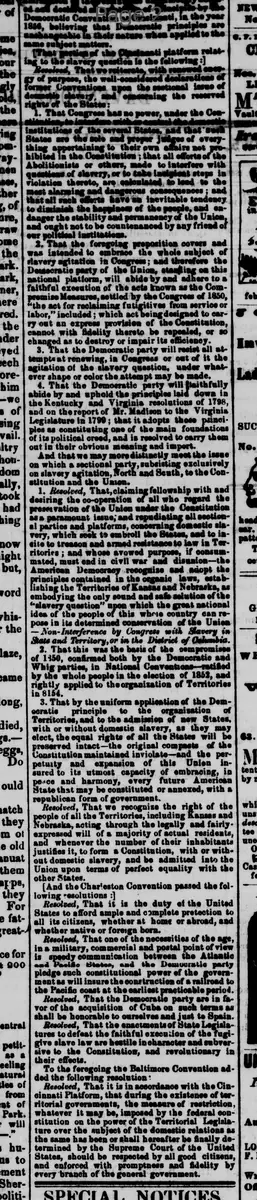
Resolved, That we re-affirm with renewed zeal and fixedness of purpose, the well-considered opinions and resolves of former Conventions upon the sectional issue, domestic controversy concerning the rights of the States:
1. That Congress has no power, under the Constitution, to interfere with or control the domestic institutions of the several States, and that such States are the sole and proper judges of everything appertaining to their own affairs not prohibited by the Constitution; that all efforts of the Abolitionists or others, made to induce Congress to interfere with questions of slavery, or to take incipient steps in that direction, are calculated to lead to the most alarming and far-reaching consequences, to diminish the happiness of the people, and endanger the stability and permanency of the Union and ought not to be countenanced by any friend of our political institutions.
2. That the foregoing proposition covers and was intended to embrace the whole subject of slavery agitation in Congress; and therefore the Democratic party of the Union, standing on this national platform, will abide by and adhere to a faithful execution of the acts known as the Compromise Measures, settled by the Congress of 1850, "the act for reclaiming fugitives from service or labor," included; which act being designed to carry out an express provision of the Constitution, cannot with fidelity thereto be repealed, or so changed as to destroy or impair its efficiency.
3. That the Democratic party will resist all attempts at renewing, in Congress or out of it the agitation of the slavery question, under whatever shape or color the attempt may be made.
4. That the Democratic party will faithfully abide by and uphold the principles laid down in the Kentucky and Virginia resolutions of 1798, and in the report of Mr. Madison to the Virginia Legislature in 1799; that it adopts those principles as constituting one of the main foundations of its political creed, and is resolved to carry them out in their obvious meaning and import.
And that we may more distinctly meet the issue on which a sectional party, subsisting exclusively on slavery agitation, North and South, to the Constitution and the Union.
1. Resolved, That, claiming fellowship with and desiring the co-operation of all who regard the preservation of the Union under the Constitution as a paramount issue; and repudiating all sectional parties and platforms, concerning domestic slavery, which seek to embroil the States, and to incite to treason and armed resistance to law in Territories; and whose avowed purpose, if consummated, must end in civil war and disunion—the American Democracy recognize and adopt the principles contained in the organic laws, establishing the Territories of Kansas and Nebraska, as embodying the only sound and safe solution of the "slavery question" upon which the great national idea of the people of this whole country can repose in its determined conservation of the Union—Non-Interference by Congress with Slavery in State and Territory, or in the District of Columbia.
2. That this was the basis of the compromises of 1850, confirmed both by the Democratic and Whig parties in National Conventions—ratified by the whole people in the election of 1852, and rightly applied to the organization of Territories in 1854.
3. That by the uniform application of the Democratic principle to the organization of Territories, and to the admission of new States, with or without domestic slavery, as they may elect, the equal rights of all the States will be preserved intact—the original compacts of the Constitution maintained inviolate—and the perpetuity and expansion of this Union insured to its utmost capacity of embracing, in peace and harmony, every future American State that may be constituted or annexed, with a republican form of government.
Resolved, That we recognize the right of the people of all the Territories, including Kansas and Nebraska, acting through the legally and fairly expressed will of a majority of actual residents, and whenever the number of their inhabitants justifies it, to form a Constitution, with or without domestic slavery, and be admitted into the Union upon terms of perfect equality with the other States.
(And the Charleston Convention passed the following resolutions:
Resolved, That it is the duty of the United States to afford ample and complete protection to all its citizens, whether at home or abroad, and whether native or foreign born.
Resolved, That one of the necessities of the age, in a military, commercial and postal point of view is speedy communication between the Atlantic and Pacific States, and the Democratic party pledge such constitutional power of the government as will insure the construction of a railroad to the Pacific coast at the earliest practicable period.
Resolved, That the Democratic party are in favor of the acquisition of Cuba on such terms as shall be honorable to ourselves and just to Spain.
Resolved, That the enactments of State Legislatures to defeat the faithful execution of the fugitive slave law are hostile in character and subversive to the Constitution, and revolutionary in their effects.
To the foregoing the Baltimore Convention added the following resolution:
Resolved, That it is in accordance with the Cincinnati Platform, that during the existence of territorial governments, the measure of restriction, whatever it may be, imposed by the federal constitution on the power of the Territorial Legislature over the subject of the domestic relations as the same has been or shall hereafter be finally determined by the Supreme Court of the United States, should be respected by all good citizens and enforced with promptness and fidelity by every branch of the general government.
1. That Congress has no power, under the Constitution, to interfere with or control the domestic institutions of the several States, and that such States are the sole and proper judges of everything appertaining to their own affairs not prohibited by the Constitution; that all efforts of the Abolitionists or others, made to induce Congress to interfere with questions of slavery, or to take incipient steps in that direction, are calculated to lead to the most alarming and far-reaching consequences, to diminish the happiness of the people, and endanger the stability and permanency of the Union and ought not to be countenanced by any friend of our political institutions.
2. That the foregoing proposition covers and was intended to embrace the whole subject of slavery agitation in Congress; and therefore the Democratic party of the Union, standing on this national platform, will abide by and adhere to a faithful execution of the acts known as the Compromise Measures, settled by the Congress of 1850, "the act for reclaiming fugitives from service or labor," included; which act being designed to carry out an express provision of the Constitution, cannot with fidelity thereto be repealed, or so changed as to destroy or impair its efficiency.
3. That the Democratic party will resist all attempts at renewing, in Congress or out of it the agitation of the slavery question, under whatever shape or color the attempt may be made.
4. That the Democratic party will faithfully abide by and uphold the principles laid down in the Kentucky and Virginia resolutions of 1798, and in the report of Mr. Madison to the Virginia Legislature in 1799; that it adopts those principles as constituting one of the main foundations of its political creed, and is resolved to carry them out in their obvious meaning and import.
And that we may more distinctly meet the issue on which a sectional party, subsisting exclusively on slavery agitation, North and South, to the Constitution and the Union.
1. Resolved, That, claiming fellowship with and desiring the co-operation of all who regard the preservation of the Union under the Constitution as a paramount issue; and repudiating all sectional parties and platforms, concerning domestic slavery, which seek to embroil the States, and to incite to treason and armed resistance to law in Territories; and whose avowed purpose, if consummated, must end in civil war and disunion—the American Democracy recognize and adopt the principles contained in the organic laws, establishing the Territories of Kansas and Nebraska, as embodying the only sound and safe solution of the "slavery question" upon which the great national idea of the people of this whole country can repose in its determined conservation of the Union—Non-Interference by Congress with Slavery in State and Territory, or in the District of Columbia.
2. That this was the basis of the compromises of 1850, confirmed both by the Democratic and Whig parties in National Conventions—ratified by the whole people in the election of 1852, and rightly applied to the organization of Territories in 1854.
3. That by the uniform application of the Democratic principle to the organization of Territories, and to the admission of new States, with or without domestic slavery, as they may elect, the equal rights of all the States will be preserved intact—the original compacts of the Constitution maintained inviolate—and the perpetuity and expansion of this Union insured to its utmost capacity of embracing, in peace and harmony, every future American State that may be constituted or annexed, with a republican form of government.
Resolved, That we recognize the right of the people of all the Territories, including Kansas and Nebraska, acting through the legally and fairly expressed will of a majority of actual residents, and whenever the number of their inhabitants justifies it, to form a Constitution, with or without domestic slavery, and be admitted into the Union upon terms of perfect equality with the other States.
(And the Charleston Convention passed the following resolutions:
Resolved, That it is the duty of the United States to afford ample and complete protection to all its citizens, whether at home or abroad, and whether native or foreign born.
Resolved, That one of the necessities of the age, in a military, commercial and postal point of view is speedy communication between the Atlantic and Pacific States, and the Democratic party pledge such constitutional power of the government as will insure the construction of a railroad to the Pacific coast at the earliest practicable period.
Resolved, That the Democratic party are in favor of the acquisition of Cuba on such terms as shall be honorable to ourselves and just to Spain.
Resolved, That the enactments of State Legislatures to defeat the faithful execution of the fugitive slave law are hostile in character and subversive to the Constitution, and revolutionary in their effects.
To the foregoing the Baltimore Convention added the following resolution:
Resolved, That it is in accordance with the Cincinnati Platform, that during the existence of territorial governments, the measure of restriction, whatever it may be, imposed by the federal constitution on the power of the Territorial Legislature over the subject of the domestic relations as the same has been or shall hereafter be finally determined by the Supreme Court of the United States, should be respected by all good citizens and enforced with promptness and fidelity by every branch of the general government.
What sub-type of article is it?
Slavery Abolition
Constitutional
Partisan Politics
What keywords are associated?
Slavery Agitation
States Rights
Democratic Platform
Compromise 1850
Kansas Nebraska Act
Fugitive Slave Law
Union Preservation
Popular Sovereignty
Pacific Railroad
Cuba Acquisition
What entities or persons were involved?
Congress
Democratic Party
Abolitionists
Mr. Madison
Sectional Party
Kansas And Nebraska
Charleston Convention
Baltimore Convention
Supreme Court Of The United States
Editorial Details
Primary Topic
Democratic Resolutions On Non Interference With Slavery And States' Rights
Stance / Tone
Defensive Of States' Rights, Anti Abolitionist Agitation, Pro Union Preservation
Key Figures
Congress
Democratic Party
Abolitionists
Mr. Madison
Sectional Party
Kansas And Nebraska
Charleston Convention
Baltimore Convention
Supreme Court Of The United States
Key Arguments
Congress Has No Power To Interfere With States' Domestic Institutions Including Slavery
States Are Sole Judges Of Their Affairs Not Prohibited By Constitution
Abolitionist Efforts Endanger Union
Abide By 1850 Compromise Measures And Fugitive Slave Law
Resist Renewal Of Slavery Agitation
Uphold Kentucky And Virginia Resolutions Of 1798 And Madison's 1799 Report
Adopt Kansas Nebraska Principles Of Non Interference With Slavery
Popular Sovereignty In Territories For Slavery Decision
Protect Citizens At Home And Abroad
Construct Pacific Railroad
Acquire Cuba Honorably
Oppose State Enactments Defeating Fugitive Slave Law
Respect Supreme Court On Territorial Slavery Restrictions