Thank you for visiting SNEWPapers!
Sign up free
Story
October 15, 1848
The New York Herald
New York, New York County, New York
What is this article about?
Burial of Onondaga chief Abram La Fort (De-hat-ka-tons) on a Sunday, with traditional pagan ceremonies in the Council House, including speeches by Harry Webster and passing of leadership beads to John Halftown; attended by tribe and whites; coffin buried in open field amid mourning.
Clipping
OCR Quality
95%
Excellent
Full Text
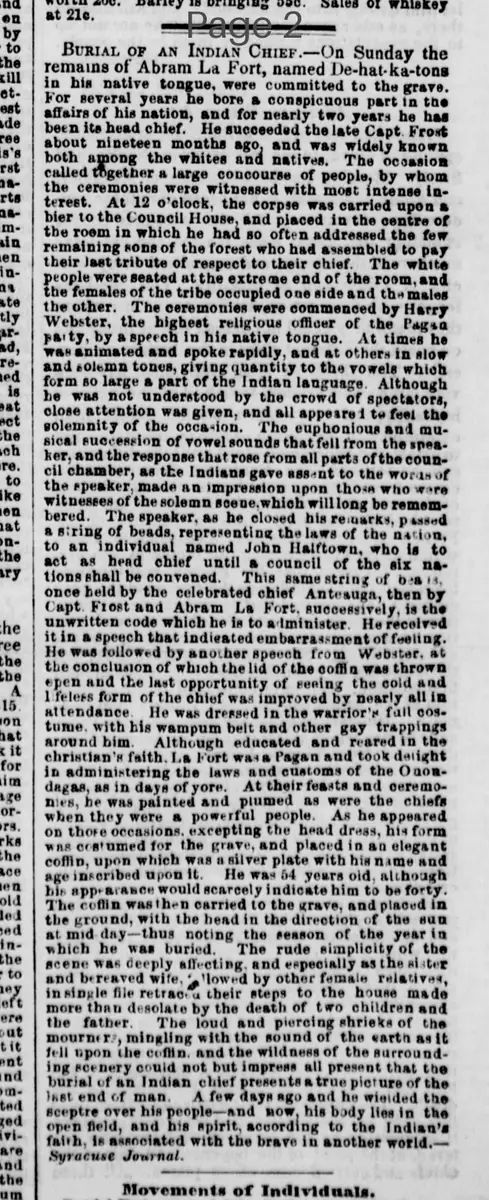
Burial Of An Indian Chief.—On Sunday the remains of Abram La Fort, named De-hat-ka-tons in his native tongue, were committed to the grave. For several years he bore a conspicuous part in the affairs of his nation, and for nearly two years he has been its head chief. He succeeded the late Capt. Frost about nineteen months ago, and was widely known both among the whites and natives. The occasion called together a large concourse of people, by whom the ceremonies were witnessed with most intense interest. At 12 o'clock, the corpse was carried upon a bier to the Council House, and placed in the centre of the room in which he had so often addressed the few remaining sons of the forest who had assembled to pay their last tribute of respect to their chief. The white people were seated at the extreme end of the room, and the females of the tribe occupied one side and the males the other. The ceremonies were commenced by Harry Webster, the highest religious officer of the Pagan party, by a speech in his native tongue. At times he was animated and spoke rapidly, and at others in slow and solemn tones, giving quantity to the vowels which form so large a part of the Indian language. Although he was not understood by the crowd of spectators, close attention was given, and all appeared to feel the solemnity of the occasion. The euphonious and musical succession of vowel sounds that fell from the speaker, and the response that rose from all parts of the council chamber, as the Indians gave assent to the words of the speaker, made an impression upon those who were witnesses of the solemn scene, which will long be remembered. The speaker, as he closed his remarks, passed a string of beads, representing the laws of the nation, to an individual named John Halftown, who is to act as head chief until a council of the six nations shall be convened. This same string of beads is, once held by the celebrated chief Anteauga, then by Capt. Frost and Abram La Fort, successively, is the unwritten code which he is to administer. He received it in a speech that indicated embarrassment of feeling. He was followed by another speech from Webster, at the conclusion of which the lid of the coffin was thrown open and the last opportunity of seeing the cold and lifeless form of the chief was improved by nearly all in attendance. He was dressed in the warrior's full costume, with his wampum belt and other gay trappings around him. Although educated and reared in the christian's faith, La Fort was a Pagan and took delight in administering the laws and customs of the Onondagas, as in days of yore. At their feasts and ceremonies, he was painted and plumed as were the chiefs when they were a powerful people. As he appeared on those occasions, excepting the head dress, his form was costumed for the grave, and placed in an elegant coffin, upon which was a silver plate with his name and age inscribed upon it. He was 54 years old, although his appearance would scarcely indicate him to be forty. The coffin was then carried to the grave, and placed in the ground, with the head in the direction of the sun at mid day—thus noting the season of the year in which he was buried. The rude simplicity of the scene was deeply affecting, and especially as the sister and bereaved wife, followed by other female relatives, in single file retraced their steps to the house made more than desolate by the death of two children and the father. The loud and piercing shrieks of the mourners, mingling with the sound of the earth as it fell upon the coffin, and the wildness of the surrounding scenery could not but impress all present that the burial of an Indian chief presents a true picture of the last end of man. A few days ago and he wielded the sceptre over his people—and now, his body lies in the open field, and his spirit, according to the Indian's faith, is associated with the brave in another world.—Syracuse Journal.
What sub-type of article is it?
Biography
Historical Event
Curiosity
What themes does it cover?
Tragedy
Misfortune
Family
What keywords are associated?
Indian Chief Burial
Onondaga Ceremony
Pagan Rites
Leadership Succession
Mourning Rituals
What entities or persons were involved?
Abram La Fort
Harry Webster
John Halftown
Capt. Frost
Anteauga
Where did it happen?
Onondagas Council House
Story Details
Key Persons
Abram La Fort
Harry Webster
John Halftown
Capt. Frost
Anteauga
Location
Onondagas Council House
Event Date
Sunday
Story Details
The remains of Onondaga chief Abram La Fort were buried with pagan ceremonies; Harry Webster spoke and passed the string of beads representing the laws to John Halftown as interim chief; the coffin was opened for viewing, then buried with head toward midday sun; mourners including wife and sister followed.