Thank you for visiting SNEWPapers!
Sign up free
Story
November 21, 1807
Alexandria Daily Advertiser
Alexandria, Virginia
What is this article about?
Courtroom proceedings from Aaron Burr's trial on October 5, featuring objections and testimony by Major James Bruff regarding General Wilkinson's alleged communications and inducements related to Burr's plans against the Spaniards.
Clipping
OCR Quality
88%
Good
Full Text
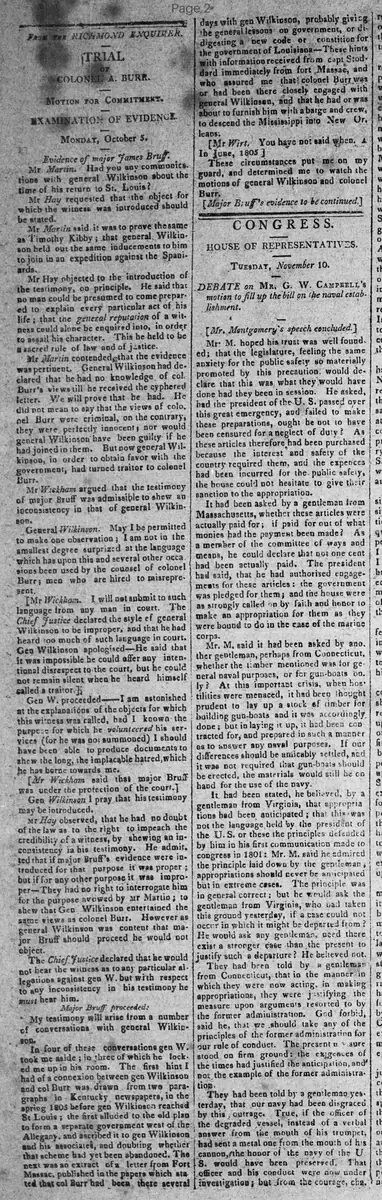
FROM THE RICHMOND ENQUIRER.
TRIAL
COLONEL A. BURR.
Motion for Commitment.
EXAMINATION OF EVIDENCE
Monday, October 5.
Mr. Martin. Had you any communications with general Wilkinson about the time of his return to St. Louis?
Evidence of major James Bruff.
Mr. Hay requested that the object for which the witness was introduced should be stated.
Mr. Martin said, it was to prove the same as Timothy Kibby: that general Wilkinson held out the same inducements to him to join in an expedition against the Spaniards.
Mr. Hay objected to the introduction of the testimony, on principle. He said that no man could be presumed to come prepared to explain every particular act of his life; that the general reputation of a witness could alone be enquired into, in order to assail his character. This he held to be a sacred rule of law and of justice.
Mr. Martin contended, that the evidence was pertinent. General Wilkinson had declared that he had no knowledge of col. Burr's views till he received the cyphered letter. We will prove that he had. He did not mean to say that the views of colonel Burr were criminal, on the contrary, they were perfectly innocent; nor would general Wilkinson have been guilty if he had joined in them. But now general Wilkinson, in order to obtain favor with the government, had turned traitor to colonel Burr.
Mr. Wickham argued that the testimony of major Bruff was admissible to shew an inconsistency in that of general Wilkinson.
General Wilkinson. May I be permitted to make one observation; I am not in the smallest degree surprized at the language which has upon this and several other occasions been used by the counsel of colonel Burr; men who are hired to misrepresent.
[Mr. Wickham. I will not submit to such language from any man in court. The Chief Justice declared the style of general Wilkinson to be improper, and that he had heard too much of such language in court.]
Gen. Wilkinson apologised. He said that it was impossible he could offer any intentional disrespect to the court, but he could not remain silent when he heard himself called a traitor.
Gen. W. proceeded. I am astonished at the explanations of the objects for which this witness was called, had I known the purpose for which he volunteered his services (for he was not summoned) I should have been able to produce documents to shew the long, the implacable hatred, which he has borne towards me.
[Mr. Wickham said that major Bruff was under the protection of the court.]
Gen. Wilkinson. I pray that his testimony may be introduced.
Mr. Hay observed, that he had no doubt of the law as to the right to impeach the credibility of a witness, by shewing an inconsistency in his testimony. He admitted that if major Bruff's evidence were introduced for that purpose it was proper; but if for any other purpose it was improper. They had no right to interrogate him for the purpose avowed by Mr. Martin; to shew that Gen. Wilkinson entertained the same views as colonel Burr. However as general Wilkinson was content that major Bruff should proceed he would not object.
The Chief Justice declared that he would not hear the witness as to any particular allegations against gen. W. but with respect to any inconsistency in his testimony he must hear him.
Major Bruff proceeded:
My testimony will arise from a number of conversations with general Wilkinson.
In one of these conversations gen. W. took me aside; in three of which he took me up to his room. The first hint I had of a connexion between gen. Wilkinson and col. Burr was drawn from two paragraphs in Kentucky newspapers, in the spring 1805 before gen. Wilkinson reached St. Louis; the first alluded to the old plan to form a separate government west of the Alleghany, and ascribed it to gen. Wilkinson and his associates, and doubting whether that scheme had yet been abandoned. The next was an extract of a letter from Fort Massac, published in the papers which stated that col. Burr had been there several days with gen. Wilkinson, probably giving the general lessons on government, or digesting a new code or constitution for the government of Louisiana. These hints with information received from capt. Stoddard immediately from fort Massac, and who assured me that colonel Burr was or had been there closely engaged with general Wilkinson, and that he had or was about to furnish him with a barge and crew, to descend the Mississippi into New Orleans:
[Mr. Wirt. You have not said when. In June, 1805.]
These circumstances put me on my guard, and determined me to watch the motions of general Wilkinson and colonel Burr.
[Major Bruff's evidence to be continued.]
TRIAL
COLONEL A. BURR.
Motion for Commitment.
EXAMINATION OF EVIDENCE
Monday, October 5.
Mr. Martin. Had you any communications with general Wilkinson about the time of his return to St. Louis?
Evidence of major James Bruff.
Mr. Hay requested that the object for which the witness was introduced should be stated.
Mr. Martin said, it was to prove the same as Timothy Kibby: that general Wilkinson held out the same inducements to him to join in an expedition against the Spaniards.
Mr. Hay objected to the introduction of the testimony, on principle. He said that no man could be presumed to come prepared to explain every particular act of his life; that the general reputation of a witness could alone be enquired into, in order to assail his character. This he held to be a sacred rule of law and of justice.
Mr. Martin contended, that the evidence was pertinent. General Wilkinson had declared that he had no knowledge of col. Burr's views till he received the cyphered letter. We will prove that he had. He did not mean to say that the views of colonel Burr were criminal, on the contrary, they were perfectly innocent; nor would general Wilkinson have been guilty if he had joined in them. But now general Wilkinson, in order to obtain favor with the government, had turned traitor to colonel Burr.
Mr. Wickham argued that the testimony of major Bruff was admissible to shew an inconsistency in that of general Wilkinson.
General Wilkinson. May I be permitted to make one observation; I am not in the smallest degree surprized at the language which has upon this and several other occasions been used by the counsel of colonel Burr; men who are hired to misrepresent.
[Mr. Wickham. I will not submit to such language from any man in court. The Chief Justice declared the style of general Wilkinson to be improper, and that he had heard too much of such language in court.]
Gen. Wilkinson apologised. He said that it was impossible he could offer any intentional disrespect to the court, but he could not remain silent when he heard himself called a traitor.
Gen. W. proceeded. I am astonished at the explanations of the objects for which this witness was called, had I known the purpose for which he volunteered his services (for he was not summoned) I should have been able to produce documents to shew the long, the implacable hatred, which he has borne towards me.
[Mr. Wickham said that major Bruff was under the protection of the court.]
Gen. Wilkinson. I pray that his testimony may be introduced.
Mr. Hay observed, that he had no doubt of the law as to the right to impeach the credibility of a witness, by shewing an inconsistency in his testimony. He admitted that if major Bruff's evidence were introduced for that purpose it was proper; but if for any other purpose it was improper. They had no right to interrogate him for the purpose avowed by Mr. Martin; to shew that Gen. Wilkinson entertained the same views as colonel Burr. However as general Wilkinson was content that major Bruff should proceed he would not object.
The Chief Justice declared that he would not hear the witness as to any particular allegations against gen. W. but with respect to any inconsistency in his testimony he must hear him.
Major Bruff proceeded:
My testimony will arise from a number of conversations with general Wilkinson.
In one of these conversations gen. W. took me aside; in three of which he took me up to his room. The first hint I had of a connexion between gen. Wilkinson and col. Burr was drawn from two paragraphs in Kentucky newspapers, in the spring 1805 before gen. Wilkinson reached St. Louis; the first alluded to the old plan to form a separate government west of the Alleghany, and ascribed it to gen. Wilkinson and his associates, and doubting whether that scheme had yet been abandoned. The next was an extract of a letter from Fort Massac, published in the papers which stated that col. Burr had been there several days with gen. Wilkinson, probably giving the general lessons on government, or digesting a new code or constitution for the government of Louisiana. These hints with information received from capt. Stoddard immediately from fort Massac, and who assured me that colonel Burr was or had been there closely engaged with general Wilkinson, and that he had or was about to furnish him with a barge and crew, to descend the Mississippi into New Orleans:
[Mr. Wirt. You have not said when. In June, 1805.]
These circumstances put me on my guard, and determined me to watch the motions of general Wilkinson and colonel Burr.
[Major Bruff's evidence to be continued.]
What sub-type of article is it?
Crime Story
Historical Event
What themes does it cover?
Crime Punishment
Justice
What keywords are associated?
Burr Trial
Wilkinson Testimony
Major Bruff
Court Objection
Expedition Against Spaniards
Cyphered Letter
What entities or persons were involved?
Colonel A. Burr
General Wilkinson
Major James Bruff
Mr. Martin
Mr. Hay
Mr. Wickham
Chief Justice
Story Details
Key Persons
Colonel A. Burr
General Wilkinson
Major James Bruff
Mr. Martin
Mr. Hay
Mr. Wickham
Chief Justice
Event Date
Monday, October 5
Story Details
In Aaron Burr's trial, Major Bruff's testimony is debated and partially introduced to demonstrate inconsistencies in General Wilkinson's claims of ignorance about Burr's plans, referencing newspaper reports and conversations suggesting earlier connections between Burr and Wilkinson in 1805.