Thank you for visiting SNEWPapers!
Sign up free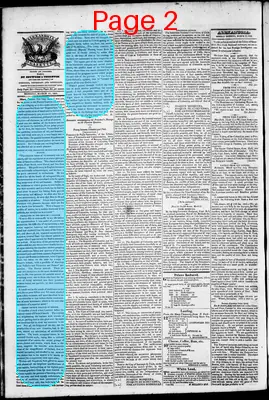
Letter to Editor
March 27, 1826
Phenix Gazette
Alexandria, Virginia
What is this article about?
A correspondent submits three extracts from the London publication 'English Spy' to the Phenix Gazette editors for potential insertion: a character sketch of Bernard Blackmantle, a description of a college head, and a scenic reflection on Christ Church College at Oxford, highlighting the work's satirical and philosophical style.
Clipping
OCR Quality
98%
Excellent
Full Text
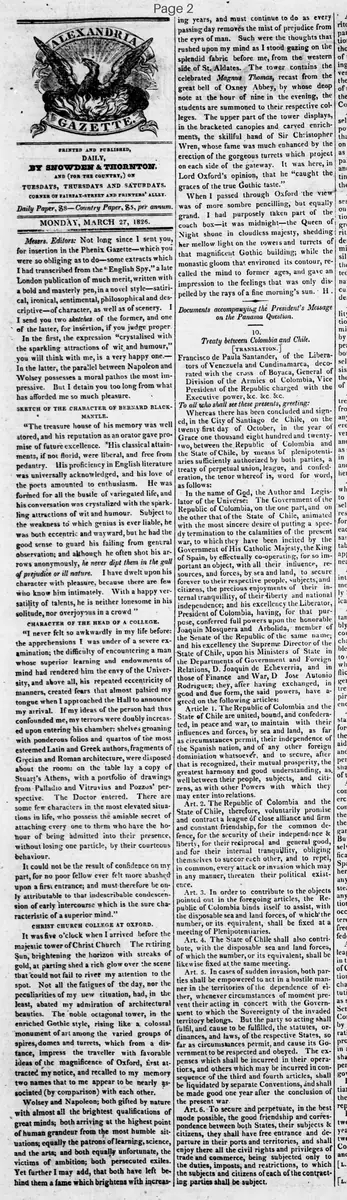
Messrs. Editors: Not long since I sent you, for insertion in the Phenix Gazette—which you were so obliging as to do—some extracts which I had transcribed from the "English Spy," a late London publication of much merit, written with a bold and masterly pen, in a novel style—satirical, ironical, sentimental, philosophical and descriptive—of character, as well as of scenery. I send you two sketches of the former, and one of the latter, for insertion, if you judge proper. In the first, the expression "crystalised with the sparkling attractions of wit and humour," you will think with me, is a very happy one.—In the latter, the parallel between Napoleon and Wolsey possesses a moral pathos the most impressive. But I detain you too long from what has afforded me so much pleasure.
SKETCH OF THE CHARACTER OF BERNARD BLACKMANTLE.
"The treasure house of his memory was well stored, and his reputation as an orator gave promise of future excellence. His classical attainments, if not florid, were liberal, and free from pedantry. His proficiency in English literature was universally acknowledged, and his love of the poets amounted to enthusiasm. He was formed for all the bustle of variegated life, and his conversation was crystalized with the sparkling attractions of wit and humour. Subject to the weakness to which genius is ever liable, he was both eccentric and wayward, but he had the good sense to guard his failing from general observation; and although he often shot his arrows anonymously, he never dipt them in the gall of prejudice or ill nature. I have dwelt upon his character with pleasure, because there are few who know him intimately. With a happy versatility of talents, he is neither lonesome in his solitude, nor overjoyous in a crowd."
CHARACTER OF THE HEAD OF A COLLEGE.
"I never felt so awkwardly in my life before: the apprehensions I was under of a severe examination; the difficulty of encountering a man whose superior learning and endowments of mind had rendered him the envy of the University, and above all, his repeated eccentricity of manners, created fears that almost palsied my tongue when I approached the Hall to announce my arrival. If my ideas of the person had thus confounded me, my terrors were doubly increased upon entering his chamber: shelves groaning with ponderous folios and quartos of the most esteemed Latin and Greek authors, fragments of Grecian and Roman architecture, were disposed about the room: on the table lay a copy of Stuart's Athens, with a portfolio of drawings from—Palladio and Vitruvius and Pozzo's perspective. The Doctor entered. There are some few characters in the most elevated situations in life, who possess the amiable secret of attaching every one to them who have the honour of being admitted into their presence, without losing one particle, by their courteous behaviour. It could not be the result of confidence on my part, for no poor fellow ever felt more abashed upon a first entrance; and must therefore be only attributable to that indescribable condescension of early intercourse which is the sure characteristic of a superior mind."
CHRIST CHURCH COLLEGE AT OXFORD.
It was five o'clock when I arrived before the majestic tower of Christ Church. The retiring Sun, brightening the horizon with streaks of gold, at parting shed a rich glow over the scene that could not fail to rivet my attention to the spot. Not all the fatigues of the day, nor the peculiarities of my new situation, had, in the least, abated my admiration of architectural beauties. The noble octagonal tower, in the enriched Gothic style, rising like a colossal monument of art among the varied groups of spires, domes and turrets, which from a distance, impress the traveller with favourable ideas of the magnificence of Oxford, first attracted my notice, and recalled to my memory two names that to me appear to be nearly associated (by comparison) with each other. Wolsey and Napoleon; both gifted by nature with almost all the brightest qualifications of great minds; both arriving at the highest point of human grandeur from the most humble situations; equally the patrons of learning, science, and the arts; and both equally unfortunate, the victims of ambition; both persecuted exiles. Yet further I may add, that both have left behind them a fame which brightens with increasing years, and must continue to do as every passing day removes the mist of prejudice from the eyes of man. Such were the thoughts that rushed upon my mind as I stood gazing on the splendid fabric before me, from the western side of St. Aldates. The tower contains the celebrated Magnus Thomas, recast from the great bell of Osney Abbey, by whose deep note at the hour of nine in the evening, the students are summoned to their respective colleges. The upper part of the tower displays, in the bracketed canopies and carved enrichments, the skillful hand of Sir Christopher Wren, whose fame was much enhanced by the erection of the gorgeous turrets which project on each side of the gateway. It was here, in Lord Oxford's opinion, that he "caught the graces of the true Gothic taste." When I passed through Oxford the view was of more sombre pencilling, but equally grand. I had purposely taken part of the coach box—it was midnight—the Queen of Night shone in cloudless majesty, shedding her mellow light on the towers and turrets of that magnificent Gothic building; while the monastic gloom that environed its contour, recalled the mind to former ages, and gave an impression to the feelings that was only dispelled by the rays of a fine morning's sun. H.
SKETCH OF THE CHARACTER OF BERNARD BLACKMANTLE.
"The treasure house of his memory was well stored, and his reputation as an orator gave promise of future excellence. His classical attainments, if not florid, were liberal, and free from pedantry. His proficiency in English literature was universally acknowledged, and his love of the poets amounted to enthusiasm. He was formed for all the bustle of variegated life, and his conversation was crystalized with the sparkling attractions of wit and humour. Subject to the weakness to which genius is ever liable, he was both eccentric and wayward, but he had the good sense to guard his failing from general observation; and although he often shot his arrows anonymously, he never dipt them in the gall of prejudice or ill nature. I have dwelt upon his character with pleasure, because there are few who know him intimately. With a happy versatility of talents, he is neither lonesome in his solitude, nor overjoyous in a crowd."
CHARACTER OF THE HEAD OF A COLLEGE.
"I never felt so awkwardly in my life before: the apprehensions I was under of a severe examination; the difficulty of encountering a man whose superior learning and endowments of mind had rendered him the envy of the University, and above all, his repeated eccentricity of manners, created fears that almost palsied my tongue when I approached the Hall to announce my arrival. If my ideas of the person had thus confounded me, my terrors were doubly increased upon entering his chamber: shelves groaning with ponderous folios and quartos of the most esteemed Latin and Greek authors, fragments of Grecian and Roman architecture, were disposed about the room: on the table lay a copy of Stuart's Athens, with a portfolio of drawings from—Palladio and Vitruvius and Pozzo's perspective. The Doctor entered. There are some few characters in the most elevated situations in life, who possess the amiable secret of attaching every one to them who have the honour of being admitted into their presence, without losing one particle, by their courteous behaviour. It could not be the result of confidence on my part, for no poor fellow ever felt more abashed upon a first entrance; and must therefore be only attributable to that indescribable condescension of early intercourse which is the sure characteristic of a superior mind."
CHRIST CHURCH COLLEGE AT OXFORD.
It was five o'clock when I arrived before the majestic tower of Christ Church. The retiring Sun, brightening the horizon with streaks of gold, at parting shed a rich glow over the scene that could not fail to rivet my attention to the spot. Not all the fatigues of the day, nor the peculiarities of my new situation, had, in the least, abated my admiration of architectural beauties. The noble octagonal tower, in the enriched Gothic style, rising like a colossal monument of art among the varied groups of spires, domes and turrets, which from a distance, impress the traveller with favourable ideas of the magnificence of Oxford, first attracted my notice, and recalled to my memory two names that to me appear to be nearly associated (by comparison) with each other. Wolsey and Napoleon; both gifted by nature with almost all the brightest qualifications of great minds; both arriving at the highest point of human grandeur from the most humble situations; equally the patrons of learning, science, and the arts; and both equally unfortunate, the victims of ambition; both persecuted exiles. Yet further I may add, that both have left behind them a fame which brightens with increasing years, and must continue to do as every passing day removes the mist of prejudice from the eyes of man. Such were the thoughts that rushed upon my mind as I stood gazing on the splendid fabric before me, from the western side of St. Aldates. The tower contains the celebrated Magnus Thomas, recast from the great bell of Osney Abbey, by whose deep note at the hour of nine in the evening, the students are summoned to their respective colleges. The upper part of the tower displays, in the bracketed canopies and carved enrichments, the skillful hand of Sir Christopher Wren, whose fame was much enhanced by the erection of the gorgeous turrets which project on each side of the gateway. It was here, in Lord Oxford's opinion, that he "caught the graces of the true Gothic taste." When I passed through Oxford the view was of more sombre pencilling, but equally grand. I had purposely taken part of the coach box—it was midnight—the Queen of Night shone in cloudless majesty, shedding her mellow light on the towers and turrets of that magnificent Gothic building; while the monastic gloom that environed its contour, recalled the mind to former ages, and gave an impression to the feelings that was only dispelled by the rays of a fine morning's sun. H.
What sub-type of article is it?
Informative
Reflective
Philosophical
What themes does it cover?
Education
What keywords are associated?
English Spy
Bernard Blackmantle
College Head
Christ Church Oxford
Wolsey Napoleon
Gothic Architecture
Literary Sketches
What entities or persons were involved?
H.
Messrs. Editors
Letter to Editor Details
Author
H.
Recipient
Messrs. Editors
Main Argument
submits extracts from the 'english spy' for publication, praising its bold, satirical, and philosophical style, particularly highlighting witty expressions and moral parallels in the sketches of characters and oxford scenery.
Notable Details
Expression 'Crystalised With The Sparkling Attractions Of Wit And Humour'
Parallel Between Napoleon And Wolsey As Victims Of Ambition
Descriptions Of Christ Church Tower, Sir Christopher Wren's Contributions
References To Stuart's Athens, Palladio, Vitruvius, Pozzo