Thank you for visiting SNEWPapers!
Sign up free
Editorial
August 15, 1829
New Hampshire Statesman And Concord Register
Concord, Merrimack County, New Hampshire
What is this article about?
Compilation of anti-Jackson editorials criticizing revoked appointments, biased ad placements, postage irregularities under Barry, election meddling in Kentucky, provisional offices, presidential extravagance, and other political maneuvers, sourced from various newspapers.
Clipping
OCR Quality
95%
Excellent
Full Text
POLITICAL.
[From the Boston Palladium.]
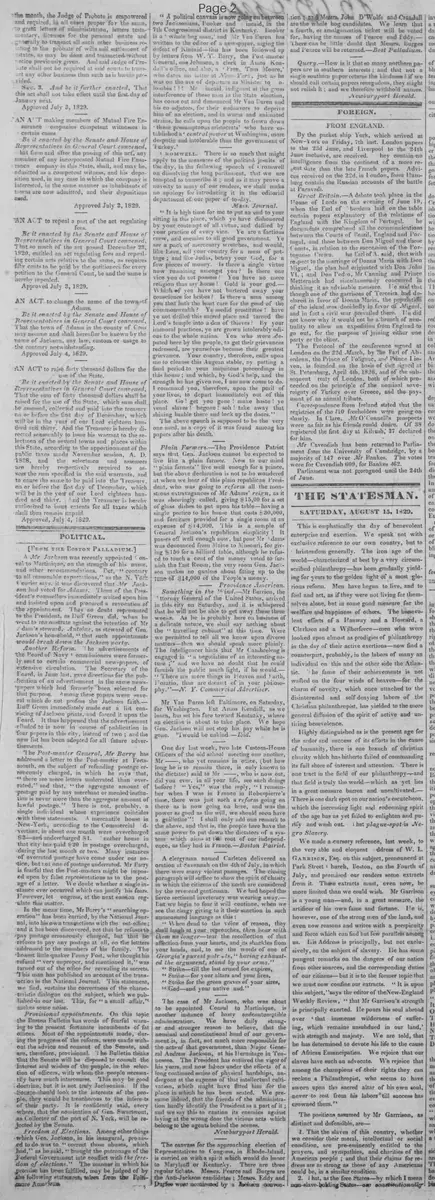
A Mr. Jarlson was recently appointed consul to Martinique, on the strength of his name, and other recommendations. But, "contrary to all reasonable expectations," as the N. York Courier says, it was discovered that Mr. Jackson had voted for Adams. Three of the President's counsellors immediately waited upon him and insisted upon and procured a revocation of the appointment. They no doubt represented to the President, as Duff Green did, when he went to remonstrate against the retention of Mr. Adams's steward, Antoine, as steward of Gen. Jackson's household, "that such appointments would break down the Jackson party."
Another Reform. The advertisements of the Board of Navy Commissioners were formerly sent to certain commercial newspapers, of extensive circulation. The Secretary of the Board, in June last, gave directions for the publication of an advertisement in the same newspapers which had formerly been selected for that purpose. Among these papers were several which do not profess the Jackson faith.—Duff Green immediately made out a list consisting of Jackson prints, and forced it upon the Board. It thus happened that the advertisement alluded to is now in course of publication in four papers in this city, instead of two; and the new list has been adopted for all future advertisements.
The Post-master General, Mr. Barry has addressed a letter to the Post-master at Portsmouth, on the subject of refunding postage erroneously charged, in which he says that, "there are more letters underrated than over-rated," and that, "the aggregate amount of postage paid by any merchant or monied institution is never more than the aggregate amount of lawful postage." There is not, probably, a single individual whose experience coincides with these statements. A mercantile house in New-York, according to the Commercial Advertiser, in about one month were overcharged $3 and undercharged 1. Another house in that city has paid $20 in postage overcharged, during the last month or two. Many instances of overrated postage have come under our notice, but not one of postage underrated. Mr. Barry is fearful that the Post-masters might be imposed upon by false representations as to the postage of a letter. We doubt whether a single instance ever occurred which can justify his fears. However, let Congress, at the next session regulate this matter.
In the mean time, Mr. Barry's "searching operation" has been carried, by the National Journal, into his own transactions with the post-office: and it has been discovered, not that he refuses to pay postage erroneously charged, but that he refuses to pay any postage at all, on the letters addressed to the members of his family. The honest little quaker Penny Post, who thought his "refusal" very improper, and mentioned it, "was turned out of the office for revealing its secrets." This man has published an account of the transaction in the National Journal. This statement, we find, sustains the correctness of the characteristic dialogue on the subject, which we published in our last. This, for "a small affair," makes some noise.
Provisional appointments. On this topic the Boston Bulletin has words of fearful warning to the present fortunate incumbents of fat offices. Most of the appointments made, during the progress of the reform, were made without the advice and consent of the Senate, and are, therefore, provisional. The Bulletin thinks that the Senate will be disposed to consult the interest and wishes of the people, in the selection of officers, with whom the people necessarily have much intercourse. This may be good doctrine, but it is not truly Jacksonian. If the Senate should look to the interests of the people, they would be treacherous to the interests of their party. It is confidently said, everywhere, that the nomination of Gen. Swartwout, as Collector of the port of N. York, will be rejected by the Senate.
Freedom of Elections. Among other things which Gen. Jackson, in his inaugural, promised to do was to "correct those abuses, which had," as he said, "brought the patronage of the Federal Government into conflict with the freedom of elections." The manner in which his promise has been fulfilled, may be judged of by the following statement; taken from the Baltimore American
"A political canvass is now going on between two Jacksonians, Booker and Kincaid, in the 7th Congressional district in Kentucky. Booker is a 'whole hog man,' and Mr. Van Buren has written to the editor of a newspaper, urging the defeat of Kincaid—this has been followed up by letters from W. T. Barry, the Post-master General, one Johnson, a clerk in Amos Kendall's office, and also, a Free, Tom Moore,' who dates his letter at New-York, just as he was on the eve of departure as Minister to Colombia!! Mr. Kincaid, indignant at the gross interference of these men in the State election, has come out and denounced Mr. Van Buren and his co-adjutors, for their endeavors to deprive him of an election, and in warm and animated strains, he calls upon the people to frown down 'these presumptuous aristocrats' who have established a 'central power at Washington, more despotic and intolerable than the government of Turkey.'"
(From the Lowell Journal.) There is so much that might apply to the measures of the political jesuits of the day, in the following speech of Cromwell on dissolving the long parliament, that we are tempted to transcribe it; and as it may prove a novelty to many of our readers, we shall make no apology for introducing it in the editorial department of our paper of to-day.
Mass. Journal.
"It is high time for me to put an end to your sitting in this place, which ye have dishonored by your contempt of all virtue, and defiled by your practice of every vice. Ye are a factious crew, and enemies to all good government. Ye are a pack of mercenary wretches, and would, like Esau, sell your country for a mess of pottage; and like Judas, betray your God, for a few pieces of money. Is there a single virtue now remaining amongst you? Is there one vice you do not possess? You have no more religion than my horse! Gold is your god.—Which of you have not bartered away your conscience for bribes? Is there a man among you that hath the least care for the good of the commonwealth? Ye sordid prostitutes! have ye not defiled this sacred place and turned the Lord's temple into a den of thieves? By your immoral practices, ye are grown intolerably odious to the whole nation. You who were deputed here by the people, to get their grievances redressed, are yourselves become their greatest grievance. Your country, therefore, calls upon me to cleanse this Augean stable, by putting a final period to your iniquitous proceedings in this house; and which, by God's help, and the strength he has given me, I am now come to do. I command you, therefore, upon the peril of your lives, to depart immediately out of this place. Go! get you gone! make haste! ye venal slaves! begone! so! take away that shining bauble there and lock up the doors."
The above speech is supposed to be the very one used, as a copy of it was found among his papers after his death.
Plain Farmers.—The Providence Patriot says that Gen. Jackson cannot be expected to live like a plain farmer. Now to our mind "plain farmers" live well enough for a prince, but the above declaration is not to be wondered at when we hear of this plain republican President, who was going to reform all the monstrous extravagances of Mr. Adams' reign, as it was sneeringly called, giving $15,000 for a set of glass dishes to put upon his table—having a single portico to his house that costs $30,000, and furniture provided for a single room at an expense of $14,000. This is a sample of General Jackson's republican simplicity! It passes off well enough now, but poor Mr. Adams was denounced from Maine to Missouri, for giving $150 for a billiard table, although he refused to touch a cent of the money voted to furnish the East Room, the very room Gen. Jackson makes no qualms about fitting up to the tune of $14,000 of the People's money.
Providence American.
Something in the wind.—Mr. Berrien, the Attorney General of the United States, arrived in this city on Saturday, and it is whispered that he will not be able to get away these three weeks. As he is probably here on business of a delicate nature, we shall say nothing about the "travelling cabinet" at this time. Were we permitted to tell all we know upon diverse matters—then we should speak more plainly. The Intelligencer hints that Mr. Cambreleng is engaged in "a negotiation of an interesting nature;" and we have no doubt that he could furnish the public much light, if he would.—"There are more things in Heaven and Earth, Horatio, than are dreamt of in your philosophy."—N. Y. Commercial Advertiser.
Mr. Van Buren left Baltimore, on Saturday, for Washington. But Amos Kendall, as we learn, has set his face toward Kentucky, where an election is about to take place. We hope Gen. Jackson will not stop his pay while he is gone. "It would be unkind."—Ibid.
One day last week, two late Custom-House Officers of the old school meeting one another, Mr. ——, who yet remains in office, (but how long he is to remain there, is only known to the dictator) said to Mr. ——, who is now out, "did you ever, in all your life, see such doings before?" "Yes," was the reply, "I remember when I was in France in Robespierre's time, there was just such a reform going on there as is now going on here, and was the power as good as the will, we should soon have a guillotine!" I shall only add one remark to the above, and that is, the people here have the same power to put down the dictators of a system which aims at the root of our independence, as they had in France.—Boston Patriot.
A clergyman named Carleton delivered an oration at Savannah on the 4th of July, in which there were many violent passages. The closing paragraph will suffice to show the spirit of charity in which the citizens of the north are considered by the reverend gentleman. We had hoped this fierce sectional inveteracy was wearing away.—But we begin to fear it will continue, when we see the clergy giving to it their sanction in such unmeasured language as this:
"When dead to the voice of reason, they shall laugh at your reproaches, then bear with them no longer—tear the recollection of that affection from your hearts, and its shackles from your hands, and, to use the words of one of Georgia's purest patriots," having exhausted the argument, stand by your arms."
"Strike till the last armed foe expires,
"Strike—for your altars and your fires,
"Strike for the green graves of your sires,
"God—and your native land."
The case of Mr. Jackson, who was about to be appointed Consul to Martinique, is another instance of hasty and contemptible administration.
We have daily stronger and stronger reason to believe, that the nominal and constitutional head of our government—is, in fact, not much more responsible for the acts of that government, than Major General Andrew Jackson, at his Hermitage in Tennessee. The President has outlived the vigor of his years, and now labors under the effects of a long continued series of physical hardships, undergone at the expense of that intellectual cultivation, which might have fitted him for the place in which he has been seated. We presume indeed, that the friends of the administration hardly identify the President as a part of it: and we say this to caution its enemies against laying at the wrong door the vicious acts which belong to the agents behind the scenes.
Newburyport Herald
The canvass for the approaching election of Representatives to Congress, in Rhode-Island, is carried on with a spirit which would do honor to Maryland or Kentucky. There are three regular tickets. Messrs. Pearce and Burges are the Anti-Jackson candidates: Messrs. Eddy and Darfee were nominated by a Jackson convention; and Messrs. John D'Wolfe and Crandall are the whole hog candidates. We learn that a fourth, or amalgamation ticket will be voted for, having the names of Pearce and Eddy.—There can be little doubt that Messrs. Burges and Pearce will be returned.—Bost. Palladium.
Query.—How is it that so many northern papers are in southern interests; and that not a single southern paper returns the kindness? if we should call certain papers renegadoes, they might not relish it; and we therefore withhold names.
Newburyport Herald.
[From the Boston Palladium.]
A Mr. Jarlson was recently appointed consul to Martinique, on the strength of his name, and other recommendations. But, "contrary to all reasonable expectations," as the N. York Courier says, it was discovered that Mr. Jackson had voted for Adams. Three of the President's counsellors immediately waited upon him and insisted upon and procured a revocation of the appointment. They no doubt represented to the President, as Duff Green did, when he went to remonstrate against the retention of Mr. Adams's steward, Antoine, as steward of Gen. Jackson's household, "that such appointments would break down the Jackson party."
Another Reform. The advertisements of the Board of Navy Commissioners were formerly sent to certain commercial newspapers, of extensive circulation. The Secretary of the Board, in June last, gave directions for the publication of an advertisement in the same newspapers which had formerly been selected for that purpose. Among these papers were several which do not profess the Jackson faith.—Duff Green immediately made out a list consisting of Jackson prints, and forced it upon the Board. It thus happened that the advertisement alluded to is now in course of publication in four papers in this city, instead of two; and the new list has been adopted for all future advertisements.
The Post-master General, Mr. Barry has addressed a letter to the Post-master at Portsmouth, on the subject of refunding postage erroneously charged, in which he says that, "there are more letters underrated than over-rated," and that, "the aggregate amount of postage paid by any merchant or monied institution is never more than the aggregate amount of lawful postage." There is not, probably, a single individual whose experience coincides with these statements. A mercantile house in New-York, according to the Commercial Advertiser, in about one month were overcharged $3 and undercharged 1. Another house in that city has paid $20 in postage overcharged, during the last month or two. Many instances of overrated postage have come under our notice, but not one of postage underrated. Mr. Barry is fearful that the Post-masters might be imposed upon by false representations as to the postage of a letter. We doubt whether a single instance ever occurred which can justify his fears. However, let Congress, at the next session regulate this matter.
In the mean time, Mr. Barry's "searching operation" has been carried, by the National Journal, into his own transactions with the post-office: and it has been discovered, not that he refuses to pay postage erroneously charged, but that he refuses to pay any postage at all, on the letters addressed to the members of his family. The honest little quaker Penny Post, who thought his "refusal" very improper, and mentioned it, "was turned out of the office for revealing its secrets." This man has published an account of the transaction in the National Journal. This statement, we find, sustains the correctness of the characteristic dialogue on the subject, which we published in our last. This, for "a small affair," makes some noise.
Provisional appointments. On this topic the Boston Bulletin has words of fearful warning to the present fortunate incumbents of fat offices. Most of the appointments made, during the progress of the reform, were made without the advice and consent of the Senate, and are, therefore, provisional. The Bulletin thinks that the Senate will be disposed to consult the interest and wishes of the people, in the selection of officers, with whom the people necessarily have much intercourse. This may be good doctrine, but it is not truly Jacksonian. If the Senate should look to the interests of the people, they would be treacherous to the interests of their party. It is confidently said, everywhere, that the nomination of Gen. Swartwout, as Collector of the port of N. York, will be rejected by the Senate.
Freedom of Elections. Among other things which Gen. Jackson, in his inaugural, promised to do was to "correct those abuses, which had," as he said, "brought the patronage of the Federal Government into conflict with the freedom of elections." The manner in which his promise has been fulfilled, may be judged of by the following statement; taken from the Baltimore American
"A political canvass is now going on between two Jacksonians, Booker and Kincaid, in the 7th Congressional district in Kentucky. Booker is a 'whole hog man,' and Mr. Van Buren has written to the editor of a newspaper, urging the defeat of Kincaid—this has been followed up by letters from W. T. Barry, the Post-master General, one Johnson, a clerk in Amos Kendall's office, and also, a Free, Tom Moore,' who dates his letter at New-York, just as he was on the eve of departure as Minister to Colombia!! Mr. Kincaid, indignant at the gross interference of these men in the State election, has come out and denounced Mr. Van Buren and his co-adjutors, for their endeavors to deprive him of an election, and in warm and animated strains, he calls upon the people to frown down 'these presumptuous aristocrats' who have established a 'central power at Washington, more despotic and intolerable than the government of Turkey.'"
(From the Lowell Journal.) There is so much that might apply to the measures of the political jesuits of the day, in the following speech of Cromwell on dissolving the long parliament, that we are tempted to transcribe it; and as it may prove a novelty to many of our readers, we shall make no apology for introducing it in the editorial department of our paper of to-day.
Mass. Journal.
"It is high time for me to put an end to your sitting in this place, which ye have dishonored by your contempt of all virtue, and defiled by your practice of every vice. Ye are a factious crew, and enemies to all good government. Ye are a pack of mercenary wretches, and would, like Esau, sell your country for a mess of pottage; and like Judas, betray your God, for a few pieces of money. Is there a single virtue now remaining amongst you? Is there one vice you do not possess? You have no more religion than my horse! Gold is your god.—Which of you have not bartered away your conscience for bribes? Is there a man among you that hath the least care for the good of the commonwealth? Ye sordid prostitutes! have ye not defiled this sacred place and turned the Lord's temple into a den of thieves? By your immoral practices, ye are grown intolerably odious to the whole nation. You who were deputed here by the people, to get their grievances redressed, are yourselves become their greatest grievance. Your country, therefore, calls upon me to cleanse this Augean stable, by putting a final period to your iniquitous proceedings in this house; and which, by God's help, and the strength he has given me, I am now come to do. I command you, therefore, upon the peril of your lives, to depart immediately out of this place. Go! get you gone! make haste! ye venal slaves! begone! so! take away that shining bauble there and lock up the doors."
The above speech is supposed to be the very one used, as a copy of it was found among his papers after his death.
Plain Farmers.—The Providence Patriot says that Gen. Jackson cannot be expected to live like a plain farmer. Now to our mind "plain farmers" live well enough for a prince, but the above declaration is not to be wondered at when we hear of this plain republican President, who was going to reform all the monstrous extravagances of Mr. Adams' reign, as it was sneeringly called, giving $15,000 for a set of glass dishes to put upon his table—having a single portico to his house that costs $30,000, and furniture provided for a single room at an expense of $14,000. This is a sample of General Jackson's republican simplicity! It passes off well enough now, but poor Mr. Adams was denounced from Maine to Missouri, for giving $150 for a billiard table, although he refused to touch a cent of the money voted to furnish the East Room, the very room Gen. Jackson makes no qualms about fitting up to the tune of $14,000 of the People's money.
Providence American.
Something in the wind.—Mr. Berrien, the Attorney General of the United States, arrived in this city on Saturday, and it is whispered that he will not be able to get away these three weeks. As he is probably here on business of a delicate nature, we shall say nothing about the "travelling cabinet" at this time. Were we permitted to tell all we know upon diverse matters—then we should speak more plainly. The Intelligencer hints that Mr. Cambreleng is engaged in "a negotiation of an interesting nature;" and we have no doubt that he could furnish the public much light, if he would.—"There are more things in Heaven and Earth, Horatio, than are dreamt of in your philosophy."—N. Y. Commercial Advertiser.
Mr. Van Buren left Baltimore, on Saturday, for Washington. But Amos Kendall, as we learn, has set his face toward Kentucky, where an election is about to take place. We hope Gen. Jackson will not stop his pay while he is gone. "It would be unkind."—Ibid.
One day last week, two late Custom-House Officers of the old school meeting one another, Mr. ——, who yet remains in office, (but how long he is to remain there, is only known to the dictator) said to Mr. ——, who is now out, "did you ever, in all your life, see such doings before?" "Yes," was the reply, "I remember when I was in France in Robespierre's time, there was just such a reform going on there as is now going on here, and was the power as good as the will, we should soon have a guillotine!" I shall only add one remark to the above, and that is, the people here have the same power to put down the dictators of a system which aims at the root of our independence, as they had in France.—Boston Patriot.
A clergyman named Carleton delivered an oration at Savannah on the 4th of July, in which there were many violent passages. The closing paragraph will suffice to show the spirit of charity in which the citizens of the north are considered by the reverend gentleman. We had hoped this fierce sectional inveteracy was wearing away.—But we begin to fear it will continue, when we see the clergy giving to it their sanction in such unmeasured language as this:
"When dead to the voice of reason, they shall laugh at your reproaches, then bear with them no longer—tear the recollection of that affection from your hearts, and its shackles from your hands, and, to use the words of one of Georgia's purest patriots," having exhausted the argument, stand by your arms."
"Strike till the last armed foe expires,
"Strike—for your altars and your fires,
"Strike for the green graves of your sires,
"God—and your native land."
The case of Mr. Jackson, who was about to be appointed Consul to Martinique, is another instance of hasty and contemptible administration.
We have daily stronger and stronger reason to believe, that the nominal and constitutional head of our government—is, in fact, not much more responsible for the acts of that government, than Major General Andrew Jackson, at his Hermitage in Tennessee. The President has outlived the vigor of his years, and now labors under the effects of a long continued series of physical hardships, undergone at the expense of that intellectual cultivation, which might have fitted him for the place in which he has been seated. We presume indeed, that the friends of the administration hardly identify the President as a part of it: and we say this to caution its enemies against laying at the wrong door the vicious acts which belong to the agents behind the scenes.
Newburyport Herald
The canvass for the approaching election of Representatives to Congress, in Rhode-Island, is carried on with a spirit which would do honor to Maryland or Kentucky. There are three regular tickets. Messrs. Pearce and Burges are the Anti-Jackson candidates: Messrs. Eddy and Darfee were nominated by a Jackson convention; and Messrs. John D'Wolfe and Crandall are the whole hog candidates. We learn that a fourth, or amalgamation ticket will be voted for, having the names of Pearce and Eddy.—There can be little doubt that Messrs. Burges and Pearce will be returned.—Bost. Palladium.
Query.—How is it that so many northern papers are in southern interests; and that not a single southern paper returns the kindness? if we should call certain papers renegadoes, they might not relish it; and we therefore withhold names.
Newburyport Herald.
What sub-type of article is it?
Partisan Politics
What keywords are associated?
Jackson Administration
Political Appointments
Post Office Abuse
Election Interference
Partisan Favoritism
Administrative Reform
Republican Simplicity
What entities or persons were involved?
Gen. Jackson
Mr. Barry
Duff Green
Mr. Van Buren
Amos Kendall
Mr. Adams
Editorial Details
Primary Topic
Criticism Of Jackson Administration Appointments, Reforms, And Interferences
Stance / Tone
Strongly Anti Jackson, Satirical And Accusatory
Key Figures
Gen. Jackson
Mr. Barry
Duff Green
Mr. Van Buren
Amos Kendall
Mr. Adams
Key Arguments
Revocation Of Appointments For Voting Against Jackson
Switching Advertisements To Jackson Friendly Papers
Overcharges In Postage Contradicting Barry's Claims
Barry Refusing Postage For Family Letters
Provisional Appointments Likely To Be Rejected By Senate
Interference In Elections By Administration Officials
Jackson's Extravagance Contradicting Republican Simplicity