Thank you for visiting SNEWPapers!
Sign up free
The Nome Nugget
Nome, Nome County, Alaska
What is this article about?
In Paris, NATO Supreme Commander U.S. Gen. Lauris Norstad urged the 15-nation alliance's foreign ministers to rapidly deploy intermediate-range U.S. missiles in Europe against Soviet threats over Berlin. Britain accepts, Italy near agreement, France delays. He also called for 30 full-strength divisions and more antisubmarine forces, backed by other commanders.
Merged-components note: Continuation of the NATO commander article from page 1 to page 2.
Clippings
1 of 2
OCR Quality
Full Text
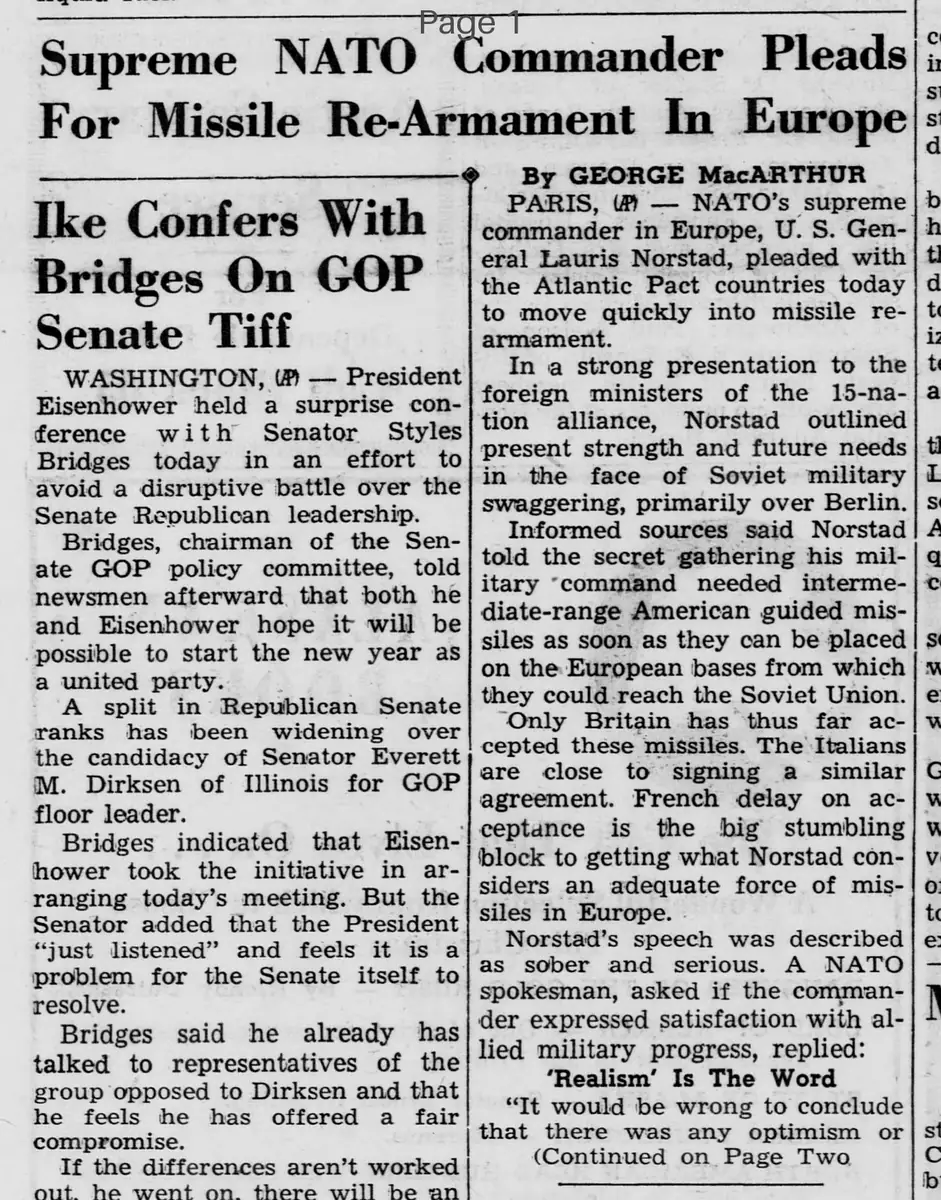
By GEORGE MacARTHUR
PARIS, (AP) -- NATO's supreme commander in Europe, U. S. General Lauris Norstad, pleaded with the Atlantic Pact countries today to move quickly into missile re-armament.
In a strong presentation to the foreign ministers of the 15-nation alliance, Norstad outlined present strength and future needs in the face of Soviet military swaggering, primarily over Berlin.
Informed sources said Norstad told the secret gathering his military command needed intermediate-range American guided missiles as soon as they can be placed on the European bases from which they could reach the Soviet Union.
Only Britain has thus far accepted these missiles. The Italians are close to signing a similar agreement. French delay on acceptance is the big stumbling block to getting what Norstad considers an adequate force of missiles in Europe.
Norstad's speech was described as sober and serious. A NATO spokesman, asked if the commander expressed satisfaction with allied military progress, replied: 'Realism' Is The Word
"It would be wrong to conclude that there was any optimism or pessimism. Realism would be a better word."
Before Norstad spoke, many of the delegates displayed little or no sense of urgency toward the strengthening of land forces or equipping them with missiles.
For one thing, U. S. Secretary of State, John Foster Dulles, had told them Tuesday:
"Our military advisers are absolutely confident that the Soviet Union will not risk war over Berlin."
Soviet warnings of nuclear war if the West insists on continued access to West Berlin were termed by Dulles "empty threats which ought not to frighten anyone."
Norstad also appealed for speedy fulfillment of NATO plans for 30 full-strength, combat-ready divisions in Europe. So far the NATO forces lack half of the divisions.
A military report to the NATO ministers warned that the Russians could launch a massive attack without resorting to weapons of mass destruction.
Norstad's appeals were backed by the other top NATO commanders at the conference.
The Naval men have been urging more antisubmarine forces--planes, destroyers and escort vessels. They feel their forces now are adequate only for the most limited defense, with no extras in case of war.
What sub-type of article is it?
What keywords are associated?
What entities or persons were involved?
Where did it happen?
Foreign News Details
Primary Location
Paris
Key Persons
Outcome
only britain has accepted intermediate-range missiles; italians close to agreement; french delay is stumbling block. nato lacks half of planned 30 divisions. appeals backed by other commanders.
Event Details
NATO's supreme commander in Europe, U. S. General Lauris Norstad, pleaded with the Atlantic Pact countries to move quickly into missile re-armament. In a presentation to foreign ministers, he outlined needs for intermediate-range American guided missiles on European bases to reach the Soviet Union, in face of Soviet threats over Berlin. He appealed for fulfillment of plans for 30 full-strength divisions and more antisubmarine forces. A report warned Russians could launch massive attack without mass destruction weapons. Delegates showed little urgency before, influenced by Dulles' view of Soviet threats as empty.