Thank you for visiting SNEWPapers!
Sign up free
Story
December 29, 1952
The Key West Citizen
Key West, Monroe County, Florida
What is this article about?
US military scientists approach firing non-returning missiles into space, per Air Force Secretary Finletter's forecast of powerful rocket engines enabling artificial satellites for surveillance, costing billions.
Clipping
OCR Quality
98%
Excellent
Full Text
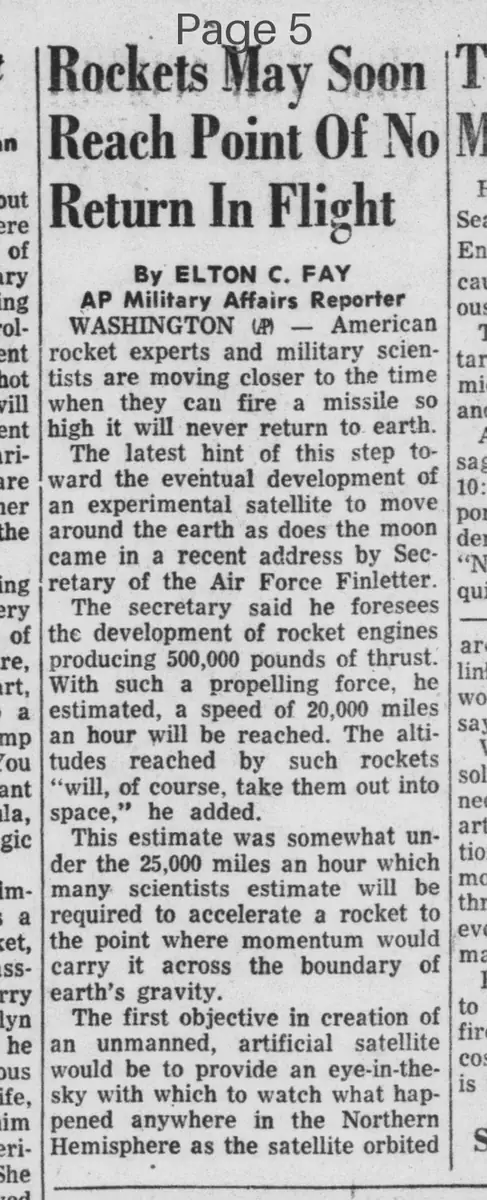
Rockets May Soon
Reach Point Of No
Return In Flight
By ELTON C. FAY
AP Military Affairs Reporter
WASHINGTON (P) - American rocket experts and military scientists are moving closer to the time when they can fire a missile so high it will never return to earth.
The latest hint of this step toward the eventual development of an experimental satellite to move around the earth as does the moon came in a recent address by Secretary of the Air Force Finletter.
The secretary said he foresees the development of rocket engines producing 500,000 pounds of thrust.
With such a propelling force, he estimated, a speed of 20,000 miles an hour will be reached. The altitudes reached by such rockets "will, of course, take them out into space," he added.
This estimate was somewhat under the 25,000 miles an hour which many scientists estimate will be required to accelerate a rocket to the point where momentum would carry it across the boundary of earth's gravity.
The first objective in creation of an unmanned, artificial satellite would be to provide an eye-in-the-sky with which to watch what happened anywhere in the Northern Hemisphere as the satellite orbited around the earth. A kind of camera linked electronically to the earth would serve as the eye, scientists say.
While scientists think they have solved many of the major engineering projects for getting an artificial satellite aloft and on station in space, it would cost big money. Estimates range from three to five billion dollars for even a comparatively modest unmanned satellite.
But the building of a test missile to prove whether an object can be fired into space presumably will cost considerably less. It probably is much nearer attainment.
Reach Point Of No
Return In Flight
By ELTON C. FAY
AP Military Affairs Reporter
WASHINGTON (P) - American rocket experts and military scientists are moving closer to the time when they can fire a missile so high it will never return to earth.
The latest hint of this step toward the eventual development of an experimental satellite to move around the earth as does the moon came in a recent address by Secretary of the Air Force Finletter.
The secretary said he foresees the development of rocket engines producing 500,000 pounds of thrust.
With such a propelling force, he estimated, a speed of 20,000 miles an hour will be reached. The altitudes reached by such rockets "will, of course, take them out into space," he added.
This estimate was somewhat under the 25,000 miles an hour which many scientists estimate will be required to accelerate a rocket to the point where momentum would carry it across the boundary of earth's gravity.
The first objective in creation of an unmanned, artificial satellite would be to provide an eye-in-the-sky with which to watch what happened anywhere in the Northern Hemisphere as the satellite orbited around the earth. A kind of camera linked electronically to the earth would serve as the eye, scientists say.
While scientists think they have solved many of the major engineering projects for getting an artificial satellite aloft and on station in space, it would cost big money. Estimates range from three to five billion dollars for even a comparatively modest unmanned satellite.
But the building of a test missile to prove whether an object can be fired into space presumably will cost considerably less. It probably is much nearer attainment.
What sub-type of article is it?
Curiosity
Historical Event
What themes does it cover?
Exploration
Triumph
What keywords are associated?
Rockets
Satellites
Space
Thrust
Missile
What entities or persons were involved?
Elton C. Fay
Finletter
Where did it happen?
Washington
Story Details
Key Persons
Elton C. Fay
Finletter
Location
Washington
Story Details
American rocket experts are advancing toward missiles that escape Earth's gravity, as hinted in Secretary of the Air Force Finletter's address foreseeing 500,000-pound thrust engines reaching 20,000 mph for artificial satellites.