Thank you for visiting SNEWPapers!
Sign up free
The People's Vindicator
Natchitoches, Natchitoches County, Louisiana
What is this article about?
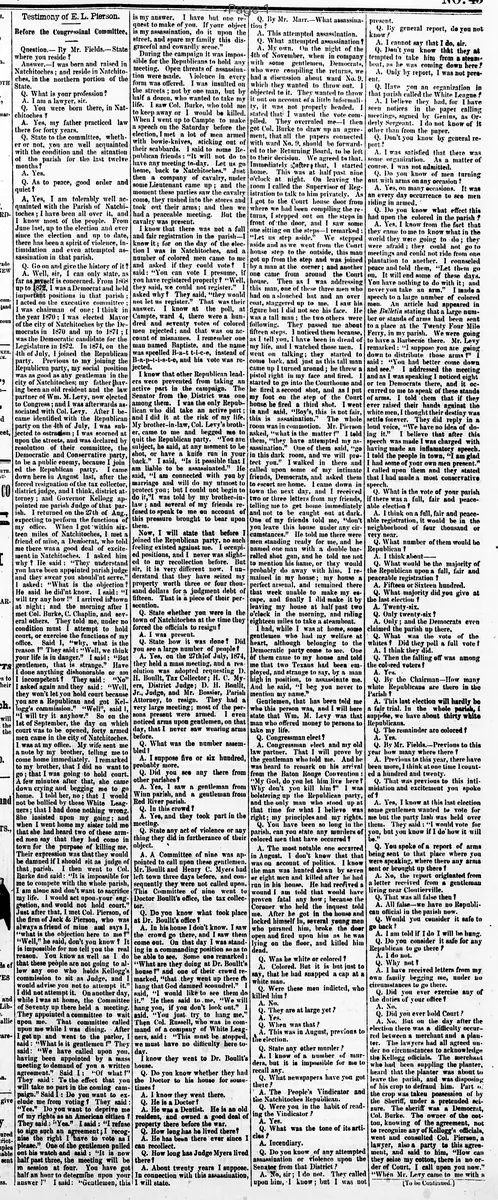
Testimony of a Natchitoches, LA lawyer before a Congressional Committee detailing political violence, intimidation against Republicans, forced resignations of officials, election fraud, voter suppression of colored men, and his own attempted assassination in 1874 amid White League activities.
Clipping
OCR Quality
Full Text
Question.- By Mr. Fields. State where you reside ?
Answer.-I was born and raised in Natchitoches; and reside in Natchitoches, in the northern portion of the State.
Q. What is your profession?
A. I am a lawyer. sir
Q. You were born there, in Natchitoches?
A. Yes, my father practiced law there for forty years.
Q. State to the committee, whether or not, you are well acquainted with the condition and the situation of the parish for the last twelve months?
A. Yes.
Q. As to peace, good order and quiet ?
A. Yes. I am tolerably well acquainted with the Parish of Natchitoches; I have been all over it, and I know most of the people. From June last, up to the election and ever since the election and up to date, there has been a spirit of violence, intimidation and even attempted assassination in that parish.
Q. Go on and give the history of it ?
A. Well, sir, I can only state. as far as myself is concerned. From 1865 up to 1872, I was a Democrat and held important positions in that parish ; I acted on the executive committee ; I was chairman of one; I think in the year 1870 : I was elected Mayor of the city of Natchitoches by the Democrats in 1870 and up to 1871: I was the Democratic candidate for the Legislature in 1872. In 1874. on the 4th of July. I joined the Republican party. Previous to my joining the Republican party, my social position was as good as any gentleman in the city of Natchitoches; my father having been an old resident and the law partner of Wm. M. Levy, now elected to Congress ; and I was afterwards associated with Col. Levy, After I became identified with the Republican party on the 4th of July, I was subjected to ostracism ; I was scorned at upon the streets, and was declared by resolution of their committee, the Democratic and Conservative party, to be a public enemy, because I joined the Republican party. I came down here in August last, after the forced resignation of the tax collector. district judge, and I think, district attorney; and Governor Kellogg appointed me parish Judge of that parish. I returned on the 27th of Aug., expecting to perform the functions of my office. When I got within sixteen miles of Natchitoches, I met a friend of mine, a Democrat. who told me there was a good deal of excitement in Natchitoches. I asked him why ? He said : "They understand you have been appointed parish judge and they swear you shouldn't serve.' I asked: "What is the objection? He said he didn't know. I said: "I will try any how !" I arrived in town at night; and the morning after I met Col. Burke, C. Chaplin, and several others. They told me, under no condition must I attempt to hold court, or exercise the functions of my office. Said I, "why, what is the reason " They said: "Well, we think your life is in danger." I said : "But gentlemen, that is strange." Have I done anything dishonorable or am I incompetent! They said: "No" I asked again and they said: "Well they won't let you hold court because you are a Republican and got Kellogg's commission." "Well". said I. "I will try it anyhow." So on the 1st of September, the day on which court was to be opened, forty armed men came in the city of Natchitoches. I was at my office. My wife sent me a note by my brother, telling me to come home immediately. I remarked to my brother, that I did not want to go; that I was going to hold court. A few minutes after that, she came down crying and begging me to go home. I told her, no ; that I would not be bullied by these White Leaguers; that I had done nothing wrong. She insisted upon my going; and when I went home my sister told me that she had heard two of these armed men say that they had come in town for the purpose of killing me. Their expression was that they would be damned if I should sit as judge of that. parish. I then went to Col. Burke and said: "It is impossible for me to compete with the whole parish, I am alone and don't want to sacrifice my life. I would act upon your suggestion, and would not hold court." Just after that, I met Col. Pierson, of the firm of Jack & Pierson, who was always a friend of mine and says I, "what is the objection here to me ?" "Well." he said, don't you know ? It is impossible for me tell you the real reason. You know as well as I do that these people are not going to allow any one who holds Kellogg's commission to sit as Judge, and I would advise you not to attempt it." I did not attempt it. On another day, while I was at home, the Committee of Seventy up there held a meeting. They appointed a committee to wait upon me. That committee called upon me while I was dining. After I got up and went to the parlor, I said : "What is it gentlemen ?" They said: "We have called upon you, having been appointed by a mass meeting to demand of you a written agreement." Said I: "Of what?" They said: To the effect that you will take no part in the coming campaign." Said I : Do you want to exclude me from voting! They said : "Yes." Do you want to deprive me of my rights as an American citizen They said : 'Yes." I said : "I refuse to sign such an agreement; I recognize the right I have to vote as I please.". One of the gentlemen pulled out his watch and said : It is now half past three, the meeting will be in session at four. You have got half an hour to determine upon your answer." This is my answer. I have but one request to make of you. If your object is my assassination, do it upon the street, and spare my family this disgraceful and cowardly scene. During the campaign it was impossible for the Republicans to hold any meeting. Open threats of assassination were made. Violence in every form was offered. I was insulted on the streets ; not by one man, but by half a dozen, who wanted to take my life. I saw Col. Burke, who told me to keep away or I would be killed. When I went up to Campti to make a speech on the Saturday before the election, I met a lot of men armed with bowie-knives, sticking out of their scabbards. I said to some Republican friends: "It will not do to have any meeting to-day. Let us go home, back to Natchitoches." Just then a company of cavalry, under some Lieutenant came up ; and the moment these parties saw the cavalry come, they rushed into the stores and took out their arms; and then we had a peaceable meeting. But the cavalry was present. I know that there was not a full and fair registration in the parish-I know it; for on the day of the election I was in Natchitoches, and a number of colored men came to me and asked if they could vote? said: "You can vote I presume, if you have registered properly?"Well. they said, we could not register." asked why? They said, "they would not let us register." That was their answer. I know at the poll, at Campti, ward 4, there were a hundred and seventy votes of colored men rejected; and that was on account of misnames. I remember one man named Baptiste, and the name was spelled B-a-t-t-i-c-e, instead of B-a-p-t-i-s-t-e, and his vote was rejected. I know that other Republican leaders were prevented from taking an active part in the campaign. The Senator from the District was one among them. I was the only Republican who did take an active part; and I did it at the risk of my life. My brother-in-law, Col. Levy's brother, came to me and begged me to quit the Republican party. "You are subject, he said, at any moment to be shot, or have a knife run in your back." I said, "Is it possible that I am liable to be assassinated." He said, "I am connected with you by marriage and will do my utmost to protect you; but I could not begin to do it."I was told by my brother-in-law ; and several of my friends refused to speak to me on account of this pressure brought to bear upon them. Now, I will state that before I joined the Republican party, no such feeling existed against me. I occupied positions, and I never was slighted to my recollection before. But sir, it is very different now. I understand that they have seized my property worth three or four thousand dollars for a judgment debt of fifteen. That is a piece of their persecution. Q. State whether you were in the town of Natchitoches at the time they forced the officials to resign ?
A. I was present.
Q. State how it was done? Did you see a large number of people?
A. Yes, on the 27th of July, 1874, they held a mass meeting, and a resolution was adopted requesting D. H. Boullt, Tax Collector: H. C. Myers, District Judge; D. H. Boullt, Jr., Judge, and Mr. Bossior, Parish Attorney, to resign. They had a very large meeting; most of the persons present were armed. I even noticed arms upon gentlemen, on that day, that I never saw wearing arms before.
Q. What was the number assembled
A. I suppose five or six hundred, probably more.
Q. Did you see any there from other parishes?
A. Yes, I saw a gentleman from Winn parish, and a gentleman from Red River parish.
Q. In this crowd ?
A. Yes, and they took part in the meeting.
Q. State any act of violence or anything they did in furtherance of their object.
A. A Committee of nine was appointed to call upon these gentlemen. Mr. Boullt and Henry C. Myers had left town three days before, and consequently they were not called upon. This Committee of nine went to Doctor Boullt's office, the tax collector.
Q. Do you know what took place at Dr. Boullt's office ?
A. In his house I don't know. I saw the crowd go there, and I saw them come out. On that day I was standing in a commanding position so as to be able to see, Some one remarked: "What are they doing at Dr. Boullt's house?" and one of their crowd remarked, "that they went up there to hang that God damned scoundrel." I said, "I would like to see them do it." He then said to me, "We will hang you, if you don't look out." I said. "You just. try to hang me." Then Col. Russell, who was in command of a company of White Leaguers, said: "This must be stopped, we must have no difficulty here to-day." I know they went to Dr. Boullt's house.
Q. Do you know whether they had the Doctor to his house for some times?
A. I know they went there.
Q. He is a Doctor?
A. He was a Dentist. He is an old resident, and owned a good deal of property there before the war.
Q. How long has he lived there ?
A. He has been there ever since I can recollect.
Q. How long has Judge Myers lived there ?
A. About twenty years I suppose.
In connection with this assassination, I will state.
Q. By Mr. Marr.-What assassination?
A. This attempted assassination.
Q. What attempted assassination
A. My own. On the night of the 4th of November, when in company with some gentlemen, Democrats, who were compiling the returns, we had a discussion about ward No. 9. which they wanted to throw out. I objected to it. They wanted to throw it out on account of a little informality. it was not properly headed. I stated that I wanted the. vote compiled. They overruled me-I then got Col. Burke to draw up an agreement. that all the papers connected with ward No. 9. should be forwarded to the Returning Board. to be left to their decision. We agreed to that. Immediately after that, I started home. This was at half past nine o'clock at night. On leaving the room I called the Supervisor of Registration to talk to him privately. As I got to the Court house door from where we had been compiling the returns, I stepped out on the steps in front of the door, and I saw some one sitting on the steps-I remarked : "Let us step aside." We stepped aside and as we went from the Court house step to the outside, this man got up from the step and was joined by a man at the corner; and another one came from around the Court house. Then as I was addressing this man. one of these three men who had on a slouched hat and an over coat, staggered up to me. I saw his figure but I did not see his face. He was a tall man : the two others were following. They passed me about fifteen steps. I noticed them because, as I tell you, I have been in dread of my life, and I watched those men. I went on talking: they started to come back, and just as this tall man came up I turned around: he threw a pistol right in my face and fired. I started to go into the Courthouse and he fired a second shot. and as I put my foot on the step of the Court house he fired a third shot. I went in and said, "Boys, this is not fair, this is assassination." The whole room was in commotion. Mr. Pierson asked. "what is the matter ?" I told them,' "they have attempted my assassination." One of them said, "go in this dark room, and we will protect you." I walked in there and called upon some of my intimate friends, Democrats, and asked them to escort me home. I came down in town the next day, and I received two or three letters from my friends, telling me to get home immediately and not to be caught out at dark. One of my friends told me, "don't you leave this house under any circumstances." He told me there were men standing ready for me, and he named one man with a double barrelled shot gun, and he told me not to mention his name, or they would probably do away with him. I remained in my house; my house a perfect arsenal, and remained there that week unable to make my escape, and finally I did make it by leaving my house at half past two o'clock in the morning. and riding eighteen miles to take a steamboat. I had, while I was at home, some gentlemen who had my welfare at heart, although belonging to the Democratic party come to me. One of them came to my house and told me that two Texans had been employed, and strange to say, by a man high in position, to assassinate me. And he said, "I beg you never to mention my name. Gentlemen, that has been told me who this person was, and I will here state that Wm. M. Levy was that man who offered money to persons to take my life.
Q. Congressman elect ?
A. Congressman elect and my old law partner. That I will prove by the gentleman who told me. And he was heard to remark on his arrival from the Baton Rouge Convention : "My God, do you let him live here? Why don't you kill him ?" I was bolstering up the Republican party, and the only man who stood up at that time for what I believe was right: my principles and my rights.
Q. You have been so long in the parish, can you state any murders of colored men that have occurred ?
A. The most notable one occurred in August. I don't know that that was on account of politics. I know the man was hunted down by seven or eight men and killed after he had run in his house. He had received a wound I am told that would have proven fatal any how; because the Coroner who held the inquest told me. After he got in the house and locked himself in, several young men who pursued him, broke the door open and fired upon him as he was lying on the floor, and killed him dead.
Q. Was he white or colored ?
A. Colored. But it is but just to say, that he had snapped a cap at a white man.
Q. Were these men indicted, who killed him?
A. No.
Q. They are at large yet ?
A. Yes.
Q. When was that?
A. This was in August, previous to the election.
Q. State any other murder?
A. I know of a number of murders, but it is impossible for me to recall any.
Q. What newspapers have you got there?
A. The People's Vindicator and the Natchitoches Republican.
Q. Were you in the habit of reading the Vindicator ?
A. Yes.
Q. What was the tone of its articles ?
A. Incendiary
Q. Do you know of any attempted assassination or violence upon the Senator from that District?
A. No, sir: I do not. They called upon him, I know; but I was not
Q. By general report, do you not know?
A. I cannot say that I do, sir.
Q. Don't you know that they attempted to take him from a steamboat, as he was coming down here?
A. Only by report, I was not present.
Q. Have you an organization in that parish called the White League?
A. I believe they had, for I have seen notices in the paper calling meetings, signed by Genius, as Orderly Sergeant. I do not know of it other than from the paper.
Q. Don't you know by general report?
A. I was satisfied that there was some organization. As a matter of course, I was not admitted
Q. Do you know of men turning out with arms on any occasion?
A. Yes, on many occasions. It was an every day occurrence to see men riding in armed.
Q. Do you know what effect this had upon the colored in the parish
A. Yes. I know from the fact that they came to me to know what in the world they were going to do ; they were afraid: they could not go to meetings and could not ride from one plantation to another. I counseled peace and told them, "Let them go on. It will end some of these days. You have nothing to do with it; and never you take an arm." I made a speech to a large number of colored men. An article had appeared in the Bulletin stating that a large number of stands of arms had been sent to a place at the Twenty Four Mile Ferry, in my parish. We were going to have a Barbecue there. Mr. Levy remarked: "I suppose you are going down to distribute those arms ?" I said: "You had better come down and see." I addressed the meeting and as I was speaking I noticed eight or ten Democrats there, and it occurred to me to speak of these stands of arms, I told them that if they ever raised their hands against the white men, I thought their destiny was settled forever. They did reply in a loud voice. "We have no idea of doing it." I believe that after this speech was made I was charged with having made an inflammatory speech. I told the people in town, "I am glad I had some of your own men present." I called upon them and they stated that I had made a most conservative speech.
Q. What is the vote of your parish if there was a full, fair and peaceable election
A. I think on a full, fair and peaceable registration. it would be in the neighborhood of four thousand or very near.
Q. What number of them would be Republican?
A. I think about
Q. What would be the majority of the Republican upon a full. fair and peaceable registration?
A. Fifteen or Sixteen hundred.
Q. What majority did you give at the last election!
A. Twenty-six.
Q. Only twenty-six ?
A. Only; and the Democrats even claimed the parish up there.
Q. What was the vote of the whites ? Did they poll a full vote?
A. I think they did.
Q. Then the falling off was among the colored voters
A. Yes.
Q. By the Chairman-How many white Republicans are there in the Parish ?
A. This last election will hardly be a fair trial. In the whole parish. I suppose, we have about thirty white Republicans.
Q. The remainder are colored ?
A. Yes.
Q. By Mr. Fields.-Previous to this year how many white there ?
A. Previous to this year, there have been more, I think at one time I counted a hundred and twenty.
Q. That was previous to this intimidation and excitement you spoke of ?
A. Yes, I know at this last election some gentlemen wanted to vote for me but the party lash was held over them. They said:"I would vote for you, but you know if I do' how it will be."
Q. You spoke of a report of arms being sent to that place where you were speaking, were there any arms sent or brought up there ?
A. No. the report originated from a letter received from a gentleman living near Cloutierville.
Q. That was all false then ?
A. All false-we have no Republican official in the parish now.
Q. Would you consider it safe to go back!
A. I am told if I do I will be hung
Q. Do you consider it safe for any Republican to go there?
A. I do not.
Q. Why not
A. I have received letters from my own family begging me, under no circumstances to go there.
Q. Did you ever exercise any of the duties of your office
A. No.
Q. Did you ever hold Court ?
A. No. But on the day after the election there was a difficulty occurred between a merchant and a planter. The lawyers had all agreed under no circumstances to acknowledge the Kellogg officials. The merchant who had been supplying the planter, heard that the planter was about to leave the parish, and was disposing of his crop to defraud him. Part . the crop was taken possession of by the Sheriff, under a pretended seizure. The sheriff was a Democrat, Col. Burke. The owner of the cotton, knowing of the agreement, not to recognize any of Kellogg's officials, went and consulted Col. Pierson, a lawyer, also a party to this agreement, and said to him, "How can they seize my cotton. there is no order of Court. I call upon you now."
When Mr. Levy came to me with a
To be Continued
What sub-type of article is it?
What themes does it cover?
What keywords are associated?
What entities or persons were involved?
Where did it happen?
Story Details
Key Persons
Location
Natchitoches Parish, Louisiana
Event Date
1874
Story Details
A Natchitoches lawyer, formerly Democrat, joins Republicans in July 1874, faces ostracism, threats, and forced non-exercise of his parish judge appointment by Governor Kellogg; describes mass meeting forcing official resignations, White League intimidation, election violence, voter suppression of colored men, and his attempted assassination on November 4, 1874.