Thank you for visiting SNEWPapers!
Sign up free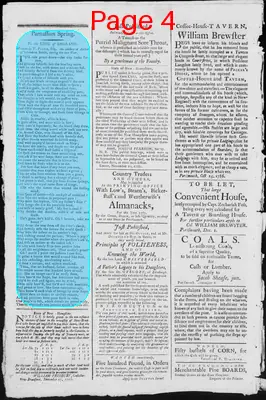
Poem
December 16, 1786
Fowle's New Hampshire Gazette And General Advertiser
Portsmouth, Rockingham County, New Hampshire
What is this article about?
Satirical poem by Thomas Paine addressing the King of England (George III) during the American Revolutionary War, likening the king to Cain for his cruelty and warmongering, expressing grief over war's victims and calling for his death.
Clipping
OCR Quality
98%
Excellent
Full Text
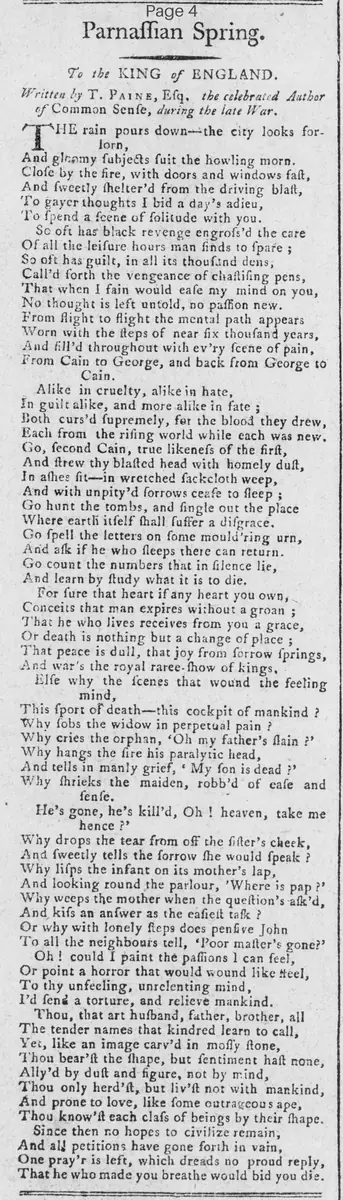
Parnassian Spring
To the KING of ENGLAND.
Written by T. Paine, Esq. the celebrated Author
of Common Sense, during the late War.
THE rain pours down--the city looks forlorn,
And gloomy subjects suit the howling morn.
Close by the fire, with doors and windows shut,
And sweetly shelter'd from the driving blast,
To gayer thoughts I bid a day's adieu,
To spend a scene of solitude with you.
So oft has black revenge engross'd the care
Of all the leisure hours man finds to spare ;
So oft has guilt, in all its thousand dens,
Call'd forth the vengeance of chastising pens,
That when I fain would ease my mind on you,
No thought is left untold, no passion new.
From night to night the mental path appears
Worn with the steps of near six thousand years,
And fill'd throughout with ev'ry scene of pain,
From Cain to George, and back from George to Cain.
Alike in cruelty, alike in hate,
In guilt alike, and more alike in fate ;
Both curs'd supremely, for the blood they drew,
Each from the rising world while each was new.
Go, second Cain, true likeness of the first,
And strew thy blasted head with homely dust,
In ashes sit--in wretched sackcloth weep,
And with unpity'd sorrows cease to sleep ;
Go hunt the tombs, and single out the place
Where earth itself shall suffer a disgrace.
Go spell the letters on some mould'ring urn,
And ask if he who sleeps there can return.
Go count the numbers that in silence lie,
And learn by study what it is to die.
For sure that heart if any heart you own,-
Conceits that man expires without a groan ;
That he who lives receives from you a grace,
Or death is nothing but a change of place ;
That peace is dull, that joy from sorrow springs,
And war's the royal raree-show of kings.
Else why the scenes that wound the feeling mind.
This sport of death--this cockpit of mankind ?
Why sobs the widow in perpetual pain ?
Why cries the orphan, 'Oh my father's slain ?'
Why hangs the sire his paralytic head.
And tells in manly grief, ' My son is dead ?'
Why shrieks the maiden, robb'd of peace and sense.
He's gone, he's kill'd, Oh ! heaven, take me hence ?'
Why drops the tear from off the sister's cheek.
And sweetly tells the sorrow she would speak ?
Why lisps the infant on its mother's lap,
And looking round the parlour, 'Where is pap ?'
Why weeps the mother when the question's ask'd,
And kiss an answer as the easiest task ?
Or why with lonely steps does pensive John
To all the neighbours tell, 'Poor master's gone?'
Oh ! could I paint the passions I can feel,
Or point a horror that would wound like steel,
To thy unfeeling, unrelenting mind,
I'd end a torture, and relieve mankind.
Thou, that art husband, father, brother, all
The tender names that kindred learn to call,
Yet, like an image carv'd in mossy stone,
Thou bear'st the shape, but sentiment hast none,
Allied by duty and figure, not by mind,
Thou only herd'st, but liv'st not with mankind,
And prone to love, like some outrageous ape,
Thou know'st each class of beings by their shape.
Since then no hopes to civilize remain,
And all petitions have gone forth in vain,
One pray'r is left, which dreads no proud reply,
That he who made you breathe would bid you die.
To the KING of ENGLAND.
Written by T. Paine, Esq. the celebrated Author
of Common Sense, during the late War.
THE rain pours down--the city looks forlorn,
And gloomy subjects suit the howling morn.
Close by the fire, with doors and windows shut,
And sweetly shelter'd from the driving blast,
To gayer thoughts I bid a day's adieu,
To spend a scene of solitude with you.
So oft has black revenge engross'd the care
Of all the leisure hours man finds to spare ;
So oft has guilt, in all its thousand dens,
Call'd forth the vengeance of chastising pens,
That when I fain would ease my mind on you,
No thought is left untold, no passion new.
From night to night the mental path appears
Worn with the steps of near six thousand years,
And fill'd throughout with ev'ry scene of pain,
From Cain to George, and back from George to Cain.
Alike in cruelty, alike in hate,
In guilt alike, and more alike in fate ;
Both curs'd supremely, for the blood they drew,
Each from the rising world while each was new.
Go, second Cain, true likeness of the first,
And strew thy blasted head with homely dust,
In ashes sit--in wretched sackcloth weep,
And with unpity'd sorrows cease to sleep ;
Go hunt the tombs, and single out the place
Where earth itself shall suffer a disgrace.
Go spell the letters on some mould'ring urn,
And ask if he who sleeps there can return.
Go count the numbers that in silence lie,
And learn by study what it is to die.
For sure that heart if any heart you own,-
Conceits that man expires without a groan ;
That he who lives receives from you a grace,
Or death is nothing but a change of place ;
That peace is dull, that joy from sorrow springs,
And war's the royal raree-show of kings.
Else why the scenes that wound the feeling mind.
This sport of death--this cockpit of mankind ?
Why sobs the widow in perpetual pain ?
Why cries the orphan, 'Oh my father's slain ?'
Why hangs the sire his paralytic head.
And tells in manly grief, ' My son is dead ?'
Why shrieks the maiden, robb'd of peace and sense.
He's gone, he's kill'd, Oh ! heaven, take me hence ?'
Why drops the tear from off the sister's cheek.
And sweetly tells the sorrow she would speak ?
Why lisps the infant on its mother's lap,
And looking round the parlour, 'Where is pap ?'
Why weeps the mother when the question's ask'd,
And kiss an answer as the easiest task ?
Or why with lonely steps does pensive John
To all the neighbours tell, 'Poor master's gone?'
Oh ! could I paint the passions I can feel,
Or point a horror that would wound like steel,
To thy unfeeling, unrelenting mind,
I'd end a torture, and relieve mankind.
Thou, that art husband, father, brother, all
The tender names that kindred learn to call,
Yet, like an image carv'd in mossy stone,
Thou bear'st the shape, but sentiment hast none,
Allied by duty and figure, not by mind,
Thou only herd'st, but liv'st not with mankind,
And prone to love, like some outrageous ape,
Thou know'st each class of beings by their shape.
Since then no hopes to civilize remain,
And all petitions have gone forth in vain,
One pray'r is left, which dreads no proud reply,
That he who made you breathe would bid you die.
What sub-type of article is it?
Satire
What themes does it cover?
Political
War Military
Liberty Independence
What keywords are associated?
Thomas Paine
King George
American War
Satire King
War Cruelty
Cain Comparison
Tyranny
Revolutionary Poem
What entities or persons were involved?
Written By T. Paine, Esq. The Celebrated Author Of Common Sense, During The Late War.
Poem Details
Title
Parnassian Spring
Author
Written By T. Paine, Esq. The Celebrated Author Of Common Sense, During The Late War.
Subject
To The King Of England.
Form / Style
Rhymed Couplets
Key Lines
From Cain To George, And Back From George To Cain.
Alike In Cruelty, Alike In Hate,
Go, Second Cain, True Likeness Of The First,
And War's The Royal Raree Show Of Kings.
One Pray'r Is Left, Which Dreads No Proud Reply,
That He Who Made You Breathe Would Bid You Die.