Thank you for visiting SNEWPapers!
Sign up free
Editorial
January 12, 1769
The Virginia Gazette
Richmond, Williamsburg, Richmond County, Virginia
What is this article about?
An editorial critiques the folly of social climbers who seek importance by associating with the nobility, leading to extravagance and servile dependence. It advocates for proper, sensible interactions across classes and warns against the miseries of court favoritism, quoting poetry on human desires and failures.
Clipping
OCR Quality
96%
Excellent
Full Text
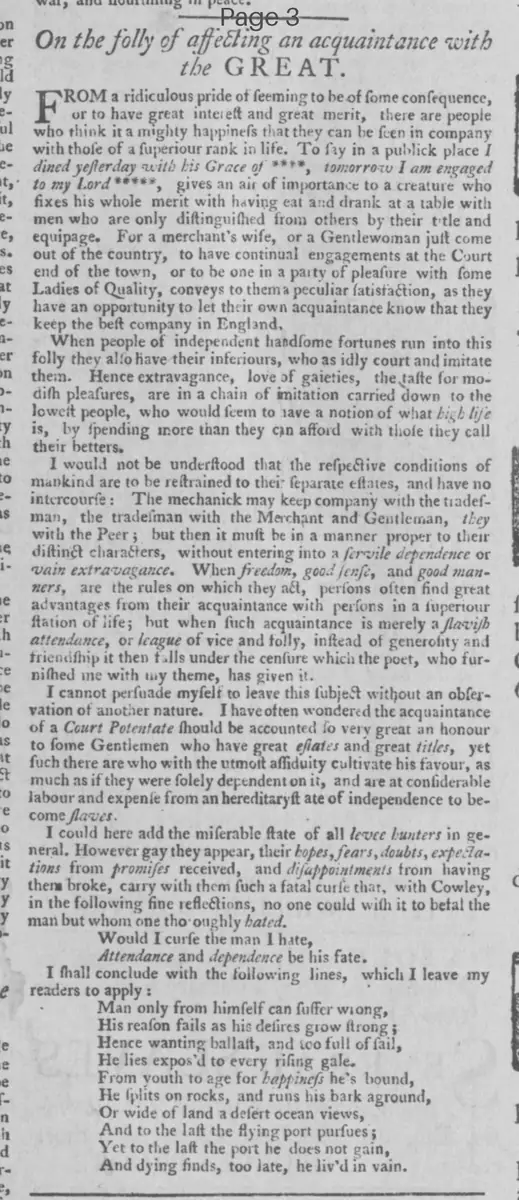
On the folly of affecting an acquaintance with the GREAT.
From a ridiculous pride of seeming to be of some consequence, or to have great interest and great merit, there are people who think it a mighty happiness that they can be seen in company with those of a superior rank in life. To say in a publick place I dined yesterday with his Grace of * * *, tomorrow I am engaged to my Lord * * * *, gives an air of importance to a creature who fixes his whole merit with having eat and drank at a table with men who are only distinguished from others by their title and equipage. For a merchant's wife, or a Gentlewoman just come out of the country, to have continual engagements at the Court end of the town, or to be one in a party of pleasure with some Ladies of Quality, conveys to them a peculiar satisfaction, as they have an opportunity to let their own acquaintance know that they keep the best company in England.
When people of independent handsome fortunes run into this folly they also have their inferiors, who as idly court and imitate them. Hence extravagance, love of gaieties, the taste for modish pleasures, are in a chain of imitation carried down to the lowest people, who would seem to have a notion of what high life is, by spending more than they can afford with those they call their betters.
I would not be understood that the respective conditions of mankind are to be restrained to their separate estates, and have no intercourse: The mechanick may keep company with the tradesman, the tradesman with the Merchant and Gentleman, they with the Peer; but then it must be in a manner proper to their distinct characters, without entering into a servile dependence or vain extravagance. When freedom, good sense, and good manners, are the rules on which they act, persons often find great advantages from their acquaintance with persons in a superior station of life; but when such acquaintance is merely a slavish attendance, or league of vice and folly, instead of generosity and friendship it then falls under the censure which the poet, who furnished me with my theme, has given it.
I cannot persuade myself to leave this subject without an observation of another nature. I have often wondered the acquaintance of a Court Potentate should be accounted so very great an honour to some Gentlemen who have great estates and great titles, yet such there are who with the utmost assiduity cultivate his favour, as much as if they were solely dependent on it, and are at considerable labour and expense from an hereditary state of independence to become slaves.
I could here add the miserable state of all levee hunters in general. However gay they appear, their hopes, fears, doubts, expectations from promises received, and disappointments from having them broke, carry with them such a fatal curse that, with Cowley, in the following fine reflections, no one could wish it to befall the man but whom one thoroughly hated.
Would I cure the man I hate,
Attendance and dependence be his fate.
I shall conclude with the following lines, which I leave my readers to apply:
Man only from himself can suffer wrong,
His reason fails as his desires grow strong;
Hence wanting ballast, and too full of sail,
He lies expos'd to every rising gale.
From youth to age for happiness he's bound,
He splits on rocks, and runs his bark aground,
Or wide of land a desert ocean views,
And to the last the flying port pursues;
Yet to the last the port he does not gain,
And dying finds, too late, he liv'd in vain.
From a ridiculous pride of seeming to be of some consequence, or to have great interest and great merit, there are people who think it a mighty happiness that they can be seen in company with those of a superior rank in life. To say in a publick place I dined yesterday with his Grace of * * *, tomorrow I am engaged to my Lord * * * *, gives an air of importance to a creature who fixes his whole merit with having eat and drank at a table with men who are only distinguished from others by their title and equipage. For a merchant's wife, or a Gentlewoman just come out of the country, to have continual engagements at the Court end of the town, or to be one in a party of pleasure with some Ladies of Quality, conveys to them a peculiar satisfaction, as they have an opportunity to let their own acquaintance know that they keep the best company in England.
When people of independent handsome fortunes run into this folly they also have their inferiors, who as idly court and imitate them. Hence extravagance, love of gaieties, the taste for modish pleasures, are in a chain of imitation carried down to the lowest people, who would seem to have a notion of what high life is, by spending more than they can afford with those they call their betters.
I would not be understood that the respective conditions of mankind are to be restrained to their separate estates, and have no intercourse: The mechanick may keep company with the tradesman, the tradesman with the Merchant and Gentleman, they with the Peer; but then it must be in a manner proper to their distinct characters, without entering into a servile dependence or vain extravagance. When freedom, good sense, and good manners, are the rules on which they act, persons often find great advantages from their acquaintance with persons in a superior station of life; but when such acquaintance is merely a slavish attendance, or league of vice and folly, instead of generosity and friendship it then falls under the censure which the poet, who furnished me with my theme, has given it.
I cannot persuade myself to leave this subject without an observation of another nature. I have often wondered the acquaintance of a Court Potentate should be accounted so very great an honour to some Gentlemen who have great estates and great titles, yet such there are who with the utmost assiduity cultivate his favour, as much as if they were solely dependent on it, and are at considerable labour and expense from an hereditary state of independence to become slaves.
I could here add the miserable state of all levee hunters in general. However gay they appear, their hopes, fears, doubts, expectations from promises received, and disappointments from having them broke, carry with them such a fatal curse that, with Cowley, in the following fine reflections, no one could wish it to befall the man but whom one thoroughly hated.
Would I cure the man I hate,
Attendance and dependence be his fate.
I shall conclude with the following lines, which I leave my readers to apply:
Man only from himself can suffer wrong,
His reason fails as his desires grow strong;
Hence wanting ballast, and too full of sail,
He lies expos'd to every rising gale.
From youth to age for happiness he's bound,
He splits on rocks, and runs his bark aground,
Or wide of land a desert ocean views,
And to the last the flying port pursues;
Yet to the last the port he does not gain,
And dying finds, too late, he liv'd in vain.
What sub-type of article is it?
Moral Or Religious
Social Reform
What keywords are associated?
Social Climbing
Pride
Extravagance
High Life
Servile Dependence
Court Favor
Moral Folly
Imitation
Editorial Details
Primary Topic
Folly Of Affecting Acquaintance With The Great
Stance / Tone
Critical Of Social Climbing And Servile Dependence
Key Arguments
Pride Leads People To Seek Importance Through Association With Superiors
Boasting About Dining With Nobility Gives False Air Of Importance
Imitation Of Higher Classes Causes Extravagance Among Inferiors
Social Intercourse Should Be Proper, Based On Freedom And Good Sense
Servile Attendance On Superiors Leads To Vice And Folly
Gentlemen With Estates Cultivate Court Favor At Expense Of Independence
Levee Hunters Endure Miseries Of Hopes And Disappointments
Human Desires Cause Self Inflicted Suffering And Failure