Thank you for visiting SNEWPapers!
Sign up free
Edgefield Advertiser
Edgefield, Edgefield County, South Carolina
What is this article about?
In the U.S. House of Representatives, Mr. Marshall of Kentucky introduced resolutions censuring J.Q. Adams for presenting a petition to dissolve the Union, calling it a breach of privilege and insult. Debate ensued with speeches by Adams, Everett, and Wise; adjourned without conclusion.
Merged-components note: Merged continuation of article on J.Q. Adams and dissolution petition.
Clippings
1 of 2
OCR Quality
Full Text
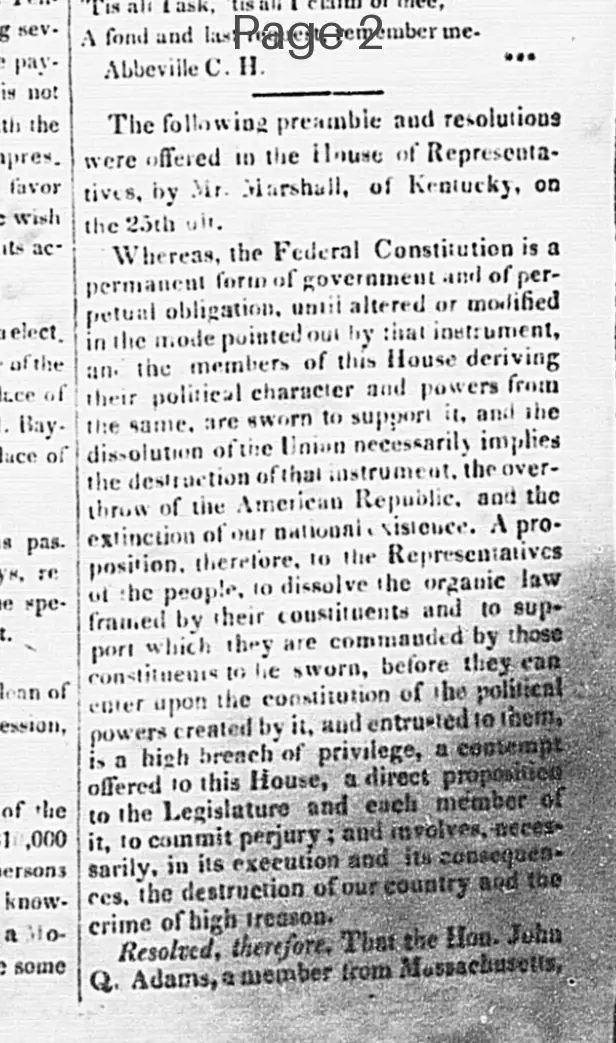
The following preamble and resolutions were offered in the House of Representatives, by Mr. Marshall, of Kentucky, on the 25th ult.
Whereas, the Federal Constitution is a permanent form of government and of perpetual obligation, until altered or modified in the mode pointed out by that instrument, their political character and powers from the members of this House deriving the same, are sworn to support it, and the dissolution of the Union necessarily implies the destruction of that instrument, the overthrow of the American Republic, and the extinction of our national existence. A proposition, therefore, to the Representatives of the people, to dissolve the organic law framed by their constituents and to support which they are commanded by those constituents to have sworn, before they can enter upon the constitution of the political powers created by it, and entrusted to them is a high breach of privilege, a contempt of the powers created by it, and offered to this House, a direct proposition to the Legislature and each member of it, to commit perjury; and involves necessarily, in its execution and its consequences the destruction of our country and the crime of high treason.
Resolved, therefore That J. Q. Adams, a member from Massachusetts who presented for the consideration of the House of Representatives of the United States a petition praying the dissolution of the Union. He offered the document in hostility to the House of which he is a member—an insult to the people of the United States, of which that House is the legislative body, and will, if this outrage be permitted to pass unrebuked and unpunished, have disgraced his country, through their Representatives, in the eyes of the whole world.
Resolved further, That the aforesaid J. Q. Adams, for this insult, the first of the kind ever offered to the government, and for the wound which he has permitted to be aimed, through his instrumentality, at the Constitution and existence of his country, the peace, the security, and the liberty of the people of these States, might well be held to merit expulsion from the national councils; and the House deem it an act of grace and mercy, when they only inflict upon him their severest censure for conduct so utterly unworthy of his past relations to the State, and his present position.
This they hereby do for the maintenance of their own conscience and the indignation of all true American citizens.
The correspondent of the Charleston Mercury says:—At the close of the reading of the resolutions there was a spontaneous burst of applause on the floor and in the galleries. Order being restored, Mr. Marshall in some very appropriate and eloquent remarks advocated the adoption of his resolutions.
Mr. Adams spoke for half an hour in reply; and, though declining to go generally into his defense until he ascertained whether the House would entertain the resolutions, he insisted on the propriety of his course, and the right of the petitioner to make known their grievances and demand redress. To preserve the Union, he said, it was necessary that the free States should be protected in their rights, and the right of petition more especially, and without this the Union could not long exist.
He was followed by Mr. Everett, of Vermont, who moved that the further consideration of the resolutions be postponed until Tuesday next. He said it was a subject which demanded the greatest deliberation that could be bestowed upon it, and it became them to look well to the consequences before they proceeded in it. In his opinion if these resolutions were passed, it would be the initiatory step to a dissolution of the Union which would be the effect, peaceably if they could, forcibly if they must. Mr. Wise followed in reply to Mr. Adams, and showed by a chain of documentary evidence, that ever since he had been hurled from power by the South in 1828, he had evinced the most deadly hatred to that section of the Union, and in furtherance of that hostility he was now lending himself as the agent of the British party to effect a dismemberment of this glorious Confederacy, determined to ruin if he could not rule.
Without concluding, Mr. Wise yielded to a motion for adjournment, which was carried.
It is hardly possible to conjecture what will be the result of the debate commenced to-day; but be that as it may, it is time that the controversy was settled, and that the South knew what she has to expect. The friends of the constitution however, in the promptitude of the present movement, have taken the incendiaries at a disadvantage and if it is followed up courageously but prudently, it will result in their annihilation.
What sub-type of article is it?
What keywords are associated?
What entities or persons were involved?
Where did it happen?
Domestic News Details
Primary Location
House Of Representatives, United States
Event Date
On The 25th Ult.
Key Persons
Outcome
debate adjourned without conclusion; resolutions not yet adopted.
Event Details
Mr. Marshall introduced preamble and resolutions censuring J.Q. Adams for presenting a petition praying dissolution of the Union, deeming it a breach of privilege, contempt, and insult warranting expulsion or severe censure. Debate included speeches by Marshall advocating adoption, Adams defending his actions and the right of petition, Everett moving postponement to Tuesday next, and Wise accusing Adams of hostility to the South. Motion for adjournment carried.