Thank you for visiting SNEWPapers!
Sign up free
Editorial
November 1, 1959
Atlanta Daily World
Atlanta, Fulton County, Georgia
What is this article about?
Editorial critiques the Senate Labor Subcommittee's July vote to raise federal minimum wage from $1.00 to $1.25, arguing it causes unemployment among unskilled workers by pricing them out of jobs and limiting skill-building opportunities. Warns against extending coverage to exempt sectors like retailing.
Clipping
OCR Quality
98%
Excellent
Full Text
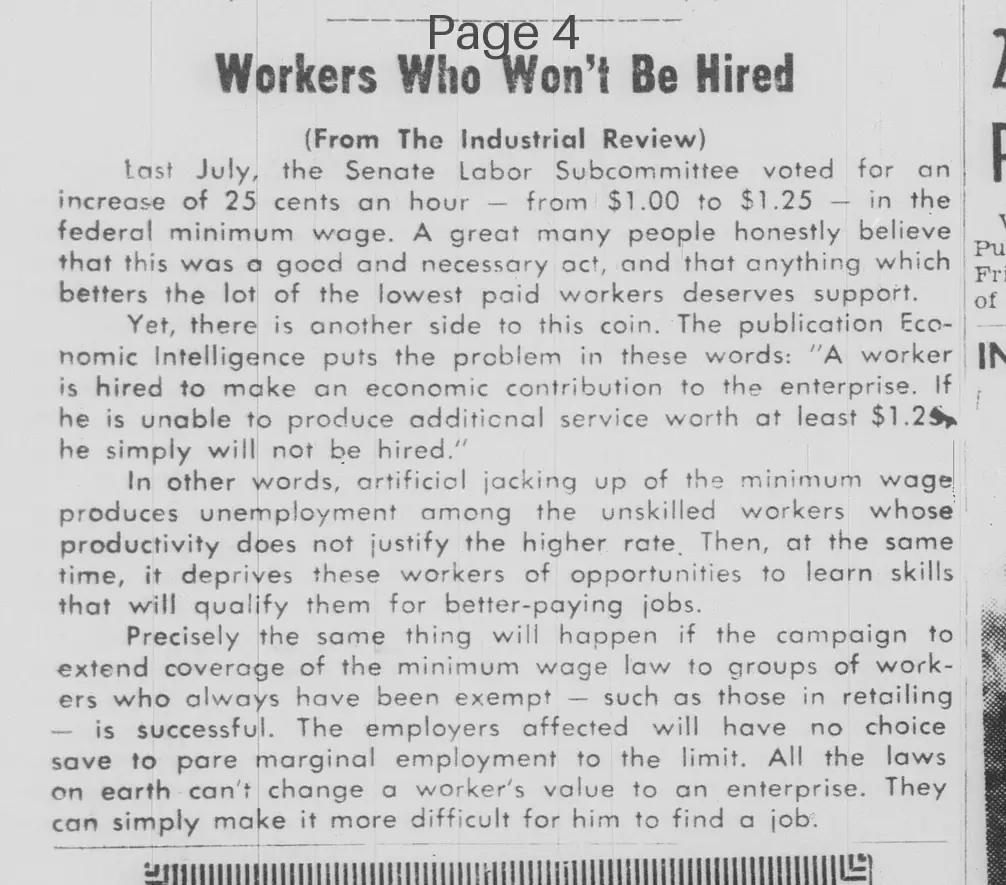
Workers Who Won't Be Hired
(From The Industrial Review)
Last July, the Senate Labor Subcommittee voted for an increase of 25 cents an hour - from $1.00 to $1.25 - in the federal minimum wage. A great many people honestly believe that this was a good and necessary act, and that anything which betters the lot of the lowest paid workers deserves support.
Yet, there is another side to this coin. The publication Economic Intelligence puts the problem in these words: "A worker is hired to make an economic contribution to the enterprise. If he is unable to produce additional service worth at least $1.25 he simply will not be hired."
In other words, artificial jacking up of the minimum wage produces unemployment among the unskilled workers whose productivity does not justify the higher rate. Then, at the same time, it deprives these workers of opportunities to learn skills that will qualify them for better-paying jobs.
Precisely the same thing will happen if the campaign to extend coverage of the minimum wage law to groups of workers who always have been exempt - such as those in retailing - is successful. The employers affected will have no choice save to pare marginal employment to the limit. All the laws on earth can't change a worker's value to an enterprise. They can simply make it more difficult for him to find a job.
(From The Industrial Review)
Last July, the Senate Labor Subcommittee voted for an increase of 25 cents an hour - from $1.00 to $1.25 - in the federal minimum wage. A great many people honestly believe that this was a good and necessary act, and that anything which betters the lot of the lowest paid workers deserves support.
Yet, there is another side to this coin. The publication Economic Intelligence puts the problem in these words: "A worker is hired to make an economic contribution to the enterprise. If he is unable to produce additional service worth at least $1.25 he simply will not be hired."
In other words, artificial jacking up of the minimum wage produces unemployment among the unskilled workers whose productivity does not justify the higher rate. Then, at the same time, it deprives these workers of opportunities to learn skills that will qualify them for better-paying jobs.
Precisely the same thing will happen if the campaign to extend coverage of the minimum wage law to groups of workers who always have been exempt - such as those in retailing - is successful. The employers affected will have no choice save to pare marginal employment to the limit. All the laws on earth can't change a worker's value to an enterprise. They can simply make it more difficult for him to find a job.
What sub-type of article is it?
Economic Policy
Labor
What keywords are associated?
Minimum Wage
Unemployment
Unskilled Workers
Labor Policy
Economic Contribution
What entities or persons were involved?
Senate Labor Subcommittee
Economic Intelligence
Editorial Details
Primary Topic
Opposition To Federal Minimum Wage Increase
Stance / Tone
Critical Of Minimum Wage Hikes As Causing Unemployment
Key Figures
Senate Labor Subcommittee
Economic Intelligence
Key Arguments
Workers Unable To Produce Value Worth At Least $1.25 Per Hour Will Not Be Hired
Minimum Wage Increase Produces Unemployment Among Unskilled Workers
Deprives Unskilled Workers Of Opportunities To Learn Skills For Better Jobs
Extending Minimum Wage To Exempt Groups Like Retailing Will Lead To Reduced Marginal Employment
Laws Cannot Change A Worker's Economic Value To An Enterprise