Thank you for visiting SNEWPapers!
Sign up free
Phillipsburg Herald
Phillipsburg, Phillips County, Kansas
What is this article about?
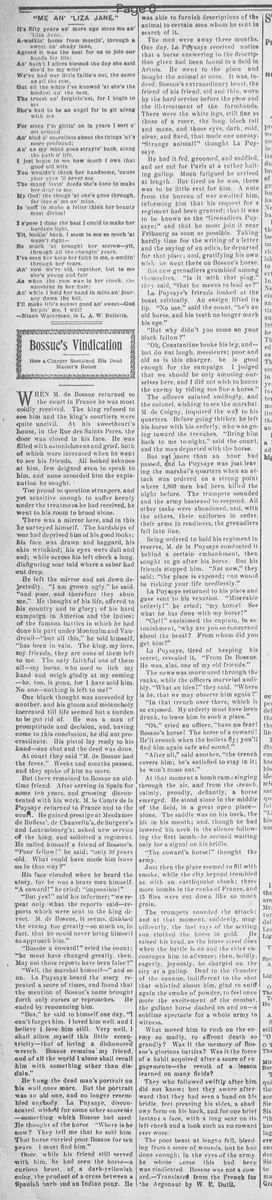
After false cowardice accusations drive M. de Bossue to suicide, his loyal friend Comte de La Puysaye acquires Bossue's old war horse. In battle near Fribourg, the horse heroically charges the enemy alone, appearing guided by Bossue's spirit, restoring his honor in the army's eyes. (248 characters)
Clipping
OCR Quality
Full Text
How a Charger Sustained His Dead
Master's Honor
When M. de Bossue returned to
the court in France he was most
coldly received. The king refused to
see him and the king's courtiers were
quite uncivil. At his sweet-heart's
house, in the Rue des Saints Peres, the
door was closed in his face. He was
filled with astonishment and grief, both
of which were increased when he went
to see his friends. All looked askance
at him, few deigned even to speak to
him, and none accorded him the explanation he sought.
Too proud to question strangers, and
yet sensitive enough to suffer keenly
under the treatment he had received, he
went to his room to brood alone.
There was a mirror here, and in this
he surveyed himself. The hardships of
war had deprived him of his good looks:
his face was drawn and haggard, his
skin wrinkled: his eyes were dull and
sad; while across his left cheek a long
disfiguring scar told where a saber had
cut deep.
He left the mirror and sat down dejectedly. "I am grown ugly," he said.
"and poor, and therefore they shun
me." He thought of his life, offered to
his country and to glory: of his hard
campaign in America and the Indies;
of the famous battles in which he had
done his part under Montcalm and Vaudreuil-"but all this," he told himself,
has been in vain. The king, my love
my friends, they are none of them left
to me. The only faithful one of them
all-my horse, who used to lick my
hand and neigh gladly at my coming
—he, too, is gone, for I have sold him.
No one-nothing is left to me!"
One black thought was succeeded by
another. and his gloom and melancholy
increased till life seemed but a burden
to be got rid of. He was a man of
promptitude and decision, and. having
come to this conclusion, he did not procrastinate. His pistol lay ready to his
hand-one shot and the deed was done.
At court they said "M. de Bossue had
the fever." Weeks and months passed.
and they spoke of him no more.
But there remained to Bossue an old
time friend. After serving in Spain for
some ten years, and growing discontented with his work, M. le Comte de La
Puysaye returned to France and to the
court. He gained prestige at Mesdames
de Bufless', de Chauvelin's, de Surgere's
and Luxembourg's; asked new service
of the king, and solicited a regiment.
He called himself a friend of Bossue's.
"Poor fellow!" he said; "only 30 years
old. What could have made him leave
us in that way?"
His face clouded when he heard the
story, for he was a brave man himself.
"A coward!" he cried; "impossible!"
"But yes!" said his informer; "we repeat only what the reports said-reports which were sent to the king directly. M. de Bossue, it seems, disliked
the enemy too greatly-so much so, in
fact, that he could never bring himself
to approach him."
"Bossue a coward!" cried the count:
he must have changed greatly, then.
May not those reports have been false?"
"Well, the marshal himself—" and so
on. La Puysaye heard the story repeated a score of times, and found that
the mention of Bossue's name brought
forth only curses or reproaches.
He
ended by renouncing him.
But," he said to himself one day. "
can't forget him. I loved him well, and I
believe I love him still. Very well. I
shall allow myself this little eccentricity-that of loving a dishonored
wretch. Bossue remains 'my friend.
and of all the world I alone shall recall
him with something other than disdain."
He hung the dead man's portrait on
his wall once more. But the portrait
was an old one, and no longer resembled anybody. La Puysaye, discontented wished for some other souvenir—something which Bossue had used
He thought of the horse "Where is he
now? They tell me that he sold him
That horse carried poor Bossue for ten
years. I must find him."
Once, while his friend still served
with him. he had seen the horse-a
curious beast. of a dark-yellowish
color. the product of a cross between a
Spanish barb and an Indian pony. He
was able to furnish descriptions of the
animal to certain men whom he sent in
search of it.
The men were away three months.
One day, La Puysaye received notice
that a horse answering to the description given had been found in a field in
Artois. He went to the place and
bought the animal at once. It was, indeed. Bossue's extraordinary beast, the
friend of his friend, old and thin. worn
by the hard service before the plow and
the ill-treatment of the farmhands.
There were the white legs, still fine as
those of a racer, the long. black tail
and mane, and those eyes, dark, cold
clear, and fixed, that made one uneasy.
"Strange animal!" thought La Puysaye.
He had it fed, groomed, and saddled
and set out for Paris at a rather halting
gallop. Much fatigued he arrived
at length. But tired as he was, there
was to be little rest for him. A note
from the bureau of war awaited him.
informing him that his request for a
regiment had been granted; that it was
to be known as the "Grenadiers Puysaye;" and that he must join it near
Fribourg as soon as possible. Taking
hardly time for the writing of a letter
and the saying of an adieu, he departed
for that place; and, gratifying his own
wish he went there on Bossue's horse
His new grenadiers grumbled among
themselves. "Is it with that plug.'
they said, "that he means to lead us?"
La Puysaye's friends looked at the
beast critically. An ensign lifted its
lip. "No use," said the count, "he's an
old horse, and his teeth no longer mark
his age.
"But why didn't you come on your
black fellow?"
"Oh, Constantine broke his leg, and—but do not laugh, messieurs: poor and
old as is this charger. he is good
enough for the campaign. I judged
that we should be only amusing ourselves here, and I did not wish to honor
the enemy by riding too fine a horse."
The officers saluted smilingly, and
the colonel, wishing to see the marshal
M de Coigny, inquired the way to his
quarters. Before going thither, he left
his horse with his orderly. who was going
toward the trenches. "Bring him
back to me to-night," said the count,
and the man departed with the horse.
But not more than an hour had
passed, and La Puysaye was just leaving
the marshal's quarters when an attack was ordered on a strong point
where 1,500 men had been killed the
night before. The trumpets sounded
and the army hastened to respond. All
other tasks were abandoned, and, with
the others, their uniforms in order
their arms in readiness, the grenadiers
fell into line.
Being ordered to hold his regiment in
reserve, M. de la Puysaye conducted it
behind a certain embankment, then
sought to go after his horse. But his
friends stopped him. "Not now," they
said; "the place is exposed; you would
be risking your life needlessly."
La Puysaye returned to his place and
gave vent to his vexation. "Miserable
orderly!" he cried; "my horse! See
what he has done with my horse!"
"Ciel!" exclaimed the captain, in astonishment, "why are you so concerned
about the beast? From whom did you
get him?"
La Puysaye, tired of keeping his
secret, revealed it. "From De Bossue.
He was, alas, one of my old friends."
The news was murmured through the
ranks, while the officers marveled audibly. "What an idea!" they said. "Where
is he, that we may observe him again?"
"In that trench over there, which is
so exposed. My orderly must have been
drunk, to leave him in such a place."
"Oh." cried an officer, "have no fear!
Bossue's horse! The horse of a coward!
He'll crouch when the bullets fly; you'll
find him again safe and sound."
"After all," said another, "the trench
covers him: he's satisfied to stay in it:
he won't come out."
At that moment a bomb came singing
through the air, and from the trench.
calmly, proudly, defiantly, a horse
emerged. He stood alone in the middle
of the field, in a great open place—
alone. The saddle was on his back, the
bit in his mouth; and, though he had
lowered his neck in the silence following the first bomb, he seemed waiting
only for a signal on his bridle.
"The coward's horse!" thought the
army.
Just then the place seemed to fill with
smoke, while the city beyond trembled
as with an earthquake shock; three
more bombs in the ranks of France, and
15 files were cut down like so much
grain.
The trumpets sounded the attack:
and at that moment, suddenly, magnificently, the last rays of the setting
sun clothed the horse in gold. He
raised his head, as the brave steed does
when the battle is on and the rider encourages him to advance: then, boldly.
eagerly, joyously, he charged on the
city at a gallop. Deaf to the thunder
of the cannon, indifferent to the shot
that whistled about him, glad to sniff
again the smoke of powder, to feel once
more the excitement of the combat
the gallant horse dashed on and on-a
sublime spectacle for a whole army to
witness.
What moved him to rush on the enemy so madly, to affront death so
grandly? Was it the memory of Bossue's glorious battles? Was it the force
of a habit acquired after a score of engagements-the result of a lesson
learned on many fields?
They who followed swiftly after him
did not know: but they swore afterward that they had seen a hand on his
bridle, feet pressing his sides, a shadowy
form on his back, and for one brief
instant a face, with a long scar on its
left cheek and a look such as no coward
ever wore.
The poor beast at length fell, bleeding
from a score of wounds, but he had
done enough; in the eyes of the army
he whose horse this had been
was vindicated. Bossue was not a coward.
-Translated from the French for
the Argonaut by W. E. Dutil.
What sub-type of article is it?
What themes does it cover?
What keywords are associated?
What entities or persons were involved?
Where did it happen?
Story Details
Key Persons
Location
France, Near Fribourg
Story Details
M. de Bossue returns from war disfigured and poor, faces rejection and false accusations of cowardice, leading to suicide. His friend La Puysaye, believing in him, buys Bossue's old war horse. During battle, the horse charges alone into enemy lines, seemingly guided by Bossue's spirit, vindicating his honor before the army.