Thank you for visiting SNEWPapers!
Sign up free
The Republican
Oakland, Garrett County, Maryland
What is this article about?
Overview of the growth of women physicians in America, from the first diploma in 1849 to nearly 3,000 practitioners today, their educational opportunities, establishment of women-led institutions, and barriers to public service roles.
Clipping
OCR Quality
Full Text
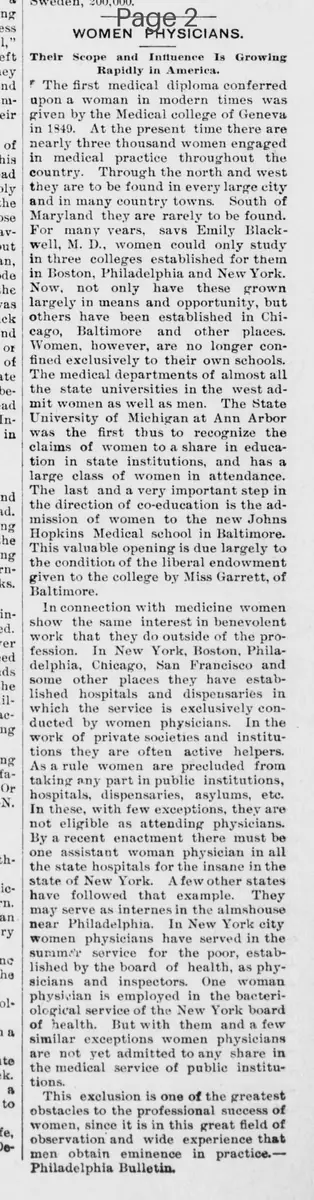
Their Scope and Influence Is Growing Rapidly in America.
The first medical diploma conferred upon a woman in modern times was given by the Medical college of Geneva in 1849. At the present time there are nearly three thousand women engaged in medical practice throughout the country. Through the north and west they are to be found in every large city and in many country towns. South of Maryland they are rarely to be found.
For many years, says Emily Blackwell, M. D., women could only study in three colleges established for them in Boston, Philadelphia and New York. Now, not only have these grown largely in means and opportunity, but others have been established in Chicago, Baltimore and other places. Women, however, are no longer confined exclusively to their own schools. The medical departments of almost all the state universities in the west admit women as well as men. The State University of Michigan at Ann Arbor was the first thus to recognize the claims of women to a share in education in state institutions, and has a large class of women in attendance.
The last and a very important step in the direction of co-education is the admission of women to the new Johns Hopkins Medical school in Baltimore. This valuable opening is due largely to the condition of the liberal endowment given to the college by Miss Garrett, of Baltimore.
In connection with medicine women show the same interest in benevolent work that they do outside of the profession. In New York, Boston, Philadelphia, Chicago, San Francisco and some other places they have established hospitals and dispensaries in which the service is exclusively conducted by women physicians. In the work of private societies and institutions they are often active helpers.
As a rule women are precluded from taking any part in public institutions, hospitals, dispensaries, asylums, etc. In these, with few exceptions, they are not eligible as attending physicians. By a recent enactment there must be one assistant woman physician in all the state hospitals for the insane in the state of New York. A few other states have followed that example. They may serve as internes in the almshouse near Philadelphia. In New York city women physicians have served in the summer service for the poor, established by the board of health, as physicians and inspectors. One woman physician is employed in the bacteriological service of the New York board of health. But with them and a few similar exceptions women physicians are not yet admitted to any share in the medical service of public institutions.
This exclusion is one of the greatest obstacles to the professional success of women, since it is in this great field of observation and wide experience that men obtain eminence in practice.—Philadelphia Bulletin.
What sub-type of article is it?
What themes does it cover?
What keywords are associated?
What entities or persons were involved?
Where did it happen?
Story Details
Key Persons
Location
America
Event Date
1849 To Present
Story Details
The article traces the history of women in medicine from the first U.S. diploma in 1849, growth to nearly 3,000 practitioners mainly in the North and West, expansion of women's medical colleges and co-education in state universities like Michigan and Johns Hopkins, establishment of women-run hospitals, and ongoing exclusion from most public institutions despite some recent gains.