Thank you for visiting SNEWPapers!
Sign up free
Evening Times Republican
Marshalltown, Marshall County, Iowa
What is this article about?
Berlin, Dec. 4: German officials relieved Mr. Kruger won't visit, refusing to abandon neutrality in Boer War; press divided, czar assured non-intervention; Austria also declines reception. Seen as boosting Germany-Britain ties.
Clipping
OCR Quality
Full Text
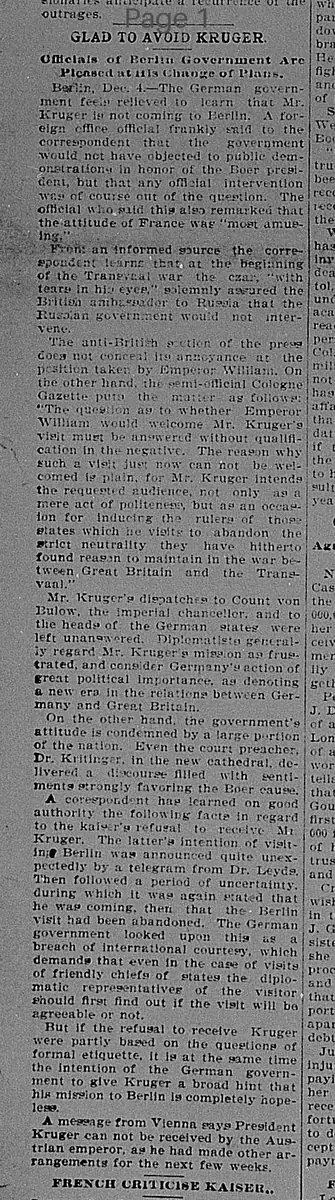
Officials of Berlin Government Are Pleased at His Change of Plans.
Berlin, Dec. 4.—The German government feels relieved to learn that Mr. Kruger is not coming to Berlin. A foreign office official frankly said to the correspondent that the government would not have objected to public demonstration in honor of the Boer president, but that any official intervention was of course out of the question. The official who said this also remarked that the attitude of France is 'most amusing.'
From an informed source the correspondent learns that at the beginning of the Transvaal war the czar, 'with tears in his eyes,' solemnly assured the British ambassador to Russia that the Russian government would not intervene.
The anti-British section of the press does not conceal its annoyance at the position taken by Emperor William. On the other hand, the semi-official Cologne Gazette puts the matter as follows:
'The question as to whether Emperor William would welcome Mr. Kruger's visit must be answered without qualification in the negative. The reason why such a visit just now can not be welcomed is plain, for Mr. Kruger intends the requested audience, not only as a mere act of politeness, but as an occasion for inducing the rulers of those states which he visits to abandon the strict neutrality they have hitherto found reason to maintain in the war between Great Britain and the Transvaal.'
Mr. Kruger's dispatches to Count von Bulow, the imperial chancellor, and to the heads of the German states were left unanswered. Diplomats generally regard Mr. Kruger's mission as frustrated, and consider Germany's action of great political importance, as denoting a new era in the relations between Germany and Great Britain.
On the other hand, the government's attitude is condemned by a large portion of the nation. Even the court preacher Dr. Kittinger, in the new cathedral, delivered a discourse filled with sentiments strongly favoring the Boer cause.
A correspondent has learned on good authority the following facts in regard to the kaiser's refusal to receive Mr. Kruger. The latter's intention of visiting Berlin was announced quite unexpectedly by a telegram from Dr. Leyds. Then followed a period of uncertainty, during which it was again stated that he was coming, then that the Berlin visit had been abandoned. The German government looked upon this as a breach of international courtesy, which demands that even in the case of visits of friendly chiefs of states the diplomatic representative of the visitor should first find out if the visit will be agreeable or not.
But if the refusal to receive Kruger were partly based on the question of formal etiquette, it is at the same time the intention of the German government to give Kruger a broad hint that his mission to Berlin is completely hopeless.
A message from Vienna says President Kruger can not be received by the Austrian emperor, as he had made other arrangements for the next few weeks.
What sub-type of article is it?
What keywords are associated?
What entities or persons were involved?
Where did it happen?
Foreign News Details
Primary Location
Berlin
Event Date
Dec. 4
Key Persons
Outcome
german government refuses to receive mr. kruger, maintaining strict neutrality in the transvaal war; diplomats see this as denoting a new era in germany-britain relations; austrian emperor also cannot receive him.
Event Details
The German government is relieved that Mr. Kruger is not visiting Berlin, viewing it as avoiding pressure to abandon neutrality in the Transvaal war. Press reactions are mixed, with anti-British sections annoyed and semi-official press supporting the refusal. Kruger's dispatches went unanswered. The czar assured non-intervention to Britain. Refusal partly based on etiquette breach via Dr. Leyds' telegram. Vienna reports Austrian emperor unavailable.