Thank you for visiting SNEWPapers!
Sign up free
Editorial
March 13, 1899
The Morning News
Savannah, Chatham County, Georgia
What is this article about?
The editorial examines the unresolved question of army command authority post-President, tracing history from Washington to present frictions under Miles, advocating for a clear military head over civilian oversight due to disorganization.
Clipping
OCR Quality
98%
Excellent
Full Text
THE COMMAND OF THE ARMY.
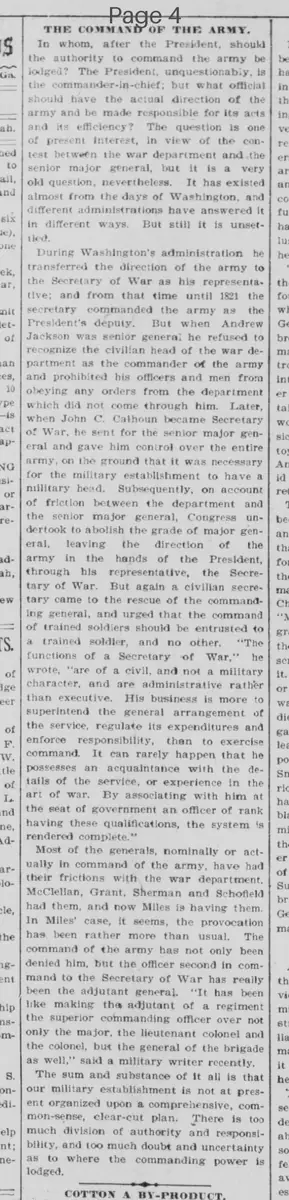
In whom, after the President, should the authority to command the army be lodged? The President, unquestionably, is the commander-in-chief; but what official should have the actual direction of the army and be made responsible for its acts and its efficiency? The question is one of present interest, in view of the contest between the war department and the senior major general, but it is a very old question, nevertheless. It has existed almost from the days of Washington, and different administrations have answered it in different ways. But still it is unsettled.
During Washington's administration he transferred the direction of the army to the Secretary of War as his representative; and from that time until 1821 the secretary commanded the army as the President's deputy. But when Andrew Jackson was senior general, he refused to recognize the civilian head of the war department as the commander of the army and prohibited his officers and men from obeying any orders from the department which did not come through him. Later, when John C. Calhoun became Secretary of War, he sent for the senior major general and gave him control over the entire army, on the ground that it was necessary for the military establishment to have a military head. Subsequently, on account of friction between the department and the senior major general, Congress undertook to abolish the grade of major general, leaving the direction of the army in the hands of the President, through his representative, the Secretary of War. But again a civilian secretary came to the rescue of the commanding general, and urged that the command of trained soldiers should be entrusted to a trained soldier, and no other. "The functions of a Secretary of War," he wrote, "are of a civil, and not a military character, and are administrative rather than executive. His business is more to superintend the general arrangement of the service, regulate its expenditures and enforce responsibility, than to exercise command. It can rarely happen that he possesses an acquaintance with the details of the service, or experience in the art of war. By associating with him at the seat of government an officer of rank having these qualifications, the system is rendered complete."
Most of the generals, nominally or actually in command of the army, have had their frictions with the war department. McClellan, Grant, Sherman and Schofield had them, and now Miles is having them. In Miles' case, it seems, the provocation has been rather more than usual. The command of the army has not only been denied him, but the officer second in command to the Secretary of War has really been the adjutant general. "It has been like making the adjutant of a regiment the superior commanding officer over not only the major, the lieutenant colonel and the colonel, but the general of the brigade as well," said a military writer recently.
The sum and substance of it all is that our military establishment is not at present organized upon a comprehensive, common-sense, clear-cut plan. There is too much division of authority and responsibility, and too much doubt and uncertainty as to where the commanding power is lodged.
In whom, after the President, should the authority to command the army be lodged? The President, unquestionably, is the commander-in-chief; but what official should have the actual direction of the army and be made responsible for its acts and its efficiency? The question is one of present interest, in view of the contest between the war department and the senior major general, but it is a very old question, nevertheless. It has existed almost from the days of Washington, and different administrations have answered it in different ways. But still it is unsettled.
During Washington's administration he transferred the direction of the army to the Secretary of War as his representative; and from that time until 1821 the secretary commanded the army as the President's deputy. But when Andrew Jackson was senior general, he refused to recognize the civilian head of the war department as the commander of the army and prohibited his officers and men from obeying any orders from the department which did not come through him. Later, when John C. Calhoun became Secretary of War, he sent for the senior major general and gave him control over the entire army, on the ground that it was necessary for the military establishment to have a military head. Subsequently, on account of friction between the department and the senior major general, Congress undertook to abolish the grade of major general, leaving the direction of the army in the hands of the President, through his representative, the Secretary of War. But again a civilian secretary came to the rescue of the commanding general, and urged that the command of trained soldiers should be entrusted to a trained soldier, and no other. "The functions of a Secretary of War," he wrote, "are of a civil, and not a military character, and are administrative rather than executive. His business is more to superintend the general arrangement of the service, regulate its expenditures and enforce responsibility, than to exercise command. It can rarely happen that he possesses an acquaintance with the details of the service, or experience in the art of war. By associating with him at the seat of government an officer of rank having these qualifications, the system is rendered complete."
Most of the generals, nominally or actually in command of the army, have had their frictions with the war department. McClellan, Grant, Sherman and Schofield had them, and now Miles is having them. In Miles' case, it seems, the provocation has been rather more than usual. The command of the army has not only been denied him, but the officer second in command to the Secretary of War has really been the adjutant general. "It has been like making the adjutant of a regiment the superior commanding officer over not only the major, the lieutenant colonel and the colonel, but the general of the brigade as well," said a military writer recently.
The sum and substance of it all is that our military establishment is not at present organized upon a comprehensive, common-sense, clear-cut plan. There is too much division of authority and responsibility, and too much doubt and uncertainty as to where the commanding power is lodged.
What sub-type of article is it?
Military Affairs
Constitutional
What keywords are associated?
Army Command
Secretary Of War
Military Authority
Senior General
War Department Friction
Historical Precedents
Divided Responsibility
What entities or persons were involved?
President
Washington
Andrew Jackson
John C. Calhoun
Secretary Of War
Mcclellan
Grant
Sherman
Schofield
Miles
Congress
Editorial Details
Primary Topic
Authority To Command The Us Army
Stance / Tone
Critical Of Divided Authority And Disorganization
Key Figures
President
Washington
Andrew Jackson
John C. Calhoun
Secretary Of War
Mcclellan
Grant
Sherman
Schofield
Miles
Congress
Key Arguments
President Is Commander In Chief But Needs A Deputy For Actual Direction
Historical Shifts: Washington Delegated To Secretary Of War Until 1821
Jackson Refused Civilian Command And Insisted On Military Head
Calhoun Granted Control To Senior Major General For Efficiency
Congress Abolished Major General Grade To Centralize Under Secretary
Civilian Secretaries Argued For Trained Military Leader
Generals Like Mcclellan, Grant, Sherman, Schofield, And Miles Faced Frictions With War Department
Current System Denies Command To Senior General, Elevating Adjutant General Inappropriately
Military Establishment Lacks Comprehensive Organization With Divided Authority