Thank you for visiting SNEWPapers!
Sign up free
Story
September 4, 1816
Daily National Intelligencer
Washington, District Of Columbia
What is this article about?
A letter corrects a Port Folio article claiming Marquis de Lafayette's 1797 release from Olmutz prison was part of a Bonaparte treaty, attributing it instead to American interest via Consul Parish's efforts, supported by letters from Austrian officials Thugut and Buol.
Clipping
OCR Quality
98%
Excellent
Full Text
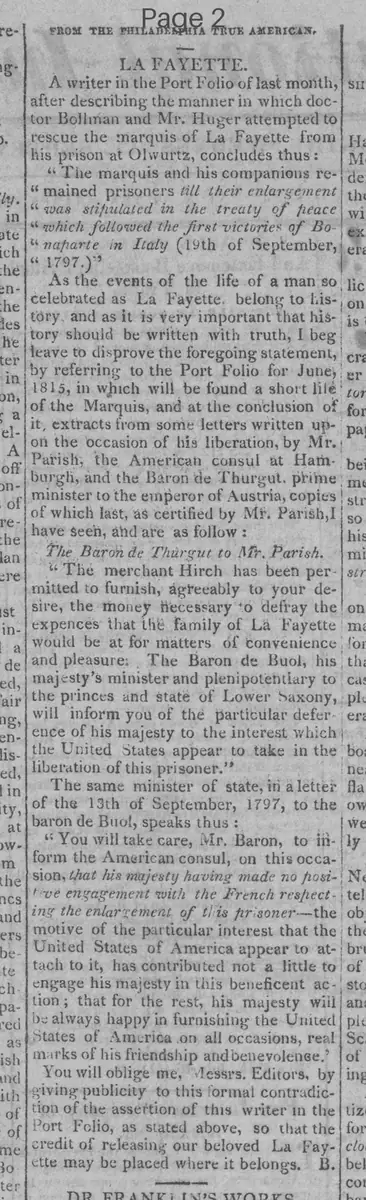
LAFAYETTE.
A writer in the Port Folio of last month, after describing the manner in which doctor Bollman and Mr. Huger attempted to rescue the marquis of La Fayette from his prison at Olmutz, concludes thus:
"The marquis and his companions remained prisoners till their enlargement was stipulated in the treaty of peace which followed the first victories of Bonaparte in Italy (19th of September, 1797.)"
As the events of the life of a man so celebrated as La Fayette, belong to history, and as it is very important that history should be written with truth, I beg leave to disprove the foregoing statement, by referring to the Port Folio for June 1815, in which will be found a short life of the Marquis, and at the conclusion of it, extracts from some letters written upon the occasion of his liberation, by Mr. Parish, the American consul at Hamburg, and the Baron de Thugut, prime minister to the emperor of Austria, copies of which last, as certified by Mr. Parish, I have seen, and are as follow:
The Baron de Thugut to Mr. Parish.
"The merchant Hirsch has been permitted to furnish, agreeably to your desire, the money necessary to defray the expences that the family of La Fayette would be at for matters of convenience and pleasure: The Baron de Buol, his majesty's minister and plenipotentiary to the princes and state of Lower Saxony, will inform you of the particular deference of his majesty to the interest which the United States appear to take in the liberation of this prisoner."
The same minister of state, in a letter of the 13th of September, 1797, to the baron de Buol, speaks thus:
"You will take care, Mr. Baron, to inform the American consul, on this occasion, that his majesty having made no positive engagement with the French respecting the enlargement of this prisoner--the motive of the particular interest that the United States of America appear to attach to it, has contributed not a little to engage his majesty in this beneficent action; that for the rest, his majesty will be always happy in furnishing the United States of America on all occasions, real marks of his friendship and benevolence."
You will oblige me, Messrs. Editors, by giving publicity to this formal contradiction of the assertion of the writer in the Port Folio, as stated above, so that the credit of releasing our beloved La Fayette may be placed where it belongs. B.
A writer in the Port Folio of last month, after describing the manner in which doctor Bollman and Mr. Huger attempted to rescue the marquis of La Fayette from his prison at Olmutz, concludes thus:
"The marquis and his companions remained prisoners till their enlargement was stipulated in the treaty of peace which followed the first victories of Bonaparte in Italy (19th of September, 1797.)"
As the events of the life of a man so celebrated as La Fayette, belong to history, and as it is very important that history should be written with truth, I beg leave to disprove the foregoing statement, by referring to the Port Folio for June 1815, in which will be found a short life of the Marquis, and at the conclusion of it, extracts from some letters written upon the occasion of his liberation, by Mr. Parish, the American consul at Hamburg, and the Baron de Thugut, prime minister to the emperor of Austria, copies of which last, as certified by Mr. Parish, I have seen, and are as follow:
The Baron de Thugut to Mr. Parish.
"The merchant Hirsch has been permitted to furnish, agreeably to your desire, the money necessary to defray the expences that the family of La Fayette would be at for matters of convenience and pleasure: The Baron de Buol, his majesty's minister and plenipotentiary to the princes and state of Lower Saxony, will inform you of the particular deference of his majesty to the interest which the United States appear to take in the liberation of this prisoner."
The same minister of state, in a letter of the 13th of September, 1797, to the baron de Buol, speaks thus:
"You will take care, Mr. Baron, to inform the American consul, on this occasion, that his majesty having made no positive engagement with the French respecting the enlargement of this prisoner--the motive of the particular interest that the United States of America appear to attach to it, has contributed not a little to engage his majesty in this beneficent action; that for the rest, his majesty will be always happy in furnishing the United States of America on all occasions, real marks of his friendship and benevolence."
You will oblige me, Messrs. Editors, by giving publicity to this formal contradiction of the assertion of the writer in the Port Folio, as stated above, so that the credit of releasing our beloved La Fayette may be placed where it belongs. B.
What sub-type of article is it?
Biography
Historical Event
What themes does it cover?
Justice
What keywords are associated?
Lafayette Release
Historical Correction
American Diplomacy
Austrian Letters
Prison Liberation
What entities or persons were involved?
La Fayette
Doctor Bollman
Mr. Huger
Bonaparte
Mr. Parish
Baron De Thugut
Baron De Buol
B.
Where did it happen?
Olmutz
Story Details
Key Persons
La Fayette
Doctor Bollman
Mr. Huger
Bonaparte
Mr. Parish
Baron De Thugut
Baron De Buol
B.
Location
Olmutz
Event Date
1797
Story Details
Correction of historical claim that Lafayette's release was treaty-stipulated; instead due to U.S. interest via Parish, evidenced by Thugut's letters acknowledging American role without French engagement.