Thank you for visiting SNEWPapers!
Sign up free
Letter to Editor
June 22, 1855
The Liberator
Boston, Suffolk County, Massachusetts
What is this article about?
Joseph Barker details his 1855 lecture tour in England for The Liberator, covering 153 lectures on America, slavery, reforms, and Bible criticism. He faced violent opposition in Liverpool from Orthodox groups but prevailed, debated figures like Brewin Grant, and praised supporters including John Finch and Elizabeth Pease Nichol.
Clipping
OCR Quality
98%
Excellent
Full Text
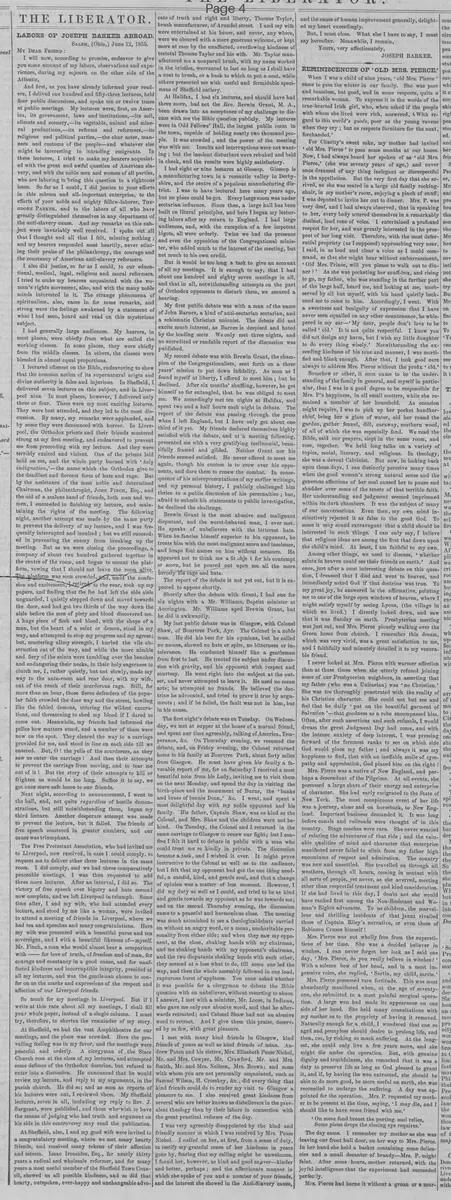
THE LIBERATOR.
LABORS OF JOSEPH BARKER ABROAD
SALEM, (Ohio,) June 12, 1855.
My Dear Friend:
I will now, according to promise, endeavor to give you some account of my labors, observations and experiences, during my sojourn on the other side of the Atlantic,
And first, as you have already informed your readers, I delivered one hundred and fifty-three lectures, held four public discussions, and spoke ten or twelve times at public meetings. My lectures were, first, on America, its government, laws and institutions,—its soil, climate and scenery, its vegetable, animal and mineral productions,—its reforms and reformers,—its religious and political parties, the character, manners and customs of the people—and whatever else might be interesting to intending emigrants. In these lectures, I tried to make my hearers acquainted with the great and awful question of American slavery, and with the noble men and women of all parties, who are laboring to bring this question to a righteous issue. So far as I could, I did justice to your efforts in this solemn and all-important enterprise, to the efforts of your noble and mighty fellow-laborer, Theodore Parker, and to the labors of all who have greatly distinguished themselves in any department of the anti-slavery cause. And my remarks on this subject were invariably well received. I spoke out all that I thought and all that I felt, mincing nothing; and my hearers responded most heartily, never stinting their praise of the philanthropy, the courage and the constancy of American anti-slavery reformers.
I also did justice, so far as I could, to our educational, medical, legal, religious and moral reformers. I tried to make my hearers acquainted with the woman's rights movement, also, and with the many noble minds interested in it. The strange phenomena of spiritualism, also, came in for some remarks, and strong were the feelings awakened by a statement of what I had seen, heard and read on this mysterious subject.
I had generally large audiences. My hearers, in most places, were chiefly from what are called the working classes. In some places, they were chiefly from the middle classes. In others, the classes were blended in almost equal proportions.
I lectured oftenest on the Bible, endeavoring to show that the common notion of its supernatural origin and divine authority is false and injurious. In Sheffield, I delivered seven lectures on this subject, and in Liverpool nine. In most places, however, I delivered only three or four. These were my most exciting lectures. They were best attended, and they led to the most discussion. By many, my remarks were applauded, and by some they were denounced with horror. In Liverpool, the Orthodox priests and their friends mustered strong at my first meeting, and endeavored to prevent me from proceeding with my lecture. And they were terribly excited and violent. One of the priests laid hold on me, and the whole party burned with 'holy indignation,'—the name which the Orthodox give to the deadliest and fiercest form of hate and rage. But by the assistance of the most noble and determined Chairman, the philanthropist, John Finch, Esq., and the aid of a zealous band of friends, both men and women, I succeeded in finishing my lecture, and maintaining the rights of the meeting. The following night, another attempt was made by the same party to prevent the delivery of my lecture, and I was frequently interrupted and insulted; but we still succeeded in preventing the enemy from breaking up the meeting. But as we were closing the proceedings, a company of about two hundred gathered together in the centre of the room, and began to mount the platform, vowing that I should not leave the room alive. The platform was soon crowded, and, amid the confusion and excitement, I retired to the rear, took up my papers, and finding that the foe had left the side aisle unguarded, I quietly stepped down and moved towards the door, and had got two thirds of the way down the aisle before the men of piety and blood discovered me. A huge piece of flesh and blood, with the shape of a man, but the heart of a saint or demon, stood in my way, and attempted to stop my progress and my egress; but, mustering all my strength, I hurled the vile obstruction out of the way, and while the more nimble and fiery of the saints were tumbling over the benches and endangering their necks, in their holy eagerness to clutch me, I, rather quietly, but not slowly, made my way to the ante-room and rear door, with my wife, out of the reach of their murderous rage. Still, for more than an hour, those fierce defenders of the popular faith crowded the door way and the street, howling like the fabled demons, uttering the wildest execrations, and threatening to shed my blood if I dared to come out. Meanwhile, my friends had informed the police how matters stood, and a number of them were now on the spot. They cleared the way to a carriage provided for me, and stood in line on each side till we entered. But, O! the yells of the murderers, as they saw us enter the carriage! And then their attempts to prevent the carriage from moving, and to tear me out of it! But the story of their attempts to kill or frighten us would be too long. Suffice it to say, we got once more safe home to our friends.
Next night, according to announcement, I went to the hall, and, not quite regardless of hostile demonstrations, but still notwithstanding them, began my third lecture. Another desperate attempt was made to prevent the lecture, but it failed. The friends of free speech mustered in greater numbers, and our cause was triumphant.
The Free Protestant Association, who had invited me to Liverpool, now resolved, in case I could comply, to request me to deliver other three lectures in the same room. I did comply, and we had three comparatively peaceable meetings. I was then requested to add three more lectures. After an interval, I did so. The victory of free speech over bigotry and hate seemed now complete, and we left Liverpool in triumph. Some time after, I and my wife, who had attended every lecture, and stood by me like a woman, were invited to attend a meeting of friends in Liverpool, where we had tea and speeches and many congratulations. Here my wife was presented with a beautiful purse and ten sovereigns, and I with a beautiful likeness of myself. Mr. Finch, a man who would almost bear a comparison with Garrison for love of truth, of freedom and of man, for courage and constancy in a good cause, and for unaffected kindness and incorruptible integrity, presided at all my lectures, and was the gentleman chosen to confer on us the marks and expressions of the respect and affection of our Liverpool friends.
So much for my meetings in Liverpool. But if I write at this rate about all my meetings, I shall fill your whole paper, instead of a single column. I must try, therefore, to shorten the remainder of my story.
At Sheffield, we had the vast Amphitheatre for our meetings, and the place was crowded. Here the prevailing feeling was in my favor, and the meetings were peaceful and orderly. A clergyman of the State Church rose at the close of my lectures, and attempted some defence of the Orthodox doctrine, but refused to enter into a discussion. He announced that he would review my lecture, and reply to my arguments, in the parish church. He did so; and as soon as reports of his lectures were out, I reviewed them. My Sheffield lectures, seven in all, including my reply to Rev. J. Sargeant, were published, and those who wish to have the means of judging who had truth and argument on his side in this controversy may read the publication.
At Sheffield, also, I and my good wife were invited to a congratulatory meeting, where we met many hearty friends, and received many tokens of their affection and esteem. Isaac Ironsides, Esq., for nearly thirty years a radical and wholesale reformer, and for many years a most useful member of the Sheffield Town Council, showed us all possible kindness, and so did that hearty, outspoken, ever-happy and unchangeable advocate of truth and right and liberty, Thomas Taylor, brush manufacturer, of Arundel street. I and my wife were entertained at his house, and never, anywhere, were we cheered with a more generous welcome, or kept more at ease by the unaffected, overflowing kindness of teetotal Thomas Taylor and his wife. Mr. Taylor manufactured me a nonpareil brush, with my name worked in the bristles, warranted to last as long as I shall have a coat to brush, or a back to which to put a coat, while others presented me with useful and formidable specimens of Sheffield cutlery.
At Halifax, I had six lectures, and should have had three more, had not the Rev. Brewin Grant, M. A., been drawn into an acceptance of my challenge to discuss with me the Bible question publicly. My lectures were in Odd Fellows' Hall, the largest public room in the town, capable of holding nearly two thousand people. It was crowded, and the power of the meeting was with me. Insults and interruptions were not wanting; but the insolent disturbers were rebuked and held in check, and the results were highly satisfactory.
I had eight or nine lectures at Glossop. Glossop is a manufacturing town in a romantic valley in Derbyshire, and the centre of a populous manufacturing district. I was to have lectured here many years ago, but no place could be got. Every large room was under sectarian influence. Since then, a large hall has been built on liberal principles, and here I began my lecturing labors after my return to England. I had large audiences, and, with the exception of a few impotent bigots, all were orderly. Twice we had the presence and even the opposition of the Congregational minister, who added much to the interest of the meeting, but not much to his own credit.
But it would be too long a task to give an account of all my meetings. It is enough to say, that I had about one hundred and eighty-seven meetings in all, and that in all, notwithstanding attempts on the part of Orthodox opponents to disturb them, we secured a hearing.
My first public debate was with a man of the name of John Barnes, a kind of anti-sectarian sectarian, and a schismatic Christian unionist. The debate did not excite much interest, as Barnes is despised and hated by the leading sects. We only met three nights, and no accredited or readable report of the discussion was published.
My second debate was with Brewin Grant, the champion of the Congregationalists, sent forth on a three years' mission to put down infidelity. As soon as I found myself at liberty, I offered to meet him; but he declined. After six months' shuffling, however, he got himself so far entangled, that he was obliged to meet me. We accordingly met ten nights at Halifax, and spent two and a half hours each night in debate. The report of the debate was passing through the press when I left England, but I have only got about one third of it yet. My friends declared themselves highly satisfied with the debate, and at a meeting following, presented me with a very gratifying testimonial, beautifully framed and gilded. Neither Grant nor his friends seemed satisfied. He never offered to meet me again, though his custom is to crow over his opponents, and dare them to renew the combat. In consequence of his misrepresentations of my earlier writings, and my personal history, I publicly challenged him thrice to a public discussion of his personalties; but, afraid to submit his statements to public investigation, he declined the challenge.
Brewin Grant is the most abusive and malignant disputant, and the worst-behaved man, I ever met. He speaks of unbelievers with the bitterest hate. When he fancies himself superior to his opponent, he treats him with the most malignant scorn and insolence, and heaps foul names on him without measure. He appeared not to think me a fit object for his contempt or scorn, but he poured out upon me all the more fiercely his rage and hate.
The report of the debate is not yet out, but it is expected to appear shortly.
Shortly after the debate with Grant, I had one for six nights with a Mr. Williams, Baptist minister at Accrington. Mr. Williams aped Brewin Grant, but he did it awkwardly.
My last public debate was in Glasgow, with Colonel Shaw, of Bourtree Park, Ayr. The Colonel is a noble man. He did his best for his opinions, but he called no names, showed no hate or spite, no bitterness or intolerance. He conducted himself like a gentleman from first to last. He treated the subject under discussion with gravity, and his opponent with respect and courtesy. He went right into the subject at the outset, and never attempted to leave it. He used no mean arts; he attempted no frauds. He believed the doctrine he advocated, and tried to prove it true by arguments; and if he failed, the fault was not in him, but in his cause.
The first night's debate was on Tuesday. On Wednesday, we met at supper at the house of a mutual friend, and spent our time agreeably, talking of America, Temperance, &c. On Thursday evening, we resumed the debate, and, on Friday evening, the Colonel returned home to his family at Bourtree Park, about forty miles from Glasgow. He must have given his family a favorable report of me, for on Saturday I received a most beautiful note from his Lady, inviting me to visit them on the next Monday, and spend the day in visiting the birth-place and the monument of Burns, the banks and braes of bonnie Doon,' &c. I went, and spent a most delightful day with my noble opponent and his family. His father, Captain Shaw, was as kind as the Colonel, and Mrs. Shaw and the children were not behind. On Tuesday, the Colonel and I returned in the same carriage to Glasgow to renew our fight; but I confess I felt it hard to debate in public with a man who could treat me so kindly in private. The discussion became a task, and I wished it over. It might prove instructive to the Colonel as well as to the audience, but I felt that my opponent had got the one thing needful, a candid, kind, and gentle soul, and that a change of opinion was a matter of less moment. However, I did my duty as well as I could, and tried to be as kind and gentle towards my opponent as he was towards me; and on the second Thursday evening, the discussion came to a peaceful and harmonious close. The meeting was much astonished to see a theological debate carried on without an angry word, or a mean, uncharitable personality from either side; and when they saw my opponent, at the close, shaking hands with my chairman, and me shaking hands with my opponent's chairman, and the two disputants shaking hands with each other, they seemed at a loss what to do, till some one led the way, and then the whole assembly followed in one loud, rapturous burst of applause. You once asked whether it was possible for a clergyman to debate the Bible question with an unbeliever, without resorting to abuse. I answer, I met with a minister, Mr. Loose, in Indiana, who gave me only one abusive word, and that he afterwards retracted; and Colonel Shaw had not an abusive word to retract. And I give them this praise, deserved by so few, with great pleasure.
I met with many kind friends in Glasgow, kind friends of yours as well as kind friends of mine. Andrew Paton and his sisters, Mrs. Elizabeth Pease Nichol, Mr. and Mrs. Cowper, Mr. Crawford, Mr. and Mrs. Smith, Mr. and Mrs. Neilson, Mrs. Brown: and some with whom you are not personally acquainted, such as Samuel Wilson, H. Crosskey, &c., did every thing that kind friends could do to render my visit to Glasgow a pleasure to me. I also received great kindness from several who are better known as disbelievers in the prevalent theology than by their labors in connection with the great practical reforms of the day.
I was very agreeably disappointed by the kind and friendly manner in which I was received by Mrs. Pease Nichol. I called on her, at first, from a sense of duty, to testify my grateful sense of her kindness in years gone by, fearing that my calling might be unwelcome. I found her, however, as kind and good as ever—kinder and better, perhaps; and the affectionate manner in which she spoke of you and a number of your friends, and the interest she showed in the Anti-Slavery cause, and the cause of human improvement generally, delighted my heart exceedingly.
But, I must close. What else I have to say, I must say hereafter. Meanwhile, I remain,
Yours, very affectionately,
JOSEPH BARKER.
LABORS OF JOSEPH BARKER ABROAD
SALEM, (Ohio,) June 12, 1855.
My Dear Friend:
I will now, according to promise, endeavor to give you some account of my labors, observations and experiences, during my sojourn on the other side of the Atlantic,
And first, as you have already informed your readers, I delivered one hundred and fifty-three lectures, held four public discussions, and spoke ten or twelve times at public meetings. My lectures were, first, on America, its government, laws and institutions,—its soil, climate and scenery, its vegetable, animal and mineral productions,—its reforms and reformers,—its religious and political parties, the character, manners and customs of the people—and whatever else might be interesting to intending emigrants. In these lectures, I tried to make my hearers acquainted with the great and awful question of American slavery, and with the noble men and women of all parties, who are laboring to bring this question to a righteous issue. So far as I could, I did justice to your efforts in this solemn and all-important enterprise, to the efforts of your noble and mighty fellow-laborer, Theodore Parker, and to the labors of all who have greatly distinguished themselves in any department of the anti-slavery cause. And my remarks on this subject were invariably well received. I spoke out all that I thought and all that I felt, mincing nothing; and my hearers responded most heartily, never stinting their praise of the philanthropy, the courage and the constancy of American anti-slavery reformers.
I also did justice, so far as I could, to our educational, medical, legal, religious and moral reformers. I tried to make my hearers acquainted with the woman's rights movement, also, and with the many noble minds interested in it. The strange phenomena of spiritualism, also, came in for some remarks, and strong were the feelings awakened by a statement of what I had seen, heard and read on this mysterious subject.
I had generally large audiences. My hearers, in most places, were chiefly from what are called the working classes. In some places, they were chiefly from the middle classes. In others, the classes were blended in almost equal proportions.
I lectured oftenest on the Bible, endeavoring to show that the common notion of its supernatural origin and divine authority is false and injurious. In Sheffield, I delivered seven lectures on this subject, and in Liverpool nine. In most places, however, I delivered only three or four. These were my most exciting lectures. They were best attended, and they led to the most discussion. By many, my remarks were applauded, and by some they were denounced with horror. In Liverpool, the Orthodox priests and their friends mustered strong at my first meeting, and endeavored to prevent me from proceeding with my lecture. And they were terribly excited and violent. One of the priests laid hold on me, and the whole party burned with 'holy indignation,'—the name which the Orthodox give to the deadliest and fiercest form of hate and rage. But by the assistance of the most noble and determined Chairman, the philanthropist, John Finch, Esq., and the aid of a zealous band of friends, both men and women, I succeeded in finishing my lecture, and maintaining the rights of the meeting. The following night, another attempt was made by the same party to prevent the delivery of my lecture, and I was frequently interrupted and insulted; but we still succeeded in preventing the enemy from breaking up the meeting. But as we were closing the proceedings, a company of about two hundred gathered together in the centre of the room, and began to mount the platform, vowing that I should not leave the room alive. The platform was soon crowded, and, amid the confusion and excitement, I retired to the rear, took up my papers, and finding that the foe had left the side aisle unguarded, I quietly stepped down and moved towards the door, and had got two thirds of the way down the aisle before the men of piety and blood discovered me. A huge piece of flesh and blood, with the shape of a man, but the heart of a saint or demon, stood in my way, and attempted to stop my progress and my egress; but, mustering all my strength, I hurled the vile obstruction out of the way, and while the more nimble and fiery of the saints were tumbling over the benches and endangering their necks, in their holy eagerness to clutch me, I, rather quietly, but not slowly, made my way to the ante-room and rear door, with my wife, out of the reach of their murderous rage. Still, for more than an hour, those fierce defenders of the popular faith crowded the door way and the street, howling like the fabled demons, uttering the wildest execrations, and threatening to shed my blood if I dared to come out. Meanwhile, my friends had informed the police how matters stood, and a number of them were now on the spot. They cleared the way to a carriage provided for me, and stood in line on each side till we entered. But, O! the yells of the murderers, as they saw us enter the carriage! And then their attempts to prevent the carriage from moving, and to tear me out of it! But the story of their attempts to kill or frighten us would be too long. Suffice it to say, we got once more safe home to our friends.
Next night, according to announcement, I went to the hall, and, not quite regardless of hostile demonstrations, but still notwithstanding them, began my third lecture. Another desperate attempt was made to prevent the lecture, but it failed. The friends of free speech mustered in greater numbers, and our cause was triumphant.
The Free Protestant Association, who had invited me to Liverpool, now resolved, in case I could comply, to request me to deliver other three lectures in the same room. I did comply, and we had three comparatively peaceable meetings. I was then requested to add three more lectures. After an interval, I did so. The victory of free speech over bigotry and hate seemed now complete, and we left Liverpool in triumph. Some time after, I and my wife, who had attended every lecture, and stood by me like a woman, were invited to attend a meeting of friends in Liverpool, where we had tea and speeches and many congratulations. Here my wife was presented with a beautiful purse and ten sovereigns, and I with a beautiful likeness of myself. Mr. Finch, a man who would almost bear a comparison with Garrison for love of truth, of freedom and of man, for courage and constancy in a good cause, and for unaffected kindness and incorruptible integrity, presided at all my lectures, and was the gentleman chosen to confer on us the marks and expressions of the respect and affection of our Liverpool friends.
So much for my meetings in Liverpool. But if I write at this rate about all my meetings, I shall fill your whole paper, instead of a single column. I must try, therefore, to shorten the remainder of my story.
At Sheffield, we had the vast Amphitheatre for our meetings, and the place was crowded. Here the prevailing feeling was in my favor, and the meetings were peaceful and orderly. A clergyman of the State Church rose at the close of my lectures, and attempted some defence of the Orthodox doctrine, but refused to enter into a discussion. He announced that he would review my lecture, and reply to my arguments, in the parish church. He did so; and as soon as reports of his lectures were out, I reviewed them. My Sheffield lectures, seven in all, including my reply to Rev. J. Sargeant, were published, and those who wish to have the means of judging who had truth and argument on his side in this controversy may read the publication.
At Sheffield, also, I and my good wife were invited to a congratulatory meeting, where we met many hearty friends, and received many tokens of their affection and esteem. Isaac Ironsides, Esq., for nearly thirty years a radical and wholesale reformer, and for many years a most useful member of the Sheffield Town Council, showed us all possible kindness, and so did that hearty, outspoken, ever-happy and unchangeable advocate of truth and right and liberty, Thomas Taylor, brush manufacturer, of Arundel street. I and my wife were entertained at his house, and never, anywhere, were we cheered with a more generous welcome, or kept more at ease by the unaffected, overflowing kindness of teetotal Thomas Taylor and his wife. Mr. Taylor manufactured me a nonpareil brush, with my name worked in the bristles, warranted to last as long as I shall have a coat to brush, or a back to which to put a coat, while others presented me with useful and formidable specimens of Sheffield cutlery.
At Halifax, I had six lectures, and should have had three more, had not the Rev. Brewin Grant, M. A., been drawn into an acceptance of my challenge to discuss with me the Bible question publicly. My lectures were in Odd Fellows' Hall, the largest public room in the town, capable of holding nearly two thousand people. It was crowded, and the power of the meeting was with me. Insults and interruptions were not wanting; but the insolent disturbers were rebuked and held in check, and the results were highly satisfactory.
I had eight or nine lectures at Glossop. Glossop is a manufacturing town in a romantic valley in Derbyshire, and the centre of a populous manufacturing district. I was to have lectured here many years ago, but no place could be got. Every large room was under sectarian influence. Since then, a large hall has been built on liberal principles, and here I began my lecturing labors after my return to England. I had large audiences, and, with the exception of a few impotent bigots, all were orderly. Twice we had the presence and even the opposition of the Congregational minister, who added much to the interest of the meeting, but not much to his own credit.
But it would be too long a task to give an account of all my meetings. It is enough to say, that I had about one hundred and eighty-seven meetings in all, and that in all, notwithstanding attempts on the part of Orthodox opponents to disturb them, we secured a hearing.
My first public debate was with a man of the name of John Barnes, a kind of anti-sectarian sectarian, and a schismatic Christian unionist. The debate did not excite much interest, as Barnes is despised and hated by the leading sects. We only met three nights, and no accredited or readable report of the discussion was published.
My second debate was with Brewin Grant, the champion of the Congregationalists, sent forth on a three years' mission to put down infidelity. As soon as I found myself at liberty, I offered to meet him; but he declined. After six months' shuffling, however, he got himself so far entangled, that he was obliged to meet me. We accordingly met ten nights at Halifax, and spent two and a half hours each night in debate. The report of the debate was passing through the press when I left England, but I have only got about one third of it yet. My friends declared themselves highly satisfied with the debate, and at a meeting following, presented me with a very gratifying testimonial, beautifully framed and gilded. Neither Grant nor his friends seemed satisfied. He never offered to meet me again, though his custom is to crow over his opponents, and dare them to renew the combat. In consequence of his misrepresentations of my earlier writings, and my personal history, I publicly challenged him thrice to a public discussion of his personalties; but, afraid to submit his statements to public investigation, he declined the challenge.
Brewin Grant is the most abusive and malignant disputant, and the worst-behaved man, I ever met. He speaks of unbelievers with the bitterest hate. When he fancies himself superior to his opponent, he treats him with the most malignant scorn and insolence, and heaps foul names on him without measure. He appeared not to think me a fit object for his contempt or scorn, but he poured out upon me all the more fiercely his rage and hate.
The report of the debate is not yet out, but it is expected to appear shortly.
Shortly after the debate with Grant, I had one for six nights with a Mr. Williams, Baptist minister at Accrington. Mr. Williams aped Brewin Grant, but he did it awkwardly.
My last public debate was in Glasgow, with Colonel Shaw, of Bourtree Park, Ayr. The Colonel is a noble man. He did his best for his opinions, but he called no names, showed no hate or spite, no bitterness or intolerance. He conducted himself like a gentleman from first to last. He treated the subject under discussion with gravity, and his opponent with respect and courtesy. He went right into the subject at the outset, and never attempted to leave it. He used no mean arts; he attempted no frauds. He believed the doctrine he advocated, and tried to prove it true by arguments; and if he failed, the fault was not in him, but in his cause.
The first night's debate was on Tuesday. On Wednesday, we met at supper at the house of a mutual friend, and spent our time agreeably, talking of America, Temperance, &c. On Thursday evening, we resumed the debate, and, on Friday evening, the Colonel returned home to his family at Bourtree Park, about forty miles from Glasgow. He must have given his family a favorable report of me, for on Saturday I received a most beautiful note from his Lady, inviting me to visit them on the next Monday, and spend the day in visiting the birth-place and the monument of Burns, the banks and braes of bonnie Doon,' &c. I went, and spent a most delightful day with my noble opponent and his family. His father, Captain Shaw, was as kind as the Colonel, and Mrs. Shaw and the children were not behind. On Tuesday, the Colonel and I returned in the same carriage to Glasgow to renew our fight; but I confess I felt it hard to debate in public with a man who could treat me so kindly in private. The discussion became a task, and I wished it over. It might prove instructive to the Colonel as well as to the audience, but I felt that my opponent had got the one thing needful, a candid, kind, and gentle soul, and that a change of opinion was a matter of less moment. However, I did my duty as well as I could, and tried to be as kind and gentle towards my opponent as he was towards me; and on the second Thursday evening, the discussion came to a peaceful and harmonious close. The meeting was much astonished to see a theological debate carried on without an angry word, or a mean, uncharitable personality from either side; and when they saw my opponent, at the close, shaking hands with my chairman, and me shaking hands with my opponent's chairman, and the two disputants shaking hands with each other, they seemed at a loss what to do, till some one led the way, and then the whole assembly followed in one loud, rapturous burst of applause. You once asked whether it was possible for a clergyman to debate the Bible question with an unbeliever, without resorting to abuse. I answer, I met with a minister, Mr. Loose, in Indiana, who gave me only one abusive word, and that he afterwards retracted; and Colonel Shaw had not an abusive word to retract. And I give them this praise, deserved by so few, with great pleasure.
I met with many kind friends in Glasgow, kind friends of yours as well as kind friends of mine. Andrew Paton and his sisters, Mrs. Elizabeth Pease Nichol, Mr. and Mrs. Cowper, Mr. Crawford, Mr. and Mrs. Smith, Mr. and Mrs. Neilson, Mrs. Brown: and some with whom you are not personally acquainted, such as Samuel Wilson, H. Crosskey, &c., did every thing that kind friends could do to render my visit to Glasgow a pleasure to me. I also received great kindness from several who are better known as disbelievers in the prevalent theology than by their labors in connection with the great practical reforms of the day.
I was very agreeably disappointed by the kind and friendly manner in which I was received by Mrs. Pease Nichol. I called on her, at first, from a sense of duty, to testify my grateful sense of her kindness in years gone by, fearing that my calling might be unwelcome. I found her, however, as kind and good as ever—kinder and better, perhaps; and the affectionate manner in which she spoke of you and a number of your friends, and the interest she showed in the Anti-Slavery cause, and the cause of human improvement generally, delighted my heart exceedingly.
But, I must close. What else I have to say, I must say hereafter. Meanwhile, I remain,
Yours, very affectionately,
JOSEPH BARKER.
What sub-type of article is it?
Informative
Reflective
Historical
What themes does it cover?
Religion
Slavery Abolition
Social Issues
What keywords are associated?
Joseph Barker Lectures
Bible Criticism
Anti Slavery Promotion
Liverpool Opposition
Brewin Grant Debate
Colonel Shaw Debate
Freethought England
Woman's Rights Mention
What entities or persons were involved?
Joseph Barker
My Dear Friend
Letter to Editor Details
Author
Joseph Barker
Recipient
My Dear Friend
Main Argument
joseph barker recounts his successful lecture tour in england promoting anti-slavery efforts, various reforms, and criticism of the bible's divine authority, despite opposition from orthodox groups, and highlights positive debates and friendships formed.
Notable Details
Delivered 153 Lectures And 4 Public Discussions
Faced Violent Opposition In Liverpool Led By Orthodox Priests
Debated Brewin Grant In Halifax
Peaceful Debate With Colonel Shaw In Glasgow
Praised Theodore Parker And Anti Slavery Reformers
Received Gifts And Support From Friends Like John Finch And Elizabeth Pease Nichol