Thank you for visiting SNEWPapers!
Sign up free
The Daily Phoenix
Columbia, Richland County, South Carolina
What is this article about?
Congressional proceedings in Washington on February 9: Debates on reconstruction policy, with Banks urging delay and cooperation with the President; eulogy for Henry Grider; resumption of Stevens' bill; passage of Nebraska veto override; Raymond proposes committee referral; mention of New Orleans riot committee bill.
Clipping
OCR Quality
Full Text
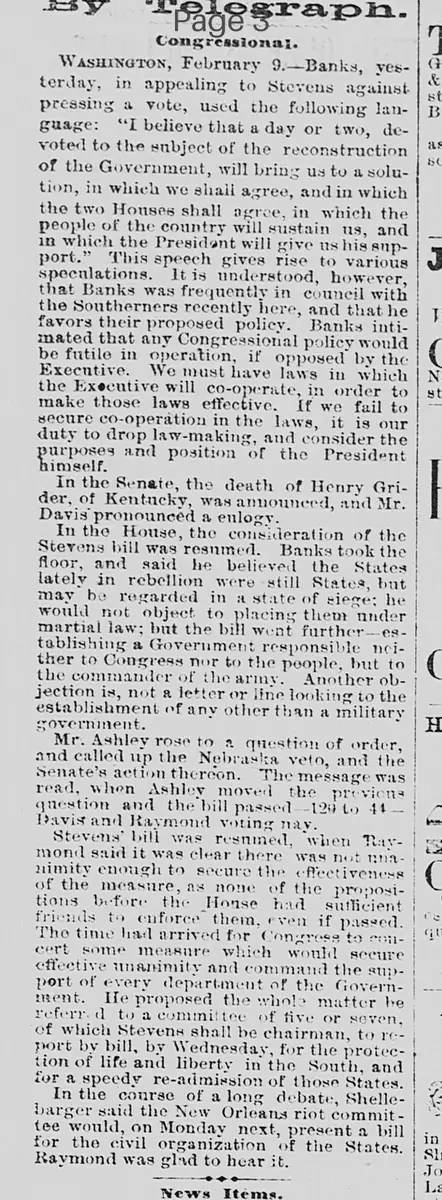
Washington, February 9.--Banks, yesterday, in appealing to Stevens against pressing a vote, used the following language: "I believe that a day or two, devoted to the subject of the reconstruction of the Government, will bring us to a solution, in which we shall agree, and in which the two Houses shall agree, in which the people of the country will sustain us, and in which the President will give us his support." This speech gives rise to various speculations. It is understood, however, that Banks was frequently in council with the Southerners recently here, and that he favors their proposed policy. Banks intimated that any Congressional policy would be futile in operation, if opposed by the Executive. We must have laws in which the Executive will co-operate, in order to make those laws effective. If we fail to secure co-operation in the laws, it is our duty to drop law-making, and consider the purposes and position of the President himself.
In the Senate, the death of Henry Grider, of Kentucky, was announced, and Mr. Davis pronounced an eulogy.
In the House, the consideration of the Stevens bill was resumed. Banks took the floor, and said he believed the States lately in rebellion were still States, but may be regarded in a state of siege: he would not object to placing them under martial law: but the bill went further--establishing a Government responsible neither to Congress nor to the people, but to the commander of the army. Another objection is, not a letter or line looking to the establishment of any other than a military government.
Mr. Ashley rose to a question of order, and called up the Nebraska veto, and the Senate's action thereon. The message was read, when Ashley moved the previous question and the bill passed--120 to 44--Davis and Raymond voting nay.
Stevens' bill was resumed, when Raymond said it was clear there was not unanimity enough to secure the effectiveness of the measure, as none of the propositions before the House had sufficient friends to enforce them, even if passed. The time had arrived for Congress to concert some measure which would secure effective unanimity and command the support of every department of the Government. He proposed the whole matter be referred to a committee of five or seven, of which Stevens shall be chairman, to report by bill, by Wednesday, for the protection of life and liberty in the South, and for a speedy re-admission of those States.
In the course of a long debate, Shellabarger said the New Orleans riot committee would, on Monday next, present a bill for the civil organization of the States. Raymond was glad to hear it.
What sub-type of article is it?
What themes does it cover?
What keywords are associated?
What entities or persons were involved?
Where did it happen?
Story Details
Key Persons
Location
Washington
Event Date
February 9
Story Details
Debates in Congress on reconstruction of Southern states, including Banks' appeal for delay and Executive cooperation, eulogy for Grider, criticisms of Stevens' bill, passage of Nebraska bill overriding veto, Raymond's proposal for a special committee, and upcoming New Orleans riot committee bill.