Thank you for visiting SNEWPapers!
Sign up free
Editorial
August 1, 1905
Evening Times Republican
Marshalltown, Marshall County, Iowa
What is this article about?
Editorial praises Cardinal Gibbons' view that press exposure prevents corruption by safeguarding reputations, but warns of the risk of sensationalism turning into scandal-mongering. Emphasizes honest publicity's role in protecting the public while cautioning against excess.
Clipping
OCR Quality
98%
Excellent
Full Text
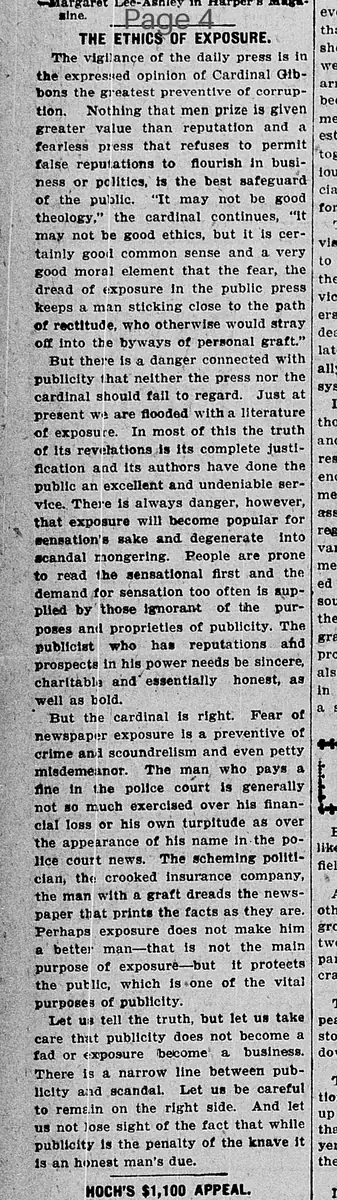
THE ETHICS OF EXPOSURE.
The vigilance of the daily press is, in the expressed opinion of Cardinal Gibbons, the greatest preventive of corruption. Nothing that men prize is given greater value than reputation and a fearless press that refuses to permit false reputations to flourish in business or politics, is the best safeguard of the public. "It may not be good theology," the cardinal continues, "it may not be good ethics, but it is certainly good common sense and a very good moral element that the fear, the dread of exposure in the public press keeps a man sticking close to the path of rectitude, who otherwise would stray off into the byways of personal graft."
But there is a danger connected with publicity that neither the press nor the cardinal should fail to regard. Just at present we are flooded with a literature of exposure. In most of this the truth of its revelations is its complete justification and its authors have done the public an excellent and undeniable service. There is always danger, however, that exposure will become popular for sensation's sake and degenerate into scandal mongering. People are prone to read the sensational first and the demand for sensation too often is supplied by those ignorant of the purposes and proprieties of publicity. The publicist who has reputations and prospects in his power needs be sincere, charitable and essentially honest, as well as bold.
But the cardinal is right. Fear of newspaper exposure is a preventive of crime and scoundrelism and even petty misdemeanor. The man who pays a fine in the police court is generally not so much exercised over his financial loss or his own turpitude as over the appearance of his name in the police court news. The scheming politician, the crooked insurance company, the man with a graft dreads the newspaper that prints the facts as they are. Perhaps exposure does not make him a better man—that is not the main purpose of exposure but it protects the public, which is one of the vital purposes of publicity.
Let us tell the truth, but let us take care that publicity does not become a fad or exposure become a business. There is a narrow line between publicity and scandal. Let us be careful to remain on the right side. And let us not lose sight of the fact that while publicity is the penalty of the knave it is an honest man's due.
The vigilance of the daily press is, in the expressed opinion of Cardinal Gibbons, the greatest preventive of corruption. Nothing that men prize is given greater value than reputation and a fearless press that refuses to permit false reputations to flourish in business or politics, is the best safeguard of the public. "It may not be good theology," the cardinal continues, "it may not be good ethics, but it is certainly good common sense and a very good moral element that the fear, the dread of exposure in the public press keeps a man sticking close to the path of rectitude, who otherwise would stray off into the byways of personal graft."
But there is a danger connected with publicity that neither the press nor the cardinal should fail to regard. Just at present we are flooded with a literature of exposure. In most of this the truth of its revelations is its complete justification and its authors have done the public an excellent and undeniable service. There is always danger, however, that exposure will become popular for sensation's sake and degenerate into scandal mongering. People are prone to read the sensational first and the demand for sensation too often is supplied by those ignorant of the purposes and proprieties of publicity. The publicist who has reputations and prospects in his power needs be sincere, charitable and essentially honest, as well as bold.
But the cardinal is right. Fear of newspaper exposure is a preventive of crime and scoundrelism and even petty misdemeanor. The man who pays a fine in the police court is generally not so much exercised over his financial loss or his own turpitude as over the appearance of his name in the police court news. The scheming politician, the crooked insurance company, the man with a graft dreads the newspaper that prints the facts as they are. Perhaps exposure does not make him a better man—that is not the main purpose of exposure but it protects the public, which is one of the vital purposes of publicity.
Let us tell the truth, but let us take care that publicity does not become a fad or exposure become a business. There is a narrow line between publicity and scandal. Let us be careful to remain on the right side. And let us not lose sight of the fact that while publicity is the penalty of the knave it is an honest man's due.
What sub-type of article is it?
Moral Or Religious
Press Freedom
Crime Or Punishment
What keywords are associated?
Press Ethics
Exposure
Corruption Prevention
Scandal Mongering
Publicity
Reputation
What entities or persons were involved?
Cardinal Gibbons
Daily Press
Editorial Details
Primary Topic
Ethics Of Press Exposure In Preventing Corruption
Stance / Tone
Supportive With Caution Against Scandal
Key Figures
Cardinal Gibbons
Daily Press
Key Arguments
Vigilance Of Press Prevents Corruption By Valuing Reputation
Fear Of Exposure Keeps Individuals On Path Of Rectitude
Literature Of Exposure Serves Public But Risks Sensationalism
Exposure Deters Crime And Protects Public
Publicity Must Avoid Becoming Scandal Or Business