Thank you for visiting SNEWPapers!
Sign up free
Virginia Argus
Richmond, Virginia
What is this article about?
Editorial urges U.S. House of Representatives to approve Mr. Giles' resolution, passed by the Senate, endorsing President Jefferson's conduct toward Mr. Jackson to demonstrate governmental unity on foreign relations matters.
Clipping
OCR Quality
Full Text
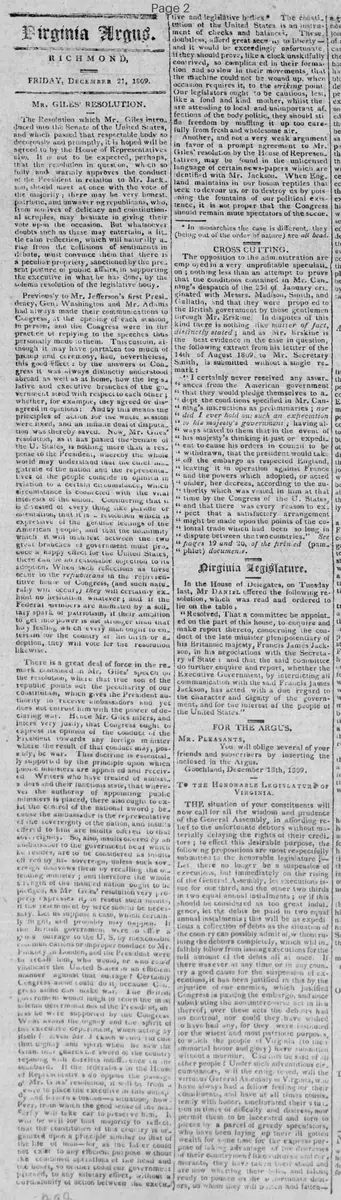
The Resolution which Mr. Giles introduced into the Senate of the United States, and which passed that respectable body so decorously and promptly, it is hoped will be agreed to by the House of Representatives also. It is not to be expected, perhaps, that the resolution in question, which so fully and warmly approves the conduct of the President in relation to Mr. Jackson, should meet at once with the vote of the majority; there may be very honest, patriotic, and unwavering republicans, who, from motives of delicacy and constitutional scruples, may hesitate in giving their vote upon the occasion. But whatsoever doubts such as these may entertain, a little calm reflection, which will naturally arise from the collisions of sentiments in debate, must convince them that there is a peculiar propriety, sanctioned by the present posture of public affairs, in supporting the executive in what he has done, by the solemn resolution of the legislative body.
Previously to Mr. Jefferson's first Presidency, Gen. Washington and Mr. Adams had always made their communications to Congress, at the opening of each session, in person, and the Congress were in the practice of replying to the speeches thus personally made to them. This custom, although it may have partaken too much of princely and ceremony, had, nevertheless, this good effect: by the answers of Congress it was always distinctly understood abroad as well as at home, how the legislative and executive branches of the government stood with respect to each other; whether, for example, they agreed or disagreed in opinions: And by this means the principles of action for the whole session were fixed, and an infinite deal of disputation was thereby saved. Now, Mr. Giles' resolution, as it has passed the Senate of the U. States, is nothing more than a response to the President, whereby the whole world may understand that the chief magistrate of the nation and the representatives of the people coincide in opinion in relation to a certain circumstance, which circumstance is connected with the vital interests of the union. Considering that it is divested of every thing like parade or ostentation, that it is a resolution which is expressive of the genuine feelings of the American people, and that the unanimity which it will manifest between the two great branches of government must produce a happy effect for the United States, there can be no reasonable objection to its adoption. When such reflections as these occur to the republicans in the representative house of Congress, (and such naturally will occur,) they will certainly exhibit no hesitation whatever; and if the Federal members are animated by a solitary spark of patriotism, if their ambition to get into power is not stronger than that holy feeling which every man ought to entertain for the country of his birth or adoption, they will vote for the resolution likewise.
There is a great deal of force in the remark contained in Mr. Giles' speech on the resolution, where that true son of the republic points out the peculiarity of our constitution, which gives the President authority to receive ambassadors and yet does not entrust him with the power of declaring war. Hence Mr. Giles infers, and infers very justly, that Congress ought to express its opinion of the conduct of the President towards any foreign minister where the result of that conduct may, possibly, be war. This doctrine is essentially supported by the principle upon which public ministers are appointed and received. Writers who have treated of ambassadors and their functions state, that wherever the authority of appointing public ministers is placed, there also ought to exist the control of the national sword; because the ambassador is the representative of the sovereignty of the nation, and insults offered to him are insults offered to that sovereignty. So, also, insults offered by an ambassador to the government near which he resides, are to be considered as insults received by his sovereign, unless such sovereign disavows them by recalling the offending minister; and therefore the whole strength of the insulted nation ought to be pledged, as Mr. Giles' resolution very properly expresses it, to resent such insults, in the presentment by force should be necessarily. Let us suppose a case, which certainly might, and probably may happen. If the British government were to offer a gross outrage to the U. S. by inexcusable communications or improper conduct to Mr. Pinkney in London, and the President were to recall him, who would, or who could vindicate the United States in an efficient manner against that outrage? Certainly Congress alone could do it because Congress alone can make war. The British government would laugh to scorn the most solemn determinations of the President, unless he were supported by the Congress. What avails the dignity and the spirit of the executive department, when acting by itself? Such Mr. Jefferson would ruin quite that dignity and spirit when he saw the giant, the guards, the sword of the country reposing in Caliban's indifference on his scapegoat. If the federalists in the House of Representatives do oppose the passage of Mr. Giles' resolution, it will be from an eager to place the executive in that false dilemma and ignominious situation, however, from which the good sense of the nation will take care to preserve him. It was too well for that majority to reflect, that the constitution of this country is organized upon a principle similar to that of the late of magistrate as the latter could not exist to any efficient purpose without the combined deliberations of the head and the heart, so neither could our government persevere, to any salutary effect, without a conformity of action between the executive and legislative bodies. The constitution of the United States is an instrument of checks and balances. These, doubtless, afford great security to liberty—and it would be exceedingly unfortunate, if they should prove, like a clock unskilfully contrived, so complicated in their formation and so slow in their movements, that the machine could not be wound up, when occasion requires it, to the striking point. Our legislators ought to be cautious, lest, like a fond and kind mother, whilst they are attending to local and unimportant affections of the body politic, they should stifle freedom by muffling it up too carefully from fresh and wholesome air.
Another, and not a very weak argument in favor of a prompt agreement to Mr. Giles' resolution by the House of Representatives, may be found in the unlicensed language of certain newspapers which are identified with Mr. Jackson. When England maintains in our bosom reptiles that seek to devour us, or to destroy us by poisoning the fountains of our political existence, it is not proper that the Congress should remain mute spectators of the scene. In monarchies the case is different, they (being out of the order of nature) are all head.
What sub-type of article is it?
What keywords are associated?
What entities or persons were involved?
Where did it happen?
Domestic News Details
Primary Location
United States
Key Persons
Outcome
resolution passed the senate; urged for house approval to affirm support for president's actions and promote governmental unity.
Event Details
Mr. Giles introduced a resolution in the U.S. Senate approving the President's conduct regarding Mr. Jackson, which passed promptly. The article argues for its adoption by the House of Representatives, emphasizing constitutional principles, historical precedents, and the need for executive-legislative alignment on foreign affairs to potentially avert war.