Thank you for visiting SNEWPapers!
Sign up free
The Virginia Gazette
Richmond, Williamsburg, Richmond County, Virginia
What is this article about?
In Letter VI to the people of Pennsylvania, Cato critiques Thomas Paine's 'Common Sense' for misinterpreting 1 Samuel 8 as a divine condemnation of monarchy, arguing that Scripture protests arbitrary rule, not monarchy itself, and supports limited monarchical government as in Britain, citing biblical passages, Grotius, and Sidney.
Merged-components note: This is a continuation of the same letter (Letter VI to the people of Pennsylvania, signed CATO) across pages, responding to Common Sense; relabeling the second part from editorial to letter_to_editor as it fits the debate/opinion letter format.
Clippings
1 of 2
OCR Quality
Full Text
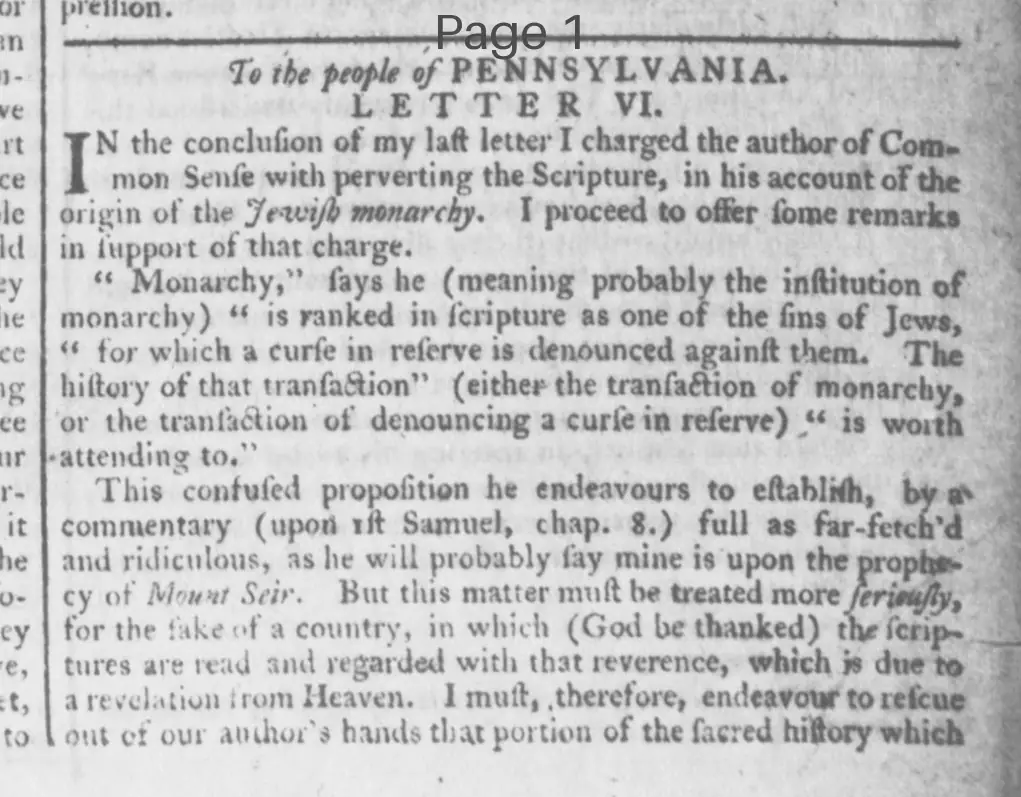
LETTER VI.
In the conclusion of my last letter I charged the author of Common Sense with perverting the Scripture, in his account of the origin of the Jewish monarchy. I proceed to offer some remarks in support of that charge.
"Monarchy," says he (meaning probably the institution of monarchy) "is ranked in scripture as one of the sins of Jews, for which a curse in reserve is denounced against them. The history of that transaction" (either the transaction of monarchy, or the transaction of denouncing a curse in reserve) "is worth attending to."
This confused proposition he endeavours to establish, by a commentary (upon it Samuel, chap. 8.) full as far-fetch'd and ridiculous, as he will probably say mine is upon the prophecy of Mount Seir. But this matter must be treated more seriously, for the sake of a country, in which (God be thanked) the scriptures are read and regarded with that reverence, which is due to a revelation from Heaven. I must, therefore, endeavour to rescue out of our author's hands that portion of the sacred history which
he has converted into a libel against the civil constitution of Great
Britain; and show in what sense the passage has been universally
received, as well by the Jews themselves, as by Commentators,
venerable for their piety and learning, in every christian country.
The Jews were long privileged with a peculiar form of govern-
ment, called a Theocracy, under which the Almighty either
stirred up some person, by an immediate signification of his will,
to be their judge, or, when there was none, ruled their pro-
ceedings himself, by Urim and Thummim, directing what
course they were to follow in the public concerns of the na-
tion."
But they were of an ungovernable temper, fond of pomp as
well as dominion over their neighbours; and being disgusted with
the misconduct of Samuel's sons, whom, in his old age, he had
made his assistant judges over Israel, they came to him, and en-
treated him to appoint a King, who might rule their nation, and
avenge them of the Philistines, Samuel, deeply afflicted at the
impious design they entertained of rejecting the divine govern-
ment, prays the Almighty for direction who authorises him to
hearken to their voice, for they have not rejected thee, but they have
rejected me (Says God) that I should not reign over them. He also
instructs Samuel to enter a solemn protest against them for their
folly and ingratitude, in preferring a human to a divine govern-
ment; and to show them the manner of the King that shall reign
over them, since they desired a King to judge them like all the nations.
Now, all the nations, which they knew, were ruled by Kings,
whose ARBITRARY WILL stood in the place of LAW; and it
appears also that the Jews, since the day that they were brought
out of Egypt, had still retained a particular hankering after the
customs of that country, The Almighty therefore, by his Pro-
phet; not only signifies his displeasure against all such arbitrary
rulers, but against every people who would impiously and foolishly
prefer such a government to one immediately under himself, where,
in his providence, he might think fit to appoint such a one. And
I have no difference with our author, But Samuel proceeds
further to reason with the Jews, and in the 12th chapter reminds
them of the many deliverances which God had given them by the
hands of their Judges, Moses, Jepthah, Gideon, &c. having
with a strong hand brought them out of Egypt; having subdued
the Assyrians, Ammonites, Moabites, and Philistines before
them; and that, for all this, they preferred a government, even
after the most corrupt models, to his just and righteous govern-
ment, And, to convince them still further of their folly and
ingratitude, the Prophet appeals to a signal which he would give
them from Heaven. He accordingly calls down an uncommon
storm in the midst of harvest, and the astonished multitude cry
OUT—WE HAVE ADDED TO OUR SINS THIS EVIL TO ASK US
A KING.
Here our author erects his standard, and here he compliments
himself with the mockery of triumph. "These portions of scrip-
ture (says he, in all the assurance of infallibility) are direct
and positive. They admit of no equivocal construction. That
the Almighty hath here entered his protest against MONAR-
CHIAL GOVERNMENT is true, or the scripture is false." But
I will take the liberty to say, that the scripture is true, and that
this author's inference is horribly false; nay, further, that from
the whole spirit of the passage, as well as the reason of things, it
is to be inferred that the Almighty would have as strongly expres-
sed his displeasure against the Jews, had they rejected his govern-
ment for one of their own appointment, whether it had been
monarchical or democratical—to be administered by one man or a
thousand men.
The author had said before, that Samuel did not shew the man-
ner of any "particular King, but the general manner of the Kings
of the earth, whom Israel was so eagerly copying after." If
he means to confine himself to these Kings, I have given them to
him, to make the best of them. But if he means to argue from
particulars to generals, and to make the old Prophet extend his
protest against all future monarchical governments, such as were to
subsist some thousands of years afterwards, however limited and
mixt, particularly that of Great Britain (which must certainly
be our author's meaning, or he proves nothing to his purpose)
I say then, if this be his meaning, I cannot so easily part with
him. For in this lies our whole difference, and the particular
case of the Jews cannot be applied to any other nation, in this
instance, as none else was ever in similar circumstances.
ARCHERLEY, in his Britannic constitutions (and I think our
author borrows some of his principles, where they can serve his
purpose) says expressly, "That the nations round about Israel
invested their Kings with absolute power and that it is a wild
imagination to say, that the Israelitish Kings, who were but
copies (of these Kings) should, either in their election or
power, be a pattern to Great Britain." "There cannot be
found, either in the Old or New Testament, any particular
description of the race of men, which are or ever were Kings of
this nation." How then can there be a scripture protest against
a race of men, who are not even described in Scripture? Mark
that, Common Sense
Let me add one authority more, from a commentator at least
as good as our author, and who, nevertheless, flatly contradicts
him—I mean the celebrated GROTIUS. He tells us that Samuel,
in this passage, does not speak of what our author calls the "ge-
neral manner of Kings," or the just and honest right of a King
to do such things; because his right is otherwise described else.
where, as shall be shewn. The Prophet also speaks of such a
right as the Kings round about Israel had acquired, which was
not a true right; for such is not the signification of the original
word Mishpat, but such an action as (being founded in might
and violence) hath the effectum juris, or comes in the place of
right.
Grotius, I fear, is too learned for us inferior writers (Script-
tores minorum gentium) to follow him in this place, But SIDNEY,
that great martyr to liberty, adopts the same explanation. "Sa-
muel's words, says he, are acknowledged by all interpreters,
who were not malicious or mad, to be a dissuasion of the Jews
from their wicked purpose; not a description of what a King
might justly do, by virtue of his office, but what those, who
should be set up against God and his law, would do when they
should have the power in their hands."
Both Grotius and Sidney are well warranted in this interpreta-
tion, not only by the Hebrew text, but other clear passages of
scripture, and particularly the 17th chapter of Deuteronomy,
where, with the approbation of Heaven, the duty of a good King
is described and limited. The Jews commonly understood this
chapter as containing an absolute promise from Heaven of a roy-
al government, and a sufficient authority for the request made to
Samuel more than three hundred years afterwards, Others un-
derstood it conditionally, that if they did reject the divine go-
vernment, and set up one of their own appointment, God would
permit them, but their King should be chosen in the manner, and
with the qualifications, in that chapter described, All this, how-
ever, was disregarded, when they asked an arbitrary King, like
those of their neighbouring nations; and therefore, it is demon-
stratively certain that Samuel, in entering his protest against such
Kings, did not protest against Kings or monarchical governments
generally. Either this remark is true, or one part of scripture is
a direct contradiction to the other. But let the passage to which I
refer speak for itself.
Lord's Commentaries
"Mark that, Cato," is a favourite expression of our autbo-
in the character of the Forester.
When thou art come unto the land which the Lord thy God giveth
thee, and shalt say, I will set a King over me, such as all the nations
that are about me; thou shalt in any-wise set him King over thee,
whom the Lord thy God shall choose, one from among thy brethren,
not a stranger, &c. It is further directed, that he shall not be
given to covetousness,—nor multiply horses,—nor wives to himself
—nor greatly multiply to himself gold and silver.—That when he
shall sit upon the throne of his kingdom, he shall write a copy of the
law in a book (which it was understood he was to do with his own
hand.)—That this book shall be with him (or always carried
about him) and he shall read therein all the days of his life, that he
may learn to fear the Lord his God, to keep the words of the law,
and make it the rule of his government, as well as private life.
If he does this, God promises a blessing on his government, to
prolong his days in his kingdom, he, and his children, in the midst of
Israel. Does not this smell strong of monarchy, and even of here-
ditary monarchy? Is not some sort of approbation, yea and a
blessing, promised to both, when religiously administered, not-
withstanding all that this writer has said to the contrary?
But he has not the candour to compare scripture with scripture;
nor does he give a single passage compleat, and connected with
the parts necessary to explain it—a clear proof that other craft may
be employed, as well as King-craft and Priest craft, in " with-
holding the scripture from the people," even in Protestant coun-
tries, Had our author proceeded a little further, or given the
passages compleat as he went along, it would have appeared that,
notwithstanding the just displeasure of the Almighty, and his
protest against the Jews for throwing off his righteous government,
yet, as mercy and forgiveness are his chief delight, and he knows
that there is no perfection in man, the matter was pretty amicably
settled at last, and the divine countenance was given to the esta-
blishment of monarchy, even in the person of Saul. God himself
directed his election and appointment; and to prepare him for
his office, gave him another heart, and also the spirit of prophecy.
As to the thunder storm in which our author exults, as an ab-
solute disapprobation of all monarchical government, it was no
more than a sign called for by Samuel, to convince the people
that he spoke in the name of the Lord. But what did he speak' in
the verses immediately preceding? Not, surely, that God had a
particular quarrel with monarchical government, as such, and
that "blood would attend it;" but rather the contrary—that
since the Jews would still insist upon a government of their own
appointment, the Almighty would yet give them a blessing under
that very form, upon condition of their obedience to his law, If ye
will fear the Lord and serve him, and obey his voice, &c, then shall
both ye, and also the King that reigneth over you, continue following
the Lord; to which duty of following the Lord a blessing is always
promised in scripture. But if ye will not obey, &c, the hand of
the Lord shall be against you. So it would have been for disobe-
dience had they not asked a King! and, immediately after the
thunder storm, Samuel confirms this doctrine, and comforts the
people, Fear not, said he; although you have sinned, the Lord
will not forsake His PEOPLE. As for me, God forbid that I should
sin against the Lord and cease to pray for you. But I will instruct you
in the good and right way. Thus, it seems a good and right
way was yet to be found under monarchical government, From
all which it is plain that the Almighty had now pardoned the
Jews; and the prophet follows the example, promising still to
proceed in the discharge of his duty among them, as a people yet
in covenant with God. But, as I hinted before, it did not suit
our author's purpose to take notice of such passages as these; and
he has been guilty of still as great a perversion of scripture con-
cerning David, whom God undeniably approved of and appointed
to monarchical rule.
"The high encomium given to David, takes no notice of him
officially as a King, but only as a man after God's own heart."
I know the poor equivocation which the author has here in reserve
to offer, for his saying that this character was not given to David
officially as a King, but as a man, It is true, that when Samuel
first applied the character to David, he had not yet entered on his
office; but when it was predicted that the Kingdom should not be
continued in the family of Saul, because he had violated the law,
and intruded himself into the Priest's duty, which did not belong
to him; the Prophet tells him, that the Lord hath sought him a man
after his own heart, with the express design of making him the
successor of Saul, on account of his excellent and God. like dis.
position. The Lord hath commanded him (this man after his own
heart) to be Captain over his people, because THOU [Saul] hast
not kept that which the Lord commanded thee. That one man is
here rejected from being a King, because of his disobedience to
God, and another chosen as his successor, because of his good-
ness of heart, and regard to religion, "is true, or scripture is
false." But one greater than Samuel, even St. PAUL, puts this
beyond all doubt, and appropriates the encomium to David not
merely as a King elect,' but one actually exercising the office.
"When he had removed him (Says the Apostle, meaning Saul)
he raised up unto them David, to be their King, to whom also he
gave testimony and said, I have found David, the son of Jesse, a
man after mine own heart, which shall fulfil all my will," name-
ly, in his character of a King.
Numerous are the passages of scripture which might be brought
to shew, that the Almighty approved of David officially as a King,
on account of his public virtues, and that a divine blessing was
given to the Jewish monarchy under his direction, The reader
may consult 2 Samuel, v, 19, 12,—viii. 6,—1 Kings, viii, 16—
Psalm lxxviii, 79, 71, 72 Psalm lxxxix, 20, 28.
I have now done with our author on this head, and can return
one of his polite expressions," I despise him" equally as a per-
verter of scripture, and of the fundamental principles of mixt
government. I am threatened with being "hunted from every
lane and lurking hole," Hunt on, I skulk in no such places, but
keep the open streets, "Wait a little," say others, Cato
will soon be found tripping, and stumbling upon Tory
Doctrine, the divine right of Kings, non-resistance, and
the like" Well, Gentlemen! wait patiently till it so hap-
pens; but let me, in the mean time, have fair play. I claim it
of the public, as being engaged in a cause which is of the utmost
importance to them, as well as to myself; and while I handle it
decently, I can rely on their candour, I have got over what
some may have viewed as the most thorny part of my way; and,
upon the whole matter, I contend for this—That where a people
are left to choose their own forms of government, as has been the case
of all the world for some thousand years, there is no particular de-
nunciation of God's displeasure against any FORM, whether O-
NARCHICAL or DEMOCRATICAL, under which such a people think
their civil happiness best secured, and their duty to God best performed.
Archerley shall again shelter me in this conclusion, which
is the main purport of the present letter, "Jesus Christ left
all the potentates of this world, and their subjects, to decide
their several rights by the temporal laws of each nation—and
never intimated WHAT FORM OF GOVERNMENT WAS CON-
VENIENT OR ELIGIBLE." This directly contradicts our au-
thor, who says that the Almighty has entered his protest against
the particular form of monarchy. Yet Archerley was a GOOD
Whig, and desired to leave scripture out of the institution of
modern governments. It might be well for the author of
Common Sense to follow the example, in his future works,
without stirring up an old dispute, of which our fathers were
long since wearied.
It has been asked, why does not Cato come to the point? He
is but yet in the suburbs. Softly, Gentlemen. If this be true,
why do you, who are in the citadel, make such a noise, and betray
such fears? Can you not let me pursue the siege in my own way?
I really thought that if I could sap, or overturn your founda-
tions, the aerial part of your fabric would tumble to the ground.
You call on me to shew my plan? I have done it, and mentioned,
as such, a safe return to a connection with our ancient friends and
kindred, accompanied with all the advantages we have formerly
experienced, and perhaps more; which, trust, are things yet
practicable; or if it should prove otherwise, we can lose nothing
by the exercise of deliberation and wisdom, in the mean while.
But what have you done? Although it was incumbent on you to
have shewn the advantages of your plan, to the great and respect.
able number of good men who will always be averse to changes,
except in the last necessity; although you ought to resolve their ho-
net doubts, concerning their future safety and peace, which
have been plentifully thrown out to you; in short, although you
ought to have counted the cost of your work, and have tried to re.
concile, with your design, a multitude of interests, commercial
political, and economical,—you have only entertained us with
Some loose declamations upon abuses in the English government ;
and shocked us, for want of better arguments, by a perversion
of things sacred; filling the papers with personal invectives and
calumnies against all who cannot swallow, at a venture, every
crude notion, which you may cook up, as the politics of the day.
This will as little agree with the stomachs of others as with mine;
although I have declared, that when the last necessity comes, I
have no expedient in view, but to take chance with you, for bet-
ter and for worse,
CATO.
What sub-type of article is it?
What themes does it cover?
What keywords are associated?
What entities or persons were involved?
Letter to Editor Details
Author
Cato
Recipient
To The People Of Pennsylvania.
Main Argument
scripture in 1 samuel does not condemn monarchy generally but arbitrary rule; paine perverts it to attack british monarchy; god approves limited monarchy when obedient to divine law, as seen in deuteronomy and david's reign.
Notable Details