Thank you for visiting SNEWPapers!
Sign up free
The Enquirer
Richmond, Henrico County, Virginia
What is this article about?
In late 1810, a House of Representatives committee reports favorably on a Senate bill to reinstate foreign gold and silver coins as legal tender in the US, recommending adjustments to rates based on mint assays to align with intrinsic values. Treasury Secretary Albert Gallatin provides detailed analysis and suggestions to prevent depreciation and address prior overvaluations, particularly for Spanish gold.
Merged-components note: Continuation of congressional report on foreign coins; relabel second part from notice to domestic_news.
Clippings
1 of 2
OCR Quality
Full Text
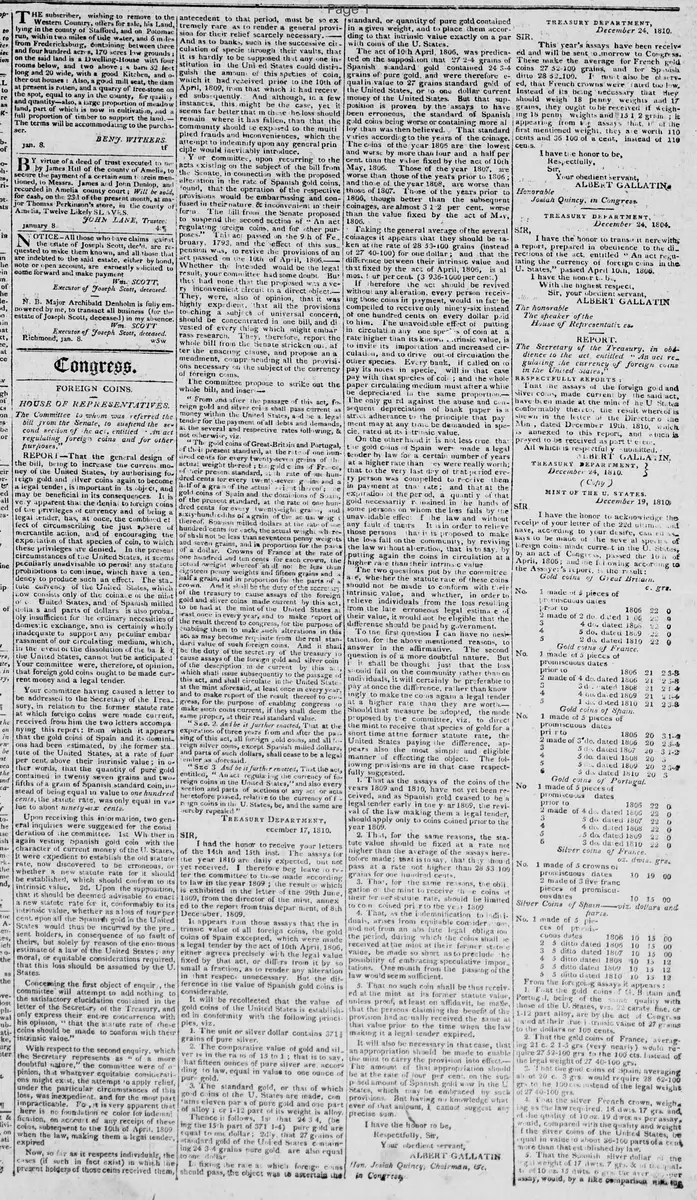
FOREIGN COINS.
HOUSE OF REPRESENTATIVES.
The Committee to whom was referred the bill from the Senate, to suspend the second section of the act, entitled "an act regulating foreign coins and for other purposes."
REPORT--That the general design of the bill, being to increase the current money of the United States, by authorising foreign gold and silver coins again to become a legal tender, is important in its object, and may be beneficial in its consequences. It is very apparent that the denial to foreign coins of the privileges of currency and of being a legal tender, has, at once, the combined effect of circumscribing the just sphere of mercantile action, and of encouraging the exportation of that species of coin, to which these privileges are denied. In the present circumstances of the United States, it seems peculiarly unadvisable to permit any statute prohibitions to continue, which have a tendency to produce such an effect. The statute currency of the United States, which now consists only of the coinage of the mint of United States, and of Spanish milled dollars and parts of dollars is also probably insufficient for the ordinary necessities of domestic exchange, and is certainly wholly inadequate to support any peculiar embarrassment of our circulating medium, which, in the event of the dissolution of the bank of the United States, cannot but be anticipated.
Your committee were, therefore, of opinion, that foreign gold coins ought to be made current money and a legal tender.
Your Committee having caused a letter to be addressed to the Secretary of the Treasury, in relation to the former statute rate at which foreign coins were made current, received from him the two letters accompanying this report: from which it appears that the gold coins of Spain and its dominions had been estimated, by the former statute of the United States, at a rate of four per cent, above their intrinsic value; in other words, that the quantity of pure gold contained in twenty seven grains and two-fifths of a grain of Spanish standard coin, instead of being equal in value to one hundred cents, the statute rate, was only equal in value to about ninety-six cents.
Upon receiving this information, two general inquiries were suggested for the consideration of the committee. 1st Whether in again vesting Spanish gold coin with the character of current money of the U. States, it were expedient to establish the old statute rate, now discovered to be erroneous, or whether a new statute rate for it should be established, which should conform to its intrinsic value. 2d. Upon the supposition, that it should be deemed advisable to enact a new statute rate for it, conformably to its intrinsic value, whether as a loss of four per cent upon all the Spanish gold in the United States would thus be incurred by the present holders, in consequence of no fault of theirs, but solely by reason of the erroneous estimate of a law of the United States; any moral, or equitable considerations required, that this loss should be assumed by the U. States.
Concerning the first object of enquiry, the committee will attempt to add nothing to the satisfactory elucidation contained in the letter of the Secretary of the Treasury, and only express their entire concurrence with his opinion, "that the statute rate of these coins should be made to conform with their intrinsic value."
With respect to the second enquiry, which the Secretary represents as "of a more doubtful nature," the committee were of opinion, that whatever equitable considerations might exist, the attempt to apply relief, under the particular circumstances of this loss, was inexpedient, and for the most part impracticable. For, it is very apparent that there is no foundation or color for indemnification, on account of any receipt of these coins, subsequent to the 10th of April, 1809 when the law, making them a legal tender, expired.
Now, so far as it respects individuals, the cases (if such in fact exist) in which the present holders of those coins received them, antecedent to that period, must be so extremely rare as to render a general provision for their relief scarcely necessary.-- And as to banks, such is the successive circulation of specie through their vaults, that it is hardly to be supposed that any one institution in the United States could distinguish the amount of this species of coin, which it had received prior to the 10th of April, 1809, from that which it had received subsequently.: And although, in a few instances, this might be the case, yet it seems far better that in these the loss should remain where it has fallen, than that the community should be exposed to the multiplied frauds and inconveniences, which the attempt to indemnify upon any general principle would inevitably introduce.
Your committee, upon recurring to the acts existing on the subject of the bill from the Senate, in connection with the proposed alteration in the rate of Spanish gold coins, found, that the operation of the respective provisions would be embarrassing and confused in their nature, & inconvenient in their form. The bill from the Senate proposed to suspend the second section of "An act regulating foreign coins, and for other purposes,"
This act passed on the 9th of February, 1793, and the effect of this suspension was, to revive the provisions of an act passed on the 10th of April, 1806.-- Whether the intended would be the legal result, your committee had some doubt. But they had none that the proposed was a very inconvenient circuit to a direct object.-- They were, also of opinion, that it was highly expedient, that all the provisions touching a subject of universal concern, should be concentrated in one bill, and divested of every thing which might embarrass research. They, therefore, report the whole bill from the Senate stricken out, after the enacting clause, and propose an amendment, comprehending all the provisions necessary on the subject of the currency of foreign coins.
The committee propose to strike out the whole bill, and insert--
"From and after the passage of this act, foreign gold and silver coins shall pass current as money within the United States, and be a legal tender for the payment of all debts and demands, at the several and respective rates following, & not otherwise, viz.
"The gold coins of Great-Britain and Portugal, of this present standard, at the rate of one hundred cents for every twenty-seven grains of the actual weight thereof: the gold coins of France, of their present standard, at the rate of one hundred cents for every twenty-seven grains and a half of a grain of the actual weight thereof; the gold coins of Spain and the dominions of Spain, of the present standard, at the rate of one hundred cents for every twenty-eight grains, and sixty-hundredths of a grain of the actual weight thereof. Spanish milled dollars at the rate of one hundred cents for each, the actual weight whereof shall not be less than seventeen penny weights and seven grains, and in proportion for the parts of a dollar. Crowns of France at the rate of one hundred and ten cents for each crown, the actual weight whereof shall not be less than eighteen penny weights and fifteen grains and a half a grain, and in proportion for the parts of a crown.
And it shall be the duty of the secretary of the treasury to cause assays of the foreign gold and silver coins made current by this act, to be had at the mint of the United States at least once in every year, and to make report of the result thereof to congress, for the purpose of enabling them to make such alterations in this act as may become requisite from the real standard value of such foreign coins. And it shall be the duty of the secretary of the treasury to cause assays of the foreign gold and silver coin of the description made current by this act, which shall issue subsequently to the passage of this act, and shall circulate in the United States at the mint aforesaid, at least once in every year, and to make report of the result thereof to congress, for the purpose of enabling congress to make such coins current, if they shall deem the same proper, at their real standard value.
"Sec. 2. And be it further enacted, That at the expiration of three years from and after the passing of this act, all foreign gold coins, and all foreign silver coins, except Spanish milled dollars, and parts of such dollars, shall cease to be a legal tender as aforesaid.
"Sec. 3. And be it further enacted, That the act, entitled, "An act regulating the currency of foreign coins in the United States," and also every section and parts of sections of any act or acts heretofore passed, relative to the currency of foreign coins in the U. States, be, and the same are hereby repealed"
Treasury Department,
December 17, 1810.
SIR,
I had the honor to receive your letters of the 14th and 15th inst. The assays for the year 1810 are daily expected, but not yet received. I therefore beg leave to refer the committee to those made according to law in the year 1809; the result of which is exhibited in the letter of the 29th June, 1809, from the director of the mint, annexed to the report from this department, of 8th December, 1809.
It appears from those assays that the intrinsic value of all foreign coins, the gold coins of Spain excepted, which were made a legal tender by the act of 10th April, 1806, either agrees precisely with the legal value fixed by that act, or differs from it by so small a fraction, as to render any alteration in that respect unnecessary. But the difference in the value of Spanish gold coins is considerable.
It will be recollected that the value of gold coins of the United States is established in conformity with the following principles, viz.
1. The unit or silver dollar contains 371 1/4 grains of pure silver.
2. The comparative value of gold and silver is in the ratio of 15 to 1; that is to say, that fifteen ounces of pure silver are, according to law, equal in value to one ounce of pure gold.
3. The standard gold, or that of which gold coins of the U. States are made, contains eleven parts of pure gold and one part of alloy; or 1/12 part of its weight is alloy.
Thence it follows. 1st that 24 3/4, (being the 15th part of 371 1/4) pure gold are equal to one dollar; 2dly, that 27 grains of standard gold of the United States containing 24 3/4 grains pure gold are also equal to one dollar.
In fixing the rate at which foreign Coins should pass, the object was to ascertain the standard, or quantity of pure gold contained in a given weight, and to place them according to that intrinsic value exactly on a par with coins of the U. States.
The act of 10th April, 1806, was predicated on the supposition that 27 2/4 grains of Spanish standard gold contained 24 3/4 grains of pure gold, and were therefore equal in value to 27 grains standard gold of the United States, or to one dollar current money of the United States. But that supposition is proven by the assays to have been erroneous, the standard of Spanish gold coins being worse or containing more alloy than was then believed. That standard varies according to the years of the coinage. The coins of the year 1806 are the lowest and worse by more than four and a half per cent. than the value fixed by the act of 10th May, 1806. Those of the year 1807, are worse than those of the years prior to 1806; and those of the year 1808, are worse than those of 1807. Those of the years prior to 1806, though better than the subsequent coinages, are almost 3 1/2 per cent. worse than the value fixed by the act of May, 1806.
Taking the general average of the several coinages it appears that they should be taken at the rate of 28 53/100 grains (instead of 27 40/100) for one dollar; and that the difference between their intrinsic value and that fixed by the act of April, 1806, is almost four percent. (3 936/1000 per cent.)
If therefore the act should be revived without any alteration, every person receiving those coins in payment, would in fact be compelled to receive only ninety-six instead of one hundred cents on every dollar paid to him. The unavoidable effect of putting in circulation any one species of coin at a rate higher than its known intrinsic value, is to invite its importation and increased circulation, and to drive out of circulation the other species. Every bank, if called on to pay its notes in specie, will in that case pay with that species of coin; and the whole paper circulating medium must after a while be depreciated in the same proportion.--
The only guard against the abuse and consequent depreciation of bank paper is a strict adherence to the principle that payment may at any time be demanded in specie rated at its intrinsic value.
On the other hand it is not less true that the gold coins of Spain were made a legal tender by law for a certain number of years at a higher rate than they were really worth; that to the very last day of that period every person was compelled to receive them in payment at that rate: and that at the expiration of the period, a quantity of that gold necessarily remained in the hands of some persons on whom the loss falls by the unavoidable effect of the law and without any fault of theirs. It is in order to relieve those persons that it is proposed to make the loss fall on the community, by reviving the law without alteration, that is to say, by putting again the coins in circulation at a higher rate than their intrinsic value.
The two questions put by the committee are, whether the statute rate of these coins should not be made to conform with their intrinsic value, and whether, in order to relieve individuals from the loss resulting from the late erroneous legal estimate of their value, it would not be eligible that the difference should be paid by government.
To the first question I can have no hesitation, for the above mentioned reasons, to answer in the affirmative. The second question is of a more doubtful nature. But if it shall be thought just that the loss should fall on the community rather than on individuals, it will certainly be preferable to pay at once the difference, rather than knowingly to make the coins again a legal tender at a higher rate than they are worth.--
Should that measure be adopted, the mode proposed by the committee, viz. to direct the mint to receive that species of gold for a short time at the former statute rate, the United States paying the difference, appears also the most simple and eligible manner of effecting the object. The following provisions are in that case respectfully suggested.
1. That as the assays of the coins of the years 1809 and 1810, have not yet been received, and as Spanish gold ceased to be a legal tender early in the year 1809, the revival of the law making them a legal tender, should apply only to coins coined prior to the year 1809.
2. That, for the same reasons, the statute value should be fixed at a rate not higher than the average of the assays heretofore made; that is to say, that they should pass at a rate not higher than 28 53/100 grains for one hundred cents.
3. That, for the same reasons, the obligation of the mint to receive the coins at their former statute rate, should be limited to coin coined prior to the year 1809.
4. That, as the indemnification to individuals, arises from equitable considerations, and not from an absolute legal obligation the period, during which the coins shall be received at the mint at their former statute value, be made so short as to preclude the possibility of embracing speculative importations. One month from the passing of the law would seem sufficient.
5. That no such coin shall be thus received at the mint at its former statute value, unless proof, at least on affidavit, be made, that the persons claiming the benefit of the provision had actually received the same at that value prior to the time when the law making it a legal tender expired.
It will also be necessary in that case, that an appropriation should be made to enable the mint to carry the provision into effect.-- The amount of that appropriation should be at the rate of four per cent. on the supposed amount of Spanish gold now in the U. States, which may be embraced by such provisions. But having no knowledge whatever of that amount, I cannot suggest any precise sum.
I have the honor to be,
Respectfully, Sir,
Your obedient servant,
ALBERT GALLATIN
Hon. Josiah Quincy, Chairman, &c. in Congress.
TREASURY DEPARTMENT,
December 24, 1810.
SIR,
This year's assays have been received and will be sent tomorrow to Congress.
These make the average for French gold coins 27 52/100 grains, and for Spanish ditto 28 52/100. I must also be of service, that French crowns were rated too low. Instead of its being necessary that they should weigh 18 penny weights and 17 grains, they ought to be received if weighing 18 penny weights and 15 1/2 grain; it appearing from the assays that, if of the first mentioned weight, they are worth 110 cents and 36/100 of a cent, instead of 110 cents.
I have the honor to be,
Respectfully,
Sir,
Your obedient servant,
ALBERT GALLATIN
Honorable Josiah Quincy, in Congress.
TREASURY DEPARTMENT,
December 24, 1809.
SIR,
I have the honor to transmit herewith, a report, prepared in obedience to the directions of the act, entitled "An act regulating the currency of foreign Coins in the U. States," passed April 10th, 1806.
I have the honor to be,
With the highest respect,
Sir, your obedient servant,
ALBERT GALLATIN
The honorable The speaker of the House of Representatives.
REPORT.
The Secretary of the Treasury, in obedience to the act, entitled "An act regulating the currency of foreign coins in the United States,"
RESPECTFULLY REPORTS:
That the assays of the foreign gold and silver coins, made current by the said act, have been made at the mint of the U. States conformably thereto. The result whereof is shown in the letter of the Director of the Mint, dated December 19th, 1810, which is annexed to this report, and which is prayed to be received as part thereof.
All which is respectfully submitted.
ALBERT GALLATIN
TREASURY DEPARTMENT,
December 24, 1810.
(Copy)
MINT OF THE U. STATES.
December 19, 1810
SIR
I have the honor to acknowledge the receipt of your letter of the 22d ult.. and have, according to your desire, caused assays to be made of the several species of foreign coin made current in the U. States, by an act of Congress, passed the 10th of April, 1806; and the following according to the Assayer's report. is the result:
Gold coins of Great Britain.
No. 1 made of 5 pieces of promiscuous dates prior to 1806 22 0 2
2 made of 2 do. dated 1806 22 0 2
3 4 do. dated 1807. 22 0 3
4 5 do. dated 1808 22 0 4
5 5 do. dated 1809 22 0 5
2 dated 1810 22 0 9
Gold coins of France.
No. 1 made of 5 pieces of promiscuous dates prior to 1806 21 2 3/8
2 made of 4 do. dated 1806 21 2 3/8
3 5 dated 1808 21 2 1/4
4 4 dated 1809 21 2 1/4
5 1 dated 1810 21 2 3/8
Gold coins of Spain,
No. 1 made of 5 pieces of promiscuous dates prior to 1806 20 3 1/8
2 made of 3 do. dated 1806 20 2 3/4
5 do. dated 1807. 20 3 1/2
5 do. dated 1808 20 3 1/2
5 do. dated 1809 20 2 3/8
3 do dated 1810 20 3
Gold coins of Portugal.
No. 1 made of 5 pieces of promiscuous dates prior to 1806 22 0
2 made of 4 do. dated 1806 22 0
3 5 do dated 1807 22 0
4 do. dated 1808 22 0
5 3 do. dated 1809 22 0
3 do. dated 1810 22 0
Silver coins of France.
oz. dwts. grs.
No. 1 made of 5 crowns of promiscuous dates 10 19 0
2 made of 3 five franc pieces of promiscuous dates 10 15 0
Silver Coins of Spain--viz. dollars and parts.
No. 1 made of 5 pieces of promiscuous dates 1806 10 15 0
2 5 ditto dated 1806 10 15 0
3 5 ditto dated 1807 10 15 0
4 5 ditto dated 1808 10 15 12
5 5 ditto dated 1809 10 15 12
5 5 ditto dated 1810 10 15 12
From the foregoing assays it appears :
1. That the gold Coins of G. Britain and Portugal, being of the same quality with those of the U. States, viz. 22 carats fine. or 1/12 part alloy, are by the act of Congress rated at their true intrinsic value of 27 grains to the dollar or 100 cents.
2. That the gold coins of France, averaging 21 c. 2 1/3 grs (very nearly) would require 27 52/100 grs to the 100 cts. Instead of the legal weight of 27 40/100 grs.
3. That the gold coins of Spain, averaging about 20 c. 3 grs. would require 28 62/100 grs. to the 100 cts, instead of the legal weight of 27 40/100 grs.
4. That the silver French crown, weighing as the law required. 18 dwts. 17 grs. and of the quality of 10 oz. 19 dwts. as per assay. would, Compared with the quality and weight of the silver Coins of the United States, be equal in value to about 36/100 parts of a cent more than that established by law.
5. That the Spanish silver dollar of the legal weight of 17 dwts. 7 grs. & of the quality of 10 oz. 15 dwts. 6 grs. the average per assay, would, by a like comparison with the silver coins of the U. States, pass at par, or 100 cents.
Silver coins of the U. S. be equal in value to about 23/100 part of a cent more than the value established by law.
It may, however, be observed, that the foreign silver coins, especially those that have been long in circulation, are seldom of the above weights; and therefore their value, as current by tale, will be generally less than that stated above.
I have the honor to be,
With great respect and esteem,
Your most ob't. serv't.
(Signed)
R. PATTERSON.
The hon. Albert Gallatin
Secretary of the Treasury
of the U. States.
What sub-type of article is it?
What keywords are associated?
What entities or persons were involved?
Where did it happen?
Domestic News Details
Primary Location
United States
Event Date
December 1810
Key Persons
Outcome
committee proposes revised bill to make foreign coins legal tender at intrinsic values, with annual assays; temporary relief for prior holders considered but deemed impracticable; prior laws repealed after three years except for spanish dollars.
Event Details
House committee reviews Senate bill to suspend section of 1793 act, reviving 1806 provisions on foreign coins as legal tender. Recommends new rates based on Treasury assays showing Spanish gold overvalued by 4%. Proposes comprehensive bill with specific rates for British, Portuguese, French, and Spanish coins, annual mint assays, and three-year limit.