Thank you for visiting SNEWPapers!
Sign up free
Republican Herald
Providence, Providence County, Rhode Island
What is this article about?
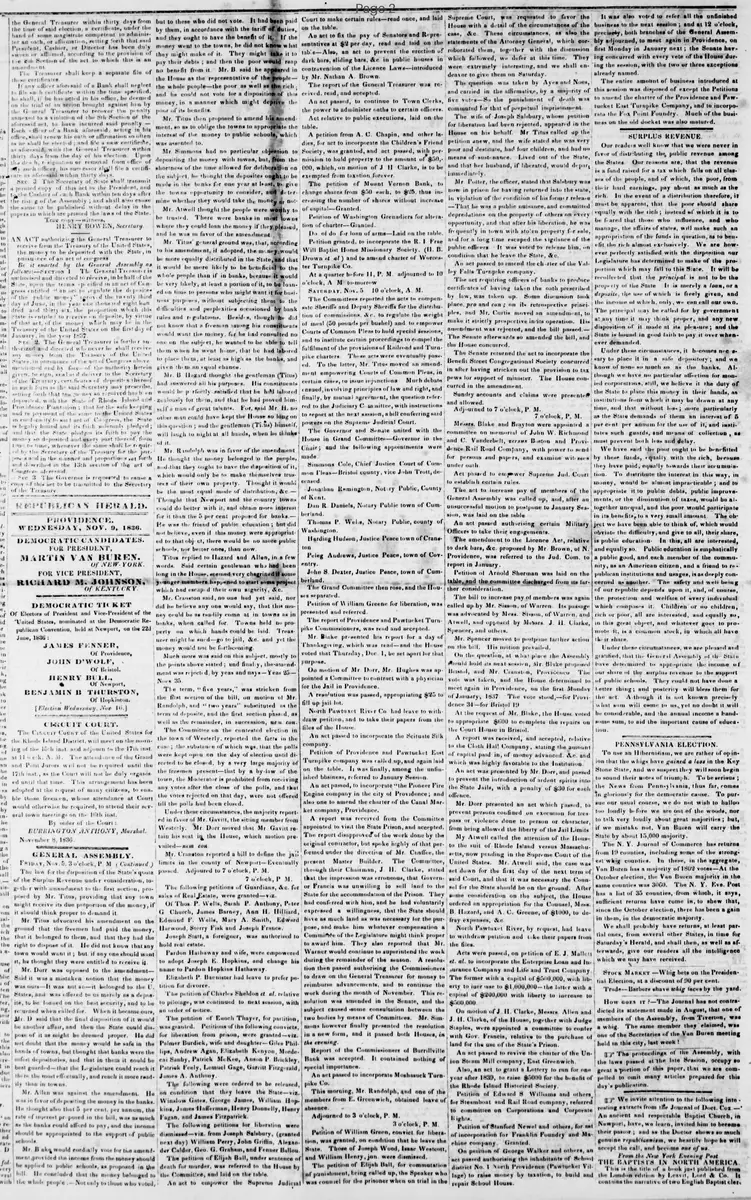
Transcript of Rhode Island General Assembly proceedings on November 5, 1836, including debate on surplus revenue distribution favoring banks over towns, rejection of amendment, handling of contested election, numerous petitions for liberations, incorporations, divorces, and appointments in Grand Committee, ending with adjournment to January 1837.
Merged-components note: These components form a continuous report on the General Assembly proceedings from Friday and Saturday sessions.
Clipping
OCR Quality
Full Text
Friday, Nov. 5, 3 o'clock, P. M. (Continued)
The law for the disposition of the State's quota of the Surplus Revenue under consideration, together with amendment to the first section, proposed by Mr. Titus, providing that any town might receive its due proportion of the money, if it should think proper to demand it.
Mr. Titus advocated his amendment on the ground that the freemen had paid the money, that it belonged to them, and that they had the right to dispose of it. He did not know that any town would want it; but, if any one should want it, he thought they were entitled to receive it.
Mr. Dorr was opposed to the amendment. Said it was a mistaken notion that the money was ours--It was not so--it belonged to the U. States, and was offered to us merely as a deposit, to be loaned on the best security, and to be returned when called for. When it became ours, Mr. D. said that the final disposition of it would be another affair, and then the State could dispose of it as might be deemed proper. He did not doubt that the money would be safe in the hands of towns, but thought that banks were the safest depositories, and that in them it could be best guarded--that the Legislature could reach it there the most effectually, and reach it more readily than in towns.
Mr. Allen was against the amendment. He was in favor of depositing the money in the banks. He thought also that 5 per cent. per annum, the rate of interest proposed in the bill, was as much as the banks could afford to pay, and the income should be appropriated to the support of public schools.
Mr. Blake would cordially vote for the amendment, provided the income from the money should be applied to public schools, as proposed in the bill. He concluded that the money belonged to the whole people--Not only to those who voted, but to those who did not vote. It had been paid by them, in accordance with the tariff of duties, and they ought to have the benefit of it. If the money went to the towns, he did not know what they might make of it. They might take it to pay their debts; and then the poor would reap no benefit from it. Mr. B. said he appeared in the House as the representative of the people--the whole people--the poor as well as the rich; and he could not vote for a disposition of this money, in a manner which might deprive the poor of its benefits.
Mr. Titus then proposed to amend his amendment, so as to oblige the towns to appropriate the interest of the money to public schools, which was assented to.
Mr. Simmons had no particular objection to depositing the money with towns, but, from the shortness of the time allowed for deliberation on the subject, he thought the deposits ought to be made in the banks for one year at least, to give the towns opportunity to consider, and determine whether they would take the money or not.
Mr. Atwell thought the people were worthy to be trusted. There were banks in most towns where they could loan the money if they pleased, and he was in favor of the amendment.
Mr. Titus' general ground was, that, according to his amendment, if adopted, the money would be more equally distributed in the State, and that it would be more likely to be beneficial to the whole people than if in banks, because it would be very likely, at least a portion of it, to be loaned on time to persons who might want it for business purposes, without subjecting them to the difficulties and perplexities occasioned by bank rules and regulations. Besides, though he did not know that a freeman among his constituents would want the money, for he had consulted no one on the subject, he wanted to be able to tell them when he went home, that he had labored to place them, at least as high as the banks, and given them an equal chance.
Mr. B. Hazard thought the gentleman (Titus) had answered all his purposes. His constituents would be perfectly satisfied that he had labored zealously for them, and that he had proved himself a man of great talents. For, said Mr. H., no other man could have kept the House so long on this question; and the gentleman (Titus) himself, will laugh to night at all hands, when he thinks of it.
Mr. Randolph was in favor of the amendment. He thought the money belonged to the people and that they ought to have the disposition of it, which would only be to make themselves trustees of their own property. Thought it would be the most equal mode of distribution, &c.--Thought that Newport and the country towns could do better with it, and obtain more interest for it than the 5 per cent proposed for banks.--He was the friend of public education; but did not believe, even if this money were appropriated to that object, there would be no more public schools, nor better ones, than now.
Titus replied to Hazard and Allen, in a few words. Said certain gentlemen who had been long in the House, seemed very chagrined if some younger members happened to start some project which had escaped their own sagacity, &c.
Mr. Cranston said, no one had yet said, nor did he believe any one would say, that this money could be as readily come at in towns as in banks, when called for. Towns held no property on which hands could be laid. Treasurer might be sued--go to jail, &c. and yet the money would not be forthcoming.
Much more was said on this subject, mostly to the points above stated; and finally, the amendment was rejected, by yeas and nays--Yeas 25--Noes 35.
The term, "five years," was stricken from the first section of the bill, on motion of Mr. Randolph, and "two years" substituted as the term of deposit, and the first section passed, as well as the remainder, in succession, nem con.
The Committee on the contested election in the town of Westerly, reported the facts in the case; the substance of which was, that the polls were kept open on the day of election until directed to be closed, by a very large majority of the freemen present--that by a by-law of the town, the Moderator is prohibited from receiving any votes after the close of the polls, and that the votes rejected on that day, were not offered till the polls had been closed.
Under these circumstances, the majority reported in favor of Mr. Gavitt, the sitting member from Westerly. Mr. Dorr moved that Mr. Gavitt retain his seat in the House, which motion prevailed--nem con.
Mr. Cranston reported a bill to define the jail limits in the county of Newport--Eventually passed. Adjourned to 7 o'clock. P. M.
7 o'clock, P M.
The following petitions of Guardians, &c. for sales of Real Estate, were granted--viz.
Of Thos. P. Wells, Sarah P. Anthony, Peter G. Church, James Barney, Ann H. Hilliard, Edmund F. Wells, Mary A. Smith, Edward Harwood, Sterry Fisk and Joseph France.
Joseph Statt, a foreigner, was authorised to hold real estate.
Pardon Hathaway and wife, were empowered to adopt Joseph E. Hopkins, and change his name to Pardon Hopkins Hathaway.
Elizabeth P. Bannister had leave to prefer petition for divorce.
The petition of Charles Sheldon et al. relative to pilotage, was continued to next session, with an order of notice.
The petition of Enoch Thayer, for partition, was granted. Petitions of the following convicts, for liberation from prison, were granted--viz. Palmer Burdick, wife and daughter--Giles Phillips, Andrew Agan, Elizabeth Kenyon, Mordecai Sanby, Patrick McKee, Anson P. Brickley, Patrick Feely, Lemuel Gage, Garritt Fitzgerald, James A. Anthony.
The following were ordered to be released on condition that they leave the State--viz. Winslow Gates, George James, William Hopkins, James Haffernan, Henry Donnelly, Henry Fagan, and James Fitzpatrick.
The following petitions for liberation were dismissed--viz. from Joseph Salsbury, (granted next day) William Perry, John Griffin, Alexander Calder, Geo. G. Graham, and Fenner Ballou.
The petition of Elijah Ball, under sentence of death for murder, was referred to the House by the Committee, and laid on the table.
An act to empower the Supreme Judicial Court to make certain rules--read once, and laid on the table.
An act to fix the pay of Senators and Representatives at 2$ per day, read and laid on the table--Also, an act to prevent the erection of dark bars, sliding bars, &c. in public houses in contravention of the Licence Laws--introduced by Mr. Nathan A. Brown.
The report of the General Treasurer was received, read, and accepted.
An act passed, to continue to Town Clerks, the power to administer oaths to certain officers.
Act relative to public executions, laid on the table.
A petition from A. C. Chapin, and other ladies, for act to incorporate the Children's Friend Society, was granted, and act passed, with permission to hold property to the amount of $50,000, which, on motion of J H Clarke, is to be exempted from taxation forever.
The petition of Mount Vernon Bank, to change shares from $50 each, to $25, thus increasing the number of shares without increase of capital--Granted.
Petition of Washington Grenadiers for alteration of charter--Granted.
Do of do for loan of arms--Laid on the table.
Petition granted, to incorporate the R. I Free Will Baptist Home Missionary Society. (H. B. Drown et al) and to amend charter of Westerly Turnpike Co.
At a quarter before 11. P. M. adjourned to 10 o'clock, A. M to-morrow.
SATURDAY. Nov. 5. 10 o'clock, A. M.
The Committees reported the acts to compensate Sheriff's and Deputy Sheriff's for the distribution of commissions. &c. to regulate the weight of meal (50 pounds per bushel) and to empower Courts of Common Pleas to hold special sessions, and to institute certain proceedings to compel the fulfilment of the provisions of Railroad and Turnpike charters. These acts were eventually passed. To the latter, Mr. Titus moved an amendment empowering Courts of Common Pleas, in certain cases, to issue injunctions. Much debate ensued, involving principles of law and right, and finally, by mutual agreement, the question referred to the Judiciary Committee, with instructions to report at the next session, a bill conferring said powers on the Supreme Judicial Court.
The Governor and Senate united with the House in Grand Committee--Governor in the Chair; and the following appointments were made.
Simmons Cole, Chief Justice Court of Common Pleas--Bristol county, vice John Trott, deceased.
Jonathan Remington, Notary Public, County of Kent.
Dan R. Daniels, Notary Public town of Cumberland.
Thomas P. Wells, Notary Public, county of Washington.
Harding Hudson. Justice Peace town of Cranston.
Peleg Andrews, Justice Peace, town of Coventry.
John S. Dexter, Justice Peace, town of Cumberland.
The Grand Committee then rose, and the Houses separated.
Petition of William Greene for liberation, was presented and referred.
The report of Providence and Pawtucket Turnpike Commissioners, was read and accepted.
Mr. Blake presented his report for a day of Thanksgiving, which was read--and the House voted that Thursday, Dec. 1, be set apart for that purpose.
On motion of Mr Dorr, Mr. Hughes was appointed a Committee to contract with a physician for the Jail in Providence.
A resolution was passed, appropriating $25 to fill up jail lot.
North Pawtuxet River Co had leave to withdraw petition, and to take their papers from the files of the House.
An act passed to incorporate the Scituate Silk company.
Petition of Providence and Pawtucket East Turnpike company was called up, and again laid on the table. It was finally, among the unfinished business, referred to January Session.
An act passed, to incorporate "the Pioneer Fire Engine company in the city of Providence; and also one to amend the charter of the Canal Market company, Providence.
A report was received from the Committee appointed to visit the State Prison, and accepted. The report disapproved of the work done by the original contractor, but spoke highly of that performed under the direction of Mr. Chaffee, the present Master Builder. The Committee, through their Chairman, J. H. Clarke, stated that the impression was erroneous, that Governor Francis was unwilling to sell land to the State for the accommodation of the Prison. They had conferred with him, and found voluntarily expressed a willingness, that the State should have as much land as was necessary for the purpose, and make him whatever compensation a Committee of the Legislature might think proper to award him. They also reported that Mr. Warner would continue to superintend the work during the remainder of the season. A resolution then passed authorising the Commissioners to draw on the General Treasurer for money to reimburse advancements, and to continue the work during the month of November. This resolution was amended in the Senate, and the subject caused some consultation between the two bodies by means of Committees. Mr. Simmons however finally presented the resolution in a new form, and it passed both Houses, in the evening.
Report of the Commissioners of Burrillville Bank was accepted. It contained nothing of special importance.
An act passed to incorporate Moshassuck Turnpike Co.
This morning, Mr. Randolph, and one of the members from E. Greenwich, obtained leave of absence.
Adjourned to 3 o'clock, P. M.
3 o'clock, P. M.
Petition of William Green, convict for liberation, was granted, on condition that he leave the State. Those of Joseph Wood, Isaac Westcott, and William Henry, jun. were dismissed.
The petition of Elijah Ball, for commutation of punishment, being called up, the Speaker who was counsel for the prisoner when on trial in the Supreme Court, was requested to favor the House with a detail of the circumstances of the case, &c. These circumstances, as also the statements of the Attorney General, which corroborated them, together with the discussion which followed, we defer at this time. They were extremely interesting, and we shall endeavor to give them on Saturday.
The question was taken by Ayes and Noes, and carried in the affirmative, by a majority of five votes--So the punishment of death was commuted for that of perpetual imprisonment.
The wife of Joseph Salsbury, whose petition for liberation had been rejected, appeared in the House on his behalf. Mr Titus called up the petition anew, and the wife stated she was very poor and destitute, had four children, and had no means of sustenance. Lived out of the State, and that her husband, if liberated, would depart immediately.
Mr. Potter, the officer, stated that Salsbury was now in prison for having returned into the state, in violation of the condition of his former release--That he was a public nuisance, and committed depredations on the property of others on every opportunity, and that after his liberation, he was frequently in town with stolen property for sale, and for a long time escaped the vigilance of the public officers. It was voted to release him, on condition that he leave the State, &c.
An act passed to amend the charter of the Valley Falls Turnpike company.
The act requiring officers of banks to produce certificates of having taken the oath prescribed by law, was taken up. Some discussion took place, pro and con; on its retrospective principles, and Mr. Curtis moved an amendment, to make it strictly prospective in its operation. His amendment was rejected, and the bill passed.--The Senate afterwards so amended the bill, and the House concurred.
The Senate returned the act to incorporate the Benefit Street Congregational Society concurred in after having stricken out the provision to tax pews for support of minister. The House concurred in the amendment.
Sundry accounts and claims were presented and allowed.
Adjourned to 7 o'clock, P. M.
7 o'clock, P. M.
Messrs. Blake and Brayton were appointed a committee on memorial of John W. Richmond and C. Vanderbelt, versus Boston and Providence Rail Road Company, with power to send for persons and papers, and examine witnesses under oath.
Act passed to empower Supreme Jud. Court to establish certain rules.
The act to increase pay of members of the General Assembly was called up, and, after an unsuccessful motion to postpone to January Session, was laid on the table.
An act passed authorising certain Military Officers to take their engagements.
The amendment to the Licence Act, relative to dark bars, &c. proposed by Mr. Brown, of N. Providence, was referred to the Jud. Com. to report in January.
Petition of Arnold Sherman was laid on the table, and the committee discharged from its further consideration.
The bill to increase pay of members was again called up by Mr. Sisson, of Warren. Its passage was advocated by Mess. Sisson, of Warren, and Atwell, and opposed by Messrs. J. H. Clarke, Spencer, and others.
Mr. Spencer moved to postpone farther action on the bill. His motion prevailed.
On the question, at what place the Assembly Should hold its next session, Mr. Blake proposed Bristol, and Mr. Cranston, Providence. The vote was taken, and the House determined to meet again in Providence, on the first Monday of January, 1837. The vote stood,--for Providence 34--for Bristol 19.
At the request of Mr. Blake, the House voted to appropriate $600 to complete the repairs on the Court House in Bristol.
A report was received, and accepted, relative to the Cloth Hall Company, stating the amount of capital paid in, of money advanced. &c. and which was highly favorable to the Institution.
An act was presented by Mr. Dorr, and passed to prevent the introduction of ardent spirits into the State Jails, with a penalty of $30 for each offence.
Mr. Dorr presented an act which passed, to prevent persons confined on execution for trespass or violence done to person or character, from being allowed the liberty of the Jail Limits.
Mr Atwell called the attention of the House to the suit of Rhode Island versus Massachusetts,' now pending in the Supreme Court of the United States. Mr. Atwell said, the case was set down for the first day of the next term of said Court, and that it was necessary the Counsel for the State should be on the ground. After some consideration on the subject, the House ordered an appropriation for the Counsel, Mess. B. Hazard, and A. C. Greene, of Scituate, to defray expenses, &c.
North Pawtuxet River, by request, had leave to withdraw petition and take their papers from the files.
Acts were passed, on petition of E. J. Mallet et. al. to incorporate the Enterprise Loan and Insurance Company and Life and Trust Company. The former with a capital of $500,000, with liberty to increase to $1,000,000--the latter with a capital of $200,000 with liberty to increase to $500,000.
On motion of J. H. Clarke, Messrs. Allen and J. H. Clarke, of the House, together with Judge Staples, were appointed a committee to confer with Gov. Francis, relative to the purchase of land for the use of the State's Prison.
An act passed to revive the charter of the Union Steam Mill company, East Greenwich.
Also, an act to grant a Lottery to run for one year after 1839, to raise $5000 for the benefit of the Rhode Island Historical Society.
Petition of Edward S Williams and others. for Steamboat and Rail Road company, referred to committee on Corporations and Corporate Rights.
Petition of Stanford Newell and others, for act of incorporation for Franklin Foundry and Machine company. Granted.
On petition of George Walker and others, an act passed authorising the inhabitants of School district No. 1 North Providence (Pawtucket Village) to raise money by taxation, to build and repair School House.
It was also voted to refer all the unfinished business to the next session; and at 12 o'clock, precisely, both branches' of the General Assembly adjourned, to meet again in Providence, on first Monday in January next; the Senate having concurred with every vote of the House during the session, with the two or three exceptions already named.
The entire amount of business introduced at this session was disposed of except the Petitions to amend the charter of the Providence and Pawtucket East Turnpike Company, and to incorporate the Fox Point Foundry. Much of the business on the old docket was also matured.
What sub-type of article is it?
What themes does it cover?
What keywords are associated?
What entities or persons were involved?
Where did it happen?
Story Details
Key Persons
Location
Rhode Island General Assembly, Providence
Event Date
November 5, 1836
Story Details
Debate on amendment by Mr. Titus to allow towns to receive surplus revenue quota for loaning with interest to public schools; opposed by Mr. Dorr, Mr. Allen, and others favoring banks; amendment rejected 25-35. Contested election in Westerly resolved in favor of Mr. Gavitt. Numerous petitions granted for real estate sales, adoptions, divorces, convict liberations (some conditional on leaving state), incorporations, bank changes, and appointments in Grand Committee. Elijah Ball's death sentence commuted to perpetual imprisonment. Session adjourned to January 1837 in Providence.