Thank you for visiting SNEWPapers!
Sign up free
Story
March 27, 1810
The New Hampshire Gazette
Portsmouth, Rockingham County, New Hampshire
What is this article about?
A traveler describes William Herschel's massive telescope near the Thames in London, detailing its 48-inch speculum, 2118-pound weight, 6000x magnification, and discoveries including lunar lightning and new celestial bodies. Completed August 29, 1789, it revealed Saturn's sixth satellite.
Clipping
OCR Quality
95%
Excellent
Full Text
From the letters of a Modern Traveler.
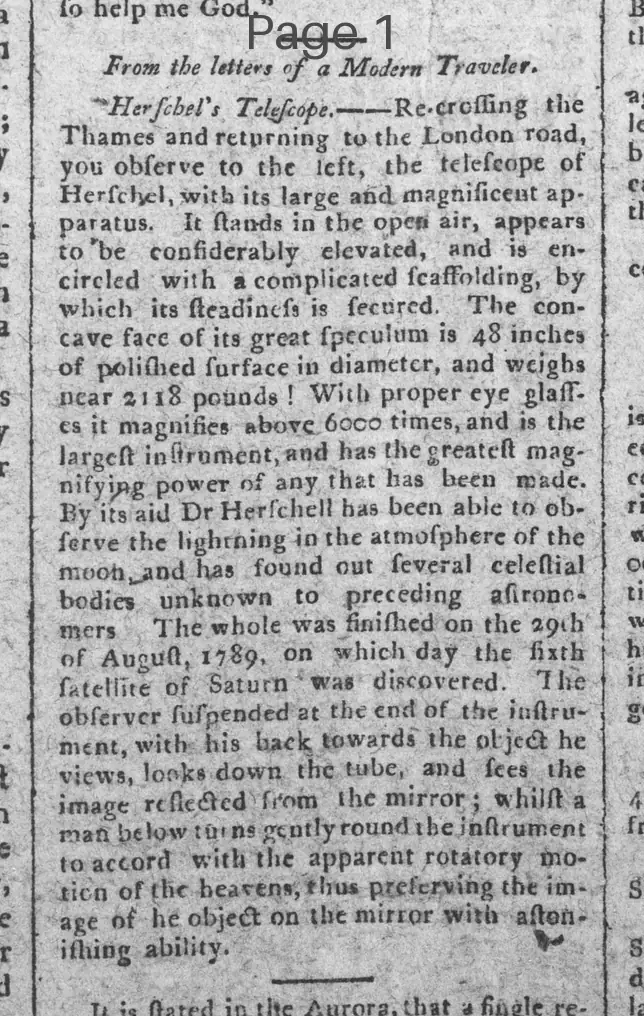
Herchel's Telescope.—Crossing the Thames and returning to the London road, you observe to the left, the telescope of Herchel, with its large and magnificent apparatus. It stands in the open air, appears to be considerably elevated, and is encircled with a complicated scaffolding, by which its steadiness is secured. The concave face of its great speculum is 48 inches of polished surface in diameter, and weighs near 2118 pounds! With proper eye glasses it magnifies above 6000 times, and is the largest instrument, and has the greatest magnifying power of any that has been made.
By its aid Dr. Herschel has been able to observe the lightning in the atmosphere of the moon, and has found out several celestial bodies unknown to preceding astronomers.
The whole was finished on the 29th of August, 1789, on which day the sixth satellite of Saturn was discovered. The observer suspended at the end of the instrument, with his back towards the object he views, looks down the tube, and sees the image reflected from the mirror; whilst a man below turns gently round the instrument to accord with the apparent rotatory motion of the heavens, thus preserving the image of the object on the mirror with astonishing ability.
Herchel's Telescope.—Crossing the Thames and returning to the London road, you observe to the left, the telescope of Herchel, with its large and magnificent apparatus. It stands in the open air, appears to be considerably elevated, and is encircled with a complicated scaffolding, by which its steadiness is secured. The concave face of its great speculum is 48 inches of polished surface in diameter, and weighs near 2118 pounds! With proper eye glasses it magnifies above 6000 times, and is the largest instrument, and has the greatest magnifying power of any that has been made.
By its aid Dr. Herschel has been able to observe the lightning in the atmosphere of the moon, and has found out several celestial bodies unknown to preceding astronomers.
The whole was finished on the 29th of August, 1789, on which day the sixth satellite of Saturn was discovered. The observer suspended at the end of the instrument, with his back towards the object he views, looks down the tube, and sees the image reflected from the mirror; whilst a man below turns gently round the instrument to accord with the apparent rotatory motion of the heavens, thus preserving the image of the object on the mirror with astonishing ability.
What sub-type of article is it?
Curiosity
Historical Event
What themes does it cover?
Exploration
Triumph
What keywords are associated?
Herschel Telescope
Astronomical Discovery
Saturn Satellite
Lunar Lightning
Scientific Instrument
What entities or persons were involved?
Dr. Herschel
Where did it happen?
Near The Thames, London Road
Story Details
Key Persons
Dr. Herschel
Location
Near The Thames, London Road
Event Date
29th Of August, 1789
Story Details
Description of Herschel's telescope: 48-inch diameter speculum weighing 2118 pounds, magnifies over 6000 times; used to observe lunar lightning and discover new celestial bodies including Saturn's sixth satellite on completion day.