Thank you for visiting SNEWPapers!
Sign up free
The Monmouth Inquirer
Freehold, Monmouth County, New Jersey
What is this article about?
Historical overview of Thanksgiving: origins in ancient cultures like Israelites and Greeks, first American celebration by Pilgrims in Plymouth 1621 with Massasoit, evolution to national holiday under Washington in 1789 and Lincoln in 1863, traditions including turkey, pumpkin pie, family reunions, and games.
Clipping
OCR Quality
Full Text
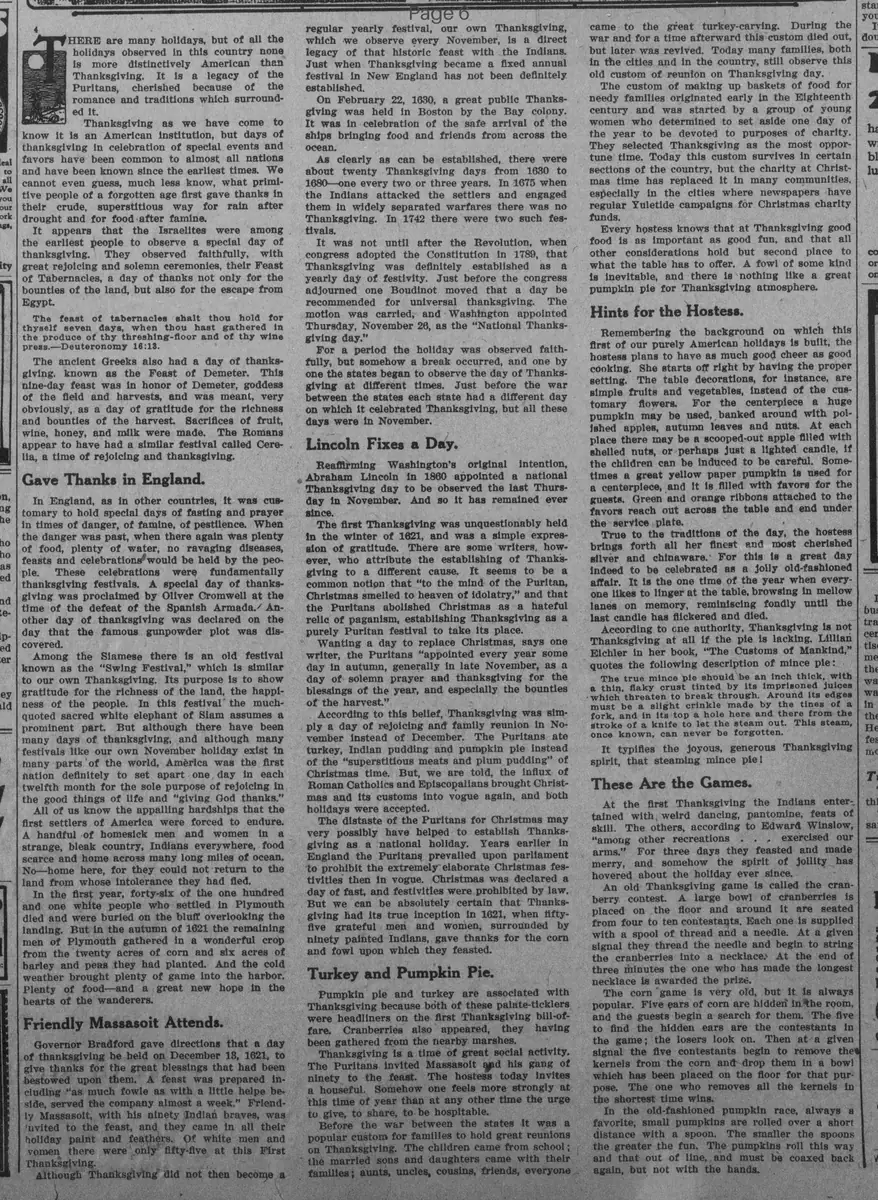
Thanksgiving as we have come to know it is an American institution, but days of thanksgiving in celebration of special events and favors have been common to almost all nations and have been known since the earliest times. We cannot even guess, much less know, what primitive people of a forgotten age first gave thanks in their crude, superstitious way for rain after drought and for food after famine.
It appears that the Israelites were among the earliest people to observe a special day of thanksgiving. They observed faithfully, with great rejoicing and solemn ceremonies, their Feast of Tabernacles, a day of thanks not only for the bounties of the land, but also for the escape from Egypt.
"The feast of tabernacles shalt thou hold for thyself seven days, when thou hast gathered in the produce of thy threshing-floor and of thy wine press."-Deuteronomy 16:13.
The ancient Greeks also had a day of thanksgiving, known as the Feast of Demeter. This nine-day feast was in honor of Demeter, goddess of the field and harvests, and was meant, very obviously, as a day of gratitude for the richness and bounties of the harvest. Sacrifices of fruit, wine, honey, and milk were made. The Romans appear to have had a similar festival called Cerealia, a time of rejoicing and thanksgiving.
Gave Thanks in England.
In England, as in other countries, it was customary to hold special days of fasting and prayer in times of danger, of famine, of pestilence. When the danger was past, when there again was plenty of food, plenty of water, no ravaging diseases, feasts and celebrations would be held by the people. These celebrations were fundamentally thanksgiving festivals. A special day of thanksgiving was proclaimed by Oliver Cromwell at the time of the defeat of the Spanish Armada. Another day of thanksgiving was declared on the day that the famous gunpowder plot was discovered.
Among the Siamese there is an old festival known as the "Swing Festival," which is similar to our own Thanksgiving. Its purpose is to show gratitude for the richness of the land, the happiness of the people. In this festival the much-quoted sacred white elephant of Siam assumes a prominent part. But although there have been many days of thanksgiving, and although many festivals like our own November holiday exist in many parts of the world, America was the first nation definitely to set apart one day in each twelfth month for the sole purpose of rejoicing in the good things of life and "giving God thanks."
All of us know the appalling hardships that the first settlers of America were forced to endure. A handful of homesick men and women in a strange, bleak country, Indians everywhere, food scarce and home across many long miles of ocean. No home here, for they could not return to the land from whose intolerance they had fled.
In the first year, forty-six of the one hundred and one white people who settled in Plymouth died and were buried on the bluff overlooking the landing. But in the autumn of 1621 the remaining men of Plymouth gathered in a wonderful crop from the twenty acres of corn and six acres of barley and peas they had planted. And the cold weather brought plenty of game into the harbor. Plenty of food--and a great new hope in the hearts of the wanderers.
Friendly Massasoit Attends.
Governor Bradford gave directions that a day of thanksgiving be held on December 13, 1621, to give thanks for the great blessings that had been bestowed upon them. A feast was prepared including "as much fowle as with a little helpe beside, served the company almost a week." Friendly Massasoit, with his ninety Indian braves, was invited to the feast, and they came in all their holiday paint and feathers. Of white men and women there were only fifty-five at this First Thanksgiving.
Although Thanksgiving did not then become a regular yearly festival, our own Thanksgiving, which we observe every November, is a direct legacy of that historic feast with the Indians.
Just when Thanksgiving became a fixed annual festival in New England has not been definitely established.
On February 22, 1630, a great public Thanksgiving was held in Boston by the Bay colony. It was in celebration of the safe arrival of the ships bringing food and friends from across the ocean.
As clearly as can be established, there were about twenty Thanksgiving days from 1630 to 1680--one every two or three years. In 1675 when the Indians attacked the settlers and engaged them in widely separated warfares there was no Thanksgiving. In 1742 there were two such festivals.
It was not until after the Revolution, when congress adopted the Constitution in 1789, that Thanksgiving was definitely established as a yearly day of festivity. Just before the congress adjourned one Boudinot moved that a day be recommended for universal thanksgiving. The motion was carried, and Washington appointed Thursday, November 26, as the "National Thanksgiving day."
For a period the holiday was observed faithfully, but somehow a break occurred, and one by one the states began to observe the day of Thanksgiving at different times. Just before the war between the states each state had a different day on which it celebrated Thanksgiving, but all these days were in November.
Lincoln Fixes a Day.
Reaffirming Washington's original intention, Abraham Lincoln in 1863 appointed a national Thanksgiving day to be observed the last Thursday in November. And so it has remained ever since.
The first Thanksgiving was unquestionably held in the winter of 1621, and was a simple expression of gratitude. There are some writers, however, who attribute the establishing of Thanksgiving to a different cause. It seems to be a common notion that "to the mind of the Puritan, Christmas smelled to heaven of idolatry," and that the Puritans abolished Christmas as a hateful relic of paganism, establishing Thanksgiving as a purely Puritan festival to take its place.
Wanting a day to replace Christmas, says one writer, the Puritans "appointed every year some day in autumn, generally in late November, as a day of solemn prayer and thanksgiving for the blessings of the year, and especially the bounties of the harvest."
According to this belief, Thanksgiving was simply a day of rejoicing and family reunion in November instead of December. The Puritans ate turkey, Indian pudding and pumpkin pie instead of the "superstitious meats and plum pudding" of Christmas time. But, we are told, the influx of Roman Catholics and Episcopalians brought Christmas and its customs into vogue again, and both holidays were accepted.
The distaste of the Puritans for Christmas may very possibly have helped to establish Thanksgiving as a national holiday. Years earlier in England the Puritans prevailed upon parliament to prohibit the extremely elaborate Christmas festivities then in vogue. Christmas was declared a day of fast, and festivities were prohibited by law.
But we can be absolutely certain that Thanksgiving had its true inception in 1621, when fifty-five grateful men and women, surrounded by ninety painted Indians, gave thanks for the corn and fowl upon which they feasted.
Turkey and Pumpkin Pie.
Pumpkin pie and turkey are associated with Thanksgiving because both of these palate-ticklers were headliners on the first Thanksgiving bill-of-fare. Cranberries also appeared, they having been gathered from the nearby marshes.
Thanksgiving is a time of great social activity. The Puritans invited Massasoit and his gang of ninety to the feast. The hostess today invites a houseful. Somehow one feels more strongly at this time of year than at any other time the urge to give, to share, to be hospitable.
Before the war between the states it was a popular custom for families to hold great reunions on Thanksgiving. The children came from school; the married sons and daughters came with their families; aunts, uncles, cousins, friends, everyone came to the great turkey-carving. During the war and for a time afterward this custom died out, but later was revived. Today many families, both in the cities and in the country, still observe this old custom of reunion on Thanksgiving day.
The custom of making up baskets of food for needy families originated early in the Eighteenth century and was started by a group of young women who determined to set aside one day of the year to be devoted to purposes of charity. They selected Thanksgiving as the most opportune time. Today this custom survives in certain sections of the country, but the charity at Christmas time has replaced it in many communities, especially in the cities where newspapers have regular Yuletide campaigns for Christmas charity funds.
Every hostess knows that at Thanksgiving good food is as important as good fun, and that all other considerations hold but second place to what the table has to offer. A fowl of some kind is inevitable, and there is nothing like a great pumpkin pie for Thanksgiving atmosphere.
Hints for the Hostess.
Remembering the background on which this first of our purely American holidays is built, the hostess plans to have as much good cheer as good cooking. She starts off right by having the proper setting. The table decorations, for instance, are simple fruits and vegetables, instead of the customary flowers. For the centerpiece a huge pumpkin may be used, banked around with polished apples, autumn leaves and nuts. At each place there may be a scooped-out apple filled with shelled nuts, or perhaps just a lighted candle, if the children can be induced to be careful. Sometimes a great yellow paper pumpkin is used for a centerpiece, and it is filled with favors for the guests. Green and orange ribbons attached to the favors reach out across the table and end under the service plate.
True to the traditions of the day, the hostess brings forth all her finest and most cherished silver and chinaware. For this is a great day indeed to be celebrated as a jolly old-fashioned affair. It is the one time of the year when everyone likes to linger at the table, browsing in mellow lanes on memory, reminiscing fondly until the last candle has flickered and died.
According to one authority, Thanksgiving is not Thanksgiving at all if the pie is lacking. Lillian Eichler in her book, "The Customs of Mankind," quotes the following description of mince pie:
The true mince pie should be an inch thick, with a thin, flaky crust tinted by its imprisoned juices which threaten to break through. Around its edges must be a slight crinkle made by the tines of a fork, and in its top a hole here and there from the stroke of a knife to let the steam out. This steam, once known, can never be forgotten.
It typifies the joyous, generous Thanksgiving spirit, that steaming mince pie!
These Are the Games.
At the first Thanksgiving the Indians entertained with weird dancing, pantomime, feats of skill. The others, according to Edward Winslow, "among other recreations . . . exercised our arms." For three days they feasted and made merry, and somehow the spirit of jollity has hovered about the holiday ever since.
An old Thanksgiving game is called the cranberry contest. A large bowl of cranberries is placed on the floor and around it are seated from four to ten contestants. Each one is supplied with a spool of thread and a needle. At a given signal they thread the needle and begin to string the cranberries into a necklace. At the end of three minutes the one who has made the longest necklace is awarded the prize.
The corn game is very old, but it is always popular. Five ears of corn are hidden in the room, and the guests begin a search for them. The five to find the hidden ears are the contestants in the game; the losers look on. Then at a given signal the five contestants begin to remove their kernels from the corn and drop them in a bowl which has been placed on the floor for that purpose. The one who removes all the kernels in the shortest time wins.
In the old-fashioned pumpkin race, always a favorite, small pumpkins are rolled over a short distance with a spoon. The smaller the spoons the greater the fun. The pumpkins roll this way and that out of line, and must be coaxed back again, but not with the hands.
What sub-type of article is it?
What themes does it cover?
What keywords are associated?
What entities or persons were involved?
Where did it happen?
Story Details
Key Persons
Location
Plymouth Colony, America; England; Ancient Israel; Greece; Rome; Siam
Event Date
1621; 1630; 1675; 1742; 1789; 1863
Story Details
Traces Thanksgiving from ancient festivals like Israelite Feast of Tabernacles and Greek Feast of Demeter, to English thanksgivings, first American event in Plymouth 1621 by Pilgrims with Massasoit after hardships, irregular observances, national establishment by Washington in 1789 and Lincoln in 1863, traditions of feasting, family reunions, charity, and games.